CD Reviews | CTD (Briefly Noted) | JFL (Dip Your Ears) | DVD Reviews
Showing posts with label Ferruccio Busoni. Show all posts

1.10.17

Forbes Classical CD Of The Week: Amid Debussy And Arno Breker


…Max Reger has a dour reputation, but for the first dozen of bars, the Romantic Suite could be mistaken for early Debussy. Christian Thielemann and his Dresden band show off sumptuous colors, hushed pianissimos and Scherzo-merriment in the dessert on a program where the main course is Hans Pfitzner’s Piano Concerto. Quipping about the composer’s aesthetic and political reputation, Tzimon Barto suggested that he tried to lure gentle music out of it, but gave up and treated it like [Arno] Breker. He kind of has a point and…

-> Classical CD Of The Week: Amid Debussy And Arno Breker

20.11.14

NSO and Busoni

available at Amazon
F. Busoni, Piano Concerto, G. Ohlsson, Cleveland Orchestra, C. von Dohnányi
(Telarc, re-released in 2002)
Ferruccio Busoni's piano concerto is an epic, crazy piece of music: over seventy minutes in length, in five movements, one of them involving a men's chorus chanting to Allah. Needless to say, one does not hear it live all that often, although there are a couple of pianists who will play it from time to time, including Marc-André Hamelin (who played the composer's second piano sonatina last year) and Garrick Ohlsson, who last night was the first to attempt it with the National Symphony Orchestra in over seventy years.

As excited as I was to hear this piece, in all its ungainly glory, what became clear in this performance is that this concerto can be a trial for the ears. Unwieldy in its proportions -- the introduction before the first solo entrance goes on forever -- there may not be enough bang for the buck when it is all said and done. Ohlsson had the piece mostly in hand, conquering the necessity of giving the solo part, at times, a scope equivalent to that of the entire orchestra, although there were a few minor blips here and there and the coordination with conductor Rossen Milanov, last heard with NSO in last year's Messiah, was not always optimal. This was most pronounced in the rather silly fourth movement, which devolves at times into an Offenbach galop and then a Rossini-overture crescendo, but perhaps too often the Lisztian excesses of the piece go too far. The Washington Men's Camerata was mostly solid in the last movement, on the text from the final scene of the verse drama Aladdin by Adam Oehlenschläger, which Busoni had long considered setting as an opera, although when the tenors were exposed at one point, the sound was not pretty. In the score, Busoni directs that the chorus should be "invisibile," a request that apparently could not be honored, since the singers were placed in full view in the chorister seats above the stage.


Other Articles:

Anne Midgette, Pianist Ohlsson brings elegance to a whiz-bang performance of massive Busoni (Washington Post, November 21)

---, Pianist Garrick Ohlsson on Busoni’s 70-minute concerto: ‘A noble, beautiful work’ (Washington Post, November 20)
The last couple performances of Stravinsky's music for The Firebird have been of the complete score, last year from the Mariinsky Theater Orchestra and Valery Gergiev, and from the NSO in 2009 with Charles Dutoit. Milanov led the 1919 version of the suite, which greatly reduces the amount of music and the lavish orchestration, halving the numbers of woodwinds and eliminating many of the most inventive coloristic effects, and he did so with startling clarity. His approach tended to favor very slow tempi for the slow movements -- an ominous, oozing introduction, for example -- and perhaps an edge too breathless in the fast ones, like the Firebird theme. His gestures, though, were all razor-sharp, creating a delicate and warm "Round Dance of the Princesses" and a drowsy Berceuse, but also a savagely unified and harsh "Infernal Dance," with just a few fuzzy spots in the woodwinds and second violins. The only drawback was a somewhat flat conclusion, where the conductor's grim efficiency made the effect of the last few pages too mechanical.

This program repeats Friday and Saturday night in the Kennedy Center Concert Hall.

29.1.13

Hamelin @ Shriver Hall

available at Amazon
Haydn, Piano Sonatas, Vol. 3, M.-A. Hamelin
(2012)

available at Amazon
Liszt, Piano Sonata (inter alia), M.-A. Hamelin
(2011)
Marc-André Hamelin is a showman, but far from an empty-headed one. The program he played on Sunday evening, for his debut at Baltimore's Shriver Hall, combined the Canadian-born pianist's cardinal virtues: ear-tickling virtuosity, an exploratory curiosity for unlikely repertory, and an unexpected approach to the familiar.

In the first category was the opening work, Bach's Great G Minor Fantasia and Fugue, BWV 542, in the expansive transcription by Tivadar Szántó. Conceived by Bach for the organ, it is a piece beloved of many composers and performers -- Liszt, among others, arranged it for piano -- and one had the sense of Hamelin meditating on one of music's ancient scriptures. With a liberal use of the sustaining pedal, applied in all sorts of interesting ways, Hamelin gave the prelude a vast scope, both crushing in volume on fully voiced chords and glowing in a haze of sound at other points. The fugue had both crystalline clarity and massive textures in turn, astounding in fortitude of tone. Put Hamelin's own set of variations on a theme of Paganini -- the theme of Paganini, the one subjected to outrageous variations in his 24th Caprice -- in the same category. Part circus march, part homage to various composers -- snippets of Beethoven, Mozart, and tribute to Rachmaninoff, Chopin, and Stravinsky -- the piece is a hoot and Hamelin played it fearlessly.

For our pianistic edification, there was Ferrucio Busoni's rarely played Piano Sonatina No. 2, an enigmatic piece that is radically unlike what is implied by the unassuming word "sonatina." Hamelin sought to unravel every eccentric tangle of the piece, reveling in its contrapuntal complexities -- a connection to the Bach that had preceded it -- and its harmonic extravagance. To draw a connection between Busoni and the Debussy that followed it, he used the work's odd conclusion to hold the audience in silence, beginning the first book of Images after a short pause. Through his scrupulous control of hand weight, Hamelin gave these three pieces an extraordinary transparency, creating the sense of imperceptible mists in Reflets dans l'eau and a blurred, almost atomic instability in Mouvement, of motion captured in a series of frozen stills. Only the middle movement, Hommage à Rameau, disappointed slightly -- sultry, but a little slow and dull, not catching the Baroque delight in rhythm. The set was capped off by a virtuostic, aquatically shimmering reading of L'Isle joyeuse.


Other Reviews:

Tim Smith, Pianist Marc-Andre Hamelin gives compelling recital at Shriver Hall (Baltimore Sun, January 28)

---, Marc-Andre Hamelin to make Shriver Hall recital debut (Baltimore Sun, January 26)

Jens F. Laurson, Ionarts-at-Large: Marc-André Hamelin at the Herkulessaal (Ionarts, December 16, 2012)
Not many pianists really make me want to hear the music of Sergei Rachmaninoff, but Hamelin is one of them. He gave a pearl-like finish to two of the op. 32 preludes: a wistful, rubato-stretched no. 5 (G major) and an aphoristic no. 12 (G♯ minor), marked by a restlessly fluttering right hand. The program concluded with the composer's second piano sonata, wisely played in the revised 1931 version -- trusting the composer's later (perhaps too late) impulses toward self-editing. Hamelin raged through the fast parts of the first movement with technical aplomb but left room for poetry, giving the second movement a voluminous sweep without letting it become too sugary. The third movement rocketed with vitality. Hopes for a Haydn sonata encore -- from Hamelin's growing set devoted to that Ionarts favorite composer -- were almost met, with a guileless, crisp reading of the first movement of Mozart's C major piano sonata, K. 545. This famous little piece, which Mozart entered into his catalog of compositions with the words "Eine kleine klavier Sonate für anfänger" (A little keyboard sonata for beginners), was a last wink of the eye and nudge of the elbow from Hamelin the showman.

We will be back at Shriver Hall next month for the recital by mezzo-soprano Magdalena Kožená and pianist Yefim Bronfman (February 17, 5:30 pm).

28.1.13

Isserlis, Gut Strings and All


Steven Isserlis (cello) and Kirill Gerstein (piano)
Photo by Kim P. Witman/Courtesy of Wolf Trap
Steven Isserlis was back in town on Friday night, this time in the Barns at Wolf Trap, with pianist Kirill Gerstein. The program was different from what they played in 2010 at the Kennedy Center (he also appeared with the National Symphony Orchestra in 2011), but it had many similar qualities. The British cellist is at his best with a soaring melodic line, with some limitations at the loud end of the dynamic spectrum, at least partly because of his preference for wound-gut strings. At the Q&A session that generally occurs at intermissions at Wolf Trap, Isserlis spoke about his preference for gut, noting that all cellists played on them until the years of World War II. With obvious conviction, he said he stands by gut because their sound has a "more human quality," and that steel strings are "harsher" in tone. "I love them: they're my voice," he concluded, and indeed the sound he makes on those strings in soft moments is one of the indelible qualities that makes Isserlis Isserlis.

available at Amazon
Brahms, Cello Sonatas, S. Isserlis, S. Hough
He was at his best in the moody opening theme of the first Brahms cello sonata, op. 38, letting the sound bloom and not giving any sense of being pressed. The two cello sonatas of Brahms are the centerpiece of the program he is touring right now, and Gerstein was a graceful partner for both of them, bringing out embedded motifs in the development of the first movement and embroidering that melancholy first theme with countermelodies at the recapitulation. The second movement was wistful without becoming cloying, and both musicians gave the third movement some Puckish folk inflections. It is, on the whole, a more affecting work than the more outgoing second sonata, op. 99, which concluded this recital. Without some more oomph in the cello tone in the bigger or more agitated movements, really all but the slow one -- and Gerstein was excellent at scaling the power of the piano to his partner's sound -- it just had less to offer here.

Other Articles:

Robert Battey, A characteristically furious Isserlis, at his best and most middling (Washington Post, January 28)

Steve Smith, Echoes, 21 Years Apart, in a Homage to Brahms (New York Times, January 28)
Although the Brahms sonatas were certainly fine, the outstanding contributions came in the small pieces dotted around them. Bartók's Rhapsody No. 1 had a free rhythmic approach and dancing pulse, but also a smoldering tone in the slow passages. It was paired beautifully with Ferruccio Busoni's Kultaselle, a set of sweet, longing variations on a Finnish folksong, a memento from the composer's time teaching in Helsinki. Best of all were a pair of Liszt delicacies, the Romance oubliée and Die Zelle in Nonnenwerth, both tinged with unexpected harmonies and arching melodic lines that gave voice to expanses of Romantic longing. The encore offered one more chance to wallow in that singing cello tone, an arrangement of Schubert's Lied Nacht und Träume.

16.12.12

Ionarts-at-Large: Marc-André Hamelin at the Herkulessaal

Ferrucio Busoni


Ten years ago, no one would ha ve wanted to hear Marc-André Hamelin in Debussy, and rightly so. Now he’s among the best in that sort of repertoire. The transformation of Hamelin from piano-pyrotechnician to musician with great tonal control and a splendid legato is remarkable. He proved that with ease and a gorgeous tone from his Fazioli piano in a recital at Munich’s half-filled Herkulessaal on December 12.


M-A.Hamelin on ionarts:


Blame Canada!, National Gallery of Art (18.1.04)

Marc-André Hamelin in New York, Mannes College of Music (4.8.05)

Who for Whom? Marc-André Hamelin Pinch-Hits, Strathmore (10.4.09)

Hamelin @ Strathmore, Strathmore Hall (2.5.11)

Takács and Hamelin, Library of Congress (14.11.12)


Dip Your Ears, No. 19, Nikolai Kapustin (25.11.04)

Debussy’s Images (Book 1) followed seamlessly after Busoni’s wonderfully radical Sonatina Seconda, Hamelin ensuring the applause-less transition—and therefore the hint at harmonic similarities—with the good old curled-at-the-piano-bench technique. If you didn’t know Busoni’s ‘Sonata on Themes from Doktor Faust’ was on the program, the 1912 work could be mistaken for some off-the-wall Debussy; at least for a few bars of airy and tonally adventurous harmonies. But eventually Busoni’s unique blend of German spunk (elsewhere an oxymoron) breaks out of the Germanic-Italian composer and throws into question anyone else’s authorship with passages that are wild, difficult, more difficult-sounding still… then deceptively calm and simple again. The work, underappreciated though it is, can stand proudly next to the exactly contemporaneous Concord Sonata (Ives) and Scriabin’s Seventh Sonata.

The Debussy meanwhile was full of shades and softly subtle tones (Reflets dans l'eau), regal (Hommage à Rameau), and of a seamless rhythmic back-and-forth (Mouvement). L'Isle joyeuse was similarly sumptuous.

Hamelin still pulls out the crazy virtuoso stuff, tough, as he did after intermission with his own Paganini Variations, a marvelously ridiculous work and just the thing for those who love him for Godowski-Chopin Étude outbreaks and Alkan acrobatics. It’s a sack full of pianistic difficulty, spiced with musical references subtle and unsubtle, witty and crude, to Chopin and Rachmaninoff and Beethoven and Liszt and probably many others, which was lapped up with giggles of disbelief and impromptu laughter whenever the audience recognized the original behind the quote.

You’d think the piano would be out of notes after that tour de force, but he still had enough left to play two luscious Rachmaninoff Préludes (op.32/5 and 12) and then the Second Sonata (1931 version). A seeing-eye dog in the audience let out a long, content and sleepy grunt with the onset of the soft and calming second movement, after the stormy first—a sentiment I shared as I indulged in the brawn and sweep, the round tone—but never any smudges—of the remainder of the work. An Andante (inedit, H64) from the father of the Nocturne, John Field, followed as a mellow encore with hints of Beethoven, Schubert, and Chopin, before Hamelin threw the crowd another virtuoso bone with a Godowski-Chopin Étude. It went to show that the increased depth of his playing has not come at the expense of his wizardry. Hamelin had opened the recital with a meaty Theodor Szántó transcription of Bach's G minor Fantasia & Fugue (BWV 542)... a gravely grandiose opening full of the rhythmic calm and steady propulsion that makes for that uniquely Bachian beauty that no soloist's slips or arranging could endanger.

Washington-area readers should know that Marc-André Hamelin will play essentially the same program in his recital at Shriver Hall in Baltimore next month (January 27, 5:30 pm). [-- Ed.]

9.7.08

Ionarts-at-Large: Munich 2008 Opera Festival Premiere - Busoni's Doktor Faust

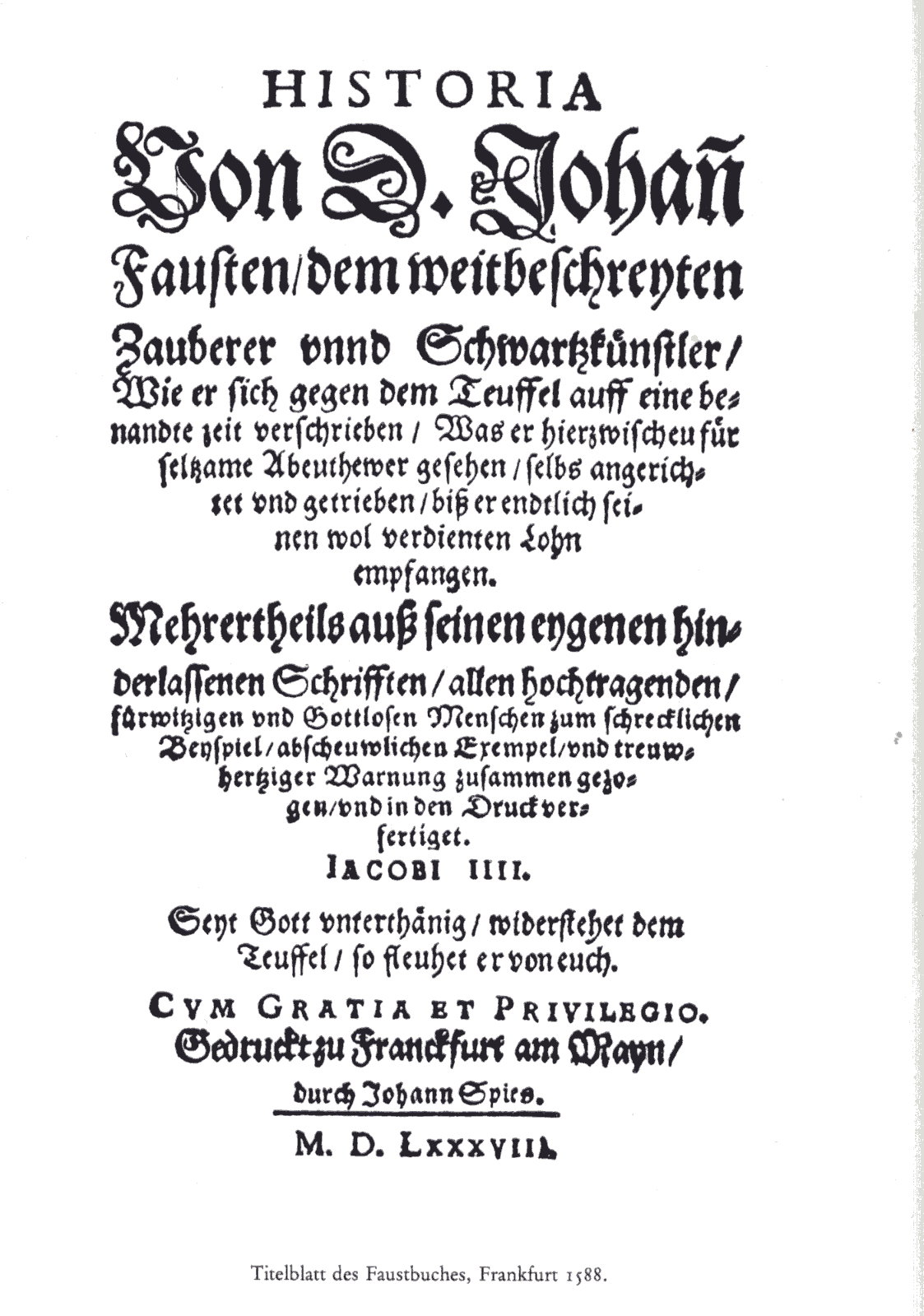
The great tale of “Faust”, has fascinated, inspired, and daunted artists since the 16th century when Johann Spies’ Historia von D. Johann Fausten first put the legend in print. Marlowe and Goethe, Rembrandt and Delacroix, Oscar Wilde, F.W.Murnau, Thomas Mann, Václav Havel, and Radiohead have all created works based on or around Faust.


Composers, too, have been inspired – usually via Goethe: Wagner wrote a Faust Overture (not his most inspired moment), and Liszt the Faust Symphony. Mahler’s Eight Symphony bases its second part onFaust II. Schubert composed the Lied “Gretchen am Spinnrade”, and Schumann his overly ambitious, terrifically strange (and strangely terrific) Scenes from Goethe's Faust. (The good recordings –HerrewegheAbbadoKlee – are out of print, but a new one including Christian Gerhaher might be issued soon.) Lili Boulanger contributed a half hour cantata Faust et Hélène, Dusapin Faustus, The Last Night(owing more to Marlowe than Goethe). Prokofiev’s Fiery Angel, Stravinsky’s The Rake’s Progress, and even Adams’ Doctor Atomic are adaptations – albeit loose ones – of Faust.

“Only Mozart” (who had already died), did Goethe proclaim as capable of writing an opera of his Faust – but that did not keep others from trying. Arrigo Boito succeeded most resoundingly with Mefistofele, Berlioz’ “légende dramatique” La Damnation de Faust offers the most boldly literal operatic take, and Gounod’s Faust (formerly known as Maguerite) makes it an example of how grand French opera should be.

“German” (in the loosest sense) composers must have found the Goethe-model a little too daunting. First Louis Spohr (“Faust”), most recently Alfred Schnittke (“Die Historia von D. Johann Fausten”), and inbetween Ferruccio Busoni with Doktor Faust all tackled the subject from different directions. Busoni used the 16th century puppet plays – the same source that inspired Goethe – to avoid direct comparison. But he also drew on Heinrich Heine’s Der Doktor Faust – Ein Tanzpoem and very likely on F.T.Vischer’sFaust III.

From these sources Busoni created one of the great German 20th century operas, an opera that is finally catching on with recent performances in New York, San Francisco, Stuttgart, Zurich, Berlin (Unter den Linden), and now Munich, where it opened the 2008 Opera Festival.

Director Nicolaus Brieger (with Hermann Feuchter’s sets, Margit Koppendorfer’s costumes, and Alexander Koppelmann’s lighting) achieved the small miracle of staging Busoni’s magnum opus for the festival premiere without incurring any of the near-customary “boos” that accompany them. If the lack of vocal disagreement was accompanied by slightly less than enthusiastic cheering, it might have been because many ears had difficulty digesting the nearly three hours of Busoni’s music – even 80 years after its premiere.


In Zurich, Philippe Jordan turned the orchestral score into the highlight next to the superb, fittingly haughty Faust of Thomas Hampson’s. In Munich Tomáš Netopil, winner of the first Sir Georg Solti Conducting Competition, navigated rather dutifully through the score, neglecting nothing and offering – occasionally – gripping moments. The main attractions were Brieger’s direction, the successful effort and achievement of the singers, but most of all Busoni’s opera itself.

In turns grim and fantastical, Wolfgang Koch (Doktor Faust), John Daszak (Mephistopheles), Raymond Very (Duke, Valentin – “the Girl’s brother”, et al.), Catherine Naglestad (Duchess of Parma), and Steven Humes (Wagner) sang and acted their way through this beastly, beautiful work that engulfs the senses with renaissance sounds and chorales, a romantic chromatic haze, expected Wagnerian touches and unexpected moments of Offenbach. Steven Humes had little voice-time showcase his skills, but his strong, blooming baritone pushed Wagner – who later takes over Faust’s job as Rector magnificus – to the forefront. Koch’s baritone carried very well and never tired. His and Daszak’s performance are primarily the ones where effort turned into achievement and achievement into something extraordinary. Daszak who gave Mephistopheles his tenor, was piercing in his comfortable range, offered a positive sense of struggle here and there, and covered by the orchestra only early on. The female relief of the opera, Catherine Naglestad, charmed the audience with strong singing and acting, even with a strong metallic vibration in her voice. No one else exceeded or fell short of reasonable expectations and requirements.


Perhaps because there was much staging to pay attention to: Faust and his puppet-likenesses (wonderfully animated by Peter Lutz, Lutz Grossmann, and Rike Schubert); the set that looks like Rem Koolhaas meets Starship Enterprise; the vaguely Wehrmacht-like soldiers who drill organ pipes through Valentine’s body when Mephisto has him killed on the altar; and especially the naked, bronzed demons that dangle above Faust as he summons Lucifer’s servants Gravis, Levis, Asmodus, Belzebub, and Megaros. That last being the most iconic scene of the production – a visual coups de théâtre.

Mephistopheles himself is the red-gloved, wig-wearing seducer who dons a bikini-top on his bulky, hairy frame. The grotesque androgyny doesn’t last long, thankfully, but long enough to start wondering just how real Mephistopheles is to Faust, and how much he is a figment- a creation of his will and imagination. From there, Faust moves toward ‘will and realization’ of having left convention, society, and morality so far behind that no redemption is possible for him. His prayers impotent, he heaves himself beyond categories of good and evil, God and Devil. He manifests himself (or wishes to do so) in ‘will’ itself. The bubble of grandeur, if there was one, is pricked immediately when Mephistopheles, in the guise of the Night Watchman, finds Faust’s corps and drags him away sardonically stating: “Should this man have been met with misfortune?”

A visual feast and audial joy, the Munich Doktor Faust – played in the original, unfinished version, not the Jarnach or Beaumont completion – is not a production for the ages, but it will do much in brining this fascinating composer back to the opera stages where he deserves to be much more often. And eventually not just with Doktor Faust but also –eventually– his TurandotDie Brautwahl, and Arlecchino.

3.11.04

The Devil Perks Up

Two Saturdays ago, the Göthe Institut wrapped up a two-day event on the topic of Faust, the German's favorite subject. More than two dozen participants—most of them German or German-speaking—were left by the time the final act of that "Faust Fest" commenced. Just looking at the program, it also seemed the real highlight: a talk by the lovely Ted Libbey on "Faust in Opera."

After Kaffee und Kuchen (my third chance in barely a fortnight to compare Hildabrötchen from Austrian, Swiss, and now German sources), Irmgard Wagner of the Goethe Society introduced Ted Libbey, who wondered how to fit all that he had to say, play, and show into two hours, not unlike every composer who ever tried to take the Faust material and turn it into an opera.

cover
F. Busoni, Faust, Leitner
Among the composers who were inspired by Faust—not just Goethe's version, but also the original 1587 Historia von Dr. Johannes Fausten and Marlow's Dr. Faust—are Mendelssohn (the Scherzo in his Octet is inspired by the last lines of the Walpurgisnacht, Walpurgisnacht Oratorio)—who got to meet Goethe through his teacher Zelter—Beethoven ("Come Sea and Prosperous Voyage"), Schumann (setting "Alles Vergängliche..." from Faust II), Liszt's Faust Symphonie, Wagner (Faust Overture), J. Strauss (no relation to the other Strauss, with "Aus Faust's Leben und Werken"), as well as Boito, Busoni, Gounod, Berlioz, Schnittke, Riehm, Mansoni, and a league of others.

Ted Libbey started with Busoni, the German-Italian and his Baroquish-Romantic Faust, explicitly based on the puppet play. Atmospheric, with a tiered structure, the opening Sinfonia sets the mood. A delicious recording with Dietrich Fischer-Dieskau under Fritz Leitner from 1969 shows this beauty from its best side.

cover
H. Berlioz, La Damnation de Faust, Sir Colin Davis
cover
C. Gounod, Faust, Rizzi
Berlioz, who knew Faust through its French translation and introduced Liszt to the work, created La Damnation de Faust, and Gounod's Margarethe (as his Faust is known in Germany) turns it into Grand Opera, including love-stories, choruses, ballet, and all.

Schnittke's work, based on the old history (he, too, was daunted by Goethe's work?), is a load of fun if you don't mind modern music. His Historia von D. Johann Fausten is spun out of his Faust Cantata and full of eerie effects, including musical saw.

Finally—because it is as close to an operatic treatment as Faust II comes in music—Mahler's 8th was on the menu. My favorite version, with Ozawa at Tanglewood (sadly NLA, though possible to get used at Amazon), is ethereal in the most magnificent ways. (The legendary Solti recording is completely lost on me: I cannot but assume that its status is the lore of hype.) The last movement is, even though Mahler purists wince, one of the most sublime moments in music. Imagine between 350 and 1000 participants making music in subtle pianissimo tones... shudders of delight!

Informative and fun, thanks to Mr. Libbey, this talk was a delightful way to spend a Saturday afternoon in the everlasting striving for education. Faustian, almost, only we got to keep our souls.