CD Reviews | CTD (Briefly Noted) | JFL (Dip Your Ears) | DVD Reviews
Showing posts with label Никола́й Андре́евич Ри́мский-Ко́рсаков. Show all posts

5.3.13

Борис Годунов


available at Amazon
M.Musorgsky, Boris Godunov (1869 & Rimsky Korsakov editions),
V.Gergiev, Kirov, Soloists
Philips


available at Amazon
M.Musorgsky, Boris Godunov
(1872 'R.K.' Edition)
,
V.Gergiev, Kirov, Soloists
Decca

Calixto Bieito must be getting old: His new production at the Bavarian State Opera ofModest Musorgsky’s Boris Godunov (original version in four acts and seven scenes) doesn’t feature full frontal nudity. This third performance since the February 13th premiere didn’t even draw a single Boo! At least it holds plenty violence in store. In the wake of False Dmitri (Dmitri the Pretender a.k.a. novice Grigory) bodies pile up, shot at point blank range and strangled with a pillow case. Not all of this can be found in the libretto, but even with Bieito’s best efforts, the opera version still remains considerably less violent than the Russian original, the “Time of Troubles.”

all the efforts of Bieito notwithstanding, the operatic version still remains considerably less violent than the reality of that part—the “Time of Troubles”—in Russian history.

It has been a while since I last saw a Boris: It was 2005, when Valery Gergiev conducted the Mariinsky Orchestra at the Kennedy Center; the staging (also of the unedited 1869 version) was a spruced-up traveling show—all light and foldable, a bit conventional, yet exquisite. Bieito and the State Opera lavished their considerably greater and more expensive attention on the staging, yet achieved little more.

Boris Godunov tells the story of the rise and fall of the third Russian Tsar in seven, not particularly connected pictures. It might be argued whether or not it is a duty of a production to connect that which isn’t; it might equally be argued whether Bieito doesn’t succeed in doing so, or whether he didn’t try. He badly flounders through the first act, with a tiresome “oppressed crowd scene”. Bieito at his best is an ingenious director, but, alas, hampered by his do-gooder ignorance about economics and his anarchic hyper-sensitivity to oppression by the state and clichéd ideas of capital. (Granted, he’s not the only econ-ignoramus in the opera world: Whenever manacing consumerism, evil globalization, and threatening free markets are hoisted onto the stage, I’m reminded of Mitchell & Webb’s “Lazy Writers’ Emergency Medical Treatment”.) Instead of delivering a first scene with an ultimately felt plea for Boris to become Tsar (interrupted by blips of violent ‘peace-keeping’ against mock-trouble-makers), we get ham-handed people-oppression in riot gear, with clumsy overtones of Pussy Riot, anti-austerity messages, and so erratic and pointless in its mildly sadistic aggression that it’s no longer threatening, but ludicrous.

The good news is that it gets only better from thereon. Rebecca Ringst built Bieito a ‘Machine’ for Boris which takes over from the second picture onward. It looks something like a cross of a spice harvester on Dune with a stranded barge, and it opens its many mouths of rough metal exterior to a multi-room palace on the inside. A totalitarian Kinder Egg, if you will. On the inside: Alexander Tsymbalyuk’s young and strapping Boris (in terrific, clear and resonant voice) who wonders and wanders, and instructs his little Fyodor. The latter is sung by Yulia Sokolik (an adult female), and perfectly congruously performed as a little girl. (Her inclusion as a woman added at least another female role to the two lady-cameos of this version. (Xenia, Boris’ daughter, and her nurse are the otherwise sole representatives of their gender.) Bieito’s conspiracy scene of the boyars is intimate and chilling, with the cunning Prince Shuysky plotting away like Wallace Shawn as Vizzini, in Gerhard Siegel fine tenor.


The violence and the dark set, down to Dmitri’s final murder spree, suit the bleak original version—both musically and dramatically speaking. But perhaps too well: The whole affair, without intermission, and with Kent Nagano’s often brittle touches, end up feeling more slow-going and dreary than need be. Nagano wasn’t all hardened cool, though: The softer his Bavarian State Orchestra played, the more sensitive and nuanced it got, emoting gentle empathy. (Only the horns had off night with plenty cracks.)

Vladimir Matorin skillfully indulged in the popular, populist role of Varlaam, the inebriated monk-cum-vagabond. The Innkeeper (Okka von der Damerau), now a beggarly street food vendor, gets happily molested and her little girl abused. It’s hardly a surprise when she shoots the border guards to facilitate Grigoriy/Dmitri’s escape. Anatoly Kotscherga, with soulful timbre and artless dignity, was a stand-out Pimen. Kevin Conners, the State Opera’s man for everything, did himself proud as Yuródivïy (the Holy Fool) who ends up with a bullet in the cranium, courtesy of a manipulated little girl that evidently broke bad.


Pictures above and below courtesy Bavarian State Opera, © Wilfried Hösl

13.12.11

Best Recordings of 2011 (#7)


Time for a review of classical CDs that were outstanding in 2011. My lists for the previous years: 2010, 2009, (2009 – “Almost”), 2008, (2008 - "Almost") 2007, 2006, 2005, 2004.

# 7 - New Release


J. Friedman, Quartets, Chiara String Quartet & Matmos, New Amsterdam Records NWAM-030

available at Amazon
J.Friedman, Quartets,
Chiara SQ4t / Matmos
New Amsterdam Records


From reading the nearly non-existent liner notes, or glancing at the cover, you really don’t know what you are getting into: “Jefferson Friedman Quartets” – presumably string quartets, given the involvement of the Chiara String Quartet. With both those ingredients being unknown quantities to me, I just plopped the CD, which came recommended to me by a friend in the music-PR business whose unfailing instinct and honesty I know better than to resist, into the player and let exploration and surprise take its course.

I listened with intrigue to the 1999 Quartet no.2, which despite its three movements being suspiciously titled “I - = 120, II - Free = ca.60, and III - ♪ - 180” is a work with a strong lyrical and beauty-embracing bent... and (later) Shostakovichean drive. Modern, discernibly, but with the immediate appeal that a healthy amount of consonance brings about. Allan Kozinn calls them “neo-romantic” in his enthusing New York Times review, which is an apt, if liberal description.

As I listened, still under the fairly recent impression of Mojca Erdmann’s Yellow Lounge disaster in Salzburg (a ghastly failure of the otherwise well-intentioned experiment in forcing classical music to be hip), I thought during the propelling first and archaic-romantic slow movement, that this might actually be suited very well for a playback in a club, subtly underscored by a repetitive beat of my own imagining.

Lo and behold: the fourth track does just that. Turns out that the “Matmos” timidly emblazoned on the cover, which I therefore overlooked or ignored, is a Baltimore-based (!) two-man band that likes to amplify crayfish nerve tissue, modify the succulent sounds of liposuction surgery, and rattle rat cages. Go look, it’s all true. Friends with the young (south-of-40) Friedman, they took their re-mixing approach (fairly conventional in this case, I’d say) to the two quartets on this disc which results in two electronically re-imagined distillations (five and ten minutes, respectively) of the music one has just heard. I can imagine many listeners that are (or think themselves) allergic to that kind of treatment, which so blurs the sacred boundaries between “serious” and “entertainment” music. Well, all the power to Matmos, all the same. Both, the originals and the re-mixes on this disc make for terrific music (Gabriel Prokofiev comes to mind, although I find Jeffereson/Matmos catchier stuff) and help erode the remnants of artificial borders that wish to divide categories that need not be divided.

The long, 17 minute slow movement “Act” of the 2005 String Quartet is like a modern meditation on Beethoven’s “Heiliger Dankgesang” – with an ethereal but never perfumed or esoteric quality that ends on slippery and sliding business which provides the contrast to the serene concluding “Epilogue/Lullaby”. Then comes the remix… in this case not something that would get you dirty on the dance floor, but with space-industrial qualities that make the ears perk. A refreshing, smartly entertaining release from New Amsterdam Records


# 7 – Reissue

11.10.11

NSO Succeeds North by Northeast

Many thanks to Robert R. Reilly for this review from the NSO.

available at Amazon
J.Sibelius, Violin Concerto et al,
Kremer / Muti / Philharmonia O.
EMI


available at Amazon
C.Nielsen, Symphony No.5 et al.,
R.Kubelik / Danish RSO
EMI
The National Symphony Orchestra under the direction of Finnish conductor John Storgårds covered itself in glory last Sunday, when it performed a program of Mussorgsky, Sibelius, Liadov, and Nielsen. Generally positive reviews of the Thursday-performance (see ionarts review) spoke of occasionally ragged playing, particularly in the Mussorgsky, but such was not the case at the Kennedy Center on Sunday afternoon. Whatever problems there may have been had been ironed out by Storgårds and players.

Mussorgsky’s Night on Bald Mountain was given a rhythmically sharp, full-bodied, and clearly delineated performance. Rimsky-Korsakov may have found Mussorgsky’s orchestration ragged, but the NSO's playing of Mussorgsky’s original version certainly wasn’t. Storgårds kept a tight grip in the piece and the NSO stayed with him for the entire, wild ride.

The Sibelius Violin Concerto featured soloist Gidon Kremer who produced a nicely nuanced, genially expressive, somewhat underpowered reading; not exactly meditative, but not driven either, and certainly not pyrotechnical. Sibelius—cliché or not—can do with a fair amount of detachment, but the concerto in particular shouldn’t be entirely devoid of fire. There was warmth here, but no heat. Perhaps my ears are still prejudiced from hearing Nikolaj Znaider in London three years ago, where he gave a charged and stirring performance with the LSO under Colin Davis. Incidentally, the powerfully accompanying NSO was not to blame; it was Kremer who did not fully match the band.

After these two high-powered pieces, Storgårds showed how well he and the NSO could handle subtlety. Playing with great finesse and refinement, they infused Liadov’s Enchanted Lake, a delicious piece of Russian impressionism, with magic and made it glitter. The Carl Nielsen's Fifth Symphony was the highlight of the afternoon. Storgårds and the NSO built the statement of the main theme in the first movement, before the main timpani attack, in a magnificent manner. The snare drum entered a bit too forcefully, though that may have been Storgårds’ interpretive choice, not an errant percussionist’s fault. Storgårds went on to capture the visionary essence of this music by building the climax toward the end of the first movement in a most persuasive manner. In media res, the second movement, starts in the center of a maelstrom—perfectly portrayed by the NSO’s exciting playing. Storgårds again demonstrated his superb ability at musical architecture with his handling of the giant fugue. There was detail in abundance without ever losing the long line. If it is impossible to single out one section of the NSO, then that’s only because they all deserve singling out; strings, winds, brass, and percussion performed exemplarily.

This was the debut performance of John Storgårds (chief conductor of the Helsinki Philharmonic Orchestra) with the National Symphony Orchestra and, based on musical evidence alone, it should not be his last. I, for one, would love to hear what he does with the Nielsen Fourth Symphony.

4.12.09

Dream Playing for “Winter Dreams”

Many thanks to Robert R. Reilly for contributing to ionarts again with this review of the NSO's world premiere of Jennifer Higdon's Piano Concerto. You can read his latest column for InsideCatholic here.

Thursday evening, December 3rd, the National Symphony Orchestra, under guest conductor Andrew Litton, presented a notable program that included the Suite from Rimsky Korsakov’s “The Snow Maiden”, Tchaikovsky’s First Symphony, “Winter Dreams” and the world première of Jennifer Higdon’s Piano Concerto, commissioned by the Hechinger Fund for New Orchestral Works.

I begin with Tchaikovsky, played last, for the simple reason that I have never heard the NSO play more beautifully in all departments than it did in the Tchaikovsky, under Litton. From the subtlest pianissimo to triple forte, and everything in between, Litton and NSO gave a finely graded, faultlessly built rendition—taught, gripping and dramatic, but lyrical and mesmerizing, as in the second movement, when it needed to be. It took no more than the opening of the first movement, with wonderfully hushed strings under the introduction of the main theme by flute and bassoon, to know that this would be a perfectly paced performance. In the Adagio, these forces achieved that thrilling sense of suspended animation that great playing of beautiful music can reach. The strings were luminous. It was a joy to hear the brass blend superbly with the winds before the gentle entry of the violins in the Finale’s opening. But there is no point in further listing instances of excellence with a performance so uniformly fine.

The deeper reason for the success of this performance lay not in the exquisite playing, but in the fact that Litton and the NSO caught the sense of the underlying experience of which Tchaikovsky’s music is an expression. That is the highest kind of artistic achievement. If for no other reason than to hear this, anyone in the Washington, D.C. area should make haste to the Kennedy Center for one of the next two performances on Friday afternoon at 1:30 PM or Saturday evening at 8:00 PM.

But there are other reasons to go, which notably include Jennifer Higdon’s new Piano Concerto. Higdon has gained, and earned, a big reputation for her highly colorful and rhythmically vivacious works. She did not disappoint in this première.

I thought it was a slight misstep on Litton’s part to take a microphone and conduct an onstage interview with Higdon before the piece was played. Let the music stand on its own, I say. We shouldn’t need to be told how popular she is, or what was going through her mind when she composed it. That is what the program notes are for. I applaud pre-concert presentations, but during a concert it violates the theatrical “fourth wall” rule to address the audience directly with something other than the music. In any case, we heard it directly from Higdon that “it is important that music communicates.” Amen to that. Unfortunately, however, Litton asked her, as if it mattered, how many notes were in the piano part. Her answer: “19,615.” (Higdon was fortunate that Emperor Joseph II was not present.)


Other Reviews:

Anne Midgette, NSO crowd delights to piano concerto's debut (Washington Post, December 4)

Tim Smith, National Symphony premieres Higdon Piano Concerto on colorful program (Baltimore Sun, December 4)

Andrew Lindemann Malone, Nonstop Ivory-Tinkling (DMV Classical, December 5)
To begin, pianist Yuja Wang announced the immediately attractive and wistfully rhapsodic main theme. Winds entered to play with and around it. Then the brass and strings came in such a big way that the piano was momentarily swamped. Instruments, entire orchestral sections jumped in and out to double up the piano part or to comment on it. Later, the orchestra ganged up for what sounded like the exotic march or heavy tread of a swaggering oriental despot. Wistful yearning of an open-hearted, Coplandesque kind opened the second movement. The movement also offered a taste of the French sensibility heard in some of Higdon’s music, particularly when she keeps the orchestration light. Which, alas, she did not do often in this densely scored piece, which might be the point of criticism with this piano concerto. Amid the orchestral hyperactivity, it was sometimes difficult to tell exactly where you were. Busy is not bad. Martinů was busy. But there is such a thing as being too busy.

Percussion is the word for the third and last movement (and every modern tonal composition, it seems), which started with a dazzling display of wood blocks, tam-tam, brake drum, and other percussion instruments, soon supplemented by pizzicato strings. I have sometimes thought that Higdon’s rhythmic excitement makes her music seem about to jump out of itself, and so it was here. There is, of course, a very playful element in this, and the wonderful interplay between the piano and percussion was fun and jazzy, at a certain point skirting boogie-woogie. Despite the complicated rhythms and percussion the orchestral balance in this movement worked better and made everything easier to hear. The last movement is, in fact, a tour de force and possibly the most successful of the three. In any case, no matter how percussive the music gets or how exotic the orchestration becomes, the beating heart of an American Romantic is never too far below the attractive surface of Higdon’s music.

I should not neglect to mention the delightful curtain raiser from Rimsky Korsakov, which shimmered and chirped with bird sounds; a fine warm up in a splendid concert. Litton, the NSO, Higdon, and Wang created one the finest evenings of the season yet. RRR

Photo of Jennifer Higdon by Candace DiCarlo

This program repeats this afternoon (December 4, 1:30 pm) and tomorrow evening (December 5, 8 pm).

16.3.07

More Great Violin Playing with the NSO: Julia Fischer & Khachaturian

Julia Fischer

available at Amazon
Bernstein, Early American Recordings & Lectures

available at Amazon
J. S. Bach, Sonatas & Partitas

available at Amazon
Glazunov, Khachaturian, Prokofiev, Violin Concertos

available at Amazon
W. A. Mozart, Violin Concertos 3&4

available at Amazon
W. A. Mozart, Violin Concertos 1,2&5

available at Amazon
P.I.Tchaikovsky, Violin Concerto
In a month that is particularly strong in violinists gracing Washington, Julia Fischer, the National Symphony Orchestra’s second such offering after the sublime Leonidas Kavakos, enjoyed a much better turnout in the Kennedy Center’s Concert Hall on Thursday night than the Greek/Finnish team from last week – and that despite heavy rain and consequent heavy traffic. The attendees were rewarded with a chiseled, pristine rendition of the Khachaturian Violin Concerto. A repeated buzzing in the vigorous opening aside (interpretive choice?), Mlle. Fischer fiddled her way through the concerto with the élan and clean agility she has gained a reputation for.

Her playing is neither showy nor ever-pushing emotional boundaries; it convinces by sheer quality and that air of irreproachability that lends, if anything, a cool touch to her tone. It was, especially in the Andante sostenuto, of such beauty that it had to be admired, even if not necessarily fallen in love with. It is tempting to retreat to the hackneyed label that used to be attached to Victoria Mullova: “Ice Queen”. But it’s a label as misleading as it is useless. Julia Fischer’s playing might never be called ‘gritty’ or ‘earthy’ – even in a fairly robust work like the Khachaturian concerto – but it certainly isn’t cold. Rather it is refined and concerned with making the music sound as good as it can. With performances like this one, or last year’s with the Baltimore Symphony Orchestra (in the Beethoven concerto with Temirkanov conducting), she is well on her way to becoming one of the world’s foremost violinists. The chance to hear her should not be missed.

Dvořák’s Symphony No.9 – long known as Symphony No.5 because he had suppressed his four earliest attempts in that genre – is America’s adopted romantic symphony and, much like his “American” String Quartet op.96 and Quintet op.97 (the “American Suite” in A Major is strangely less well known), rank high in radio play-lists and concert programs on this side of the Atlantic. The symphony might be given preferential treatment because of its title – “From the New World” – but it also happens to be a genuinely great composition of which it is difficult to tire, even upon umpteenth listening.

That there really isn’t a whole lot that’s “American” about it – Bernstein hilariously takes that myth apart in one of his 1950’s lectures (available on CD together with the performances and lectures of and about LvB Sy.#3, Tchaik.#6, Brahms #4, and Schumann #2) – has not diminished the Ninth’s popularity. The second movement’s “Goin’ home” theme, for example (played on bag-pipes during the funeral scene of “The Departed”), provided the music for the William Arms Fischer faux-spiritual, not vice versa. That the walking bass line in the same Largo (over the “Scotch snap”) is to have been derived from Jazz is an entertaining, but silly idea.

Haunting nostalgia, brazen Bohemian dances, and all the skills of good old European symphony-making are, however, included aplenty. Under Emmanuel Krivine’s careful eyes and hands, the NSO played with tenderness and devotion, force and sonority. A few incidental rough patches by the brass in the first movement were of no consequence to the fine impression the symphony left, underscoring the excellent groundwork they laid for Julia Fischer in the Khachaturian and the in turn bright and shimmering, bold and frivolous Russian Easter Overture by Rimsky-Korsakov.

Repeat performances will take place on Friday, at 1.30PM and Saturday, 8PM.

21.6.06

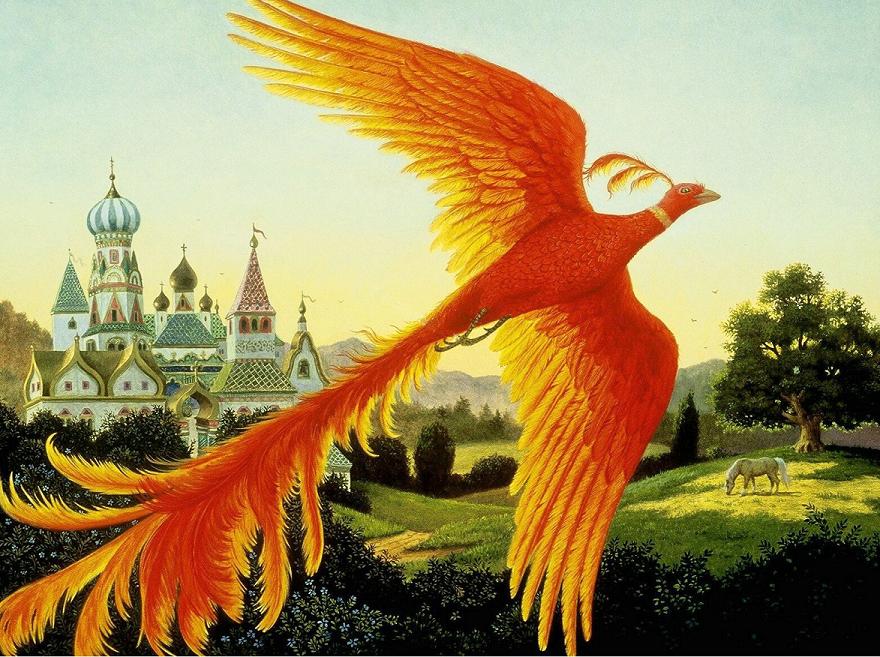
For the Family: Pecking Along with the Firebird

Robert R. Reilly, music critic for CRISIS and author of Ionarts-recommended Surprised by Beauty, was at the Kennedy Center for Ionarts, testing the child-friendliness of the NSO's Family concert with the help of his own son.


I thought I was cheating. The National Symphony Orchestra Web site suggested that children be at least seven years old to attend the family concert, The Magic of the Firebird, on Sunday, June 18th. My youngest son is six. I snuck him in anyway. I was making allowances not only for his height – he could easily pass for seven or eight – but also because my children are thoroughly immersed in classical music as a kind of amniotic sound in and ex utero. They instinctively know what bad music is because of their exposure to good music.

As an opposite kind of Gresham’s law, good music actually drives bad music out. My oldest son – then 10 – after being forced to listen to run-of-the mill, low-quality rock in a friend’s father’s car, vented his frustration. Why, I asked, didn’t you like it? “It is irritating to the mind,” he replied. Exactly.

Firebird (Maryleen Schiltkamp)This concert was part of a laudable effort by the National Symphony Orchestra to expose kids to musical quality, thus inoculating them against these inevitable irritations from a lobotomized pop culture. At least they will know that they are irritations. Also, my six-year-old insisted on a concert because his older brother and sister had already been to the Kennedy Center. This was the solution.

Before the conductor appeared, I asked my son if he would like me to read to him the story of the Firebird, neatly provided in a colorful cue sheet for families by the Kennedy Center. He declined. “I’d rather listen to the music,” he said, displaying a preference for the absolute over the descriptive.

Conductor Emil de Cou took the stage, however, and told the story anyway. First, however, he introduced and conducted an excerpt from Sleeping Beauty. This seemed to transfix my son sufficiently that he never removed two fingers thoughtfully poised on his lips. Then came the Sinbad excerpt from Rimsky-Korsakov’s Scheherazade, with the wonderful crashing waves and wrecked ship.

Finally, De Cou recited the Firebird narrative, illustrating it with orchestral excerpts. He succeeded in his delicate mission because he did not try to be cute, a terminally fatal attitude afflicting condescending adults. Then he and the NSO engagingly played the Firebird Suite (1919 version).

My son was reasonably attentive. He was also attracted by the overhead screen that displayed occasional figure drawings showing what the prince and Firebird were up to, as well as live close-ups of the featured instrumentalists. I could see he was flagging as the Firebird lulled the ogres into a deep sleep, but he was bolt upright when King Kastchei attacked. “When the music got rough, it really got my attention,” he reported.

My son has not asked to listen to more Stravinsky, but I think this was a success nonetheless. It seemed so for the general audience that included many children at least as young if not younger than my son. I saw only one baby removed. In fact, the kids were remarkably well behaved.

Firebird (Heaven and Earth Design)What about the adults, you are wondering? The family behind me was, I hope, not typical. Before that concert began, the mother announced to herself that this was their first time in the concert hall. As she examined the surroundings, she exclaimed to her daughter, “Look, dear, the whole ceiling is made of octagons.” I looked up. They are hexagons.

The father of this family never saw fit to inform the boy behind me that kicking the chair in front of him was gauche. The boy was trying to be quiet in his paper folding exercises but was ceaseless in them as well. Dad saw no problem with this, and only interrupted to read to the boy from the sous-titres on the overhead projector during the performance. Mom also thought that whispering was part of the fun, modulating her voice to follow the volume of the sound. Orchestral tutti provided opportunities for near normal conversational levels.

But this is carping. The NSO is doing the right thing, and doing it well. How about some family concerts for parents on etiquette?

9.9.05

Ready. Set. Play: NSO with Weilerstein & Oundjian

Photo by Christian Steiner
Alisa Weilerstein
It’s good to have the concert season getting back into gear, and some of the first notes were emitted by the National Symphony Orchestra in a rousing if not extraordinarily imaginative Capriccio Espagnol, Rimsky-Korsakov’s op. 34, which gave concertmaster Nurit Bar-Josef ample opportunity to showcase her skill. The harpist (Elisabeth Blakeslee?), too, must have been happy to be allowed to really go to town in this work that makes a wonderful variety of noises. I was going to say something about the Capriccio ‘displaying a multitude of orchestral colors’ but then thought of Mahler, Sibelius, and Debussy and realized that ‘color’ was not quite the word to describe the simpler and more obviously appreciable Rimsky-Korsakovian tricks. Dazzling and brilliant it certainly was, and its performance under conductor and ex-Tokyo Quartet first violin Peter Oundjian was much appreciated by the audience in the maybe two-thirds-filled Kennedy Center Concert Hall.

Tchaikovsky’s Variations on a Rococo Theme is another gem. Less dazzle but yet even more beauty. I used to listen to it excessively because it was tacked on to one of the finest Dvořák Cello Concerto recordings, but even so I had forgotten how the first bars sound like Enigma Variation segments cut into four small blocks and put together just slightly askew. The 23-year-old Ms. Alisa Weilerstein (looking even younger than that) gave an explosive and almost flawless account of it. Although her tone was on the lighter side, she was never overpowered by the orchestra. It was a rewarding performance (excellent pianissimos) and if, for a short while during the final octaves, the sound reminded me of someone speaking not with a lisp but that wet, side-of-the-mouth Donald Duck tone, that was itself more noteworthy for how vividly that image was evoked in my mind (I know someone who speaks just like that) than for how it distracted from the performance.

After two substantial appetizers, a rigorous Eroica Symphony capped the evening off in style. Crisp opening beats marked the gate through which Romanticism entered the symphony. For all its observing the retrofitted metronome markings of Beethoven, it wasn’t a light interpretation and still brought plenty of mass with it. At moments, especially in the first movement, I found the going a bit choppy. If the funeral march really did adhere to the metronome markings, Maestro Oundjian had the pulse beating slow enough to suggest a calmer tempo than expected. The third movement seemed perfunctory, but the fourth movement displayed transparency and highlighted the fugal introduction in a way that made me immediately think of his chamber music credentials.

I expect much more to come this season, but the concert was a nice opener with popular works well played. Weilerstein’s contribution stood out, particularly. A repeat performance takes place tonight at 8 PM. Tim Page’s review can be read here.

4.4.05

Form Over Matter? Lang Lang at the Kennedy Center


He has the ability to tell a story with every two notes he plays. There is never anything mechanical about it. People who have this degree of facility and technical – almost acrobatic – control of the instrument, usually don't have the sensitivity or the intelligence to go with it... whereas for Lang Lang it is so natural that one almost takes his facility for granted, which one shouldn't, because it is quite extraordinary. You know... he is like a cat on the piano.

So spoke Daniel Barenboim about Lang Lang in 2001. It is, in two to three sentences, a rebuttal of the most typical and often repeated (usually harsh) criticism of Lang Lang and his playing. Barenboim's statement, if anyone's, should give everyone reason to pause in their lambasting of Lang Lang, who gave a solo recital at the Kennedy Center's sold out Concert Hall as the capstone of WPAS's 2004/05 Celebrity Series. Still, the question invariably arises: which one is it? Vapid playing of amazing technical skill? Empty showmanship with all the right notes? Or that and intelligence and sensitivity, telling a story with every two notes he plays?

The classical music superstar came out on stage with the light-footed air of consciousness of fame in a humble exterior. Light, too, was the Mozart Piano Sonata K330 and its interpretation. Purled off with accuracy and ease, it came closer to the "Dresden china" approach than I should have liked. I've heard Marc-André Hamelin, one of the very few pianists with greater technical facility than Lang Lang, similarly and disappointingly tiptoe through a Mozart sonata. Perhaps excessive technical skill gets in the way when playing Mozart? The result, then and here, was perfectly beautiful harmlessness.

Chopin's 3rd piano sonata in B minor, op. 58, was next. It, too, seemed on the light side, miles away in character from Pollini's performance of the 2nd sonata in a WPAS concert last year. It was friendly smiling Chopin, mild-mannered, well-behaved without dramatic outbreaks, and a surprisingly narrow dynamic band. I thought there was nothing maestoso about the first movement. There was a continuous flow to the performance that underplayed audible "anchor points," like the recurrence of the first movement's theme that humbly came and went. Between physical showmanship and routine playing, the Largo and the Finale Presto ma non tanto were capably done but somewhat pedestrian. That this was distinctly a minority opinion was made clear when the audience rose up almost as one to give Lang Lang a standing ovation.

Schumann's Kinderszenen opened the second half's musical course of Romantic bits and pieces. Softness and that curiously mild-mannered touch dominated Lang Lang's playing. Except for the choices of tempo, his playing is not theatrically exaggerated. Dynamically muted, his tone is round and friendly, even in more tempestuous or bold passages. His tempi can be fast but are more often slow, maybe even overly so, dwelling at every emotional nook and cranny offered by the music. "Curiose Geschichten" was taken to such extremes that it fell apart. An increasingly noisy and restless audience seemed to indicate that he had, for a little while, failed to capture them with his drawn-out performance.


One of the distractions about Lang Lang is his habit of acting out the music's emotion with his entire body. These interpretative dances about whichever piece he is playing at the time may just be one of the reasons why so many critics love to bash his performances. It elicits an internal response along these lines: "Don't tell us how we are supposed to feel about the music through your swaying, contorting, and arm-flapping, but make us feel it through the way you push the keys." From his nose on the black keys to arms fully extended, leaning far back, then hands moving through the air with maximum gravitas, he masters the whole range of The Romantic Pianist's 101 Most Hackneyed Movements. With and because of these antics, he looks like the very image of the piano virtuoso. His performances are marvelous on sheer visual grounds. A German saying goes "the eye eats along," i.e., that food's appearance is very important and legitimately so. Would it be less legitimate for music to have to look good, too? (The Takács String Quartet, for example, is so much fun live, not least because they look so great doing Bartók.)

I suppose that it is a matter of priority. Some, especially in this town, put a premium on their food looking excellent and being served in the right, happening place; others demand it foremost taste good. Lang Lang looks better than he tastes... err, sounds. That the broad public readily forgives him that discrepancy may be related to the fact that, for all the quibbles, he still sounds darn good. Breaking into the Rachmaninov B-flat minor prelude from op. 2 with lots of gusto, though a tad pedal-heavy, was rather exciting and certainly entertaining. Ditto for Prelude No. 5 from the same set. The Liszt Hungarian Rhapsody (in Horowitz's transcription), too, went some way in proving his ability. Of course, he did almost hop off with the piano bench during his acted out wild ride, but what would come of classical music if it were all stiff, dry, proper? It's show business, after all, and Lang Lang is its rock star, drawing in thousands of newcomers to serious and well-played classical music. For that I'd let him hop out of the Kennedy Center.

The Liszt rhapsody's last note was still reverberating, when the audience leapt to their feet again, hollering and bravoing Lang Lang back to the piano bench. Moonlight Reflects on a Lake, if I caught the title correctly, was his Chinese encore and sounded like early, tame Tan Dun. Which virtuoso program does not end with Rimsky-Korsakov's Flight of the Bumblebee? And so Lang Lang indulged the audience with a performance of that, also.


22.1.05

Борис Годунов


available at Amazon
M.Musorgsky, Boris Godunov (1869 & Rimsky Korsakov editions),
V.Gergiev, Kirov, Soloists
Philips


available at Amazon
M.Musorgsky, Boris Godunov (1872 'R.K.' Edition),
V.Gergiev, Kirov, Soloists
Decca

Valery Gergiev is a common guest in Washington (and a friend of Alberto Villar's, whose fortunes seems to have improved enough to have sponsored his visit) and brought the Kirov Opera and Orchestra of the Mariinsky Theatre to the Opera House at the Kennedy Center. Apart from Cinderella and a rather odd "Kirov Spectacular" hodgepodge of a program, he brought Modest Musorgsky's (usually misspelled with two s's) greatest work, Boris Godunov. The opera is based on Pushkin's drama and was staged in its rarely seen "original" version, that is, the unedited 1869 version in which women have just barely more import than in Billy Budd. A good synopsis and explanation of the differences of the two versions can be found at the Stanford University Opera Web site.

The opera (Tim Page thought so, too) was a stunning success. From the oboe's opening statement to the fainting, soft, and spaced-out drum beats at the very end of it, Gergiev had his delightfully wild, coherent, and even scrawny (in a very appropriate way) sounding forces under complete control. He reigned them in when they were about to get too excited, and he pushed them on if they ever needed any - though I doubt that was ever necessary last night. The occasional breath of Wagner (in particular Der Fliegende Holländer) often clashed immediately with the particular Russian sounds of the score - chromatically dense and perhaps difficult to digest at first hearing.

Boris, the opera, came in seven scenes, without intermission and mercifully shorter than the usual fare with its superimposed love story. It was the first time that I got to see the work live, and it was also the first time that I was thoroughly convinced by it. The Kirov's traveling set—all light and foldable—was exquisite, and not just taking the restrictions into account. Boris, the Tsar, stunned upon entry with a great costume: a coat of woven iron wire, somewhere between jewel-encrusted beehive, birdcage, and iron maiden. In the background hovered an onion-shaped dome, reminiscent of the tsar's crown. (It also looked like it might have housed "I Dream of" Jeannie.)

Tsar Boris, sung by Vladimir Vaneyev, had a powerful and clear organ, dramatically captivating. Meanwhile, the Kirov's gong- and bell-people in the pit had more work cut out for them than an average Nieblung. Cling, dang, dong it went to scene three, where Pimen the monk was endowed with the voice of brilliant bass Mikhail Kit. Dimitri, the Pretender (a.k.a. novice Grigory) was Oleg Balashov, whose tenor voice came from the the back of the chest (chin firmly down - adding to the slightly restrained quality often heard in Russian tenors), was remarkable, too.

To be sure, there was no weak spot in this production. Gennady Bezzubenkov as Varlaam, the drunken monk, Vladimir Veneyev's Boris, Mikhail Kit, as mentioned, and the treble Mihkail Gavrilov, playing and singing the role of Tsarevitch Fedor deserve special reckognition for their outstanding contribution, both vocally and dramatically. I have never before been able to stand (much less like) children on stage - here I did. There were no stage hawks in the choir, no embarrassingly stiff "opera acting". While Tsar Boris got subtly madder and madder, the Tsarevitch acted so naturally that it was difficult to believe he was acting at all. Shy and accepting, slightly uncomfortable but confident, mildly bored, quiet, singing as though he was in his own bedroom, he delivered a most remarkable performance. (In his running around he shortly imitated an airplane... the only historical inaccuracy I could detect. Or, perhaps, it was a bird he imitated.) Alexey Steblianko's Shuisky was fine, too, but outdone amid his even more impressive colleagues.

The costumes and the lighting contributed magnificently to the complete success with stunning effects. The hallucination scene included 18 of those hollow onion domes cum bubbled crowns... martian-like in how they crept up on the Tsar and with their pest-boils neon-lit from the inside. The metallic spider that unfolded in the sublime death scene of Boris (which ends this version of the opera), too, was poignant, not gimmicky. If anything, I could have done without the first scene, which I thought pointless... but that was quickly gotten over with.

If you haven't fallen victim to the Washington hysteria about the couple inches of innocent snow (why does the whole city shut down at the mere sight of a flake), you ought to treat yourself. Tickets are available at www.kennedycenter.com.