CD Reviews | CTD (Briefly Noted) | JFL (Dip Your Ears) | DVD Reviews

16.12.11

Best Recordings of 2011 (#2)


Time for a review of classical CDs that were outstanding in 2011. My lists for the previous years: 2010, 2009, (2009 – “Almost”), 2008, (2008 - "Almost") 2007, 2006, 2005, 2004.

# 2 - New Release


J.S. Bach, Original Works & Transcriptions, Evgeni Koroliov, Duo Koroliov, Tacet 192

available at AmazonJ.S.Bach, Original Works & Transcriptions,
E.Koroliov, Duo Koroliov
Tacet 192


Transcriptions in general—and of Bach’s works or by Bach in particular—are a favorite topic of mine, and I collect recordings that suit that topic in a special box. The pile is ever growing; Marimba versions of the Cello Suites and Goldberg variations variously for harp, accordion, or various saxophone conglomerations abound. My favorite release of 2009—the Goldberg Variations in the Rheinberger-Reger arrangement—belonged to the category as well and this year’s Bach-transcription choice with Evgeni Koroliov and his wife continues very neatly in that line: Adaptations and arrangements for piano duo (and solo piano) by romantic composers (Liszt, Prelude & Fugue in A minor BWV 543), by Bach via-performer (the “Organ Mass” a.k.a. Clavierübung III, which are arrangements of chorales for organ performed on the piano), by the performer (Passacaglia for two pianos), and most delightfully of them all: various organ pieces by György Kurtág for two pianos on the audiophile Tacet label.

Taking Bach’s work from the organ to the modern grand piano is perhaps the most ‘natural’ among all the transcriptive steps, despite the fact that they’re based on two as-different-as-can-be ways of producing sound. With all the differences from one organ to another, and considering the piano’s ability to create a great variety of tonal colors (further increased when two pianos are aat work), the piano is really an organ by other means. If the organ is the king of instruments (although I’ve always thought of it, for all its pipes, as more or a resplendent queen or something gender-unspecific), the grand piano is the prince (and workhorse).

Leaving the ‘what’, ‘why’, and ‘how’ of transcribing and transcriptions aside for the time being, this disc is an absolute marvel. The work of the creative agents isn’t in this case the equal of their lowest common denominator (which would still be lofty, given the musicians involved), but achieves something as wonderful as—and just-slightly, wonderfully different than—the Bach original.

The Passacaglia, so dear to my heart, is oft transcribed and very happily so for two pianos, a version where I feel it can achieve its greatness almost more easily than in an average organ performance. Instigated by Busoni (who never made his own transcription of it), Bösendorfer even designed its Imperial Grand Piano to accommodate Bach’s writing for the grand organ sound of the Passacaglia. Koroliov’s idiomatic transcription is one of several two-piano arrangements (most famous of them probably Max Reger’s). Whether it is Koroliov and Ljupka Hadžigeorgieva’s playing or the transcription (or both) that makes the textures sound occasionally leaner than I am used to from the Reger versions is hard to tell; easy to tell is the propulsive-compelling excellence of the performance, though. Ditto the Liszt and Clavierübung III. Koroliov’s Ricercar a 6 from “The Musical Offering” (a transcription-favorite of mine in Webern’s brilliant orchestrated version) is a superb lead-in for the six Kurtág transcriptions that are such things of beauty that they bring metaphorical, sometimes literal, tears to my eyes.


Bach-Kurtág, Sonatina from "Gottes Zeit" BWV 106 (excerpt), Duo Koroliov, Tacet 192


The two and a half minutes of the Sonatina from the Actus Tragicus alone are invaluable, just for the beauty of the piece itself. But if you listen closer, also for how Kurtág teases out the interplay of the voices that, in the original, are made up of two recorders, violas, and da gambas. Elsewhere he emulates overtones by doubling the melody a twelfth above in pppp. Everywhere he exudes musical intelligence and humble passion for the great master’s music.

(Tacet does need better distribution in the US, though, and doesn't like working with German Amazon. The best deal can usually be had on Amazon.co.uk)


Best Recordings of 2011 (#3)


Time for a review of classical CDs that were outstanding in 2011. My lists for the previous years: 2010, 2009, (2009 – “Almost”), 2008, (2008 - "Almost") 2007, 2006, 2005, 2004.

# 3 - New Release


M. Weinberg, "Die Passagierin", Teodor Currentzis, Vienna Symphony Orchestra, Michelle Breedt et al., Neos Blu-ray & DVD

available at Amazon
M.Weinberg, The Passenger ♀,
T.Currentzis / VSO / Breedt,
NEOS Blu-ray


I had tickets to Weinberg’s “The Passenger” (♀) in Bregenz, but something or other got in the way and I had to cancel. What a missed opportunity. It’s almost hard to say whether the recording of the production (NEOS) alleviates the regret, or heightens it – because everything: the work, the production (directed by David Pountney), the performance, and the transfer onto DVD/BluRay is terrific.

It is one of the happy developments of the last few years that Mieczysław Weinberg doesn’t even need an introduction anymore. When I first came across him in “Surprised by Beauty” (expanded second edition in the making) and when filing him at Tower Records (RIP), we still had about six different spellings of his name to make cross references for. Now that’s settled and Weinberg is enjoying a much deserved boom to which releases on Chandos, Toccata Classics, cpo, and Naxos (who are planning a symphony cycle with Antoni Wit) have enriched the catalog tremendously. ArkivMusic now lists over 60 CDs on which at least some Weinberg is found. (Compare that to poor Walter Braunfels who is still stuck at eight.)

Shostakovich, the most obvious reference in matters musical to Weinberg, said of this Holocaust-themed opera from 1967/68: “I simply cannot stop enthusing about Weinberg’s The Passenger. I’ve heard it three times now, studied the score, and every time I understand more of the beauty and greatness of this music. It is a work of consummate form and style and its subject extremely relevant. …Weinberg’s own life and fate have de facto dictated him the work; the drama of the opera’s music is harrowing… there isn’t a single ‘empty’ or indifferent note in it. …I’m glad for every opportunity to help this opera which I love and believe in.”

In 1960 two passengers recognize each other on an ocean liner to Brazil: Lisa – who was a guard at Auschwitz, now the wife of a West German diplomat – and Martha, who was under a polish inmate under Lisa’s direct jurisdiction. Flashbacks and Lisa’s attempts (with her husband) to deal with her past and the impossible moral schism that results from it lead the viewer through eight scenes and an epilog in two acts. Librettist Alexander Medvedev’s invention of Tadeusz, the musician-fiancé of Lisa, who fatally plays Bach’s Chaconne (which strikingly moves and morphs from soloist to orchestra to chorus) instead of the concentration camp commandant’s favorite waltz, introduces music ‘naturally’ into the opera.

Beyond brimstone, drama and harrowing bits, there are moments of radiant Britten-esque beauty and calm in the multi-lingual (German-English-Polish) Passenger; climaxes that could be found in Prokofiev, and admittedly brittle stretches. The Prague Philharmonic Choir and the Vienna Symphony Orchestra under Teodor Currentzis are worth singling out; ditto Michelle Breedt, who sings the part of Lisa. (Interview with her about that character here.) Production values are great throughout, except for the Chia-Pet-like shorn-hair ‘wigs’ that make the inmates look like cartoon hedgehogs in the close-ups… one of the snags of the superb picture quality of the BluRay. It comes with an exemplary booklet that includes a synopsis, Shostakovich’s text in full, and the libretto in four languages (English, German, French, and Polish). The DVD is out in Europe, and when the distributor Qualiton gets its act together, also in the US, soon.


Reaching My M-Word Quota

Style masthead

available at Amazon
Handel, Messiah, A. Tynan,
A. Coote, A. Clayton, M. Rose, Academy of Ancient Music, Choir of King's College, Cambridge,
S. Cleobury
Charles T. Downey, National Symphony Orchestra and Matthew Halls offer average ‘Messiah’ (Washington Post, December 16, 2011)
It is pointless to complain about the annual ritual of Christmastime performances of Handel’s oratorio “Messiah.” Yes, the work is focused on the passion and death of Jesus, making it more appropriate to Eastertide, when it was first performed in Dublin in 1742. It is not a liturgical work, either, intended as it was for a public theater, with the circuslike intermission feature of Handel performing his own organ concertos: Jonathan Swift, then dean of St. Patrick’s Cathedral in Dublin, almost scuttled the premiere by initially forbidding cathedral choristers to take part in the performance because of the perceived crossing of sacred-secular lines. Still, no one can begrudge the National Symphony Orchestra its yearly slop at the “Messiah” trough, when in spite of the gluttonous saturation of the city’s churches and auditoriums with performances of this oratorio, the ensemble can expect to fill the Kennedy Center Concert Hall with people, many of whom do not regularly buy NSO tickets. [Continue reading]
SEE ALSO:
On Messiah, see the informative accounting of the work's premiere in Thomas Forrest Kelly's book Five Nights: Five Musical Premieres

Cathedral Choral Society still listed with the NSO Messiah in the Washington Post as late as Thanksgiving weekend

Recent reviews of the Cathedral Choral Society:
Glagolitic Mass at National Shrine | Russian program | Bernstein's Mass

From Alfred Thigpen's review of the CCS performance of Beethoven's Missa Solemnis:
Some performances are better learned from and then forgotten. For Music Director J. Reilly Lewis and the Cathedral Choral Society, that could take a while. “It’s something in the air,” Lewis announced from the podium to a near-capacity crowd on Sunday at Washington National Cathedral. What was in the ether were disruptive stops and start-overs in Beethoven’s “Missa Solemnis.” A venerable choral conductor, Lewis found himself mired in an uncharacteristic nightmare of contrasts, ranging from redemptive eloquence on second takes to onstage frustration best summarized by a vocal soloist’s audible sigh."
Recent NSO performances of Messiah:
2010 (UMd Chorus) | 2009 (Washington Chorus) | 2008 (Master Chorale)
2007 (Master Chorale) | 2006 (Cathedral Choral Society)

For Your Consideration: 'Tomboy'

French director Céline Sciamma has won some awards, at the Berlin Film Festival and elsewhere, for her second film, Tomboy. Like her debut picture, Naissance des Pieuvres (Water Lilies, 2007), it takes up the question of the awakening of sexual identity. The film opens with a 10-year-old who is moving to a new home, outside of Paris, because the mother is expecting a new baby. Sciamma moves us quickly into a happy but somewhat ambiguous world, following the child's first meeting with the neighborhood kids, where he introduces himself as Mikaël. He is taken in by Lisa (Jeanne Disson), who takes a shine to him. Only after these scenes, so typical of a childhood anywhere, do we learn that the skinny, short-haired boy is called Laure at home.

The juxtaposition of realities is even more striking in French, because the kids refer to Laure with masculine adjectives, because they think she is a boy, while the family uses feminine ones. Laure keeps things impersonal and does not commit to one or the other for the most part, and one has the sense of how a gender-specific language, as much as the childhood rituals of playing sports, swimming, taking a pee outdoors, do define a person's identity. Linguistic slipperiness abounds, as even the expression in French for "my name is" -- je m'appelle, or I call myself -- speaks to the ambiguity of the situation.

In a recent interview, Sciamma spoke about her own upbringing, in the suburb of Cergy-Pontoise, in the Val-d'Oise (95). "So, these are spaces that I love to shoot. They are filled with contrasts, and I love especially the border between concrete and nature." Indeed, Laure longs for the freedom of her rough-and-tumble life as a boy, which takes place in the wooded green spaces around the apartment building. It is probably no mistake that, in one of many charming interactions between Laure and her girly younger sister, Jeanne (played adorably by Malonn Lévana), Laure reads from Kipling's Jungle Book: Mowgli, the strange feral child raised by animals to learn the Law of the Jungle, is a story that has particular meaning. Taking a huge risk on an unknown child actor, Sciamma has directed her Laure, newcomer Zoé Héran, in a guileless, winning performance that is nothing short of astounding.


Other Reviews:

Los Angeles Times | New York Times | Village Voice | NPR | Movie Review Intelligence

The French expression for the word used in the film's title is garçon manqué, and its literal meaning -- a failed, or frustrated, boy -- resonates with the crisis Laure faces as the ruse is uncovered, although the term, to my knowledge, is not used by any of the characters in the film. The screenplay, also by Sciamma, does not wallow in its emotions, but it is profoundly moving. This is a sweet portrait of a loving family, with the tender father of Mathieu Demy, the son of filmmakers Agnès Varda and Jacques Demy, balancing out the more disturbed and angry reaction of the mother, Sophie Cattani. Cinematographer Crystel Fournier captures the sun and shadows of this idyllic childhood with exceptional beauty, creating visual music in a rather stark and silent movie, with essentially no soundtrack, except for one vivid dance scene of rambunctious abandon between Lisa and Laure.

This film opens today at Landmark's E Street Cinema.

15.12.11

Best Recordings of 2011 (#4)


Time for a review of classical CDs that were outstanding in 2011. My lists for the previous years: 2010, 2009, (2009 – “Almost”), 2008, (2008 - "Almost") 2007, 2006, 2005, 2004.

# 4 - New Release


R. Strauss, "Poesie", Diana Damrau, Christian Thielemann, Munich Philharmonic, Virgin Classics 628664

available at Amazon
R.Strauss, Orchestral Songs,
D.Damrau / C.Thielemann / MuPhil
Virgin Classics


Her playfulness, her ease, her joyfully purled high notes, her melodious allure and the coy sparkle: Whether in opera or concert, Diana Damrau is a perfect joy to experience... capable of making believers out of doubters and turning hackneyed roles into three dimensional, intriguing characters. If you haven't the opportunity to hear Mme. Damrau live, the proof is in her latest pudding... err: CD release on Virgin Classics. Strauss' finest orchestral songs, recorded with the best Strauss-team available at the time: Christian Thielemann and the Munich Philharmonic.... The loving, caring sensitivity of Thielemann's support is oozing through the music everywhere; he accompanies in the best sense: eager to let Damrau and Strauss shine in the best possible light.

(Full review here: “Diana Damrau’s Strauss Sublime”)


14.12.11

Best Recordings of 2011 (#5)


Time for a review of classical CDs that were outstanding in 2011. My lists for the previous years: 2010, 2009, (2009 – “Almost”), 2008, (2008 - "Almost") 2007, 2006, 2005, 2004.

# 5 - New Release


A. Scarlatti, Sonatas, Alexandre Tharaud, Virgin Classics 42016

available at Amazon
D.Scarlatti, 18 Sonatas ,
A.Tharaud
Virgin Classics


Alexandre Tharaud is a regular on this list, with Bach (HMU, 2005), Chopin (HMU, 2006), Couperin (HMU, 2007), and the re-issue of the “baroque” trilogy (HMU, 2010). He has moved from Harmonia Mundi to the Virgin Classics label now, where he has released a decent Chopin album (“Journale intime”) and most recently a very lovely recording of Bach Concertos. But inclusion on this list comes courtesy of his Scarlatti (live review here: “A Case of Perpetual Puppy”), which is more than just lovely.

Tharaud cares about every note of Scarlatti he plays, which his D-minor Sonata Kk.64 demonstrates well. On the surface this is a straightforward firecracker that one might play faster or slower, more or less abrupt… but otherwise find little differentiation in. Yet the way Tharaud enriches every space between the notes with atmosphere is surprisingly, enjoyably distinct. In Kk.141 Tharaud proves Pletnevian spunk, and a peckish-puckish Elsewhere he shows a perfect balance of attitude and cool, quicksilver fleetness and coy bumps; is delightfully whimsical here, and employs ruffian vigor elsewhere. (Full review here: “Original and Happy Freaks”)


# 5 – Reissue


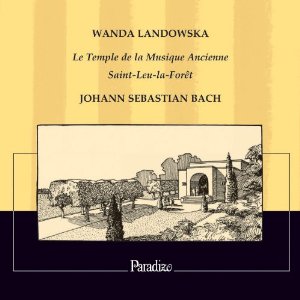
J.S. Bach, Wanda Landowska, Le Temple de la Musique Ancienne • Saint-Leu-la-Forêt, Paradizo PA0009

available at AmazonItalian Concerto et al.,
Wanda Landowska
Paradizo


The collection of Bach works performed by Wanda Landowska titled “Recordings from Le Temple de la Musique Ancienne” was specially re-mastered for Skip Sempé’s “Paradizo” label. The Partita in B-flat, Three Little Preludes, the Italian Concerto, the English Suite in A minor, and the Chromatic Fantasia and Fugue (recorded in 1935/36) present Landowska from her best side, they haven’t ever sounded that good before, and they certainly have never been re-issued with so much TLC. Sometimes her idea of “historical performance”, including her custom-built Pleyel instrument (which reminds me of Wendy Carlos' Bach, actually), are bemusedly belittled. But for all the anachronisms from a 21st century perspective, Landowska was earnestly concerned with early music, and in the 1920s its foremost champion without which the revival of old music in modern times but historical guise would certainly have come significantly slower and later. The release is a beautiful shrine to Landowska, her importance and her playing, but also to the lasting and multifaceted beauty of Bach.

(The DVD with the high resolution rare photos and documents somehow doesn’t work for me, despite having the latest version of the Adobe Reader… which means missing out on the letters from Landowska to Jean-Charles Moreux that she wrote while embarked on a concert tour of the US. I await word on how that .pdf file might be made to work and whether the file is at fault, or somehow my computer.
Edit: I've been told that my troubles seem unique; a new DVD is on the way.
Edit 2:Mea culpa: I did not have the latest version of the Adobe Reader, but 8.0. With 9.0 and above it works just fine and presents a real bonus, especially to those with an additional interest in architecture.)


-> Best Recordings of 2011 #1-10

Folger Consort's Spanish Renaissance Christmas


available at Amazon
Adio España: Romances, Villancicos, and Improvisations from Spain, Circa 1500, Baltimore Consort
Charles T. Downey, Christmas in Renaissance Spain: The Folger Consort Presents “O Magnum Mysterium” (The Washingtonian, December 13):

Out of the burgeoning field of holiday concerts in Washington, the one offered by the Folger Consort seemed likely to be the best -- and not merely the least annoying. Having heard the group’s program of music from the Spanish Renaissance on Saturday night in the Folger Shakespeare Library’s garland-and-light-adorned Elizabethan theater, it’s official. If you’re tired of the same few carols assaulting your ears everywhere—on the radio, in store lobbies, from speakers while you put gas in your car—take an evening to go back four or five hundred years in time and listen to some old and less familiar music for Christmas. Most of it, except for a few pieces that are more widely known -- including the inevitable villancico Ríu Ríu Chíu, performed here in the best possible way -- you won’t have heard before.
[Continue reading]

This concert was reviewed only at Washingtonian.com.

Best Recordings of 2011 (#6)


Time for a review of classical CDs that were outstanding in 2011. My lists for the previous years: 2010, 2009, (2009 – “Almost”), 2008, (2008 - "Almost") 2007, 2006, 2005, 2004.

# 6 - New Release


F. Mompou, "Silent Music", Jenny Lin, Steinway & Sons 30004

available at Amazon
F.Mompou, Música Callada ,
Jenny Lin
Steinway & Sons


Frederic Mompou’s life spans modern history. He was three when Brahms died. When he died at the age of 94, Ronald Reagan had just told Mikhail Gorbachev to “tear down this Wall”. The British pianist Stephen Hough has aptly described Mompou as “Satie without cynicism”. Piano miniatures are the prominent output of both, but unlike his good acquaintance Satie, Mompou doesn’t seem to be hiding behind (disingenuous?) self-effacing humor. Mompou is serious about his little gems; the fact that they look humble and are short doesn’t seem to worry him. Rightly popular is his Música Callada (“Voice of Silence”) – somber yet charming, nostalgic but affirmative. Only the occasional gentle dissonance reminds of the 20th century... breaking like waves against the stoic music. Played with enough warmth, they are as enchanting and accessible as the softer hued Impresiones intimas or his lilting little dances—and apart from Herbert Henck, it is Jenny Lin who does exactly that. She creates tapestry of subtlety into which the ears can sink like an exhausted cat on extra thick shag carpeting. Since Henck’s release, I haven’t heard such felt, beautifully simple Mompou.


# 6 – Reissue