CD Reviews | CTD (Briefly Noted) | JFL (Dip Your Ears) | DVD Reviews

13.6.07

Sayaka Shoji at Arts Club of Washington

During a private dinner ceremony at the Arts Club of Washington (in the historic home of President James Monroe in Foggy Bottom) on Monday night, the S&R Foundation conferred its Washington Awards on five deserving young musicians. For the four runners-up, we heard a brief recorded excerpt of their work: pianist Naoko Takao, Special Committee Award Winner (Persichetti's 7th sonata); marimbist Naoko Takada (a concerto by Ney Rosauro); composer Moto Osada (his own Take the Six for Marimba and Electronics); and violinist Shunské Sato, Grand Prize, 2nd place (the third Ysaÿe sonata).

Sayaki ShojiUltimately, the first place Grand Prize went to 24-year-old Japanese violinist Sayaka Shoji. She is not exactly a newcomer, in spite of her tender years, having already won the Paganini Competition in 1999 and having already played in distinguished venues around the world (including with the Baltimore Symphony last season, which Jens reviewed). She has also made several recordings, although most of them are not widely available outside Japan. After receiving her award, she played three brief selections with local pianist Edward Newman. Shoji's Mozart (first and fourth movements of the G major violin sonata, K. 301) seemed dutiful, sounding mostly as if she were constricting the sound of her rich-toned "Joachim" Stradivarius, made in 1715. A miscommunication about the repeat of the first movement's exposition (Shoji took the repeat, which the accompanist's page-turner noticed after a couple bars) was quickly righted, covered nicely by Newman's adroit approximation of the opening measures.

From there, things got much better, as she launched into four of Shostakovich's op. 34 preludes (arranged for violin by Dmitri Zyganov, selections of which she has recorded), each with a carefully crafted color all its own: otherworldly con sordino in no. 10, raspy staccato in no. 15, broad Romantic sweep in no. 16 (almost a parody of Paganini), and raucous, throaty bravura in no. 24. If modern was audibly more to Shoji's taste, the late Romantic sounded like her native language in the last movement of Grieg's third sonata, op. 45. Here, Newman really earned his fee, shining on the endless arpeggiation of the outer sections. Finally in the Grieg, Shoji allowed her violin to have the big sound she seemed to be holding back in the Mozart. In that gorgeous middle section, when the Allegro animato gives way to a slower tempo, the melodies soared and the Strad's G string barked with intensity. Our appreciation merited a short encore, some crisp and muscular Bartók.

The Arts Club of Washington hosts a free concert series, on Fridays at noon, that continues through the end of July. It was omitted from my Summer Music Agenda.

DVD: Plow and River

Available at Amazon:
available at Amazon
The Plow that Broke the Plains / The River, directed by Pare Lorentz, scores by Virgil Thomson, new recording by Post-Classical Ensemble
(released January 30, 2007)


Watch the movies online:
The Plow that Broke the Plains (1936)
The River (1937)
The National Endowment for the Arts gets so much criticism from certain quarters that it is easy to forget how much good work the agency supports. One recent example is this DVD project, which combines a version of two classic documentaries made by Pare Lorentz for the Department of Agriculture in the New Deal years, with a new recording of the musical scores composed for them by Virgil Thomson. The new soundtrack features Washington's own Post-Classical Ensemble playing the score. In his recognizable way, Thomson uses American hymn tunes that evoke the simple faith and austere lifestyle of the subjects: "Old Hundredth" opens The Plow that Broke the Fields and returns, in a sort of organ-grinder's dirge, during the dust storm sequence. "How Firm a Foundation" and "My Shepherd Will Supply My Need" (RESIGNATION) -- both from The Southern Harmony, a collection Thomson mined repeatedly -- are given a more dissonant harmonization in The River. The essentially bitonal harmonization of FOUNDATION underscores the misery of sharecroppers forced into poverty by the floods.

Other Reviews:

Anthony Tommasini, Music to Heal a Land of Dust and Floods (New York Times, February 25)

Roger L. Hall, Two Thomson Film Scores (Film Music Review, April 30)

C. Michael Bailey, DVD Review: The Plow that Broke the Plains and The River (Blogcritics.org, May 19)
All the sound had to be created anew, including a new voice narration (by Floyd King), as well as the sound effects -- farm machinery, stakes being driven into the ground (synced with the score, too), logs halved by a saw. The imagery is striking, which makes one regret that Lorentz's career was basically over with World War II, although he lived until 1992. Indeed, it is incredible that Lorentz was actually able to get these films made, considering the opposition that he encountered from all angles. Some effects look hackneyed, like the map of the United States used to show the viewer the extent of the Dust Bowl in The Plow, but the films are shockingly iconic, presenting an American visual mythos as convincing as that created by Leni Riefenstahl for Nazi Germany, the film counterpart to the photographs of Dorothea Lange and Lewis Hine. Bonus material on the DVD includes an excerpt of an interview with Virgil Thomson (audio only), several narrations by George Stoney and Charles Fussell. Excerpts from the beginning and end of the original version of The Plow that Broke the Plains show how the film was extended to accommodate some music restored to Thomson's score. You can also listen to the original soundtrack of both films, both inferior to this new version conducted by Angel Gil-Ordóñez.

Naxos DVD 2.110521

The Post-Classical Ensemble has offered a sneak preview of their 2007-08 season: an all-Revueltas concert at the Library of Congress, a live performance of Copland's score to The City (also Pare Lorentz) with a screening of the 1939 film, Manuel de Falla's Master Peter’s Puppet Show, and the first American operetta, The Doctor of Alcantara. If you live in the Washington area and do not know the group yet, this is your chance.

12.6.07

By Strauss


Hugo von Hofmannsthal and Richard Strauss, c. 1915

I spent hours yesterday, as I will also do today, worshiping at the altar of an Ionarts favorite composer, Richard Strauss. Yesterday was the 143rd anniversary of his birthday (June 11, 1864, in Munich), and our favorite stations on Sirius satellite radio are engaged in broadcast marathons. Mostly it is Met Opera Radio for me, with a two-day marathon of live broadcasts of a few of Strauss's operas, with some tuning in to the parallel symphonic and chamber music marathon at SymphonyCast during the breaks. How fortunate that this comes after school is out!

The equipment that makes this all possible is a Sirius Stiletto 100 receiver, given to me recently by a very generous person. This little device can be docked in its speaker station in the house, or in the car, where you can use it to record up to 100 hours of programming, which is a considerable amount of opera. Then you can carry it around with you and listen to your recorded radio with headphones, like an MP3 player. For the first time today, I used the special headphones that also come with it, which allow you to walk around with the Stiletto while receiving the satellite signal through an antenna in the headset. The only complaint I have with Sirius is that the signal can be unreliable, and I have experienced problems with it in the house, in the car, and on foot with the headset antenna. I see the "Acquiring Signal" message too often, although it can usually be corrected by fiddling with the antenna.

Ionarts on the Operas of Richard Strauss:

Salome (1905)
Deborah Voigt with the National Symphony Orchestra | Santa Fe Opera

Elektra (1909)
Opéra National de Paris | Tanglewood Festival | DVD

Der Rosenkavalier (1911)
Lyric Opera of Chicago

Die Frau ohne Schatten (1919)
Théâtre de la Monnaie, Brussels | Théâtre du Capitole, Toulouse | DVD

Die ägyptische Helena (1928)
Metropolitan Opera

Daphne (1938)
Renée Fleming, recording and live

Capriccio (1942)
Opéra national de Paris

It's All Too Fast


Another week begins; it’s Monday morning. I don’t hear your hair dryer or the snapping of make-up kits. No one is coming down to breakfast, just me and the dogs.

Congratulations to Mark's daughter! And good luck on adjusting to an empty nest. -- CTD

11.6.07

New Opera Notes: Zemlinsky

Zemlinsky, Der Traumgörge, directed by Joachim Schloemer, sets by Jens Kilian, Deutsche Oper, photo by A. T. Schaefer
The Deutsche Oper in Berlin has mounted a production of Zemlinsky's early 20th-century opera Der Traumgörge (The Dream-George). Gustav Mahler intended to premiere this opera in Vienna in 1907, but it was not actually staged until 1980. Shirley Apthorp reviewed it (A storyteller’s troubled dream, June 4) for the Financial Times:
The choreographer and director Joachim Schloemer has struggled so hard to come up with a contemporary take on the piece, rich in meaning and open to a variety of interpretations, that he has rendered the plot, which was confusing enough to begin with, almost entirely unintelligible. Zemlinsky’s opera plays out in a timeless setting of small-town life. Dreamy orphan Görge is more interested in the world of fairy tales than in his bride-to-be, Grete. He runs away before the engagement party. After years of wandering, he finds his dream woman, the social outcast Gertraud. He rescues her from a witch-hunt and brings her to his home town, where all are enthralled by his storytelling and respect him as their leader.

Schloemer sets the action in the broken-down anteroom of a modern- day underground railway. Static escalators, grubby stairs, illuminated announcements (“FIRE! FIRE! FIRE!”) and a couple of bare concrete walls form a space that is halfway to nowhere (sets: Jens Kilian). The villagers of the first act are grey- suited office-workers, the miller and pastor are drunks, Görge drafts film scripts and wears thick glasses.

The second act, Zemlinsky’s exploration of brutality and violence, mingles subcultures of pimps, hippy surfies, puking proletarians and lumpish religious fanatics. Görge is a tramp, his Gertraud a junkie. For the postlude of the couple’s triumphant return home, Schloemer has devised a bizarre bunker of conformist cultism, Stepford Wives meet Jim Jones. The chorus are dressed in identical 1950s leisurewear, and there’s a mass suicide just before the final curtain.
For another viewpoint, George Loomis reviewed the production (Berlin operas: A grim myth and an abstruse fairy tale, June 5) for the International Herald Tribune:
Alexander von Zemlinsky's "Der Traumgörge," or The Dreaming George, an opera about fairy tales from early 20th-century Vienna [is] now in the repertoire of the Deutsche Oper Berlin. Görge's preoccupation with fairy tales, which he believes "must be for real," breaks up his prospective marriage to Grete. But in Act II, which confusingly has almost entirely new characters, he meets Gertraud, whom he eventually recognizes as his fairy princess come to life. Reaching this conclusion is a tortuous process, however, and Zemlinsky's churning chromatic score adds another layer of complexity.

A colleague of Schönberg who never made the break to atonality, Zemlinsky rightly has his champions, but "Der Traumgörge" does not find him at his best, certainly not as a dramatist. Nor does Joachim Schlömer's production supply much in the way of insight. Jens Kilian's set depicts a vast hall with two (nonworking) escalators. It could be an office building housing Görge's potential publisher, for he and his many papers spend a lot of time in the lobby. The staging has a number of perplexing touches, such as having a shopping cart tumble down an escalator, including a quasi-ballet of skateboarders and portraying the citizens of Görge's village as dead in the final scene. The tenor Steve Davislim does yeoman work as Görge and Manuela Uhl brings an arresting dramatic soprano to Gertraud. The conductor Jacques Lacombe stressed clarity of texture over bringing out the colors and passions of the score. But it is doubtful that a more fervent interpretation would have added appreciably to the Deutsche Oper's case for the opera.
Well, I for one would still like to hear this opera. The Deutsche Oper's Web site has more pictures.

10.6.07

In Brief: Yes, It's June!

LinksYour regular Sunday roundup of links to Blogville and beyond.

  • Amid the depressing news of mainstream media outlets jettisoning their classical music critics, it was good to hear that WETA-FM's return to an all-classical format (not really a return, since their content is now more exclusively classical than it ever was) has paid off at the bottom line. As Stephen Colbert would say, "The market has spoken: classical music must be worthwhile." [Washington Post]

  • Joyce DiDonato has a blog, and she does not even link to Ionarts? After all the critical love I have given that woman... Is it because I had to miss her Vocal Arts Society recital in February? [Yankee Diva]

  • Ever wonder what your cat does during the day? Someone in Germany (hat tip to Boing Boing) put a small digital camera on a cat's collar and actually found out. [Mr. Lee CatCam]

  • In disturbing news for bloggers and blog readers everywhere, a certain redoubtable Milan-based opera blogger has run afoul of the Teatro alla Scala. La Scala has seriously miscalculated this time. This instantly reminded me of something I read in an article by Tad Friend in The New Yorker earlier this year, about a reality TV show of all things: "Even then, he was candid about the fact that journalism about rock stars isn’t a gonzo expedition in search of elusive truth so much as a mutually wary, mutually beneficial transaction. When Carly Simon complains in the film about being the subject of a hatchet job, Wenner’s character replies, 'Oh, come on, Carly. The only thing worse than being written about is not being written about'." Seriously, La Scala, Opera Chic has done more than anyone else to raise the profile of your company with English-speaking audiences. Back off. [Opera Chic]

  • Hoglands, the unusual home designed by Henry Moore for himself, is finally going to be open to the public. The 16th-century farmhouse has been restored to the state it was in during the last 20 years of Moore's life, including the art, fabrics, books, and furniture that the sculptor made for it. The number of visitors will be limited to a few dozen per day. The home is part of the holdings of the Henry Moore Foundation in Hertfordshire. [The Guardian]

  • In a shocking turn of events followed by On an Overgrown Path, Robert King, founder and director of the ensemble The King's Consort, was convicted by a London jury of 14 incidents of indecent assault over an 11-year period and sentenced to almost four years in prison. (I recently reviewed that group's recording of Monteverdi's 1610 Vespers.) King has dismissed the accusations of five of his former students as lies. The Catholic priest scandal in the United States has drawn much-needed attention to the problem of pedophile priests, but these crimes are not limited to priests. More attention needs to be paid to others who work regularly with children, like coaches and teachers, where it is likely that the rate of incidents is just as high. In a worrying development, the judge in this case "did not bar King from working with children in the future, however, citing the 'radical change' in King's life (marriage and fatherhood) since the time of the offenses." That is crazy. [Playbill Arts]

  • Andrew Taylor admired an essay by the John van Rhein in the Chicago Tribune about professional vs. amateur musicians. The decline of amateur music-making is regrettable, to be sure: it would make me very happy to see a piano return to every household, along with at least one person who knew how to play it. However, the notion that amateur musicians "love" or "delight in" the music they perform while paid musicians do not is so absurd that I am embarrassed the Chicago Tribune printed it. If we take the paragraph that Andrew quoted in his post and replace all the terms from the musical profession with those from another field, surgery, it becomes clear: "Surgeons who practice for love rather than money can teach even jaded patients something vital about what it means to practice and experience surgery. They are one reason surgery remains a living art." [The Artful Manager]

9.6.07

Touched by Four Angels


Composer Mark Adamo (b. 1962)
Photo by Martin Gram, courtesy of G. Schirmer, Inc.
At this week's concerts, the National Symphony Orchestra premiered its latest commission, a new harp concerto by Mark Adamo. Adamo dedicated Four Angels to conductor Leonard Slatkin, who helped make the commission happen, and the NSO's principal harpist, Dotian Levalier, who performed the solo part. On Friday night at the Kennedy Center, Slatkin led the NSO through a sensitive reading of this rather traditional but hauntingly lovely score. The first movement is named for Metatron, in the Kabbalah the name of the angel closest to the throne of God. Dressed in a lemon chiffon gown, Levalier strummed her way through the rather conventional harp part, accompanied by tinkly, chromatic percussion and eye-bulging slides in the brass. The second movement is a scherzo called Sraosha, after the angel of divine intuition in the Zoroastrian tradition. Adamo evokes the Persian background with an extravagant battery of unusual percussion (bell tree, Chinese Opera gongs and other gongs, crotales, temple blocks, vibraslap, and so on) -- Jens has made the point before about how some modern composers use percussion as a coloristic crutch. In this case, percussive string attacks and buzzing harp sounds created by chromatic pedal crashes round out the exotic texture.

Adamo dedicated the third movement, Regina Coeli (not an angel at all, but the Mother of God, Queen of Angels), to his mother. It is a gentle aria for luscious Hollywood strings, with the percussion banished from the gentle atmosphere, ending on a thick A-flat major chord. A melody of fourths and fifths, which appears regally in the first movement and enigmatically in the scherzo, is smoothed out here and serves to unify all four movements. The fourth movement, Mik'hail, is a restless description of that most militaristic angel, common to Judaism, Christianity, and Islam. The martial sounds included muted trumpet fanfares, and the movement's use of agitated shifting meters and driving rhythms brought the work to a triumphant end. Four Angels is pleasing to the ears in a neo-Romantic way (Adamo reportedly wanted to be a Broadway composer), but it gives the impression of being an episodic series of vignettes more than a formally unified work. With his extraordinary skill at quickly evoking different moods and characters, Adamo has likely missed his real calling, in composing film scores.

Other Reviews:

Tim Page, NSO Takes Flight With 'Four Angels' (Washington Post, June 8)

Karren L. Alenier, Mark Adamo's Harp Concerto (The Dressing, June 8)

Stephen Brookes, Composer Mark Adamo, Wild at Harp (Washington Post, June 3)
In the past few months, Ionarts has reviewed several visiting orchestras passing through Washington on tour, including Philadelphia, Australian Chamber Orchestra, the Leipzig Gewandhaus. It is good to have these performances as standards when assessing the ensembles we hear regularly. Such comparisons point out some weaknesses in the NSO: a less unified string sound, persistent if intermittent problems with woodwind intonation. While the Adamo sounded well rehearsed, as if all the performers were on the same page, the opening work -- an all too rare opportunity to hear a Haydn symphony, no. 85 (B-flat major, "Haydn La Reine"), last heard from the NSO in 1993 -- was sadly uneven. The unsettled character of much of the piece came from differences between Slatkin, who often seemed to be pushing the tempo forward, and the players. The slicing A theme of the first movement, one of my favorites, was well done, and the boisterously laughing grace notes of the Menuetto had a nice Viennese lilt. Still, most of this performance felt a little slipshod.

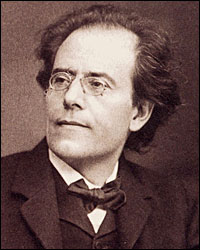
The second half offered the main attraction for many in the large if not full audience, Gustav Mahler's first symphony. The last time we reviewed the "Titan," as it is sometimes labeled (you can listen to it online), it was Jens's review of guest conductor Roberto Abbado in 2004, but the NSO has played it since then another time, at Wolf Trap in 2005. Mahler-1 three times in three years, and La Reine once every fifteen years? A work so familiar should have come off more solidly than it did overall, too. The second movement had a gutsy quality that made it a rather rustic Ländler, with a sultry salon dance trio. The enigmatic third movement is a somber funeral march with the children's song Bruder Martin as a theme -- you may know it instead as Frère Jacques, but recast in the minor mode. This was a moment of chilling irony, interspersed with interludes in a Jewish or Gypsy style, to which Slatkin gave a joyous, Klezmer-esque flavor. The turn to the major mode, for the appearance of Mahler's achingly beautiful song melody Die zwei blauen Augen was beautifully hushed and tender playing.

The first movement featured some nice offstage brass playing, as well as dolorous woodwind intonation in those slow, exposed passages. Here as in the rousing final movement, the brass were apocalyptic and showed almost superhuman strength. At the moment when Mahler asks the horn section to stand together and play the triumphant chorale theme, it was thrilling to hear. The brass were also largely responsible for making the symphony's exultant conclusion as full and final as it was. So, there was good and bad (or less good) in this worthy program, which ends the NSO's 2006-07 season with hope for the future.

This concert will be repeated once more, this evening at 8 pm. The National Symphony now moves into its summer schedule, with some lighter concerts at Wolf Trap through August. Regular concerts will return to the Kennedy Center in September.

Angelika and Vivica Join the Handel Club

Available at Amazon:
available at Amazon
Angelika Kirchschlager, Händel Arien, Kammerorchester Basel, L. Cummings
(released November 14, 2006)


Other Handel Discs Reviewed at Ionarts:
Cecilia Bartoli | Sarah Connolly
Natalie Dessay | Renée Fleming
Lorraine Hunt Lieberson
Sandrine Piau | Andreas Scholl
Last fall, Ionarts had the pleasure of hearing Angelika Kirchschlager on the stage here in Washington, in the title role of Nicholas Maw's Sophie's Choice, a role that she created. The Austrian mezzo-soprano has garnered significant critical attention, most recently in an oddly staged Pelléas et Mélisande at Covent Garden, for both her voice and her good looks. A copy of her 2006 CD of Handel arias has recently come across my desk, and I wish it had not taken so long. Kirchschlager has a suave voice, raffiné, tending toward covered tone rather than grain in the high range (and sometimes coloring slightly flat, but not offensively so). Her strengths are generally in nuanced line rather than in sheer power or forceful vocalism, and while her performances of fast arias here are impressive, if perhaps under-ornamented, it is the slow pieces where she really excels. In fact, she admits her own bias in this direction in the liner notes:
"To me Handel's ingeniousness appears most explicitly in his slow arias," she says. "The most incredible emotions and 'tremblings of the soul' are linked only to a very few notes. Basically the power of the music comes out of nothing -- but this 'nothing' seems to be everything." (remarks quoted by Martin Bernheimer)
The selections are taken from three Handel operas, beginning with Ariodante, in which Kirchschlager has just sung the title role, as reviewed in Le Figaro, Libération, and the Financial Times. This was staged at the Théâtre des Champs-Élysées with Christophe Rousset, Les Talens Lyriques, and Vivica Genaux (see below) as Polinesso. Sesto was the first Handel role Kirchschlager sang on stage, in Glyndebourne's 2005 Giulio Cesare, and it is featured second on this disc. The final set of arias is taken from a much less familiar opera, Arianna in Creta, and any company deciding to mount it should engage Kirchschlager for the role of Teseo she sings here. On this recording, made only last August, Kirchschlager collaborated with the Kammerorchester Basel, a conductor-less chamber orchestra with, in this case, British conductor Laurence Cummings at the helm. The results make for excellent listening, with lush and active sound from all sections, even those notoriously difficult horns.

Sony BMG 82876889522

available at Amazon
Vivica Genaux, Handel and Hasse Arias, Les Violons du Roy, B. Labadie
(released September 12, 2006)
The Handel CD (with some Hasse) from Alaskan soprano Vivica Genaux is just slightly older and has also recently come my way. Her name first came up at Ionarts in my review of Vivaldi's Bajazet, a recent recording from Europa Galante. Shortly after that, she had a role in Rossini's L'Assedio di Corinto at Baltimore Opera, and we will have the chance to hear her Rossini again next year, in the Bianca e Falliero from Washington Concert Opera. (At some point, I should review her 2003 Bel Canto CD of Rossini and Donizetti.) Genaux's voice, like so many mezzos, is distinctively colored and perhaps not guaranteed to please every ear. Her sometimes active vibrato is often quite close to her nervous, almost dissonant trill. Genaux's strength is not in long-lined legato, in which a tremulous agitation often twitches underneath the surface. She shines most strongly in the fast arias (like Sta nell'Ircana pietrosa tana, one of Ruggiero's arias in Alcina), with dazzling passagework, and in the excellent embellished da capos and cadenzas (uncredited, and so probably either by Genaux or the conductor, Bernard Labadie).

For her Handel and Hasse recording, Genaux worked with Labadie and his Canadian historically informed performance ensemble, Les Violons du Roy. The last time that they were in Washington, it was to give a beautiful, Handel-heavy program with soprano Karina Gauvin. Their sound is lean and lovely in this recording, with a svelte and unified violin section and exceptionally accurate wind playing. The group's concert here in Washington included a number of dance pieces from Handel operas, showing off Labadie's experienced hand at realizing the character of Baroque dance which so infuses music of this period, a strength that comes through in this recording, too. It is especially nice to combine Handel with some rare enough recording space for the music of Johann Adolf Hasse (1699-1783), with selections from one of his operas, Arminio, and a cantata, La scusa. This matches up respectably with pieces from Handel's Orlando and Alcina and his lovely cantata in honor of St. Cecilia, Splenda l'alba in oriente. In a nice marketing touch, you can watch a nifty video on the collaboration of Genaux and the instrumentalists.

Virgin Classics 7243 5 45737 2 9