CD Reviews | CTD (Briefly Noted) | JFL (Dip Your Ears) | DVD Reviews

20.4.07

Tetzlaff & Bĕlohlávek in Mozart and a Janáček Delight

available at Amazon
Janáček (et al.), Violin Concerto, Tetzlaff / Philharmonia Orchestra
Christian Tetzlaff, who performs in the National Symphony Orchestra’s current run of concerts, is easily thrown into the category of “intellectual violinist” where he resides among other notables such as Frank Peter Zimmerman, or Thomas Zehetmair. One might say that they are the last exponents of the “German School” of violinism - although that distinction among national lines is hardly possible anymore when, technically, there exist but different variations on the “Russian School” these days. But what Tetzlaff and the others mentioned – include Julia Fischer among them, if you wish – are decidedly not, are the “Gypsy fiddler” type whose fierce temperament will break through in every work they touch. Rather, their approach tends to be cool, executed with superior skill, calculated musicality, and little exaggeration. Technical difficulties don’t seem to exist – and it is in part the ease with which they can play their repertoire that some might get the impression of less than 100% involvement.

That wasn’t the impression Tetzlaff left in Mozart’s Third Violin Concerto on Thursday night. It’s already not a work known for its intellectually probing qualities… but rather its youthful, lighthearted nature with an almost carelessly treated abundance of genius. With the Czech conductor Jiří Bĕlohlávek leading the NSO, Christian Tetzlaff played with an abandon and straining for heat as if to fight the above stereotype. I found the opening Allegro surprisingly unsuccessful – with notes and phrases going awry for excess of vigor and digging into the instrument and music. If the Adagio wasn’t stereotypically ‘brainy’ either, it was less ‘out of character’ and displayed some well suited restraint. But it wasn’t until the Rondeau: Allegro that Tetzlaff hit his stride. With ease and agility, accuracy and a light enough touch he fiddled away without going for more than the music could deliver. That’s not to say that he went quietly into the night (for once, he was to return in the second half) and earned warm applause from a Concert Hall well filled with regular patrons and busloads of students. (That many of the latter applauded the first movement went on to show that instinct often knows better where the composer wanted appreciation shown than does stuffy tradition.)

available at Amazon
Janáček - Edinger


available at Amazon
Janáček - Zehetmair


available at Amazon
Janáček - Skride
Back for duty, Tetzlaff presented Janáček’s Violin Concerto “Pilgrimage of the Soul”. Not reconstructed from sketches (found on the back of the score of the opera “From the House of the Dead”) until 1988, it is a relative rarity and a first in concert performance to these ears. It turned out a most delightful discovery. Stark and naked in the opening with the violin accompanied by timpani alone. The soloist then rarely stops in a wild ride as a chorus of brass enters, winds squabble away in the background, harps plucking along. The concerto has drive and energy to spare, enough dissonance to scare away those who had come for Mozart, and of such challenging beauty as to fascinate the “finer ears”. It is brief, too (five connected movements lasting about 12 minutes), which, much like in writing, is more likely a virtue than detriment.

I heard all kinds of exciting new things – too many to really assign labels, though “Stravinsky” came to mind more than once. Its fluctuating and audacious moods toy with the listener – and writing these lines I am now reminded of Schnittke’s Fourth Violin Concerto, too. Applause came from fewer hands for this work, but that with greater gusto. Rightly so, because Tetzlaff was in high form; his playing a joy to behold.

At its rambunctious best, the concerto is as noisy and gnarly as the orchestral pieces that opened each half: Dvořák’s Othello Overture and Smetana’s Richard III symphonic poem op.11. (Both tributes to the city-wide Shakespeare celebration and the latter, like the Janáček concerto, a NSO premiere.) The orchestral works gave the brass section a workout to which the players responded most capably. Smetana’s Richard III especially was a brooding, Lisztian affair, rambling, but pleasant.

The candy awaited at the end: Vltava (“Die Moldau”) from Má vlast assured that people kept their seat during Janáček. The playing of the NSO here was matched only in the concerto. In the latter by means of an appropriate edge-of-the-seat quality, in the former through comfort.

The program will be repeated tonight at 7PM and on Saturday at 8PM.


The Janáček concerto may be rarely heard, but is well represented on disc. Baiba Skride has just released it on Sony, several Czech performers have recordings to their name (I own Christiane Edinger with Václav Neumann on the super budget RCA/Arte Nove label), aforementioned Thomas Zehetmair (Warner/Apex import) has recorded it – and of course Tetzlaff himself, on Virgin Classics – also on a budget recording (oop). Those intrigued by Tetzlaff’s artistry are well advised to look for his recordings of Bartók Violin Sonatas with Leif Ove Andsnes, the complete works for Violin by Sibelius (both Virgin), and a terrific Beethoven Concerto with David Zinman on Arte Nova which is more than just an inexpensive alternative to the difficult-to-get Zehetmair recording (Frans Brüggen / Philips) I adore.

Things on the Horizon

One more time, the Baltimore Museum of Art's final lecture in its Conversations with Contemporary Photographers series will be given next Thursday, April 26th, at 7 pm. Closing out the program of some of the hottest photographers of the day will be, film maker-photographer Anthony McCall and Tacita Dean, a British artist best known for her moody, atmospheric 16 mm films. The exhibit Pissarro: Creating the Impressionist Landscape continues through May 13th.

Don’t miss the American Visionary Art Museum’s fabulous Kinetic Sculpture Race 2007, which rolls and floats off on Saturday, May 5th! Many of our favorite competitors return this year, along with some brave new souls. Go here for the latest info. and here for my pics from last year.

IMG_0170.JPG

Speaking the Word of God: Illuminated Korans from the Walters Art Museum continues until the 29th of April. Well, you can’t do that with online publishing, now can you? The Walters' collection never ceases to amaze.

Progress has been made on my latest lithograph, and we are in for a great spring weekend. It's supposed to reach the 70s here in Baltimore, although I'll be in Vermont.

19.4.07

Atget at BNF

Eugène AtgetI have written several times about Eugène Atget and his photographs of Paris over the years. There is a new exhibit, Atget: Une Rétrospective, at the old Richelieu site of the Bibliothèque Nationale de France (through July 1). This first retrospective of Atget's photographs in France commemorates the 150th anniversary of Atget’s birth and the 80th anniversary of his death. I read a review by Angel Gurría-Quintana (Portraits of a lost metropolis, April 16) in the Financial Times:

“I can say that I now possess all of Old Paris.” This extraordinary claim, made in 1920 by the French photographer Eugène Atget (1857-1927), was not as outlandish as it sounds. Writing in a letter to the director of the Institut des Beaux-Arts, Atget was referring to the completion of a lifetime’s project: capturing the city’s streets, monuments and views in their endless variety. When he died seven years later, the photographic pioneer left behind more than 25,000 images and 8,500 glass negatives, divided among government institutions and private collectors. This cache of images remains the largest ever produced to document the French capital. [...]

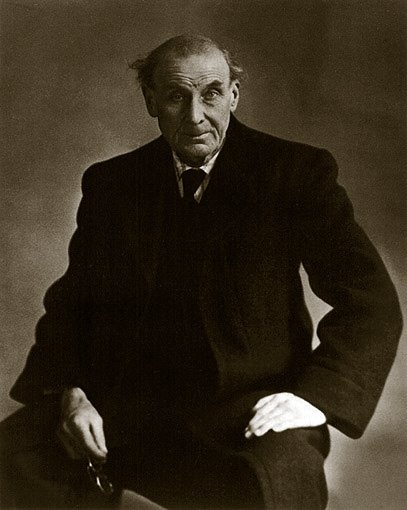
Surprisingly for someone who thought of himself as a workaday collector of views, Atget was even appropriated by the surrealists. His next-door neighbour, the American avant-garde photographer Man Ray, published a handful of his pictures in André Breton’s magazine La Révolution Surréaliste. Rather than its last romantic, Atget was photography’s first modern. Man Ray’s assistant, the American photographer Berenice Abbott, became the greatest champion of Atget’s work. It is to her that we owe the only known photographic portrait of Atget [shown here], taken months before his death, and also on display at the Bibliothèque Nationale. In it he is gaunt and hunched over, almost haunted, as if staring into a lost past that lingered only in his luminous images.
To muse on the Paris of yesteryear, here are some online Atget collections, from the George Eastman House and iPhotoCentral. Also of interest is Christopher Rauschenberg's exhibit of companion photographs, made in the same locations as Atget's.

18.4.07

Tetzlaff and Holloway, More Violin Bible

The Bach sonatas and partitas for unaccompanied violin are crucial works, the "Bible of music," as Gidon Kremer put it. Most serious listeners have more than one recording of them, and I find myself returning to many interpretations and always willing to listen to more. Ionarts has reviewed recordings by Gidon Kremer, Julia Fischer, and Rachel Podger, but also professed admiration for Nathan Milstein, Arthur Grumiaux, Shlomo Mintz, Itzhak Perlman, and Jascha Heifetz. Choice is not the problem, and here are two new recordings to consider for your bulging shelf.

Available at Amazon:
available at Amazon
J. S. Bach, Sonatas and Partitas for Solo Violin, John Holloway, Baroque violin
(released October 10, 2006)
Jens has already given high praise to Rachel Podger's recording of the sonatas and partitas on Baroque violin. The recent recording by Baroque violinist John Holloway may compete with Podger for the HIP-minded market. In his Performer's Note, Holloway states that his earliest work on these pieces was in the authoritative Urtext editions (hooray, musicology!), preparing him "for the later step of working almost exclusively with a facsimile of Bach's autograph manuscript." This recording has the "ECM sound," live and immersed in the rich acoustic of the Propstei St. Gerold, where the Hilliard Ensemble has also been recorded for ECM. Holloway writes that the "Great Room in the castle at Cöthen where Bach was employed when he completed the Sei Solo has a similar sound." Holloway gets a searing sound from his Ferdinando Gagliano, made in Naples in 1760, which is so right for the slow movements. With the older style of bow, virtuosic passage work in a single running voice is impressive, as are the long held notes which can bloom with that hard edge to the sound.

I am convinced by Holloway's argument in his liner notes, that his experience as an early music specialist (working with Andrew Manze and Roger Norrington, among others) gives him a different perspective on the works of Bach. Performers who focus on mostly later music do not have enough experience playing Baroque dance music (preferably in the context of actual danced performances), which is crucial to understanding so much Baroque music, including the partitas. Holloway's performance of the Giga from Partita No. 2 is a vital, irrepressible romp of a dance, for example. He does push the tempi to a degree, with track timings that are often much shorter than Fischer's reading, and some movements with big multiple stops suffer. The famous Ciaccona is seductive and quick (13:04), although I remain strongly in the camp of Rachel Podger's rendition (13:36), although at least some of Holloway's tracks will likely make it into the "dream" compilation of the complete sonatas and partitas I intend to make on my MP3 player.

ECM New Series 1909/10

available at Amazon
J. S. Bach, Sonatas and Partitas for Solo Violin, Christian Tetzlaff
(April 10, 2007)
German violinist Christian Tetzlaff has already released a complete Bach solo recording, in 2002 with Virgin. It is perhaps a little early to release another complete recording (Gidon Kremer waited 25 years), but that is exactly what Tetzlaff has done with this new release from Hänssler Classic. Tetzlaff's sound on his modern instrument, Peter Greiner's copy of a Guarneri del Gesu, was captured in the Hofkirke at Østre Toten, Norway, although there is none of the ring of space in this recording as in the Holloway. His Bach sound is decidedly clean, with vibrato rarefied to an admirable purity, and he tends toward regularity in rhythmic pacing. What I admire particularly is the wide range of tone, which can be reduced to a very narrow thread, and the attention to voice leading. Tetzlaff is the best I have heard so far at giving the illusion of counterpoint: in the multiple-stop pieces (good examples are the opening Adagio of the first sonata and the first partita's Allemande), he concludes one voice, nestling it at the top of a multiple stop, while another voice starts up from an independent place in the sound of the chord and sounds completely different.

Christian Tetzlaff:
available at Amazon
Bach Sonatas and Partitas
(Virgin, 2002), in half-price 4-CD set with Ralph Kirshbaum playing the Bach cello suites (thanks, Jens!)
The quality that may put off some listeners is its ultra-refinement, which could be interpreted as timidity or mildness. Tetzlaff's reading, perhaps sounding a little reserved and bookish like Tetzlaff in his press photos, is the antithesis of the raw, visceral sound produced by Gidon Kremer on his recent recording. For these unaccompanied works, which represent like almost no other an expression of the musical interior, that sound of a player at times lost in thought is quite appropriate. It is to be hoped that Christian Tetzlaff, in his upcoming appearance with the National Symphony Orchestra this week, might choose a Bach movement if called upon for an encore.

Hänssler Classic 5287318

Czech conductor Jiří Bĕlohlávek leads the NSO concerts this week (April 19 to 21), in an appealing program of mostly Czech music. Christian Tetzlaff will play as soloist for Mozart's third violin concerto (G major, K. 216) and for the NSO premiere of Janáček's Wandering of a Little Soul, a reconstructed violin concerto.

17.4.07

Thierry Escaich at the National Shrine

Thierry EscaichSunday evening French organist Thierry Escaich offered a lifting celebrity organ recital for the Octave Day of Easter at the Basilica of the National Shrine of the Immaculate Conception. The first half of the program consisted of French and German Romantic music, including an improvisation in Romantic style on a submitted theme. The second half showed Escaich’s skills as a composer and performer of 20th-century and contemporary French music.

The concert began with a compelling rendition of the Te Deum by French composer Charles Tournemire (1870-1939). Opening loudly with the chant tune in unison, Escaich did an excellent job adapting to the Shrine’s vast acoustic, where toward the end every note could be heard in the brisk passage work on full organ. Unfortunately this clarity and strength were lacking in the German Romantic selections of Brahms (two chorales and the Prelude and Fugue in G Minor) and two movements from the Sonata No. 1 of Mendelssohn. Escaich’s quick tempi were often too much for the room, while clarity was further limited by muddy registrations that were at times overly contrasting – especially in the Brahms chorales.

His Improvisation of a Prelude and Fugue in Romantic Style on a Submitted Theme opened in an impressive Elgar-like mode. As the prelude went on, Escaich continued to add an abundance of material, which left the form of the movement something of a mystery. The clever segue to the fugue was with the soft, deep bass notes of the pedal, above which the fugue subject was stated with the beautiful flutes of the Shrine organ. Given that generally a fugue must either come to an abrupt cadence or literally fall apart into something less resembling a fugue, Escaich continued in an astoundingly strict, formal way and then allowed his fugue to digress into something that could best be described as perpetually faster and louder, followed by a few crashes on the deafening high-pressure trumpet.

The high point of the program was the Joie et Clarté des Corps Glorieux of Messiaen. For possibly Messiaen’s most overtly enthusiastic work for organ, Escaich confidently presented the excited angular trumpet melody with gusto. At the end of the work, the glorious trumpet melody sounded as if it literally shot up into the heavens. Escaich’s own III Poèmes pour Orgue, with incredible rhythmic syncopations, sounded much like his improvisations and were played with much more stability. The World Awaiting the Savior of Marcel Dupré (1886-1971), a movement from his Symphonie Passion, was very well played and portrayed the struggle, chaos, and commotion of a world in need of a savior. The gentle and redemptive melodic material later in the movement was very moving. His Free Improvisation on Submitted Themes was something of a confusing romp with the previously used and somewhat superficial form of faster, louder, and then some high-pressure reed crashes. The second given theme was the Gregorian Alleluia – often used in Catholic services and at the earlier Mass that day at the Shrine – that was incorporated bit by bit rhythmically, motivically, and then fully.

16.4.07

Transformations, Maryland Opera Studio

Good collegiate opera companies can draw attention to their work and their students by consciously choosing to stage new and recent operas rather than simply doing the same old chestnuts as professional companies, just with less money and inexperienced singers. The University of Maryland Opera Studio's smart productions are often of great interest because they are the only opportunity to see rare operas on an area stage, things that mainstream opera companies are usually too cowardly to attempt. After an oh-so-crazy production of Cimarosa's Il matrimonio segreto last spring, the group has presented an equally "zany" production of an opera I have long wanted to see staged, Conrad Susa's Transformations. This production was a fitting end to a busy weekend of three operas, after Purcell's The Fairy Queen at the Folger and Britten's The Rape of Lucretia at the Châteauville Foundation.

For the 1973 premiere of this opera, American composer Conrad Susa (b. 1935) worked with poet Anne Sexton to adapt her book of the same name, the poet's reinterpretation of fairy tales by the Brothers Grimm. Sexton's book is a classic of 60s feminism, a psychological reinterpretation of fairy tales in terms of the poet's own life. The operatic collaboration happened after Sexton had become famous by winning a Pulitzer Prize for her confessional poetry, and just a year before she lost her life-long struggle with mental illness and finally succeeded in killing herself. It is only the first of Susa's several operas (Black River, The Love of Don Perlimplín, The Wise Women, and Dangerous Liaisons) that I have managed to strike off my list of opera desideria for new productions.

Kara Morgan as Anne Sexton in Transformations, Maryland Opera Studio, 2007, photo by Cory Weaver
Susa's opera, commissioned by the Minnesota Opera, uses eight characters including a role that is both Anne Sexton and others, all of whom are patients in a mental hospital. Now it is true that Anne Sexton laced her sometimes acidic poetry with humorous observations, sly references to television, pop culture, the foibles of her own generation. Still, the decision of director Pat Diamond to set the opera in 1973, the year that it was premiered, in a nightclub like Studio 54 seemed more disrespectful than enlightening. None of the official press photos quite capture how over the top it was. By the middle of the second act, the flashing sign ("Club Transformations") and disco ball, the cocktails and pill popping, the white leisure suits, platform shoes, bell-bottoms (costumes by Martha Mann), and groovy hairstyles had become utterly irrelevant.

Fortunately, there was Susa's ingenious score, set for a band, not really an orchestra, of eight players. Susa's music, which I have encountered thus far mostly in his choral pieces, is a skillful combination of dissonance, neo-Baroque tonal and contrapuntal structures, chameleon-like in its mimicry of countless other styles, both forward- and backward-looking. Transformations references swing, tango, Sousa marches, Broadway, torch songs, to name but a few. Much of the vocal writing is for various combinations of the eight roles, with especially pleasing episodes for the quintet of male voices, in close harmony, often dissonant, performed with skill and grace by Eric Sampson, Nicholas J. Houhoulis, James Biggs, Darren Perry, and VaShawn McIlwain.

Reviews and Other Articles:

Karren L. Alenier, Transformations: An Opera That Excites the Senses (The Dressing, April 13)

Anne Sexton, The Gold Key (excerpt from Transformations)

Roger Brunyate, A Feminist Far from Grimm: Anne Sexton and her Transformations

Richard Mercier, Transformations: A subjective slant on the Brothers Grimm
However, the opera rests principally on the female roles, especially that of Anne Sexton, sung with dramatic power by the slinky soprano Kara Morgan. In Sexton's poems, various fairy tales are decoded according to sexual episodes from the poet's life, although it is difficult to extricate actual autobiographical content from what may be part of Sexton's narrative persona. The supernatural slumber of Sleeping Beauty is induced by drug addiction, self-medication as a way to cope with her father's molesting of her as a child. Rapunzel, imprisoned in a tower by a possessive old witch, is equated with the old aunt who locks a girl in a study "to keep the boys away." Hansel and Gretel is prefaced by a scene showing a mother pretending to "eat up" her son. Most of the young girl roles are played by the character called Princess, sung with naïveté and vocal strength by soprano Meghan McCall (reviewed previously in two Opera Bel Cantanti productions). In particular, Morgan and McCall had a beautiful duet in the Rapunzel scene ("A woman who loves another woman is forever young").

University of Maryland Opera Studio will also stage a rare production of Gluck's Armide this week, from April 19 to 22, with Ryan Brown conducting the musicians of Opera Lafayette in the pit. Ionarts will have a review, of course.

Kissin's Fantasy

available at Amazon
Fantasy, Evgeny Kissin
(released April 10, 2007)
Russian pianist Evgeny Kissin is 35 years old now, which means that it is long past time to stop thinking of him as a prodigy. Even so, the new release in the Deutsche Grammophon Portrait of the Artist series, a 2-CD set called Fantasy, does just that, taking us back to the time when Kissin was just a kid from Russia with crazy hair. (For some context, check out this video of Kissin playing the first Chopin concerto, at the Tchaikovsky Competition, when he really was just a kid.)

The title of the compilation refers to the combination of several pieces called Fantasy. I admire Kissin's recording of Schubert's Wanderer Fantasy, which has all the delicacy and power one could want. That combination is typical of Kissin's playing, part gossamer wing and part sledgehammer, and it's a live performance, to boot. Most pleasing are the Liszt transcriptions of Schubert songs, also recorded in 1990, which qualify distantly as fantasies, I suppose, in that Liszt's handling of his source material is on the free side. Gretchen am Spinnrade and Erlkönig are savagely difficult, and Kissin plays them with panache. Auf dem Wasser zu singen and Der Müller und der Bach are more contemplative, exploited by Kissin for their harmonic and textural details. (The latter song has a truly odd, lovely melody exaggerated by Kissin's performance.)

Evgeny Kissin at Ionarts:
Kissin and Levine, Schubertabend

2005 recital, Strathmore
The Brahms pieces, op. 116, are from the same older recording, when Kissin was still not 20 years old. Kissin and Brahms seem like a good match in temperament (speaking of sledgehammers), and the second op. 116 pieces, an Intermezzo, is particularly nice. The most stunning technical achievement is probably on Liszt's 12th Hungarian Rhapsody (C sharp minor, S. 244), also recorded in 1990. After a lyrical, slow introduction, the piece begins to twitter with virtuosic Hungarian scales, dancing along in folksy accelerandi and rallentandi. One thing that has always impressed me about Kissin's technique is the individuation of his fingers, and he can make every note in the endless scales seem dry and unto itself.

For something completely different, the anthology also has Kissin's 1991 recording of Beethoven's Choral Fantasy, with the Berlin Philharmonic under Claudio Abbado (from the 1991 New Year's Concert in Berlin). It's a pleasant enough piece of music, and vocal solo contributions from Cheryl Studer and John Aler add value, but it's not something I would necessarily seek out. Even less to my taste is the Tchaikovsky first concerto, recorded in 1988 with the Berlin Philharmonic, this time under Herbert von Karajan. Kissin was only 17 when he made it, which is remarkable, yes, especially since it is also a live recording. For this big Romantic concerto, Karajan and the Berlin Phil deliver the goods along with Kissin, ensuring all those lush, bloated characteristics that make me really dislike the piece. There are ups and downs, but this anthology -- priced to move at Amazon, at $12.97 for 2 CDs -- is a good introduction to the Kissin of 15 years ago, in case you missed it.

If you want to hear the Evgeny Kissin of today, he will play a recital, sponsored by Washington Performing Arts Society, at the Kennedy Center on Wednesday night (April 18, 8 pm). The program (.PDF file) includes the Beethoven C minor variations (WoO 80), the Schubert 7th sonata, and sets of Brahms (op. 118, not op. 116) and Chopin.

Châteauville Foundation, Rape of Lucretia

The critical failure of Lorin Maazel's partially self-financed opera, 1984, was quite a fiasco. Another project funded by Maazel and his wife, the Châteauville Foundation, is poised to become an inspirational success. The Maazels have given over their own property -- Castleton Farms in Rappahannock County, Virginia, about 90 minutes by car from Washington, D.C. -- to build a 150-seat theater/recital hall. There is also enough guest housing space to invite 50-some young musicians once a year to collaborate on a chamber opera under Maazel's experienced baton. Last year's production of The Turn of the Screw, presented for a single performance at the Kennedy Center's Terrace Theater, was the best opera of the Washington season. That was the first experiment with what the foundation is now calling its Castleton Residency for Young Artists.

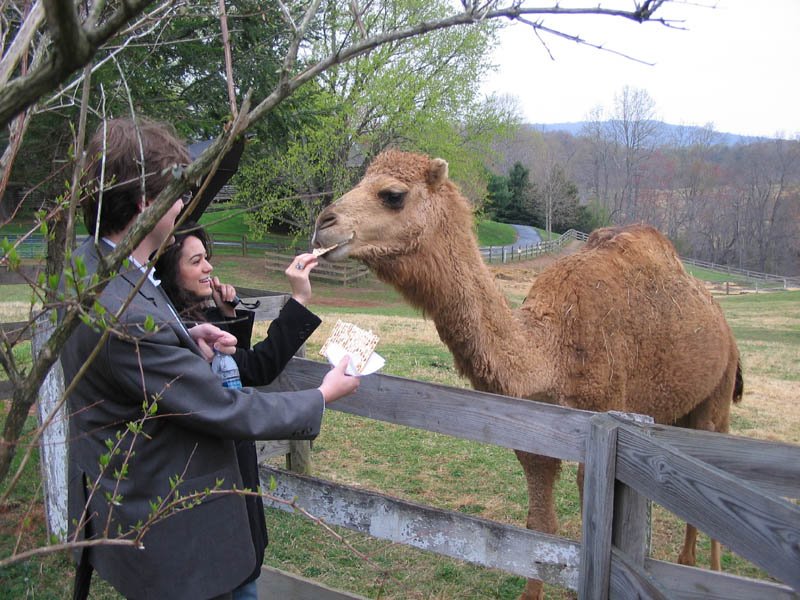
Omar the CamelThe goal is to foster the careers of young instrumentalists and singers, as well as to offer educational programs that bring music into the lives of young children. The Castleton Farms campus is set in the bucolic hills near Shenandoah National Park, and the Maazels have created a fairy tale atmosphere by bringing a host of unusual animals to live there, emus, llamas, and a zebra -- a sort of Prospero Maazel's Island. Indeed, Ionarts discovered on Saturday evening that, as you drive on smaller and smaller roads to get to Castleton Farms, you know you are there when you see the zonkey, the zebra's offspring with a donkey. A camel named Omar, pictured here, makes scary noises but is a soft touch if you come bearing matzo.

The foundation's latest production, Britten's The Rape of Lucretia, which I have reviewed recently in a DVD performance by English National Opera, sets the famous story from the prehistory of Rome. Livy told the story in the first book of Ab urbe condita, and it was adapted by Britten's librettist Ronald Duncan from a modern French play, André Obey's Le Viol de Lucrèce (adapted separately in English by Thornton Wilder), itself based on Shakespeare's adaptation, The Rape of Lucrece. The news of the virtuous Roman wife's rape by her Etruscan overlord inflamed the rebellious spirit of the Romans, according to Livy, and led to the overthrow of the Etruscans. In the opera that story is told by a male and female narrator, who relate its tragedy to the redemption offered by Jesus Christ.

Last year, for Turn of the Screw, members of the New York Philharmonic recommended worthy students from Juilliard to Maazel. This year the program draws upon members of the Youth Orchestra of the Americas for its orchestral musicians. They are all talented young players, who can now list an opera under Lorin Maazel on their resumes. The plaintive and low sounds of the alto flute (Bianca Garcia) and English horn (Elizabeth Koch) were especially moving on Saturday night, as were the all-important colors of the much-used harp (Earecka Tregenza). The only minor disappointment was the sound of an electronic keyboard, played well by Justina Lee, but with an unfortunately canned sound. The pit in the warm, blond wood-paneled theater is accessed by a staircase, and space is at too much of a premium to have a piano hoisted in. It was bad enough to manage to get the harp down there.


Matthew Worth (Tarquinius) and Tamara Mumford (Lucretia), Rape of Lucretia, Châteauville Foundation, 2007, photo by Giuseppe Di Liberto
(see more pictures of this production)
The vocal cast was uniformly excellent, with stand-out performances from lovely mezzo-soprano Tamara Mumford as Lucretia and baritones Paul LaRosa (Junius) and Matthew Worth (Tarquinius). When Mumford's Lucretia walked through the audience in a black veil and carrying the harness that was the symbol of Tarquinius's attack, it brought home the dread of the opera's conclusion. Vale Rideout was full-voiced and dramatically convincing as the Male Chorus, and Arianna Zukerman embodied the sympathetic anger of the opera's women as the Female Chorus. I reviewed the Peabody Chamber Opera's production of The Rape of Lucretia in February, and that collegiate cast was given the opportunity to serve as covers for the Châteauville Foundation main cast.

William Kerley's elegant and minimalist production cast the roles of male and female chorus as fervent Christians who appeared to be writing a book together about this episode in Roman history. They sometimes crossed themselves, which seemed Catholic, but their costumes, including the Male Chorus's tie with a cross design on it, seemed Protestant. The best part of the staging was in the second act, which began with cast members shining flashlights insidiously over the audience. The singers then delivered the chorus of angry Romans while standing in the aisles along either side of the audience, even pounding loudly on the screens from the side stairways.

We hope that the Châteauville Foundation's Castleton Residency for Young Artists flourishes as it should. It does seem a shame not to bring these productions for at least a single performance at the Kennedy Center. The audience will be unfortunately limited for private performances. (My understanding is that scheduling difficulties made the Terrace Theater impossible this year.) Before too long, the Foundation will exhaust the limited number of chamber operas appropriate for the size of the Rappahannock venue and ensemble. It is time to begin thinking about commissioning new chamber operas, too, which could be an excellent, if more expensive, way to foster new audiences for opera.