CD Reviews | CTD (Briefly Noted) | JFL (Dip Your Ears) | DVD Reviews

22.2.07

The Bolshoi's Cinderella a Gift of Wit

Svetlana Zakharova, Photo by Marc HaegemanI rarely review ballet (too difficult to write, the music too slight to endure), and when I do, I savage it. It is an art-form that is even more artificial than opera (and that’s saying something) and one for which I have even less patience when it comes to tradition for its own sake. It is bad enough when opera doesn’t try anything new, relying on the old and staid. With ballet I find it instantly unbearable; sloppiness of execution unacceptable. A superb dancer can salvage a lot, and perhaps more than a superb singer, but it’s generally not enough.

But when everything comes together – or most everything – then a ballet performance can serve as justification for its entire genre. Roland Petit’s Pique Dame for the Bolshoi is such a production and performance (available on DVD), the Bolshoi’s updated Cinderella by Yuri Possokhov (choreography) and Yuir Borisov (staging), playing at the Kennedy Center, is such a production, too, and you can see it live – today, Thursday, and tomorrow, Friday, at 7.30PM. If you have any inclination toward ballet whatsoever, do yourself a favor and experience this fantastical, fantastic performance… a box of weird delights and surprises, cute turns, fun and wit. It crackles and tickles and unless the principal dancers (Ekaterina Shipulina and Andrey Merkuriev, Thursday, and Ekaterina Krysanova, Friday) feature hoofs and claws, it should be no different with them than the Wednesday guarde. (Sergei Filin is in the Wednesday and Friday performance and proved hoof-free.)

Unlike the Kirov Ballet, the Bolshoi takes its American tours seriously (Alexei Ratmansky, the Bolshoi’s artistic director was in the audience, the Bolshoi’s top dancers are here) – and while they didn’t bring the (incomprehensibly controversial) Pique Dame, they did bring that funky Cinderella. It is retold as a story within a story… the protagonist in the title role is really the housekeeper of “the storyteller” and becomes Cinderella by playing the part in his spun tale.

It all starts on the storyteller’s little planet (very much a “The Little Prince” scene) and spins concentric circles around it – with his helpers (ravens, teacups, a teapot, spoons, a broom, grasshoppers, dragonflies, sunflowers, bullfinches, horses et al.) aiding him and Cinderella and friends all throughout the ballet. From a starry night on his moon-rock it is only a few lightweight steps for Svetlana Zakharova as Ptashka-(the helper) cum-Cinderella to chez stepmother, a box in the right corner of the stage. Out come Maria Volodina (stepmother), Anastasia Vinokur, and Lola Kochetkova (the stepsisters). The sisters put elegance to brilliant use in clumsy buffoonery as these big-boobed, rouge-drenched, obnoxious, bumbling bimbos. Whether they try to learn the latest dancing move from the dancing master (witty – and excellently danced by Gennady Yanin) or misbehave at the Prince’s party in those wild “Gone with the Wind” dresses, these two gals are outrageously funny, riotously silly, loveably over the top. Occasionally they had to catch themselves so as not to dance too well (they are supposed to be pathetic, after all) – but both deserve extra recognition of making such great fun of their own art, dancing clumsy so believably, and acting so astonishingly well in every detail of their movement.
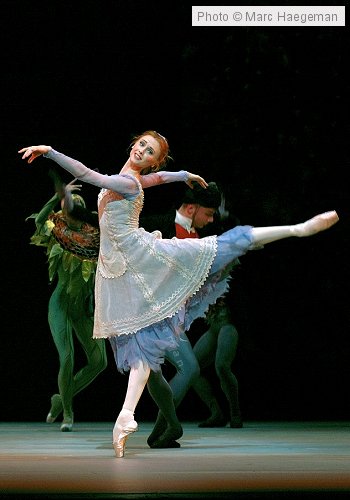
Svetlana Zakharova, Photo by Marc HaegemanA little loop through the four seasons (Mlles. Stashkevich, Kurkova, Osipova, Kobakhidze as Spring, Summer, Autumn, Winter, respectively) comes courtesy of the storyteller when he readies Cinderella for the great ball: His helping fairies (aforementioned spoons, teacups et al.) look at first like half-naked Martian space-fairies but add to the lighthearted humor as does just about every other element in this first act. The choreography, furthermore, melts right into the music (those two sisters sliding down the staircase – along with the music – in act two makes me laugh, just recallingit) and convinces with its thoughtful details: A wiggle of the hip here, a coordinated nod of heads there… that’s sometimes all it takes for a cracked smile or a little spark of delight.

When the crowd at the prince’s party takes fuzzy orange balls (laced dessert oranges, say the program notes, but also a visual link to the pumpkin in which Cinderella arrived), the audience giggled along with this perfect example of how whimsical, capricious, and bright-eyed the best moments of this production are. Over an almost childish joy about all this fancy, dreamlike concoction, it was almost possible to forget or overlook the few more serious parts that gave Ms. Zakharova and Sergey Filin’s prince a chance to show just how fine a pair of dancers they are. Svetlana Zakharova, currently one of the most reputable and admired Prima Ballerinas in Russia, is rather tall for a lady of her profession and looks lanky at first… but always controlled and displaying a sort-of old-fashioned, slightly stiff or shy elegance. But a few moves and she has you under her spell. (She must be a perfect swan!) Her arms are so light as you will rarely see, her limbs regal, straight, and made of rubber at the joints. She can turn on a soft charm akin to Audrey Hepburn’s or mix it with the wide-eyed excitement reminding of Sarah Michelle Gellar. Together with the dashing and handsome prince, their dancing was exquisite in between the romp and the fun.

Time flies in this production; neither of the two intermissions is as keenly desired as they often are in opera. The wild ride continues in the third act, even if the production seems to try harder here and loses a little of the effortless lightness. Still, the very lively horses (dancers with pony-tails, Dressage hats, and horse-tail) carrying the prince and his buddies from one shoe-fitting stop to the next (meeting Heinrich Mann’s “Blue Angel” from his Novel “Professor Unrat” – popularized by Marlene Dietrich in the 1930 film – along the way) are just one more example of the creativity that went into creating this tale. The end – with those outrageous sisters again – is as funny as it is ultimately touching.

It wouldn’t be the same without the music. While the WNO orchestra made more or less a hash out of Romeo & Juliet when the Kirov was here, they performed admirably under Igor Dronov (who was projected onto the back of the stage in the prelude to the second act) and surprised repeatedly with its distinct and evocative coloring. There are musical calling cards that link the two ballets – and if the Romeo & Juliet score is good already, Cinderella’s might be even better. In combination with this lovingly presented production, it makes for unadulterated delight.
21.2.07

Jasper Johns, Four Themes

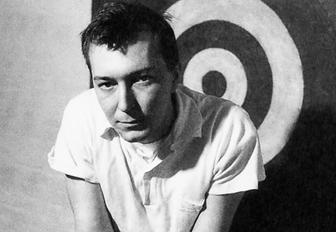
Jasper Johns with TargetThe National Gallery of Art's new exhibit, Jasper Johns: An Allegory of Painting, 1955-1965, takes a focused look at four themes in the artist's work during an important decade in American art. Johns is one of the giants of American painting, and the chance to look at this selection of paintings of sketches is welcome. Up close, one can see the process, the imprint of the painter, the thick and beautiful application of paint, and even read the yellowed strips of newspaper used in his encaustic-coated collage technique ("Chester Weddings of Interest" reads one headline in the 1961 Target). The luscious surfaces, the joy and comic touch make up for the general inscrutability of the sphinxian Johns.

Jasper Johns, Target with Plaster Casts, 1955Jasper Johns, Do It Yourself (Target), 1960

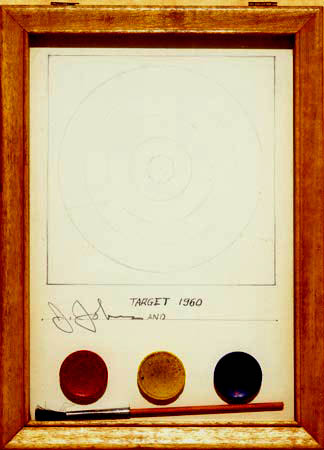
The first theme in the exhibit is the target, most familiar in an iconic Johns work, Target with Four Faces, from 1955, now in the collection of the Museum of Modern Art in New York. It is shown near its much less familiar twin from the same year, Target with Plaster Casts, now in the collection of record and movie producer David Geffen. In both cases a hinged panel opens at the top of the work to reveal casts of human body parts. In the version with four faces, these are casts of the artist's lower face, seeming to indicate that the rest of his body could be behind the target. While the four faces are in a nondescript brown, the various casts Johns made of his own body (foot, nipple, ear, penis, etc.) for the other version are brightly colored. The first level of the exhibit is filled with various versions of the target motif, worked out in sketches and other paintings. Johns makes clear that the motif had lost all meaning and became a gimmick, in his Do It Yourself (Target), from 1960, a little kit to make your own target painting, signed J. Johns and __________.

Other Reviews:

New York Times | Bloomberg News | Slate | Washington Post | Washington Times | Voice of America | Associated Press | Christian Science Monitor | New York Sun

The second theme, which begins with works on the first floor, is the naming of colors, in which the words for colors, especially RED, YELLOW, and BLUE, are applied by stencil. This strikes me as a reference to the paint by numbers technique, except that often the actual colors Johns applies do not match their corresponding words, as in the most famous canvas in this group, False Start, from 1959. This is not always without cynical reference to abstract expressionism and the so-called color field painters. Out the Window, from 1959, if the colors matched the stencils, could look something like a Mark Rothko.

Jasper Johns, Diver, 1962-63On the upper floor, the exhibit shows works that use what Johns called "the device," usually a piece of wood attached to the canvas frame that could be used to scrape the paint on the surface in a circular shape. The motion of the device was somehow related to the swirling arms of American poet Hart Crane, who committed suicide by leaping into the Gulf of Mexico. Indeed, in two paintings shown in this exhibit -- Periscope (Hart Crane) and Hatteras, both from 1963 -- a hand and arm make the same circular swath as the device. These references to Crane, whose unhappiness with his own homosexuality may have led to his suicide, may be a rare autobiographical detail in the work of Jasper Johns, who was also gay. Whether the motif is an expression of sympathy or trivialization is not clear.

One of the most beautiful and somber pieces in the show is Diver, another Hart Crane-inspired work from 1962-63. A large canvas of mostly black and muted colors received the imprint of Johns's hands and feet -- the fourth theme in this exhibit -- in motions that recall the act of diving. The feet at the top of the canvas point toward the sky, and the hands begin at the bottom of the canvas, sweep upward in circles and end up at the center of the painting, alongside the diver's body, if he had a body. The curatorial text suggests a parallel with the Crucifixion, but Diver immediately reminded me of Leonardo's Vitruvian Man, an attempt to graph the proportions of despair.

All four themes highlighted in the show are present in two large paintings shown across from one another near the end of the exhibit, Diver (1962) and According to What. As Tyler Green has remarked at Modern Art Notes, the decision of curator Jeffrey Weiss to exclude the most prominent motifs associated with Johns -- flags and numbers -- means that the NGA exhibit does not tell the whole story. In particular, the connection between Johns and the work of René Magritte is explored in the Magritte show also on display right now at the Los Angeles County Museum of Art. The curators of the NGA exhibit acknowledge this deficit in their program, stating that their four lesser-known themes, illustrated by a series of beautiful paintings, are part of "an effort at de-familiarization."

All images © Jasper Johns, courtesy of National Gallery of Art, Washington, D.C.

Jasper Johns: An Allegory of Painting, 1955-1965 continues through April 29. Admission to the National Gallery of Art is free.

20.2.07

NGA American Music Festival, Part 1

Mark Kaplan and Yael WeissIn conjunction with the Jasper Johns exhibit, the National Gallery of Art is hosting its 62nd American Music Festival, over the course of three installments of its free Sunday concert series. This past Sunday, it featured violinist Mark Kaplan and pianist Yael Weiss, both faculty members at Indiana University (and also husband and wife), in a program (.PDF file) they called "three generations of New Yorkers." This difficult music -- pieces for violin and piano by Roger Sessions (1896-1985), Elliott Carter (b. 1908), and Joel Feigin (b. 1951) -- could have few performers who serve it any better. The success or failure of each part of the recital rested only on the appeal of the score. The audience in the East Building Auditorium was sparse but mostly attentive, especially after a few strains of Sessions had driven off the mildly curious.

The opening work, a Duo for Violin and Piano composed by Roger Sessions in 1942, was rendered as four movements of rather different color. In the first, a melancholy, long-breathed violin line slowly arches over a gentle piano moto perpetuo, becoming more active in a middle section and then returning to calm. Here and in the lovely third movement, Kaplan and Weiss demonstrated that dissonance can be so pretty if played lyrically. Even jagged melodies, like those in the expressionistic second movement and the opening scherzo of the fourth (a dancelike flitting back and forth) can be treated as phrases in the same way you would approach Mozart (well, not exactly the same way). Throughout the Sessions piece, I admired the sound Kaplan got from his violin and was not surprised to learn later that he plays the Marquis Stradivarius (dated 1685), an early instrument from the Cremonese master but still of exquisite craftsmanship.

By contrast to Kaplan's extroverted playing, Weiss seemed reserved, choking off her sound with a lot of soft pedal and a touch that sometimes seemed not fully in the keys, making for sensitive playing that rarely challenged the violin's supremacy. The second work, Feigin's Veränderungen (Transformations, 1995) was suited to this approach, opening with whispery, ethereal sounds, including gentle stroking of the strings inside the piano cabinet. The composer, a student of Sessions, seemed to transform himself, too, with music that morphed temporarily into Debussy; there were even hints of Paganini in a virtuosic passage for violin. With some exciting, visceral playing in the fortissimo middle section, the piece closed with a sudden shift toward predominantly triadic harmony.

Other Reviews:

Joan Reinthaler, Violinist Mark Kaplan (Washington Post, February 20)
The less said about the concluding work, Elliott Carter's Duo for Violin and Piano (1974), the better. The intellectual ideas behind Carter's music are not always of sufficient interest to propel this listener through the relentless, humorless abstraction. This piece was no exception. Carter dedicated this piece to his wife, Helen, intending it to be understood as an expression of love, because the two instruments allow one another absolute freedom as they exist together in time. The temporal and intervallic separation meant that both players were so caught up in the difficult mathematical relationships of the work, their heads bobbing up and down in different meters, that the performance was often like two pieces happening in parallel. That was, to be sure, precisely the idea, but with frustrating consequences when that idea is extended for as long as this work. You win some, you lose some.

The second concert of the National Gallery's American Music Festival will feature pianist Alan Feinberg (February 25, 6:30 pm), playing music by Babbitt, Cage, Feldman, Helps, Ives, and Nancarrow. It will also take place in the East Building Auditorium.

Eugene Onegin Outshines his Colleagues at the MET

Photo by Ken Howard/Metropolitan OperaOn paper, the Metropolitan Opera’s Eugene Onegin offered one of the strongest casts imaginable these days for Tchaikovsky’s most beloved opera. With Renée Fleming and Dmitri Hvorostovsky as Tatiana and Onegin, Ramón Vargas as Lenski, veteran Russian bass Sergei Aleksahkin as Prince Gremin, Elena Zaremba as Olga and our Russian conductor of choice, Valery Gergiev, in the pit this was, as the New York Times had stated, the highlight of the season. All performances have sold out so far – and the remaining ones (today, February 24th, 28th, and March 3rd) will, too.

Perhaps the accordingly high expectations made for a slight disappointment – and a disappointment difficult to categorize. Much delights in this production, the singing is uniformly good or better, the staging and direction appealing and a most welcome break from the cluttered traditionalist settings Eugene Onegin endures so often, the acting very fine. Alas, last week it did not come quite together as it should. Perhaps the only noticeable flaw was the reason: The orchestra under Maestro Gergiev played dispassionate and shockingly sloppy – rushed from highlight to highlight but leaving no memorable tune quite as memorable as it should have been. Instead of ‘raw’ as in ‘exciting’, their playing and direction was raw as in ‘crass’, ‘unloving’, with insecure brass thrown in on more occasions than I care to remember. One nice swell, one forceful romp per scene dost a captivating orchestral contribution not make.

Photo by Ken Howard/Metropolitan OperaI thought I’d never think or utter the following: I wish Tchaikovsky had been played more romantically. Such a beautifully lush opera Eugen Onegin is, and its romanticism arguably more tastefully employed than in other Tchaikovsky works, there was a distinct yearning for what James Levine would or could have done here. I reckon that his approach would have had further merit by giving Renée Fleming the kind of accompaniment she deserves. Her voice may not be an ideal type for the character of young Tatiana, but it is nigh ideal for the music. In her first Russian role at the MET, she made the best of it and supported it with great acting - again cementing the fact that she is best when busy on stage, rather than when self-conscious in the recording studio. Her Tatiana was warm, suffering, unmannered, and harrowing. Although the letter-scene might offer the finest music, it was in the third act that her character, now matured, completely merged with Ms. Fleming for a cohesive, pleasantly un-spectacularly beautiful performance.

Photo by Ken Howard/Metropolitan OperaIf Ramón Vargas sounded nasal, slightly strained and underpowered for much of the February 13th performance, he made up for it in his long, searing monologue (“Kada, kada” et al.) just before he allows himself to be shot by Onegin. Elena Zaremba, who I have admired since first hearing her Carmen in Munich, but scared me during Washington’s Rheingold where he voice seemed to be an eerie ghost of the past (purposefully, for Erda?), displayed a tone that sounded healthy, burnished, dark. Not exactly the epitome of the care-free Olga, but good to hear, all the same. Svetlana Vokova, as Madame Larina, grew on the ears during the first act. Homey, not too refined, it was befitting her role as the mother. Larisa Shevchenko as Tatiana’s nurse started effortful and was covered by orchestral swells before finding her stride in Scene two of Act one.

Photo by Ken Howard/Metropolitan OperaThe staging (production by Robert Carsen, set and costume designer Michael Levine, stage director Peter McClintock), an oddly enchanting mix of conservatism and minimalism, was a treat for the eyes and left the focus where it should ideally be – on the acting. Playing with soft and hard shadows (especially in the shadow-cut-like Duel scene), vibrant colors (superb lighting by Jean Kalman), and diligent use of props, it appealed at every instance even if the over-all effect was not able to keep the excitement that these instances of inspiration provided.

It might have been an opera experience anywhere between ‘fine’ and ‘wonderful’ for all this, but no more. If it was more – and it was – then that credit belongs solely to one man: Dmitri Hvorostovsky (a singer whose fan-club I've never been a member of - but might now join) was in the very literal sense outstanding as Eugene Onegin. His voice a splendor of light and clear sounds, the only cast member that sang above the orchestra and into the wide round of the MET with seeming and shameless ease. My scribbled notes emerged from the darkness with half a dozen “D.H.!” markings in the margins. Dashing, regal, civilized, and with emphatic suffering when he finally sees “true love” slip through his hands. He was indeed the exclamation point of a production that may not have been ideal… but as Tatiana says in apt conclusion: “…came so close”!

19.2.07

Cuarteto Casals at Dumbarton Oaks


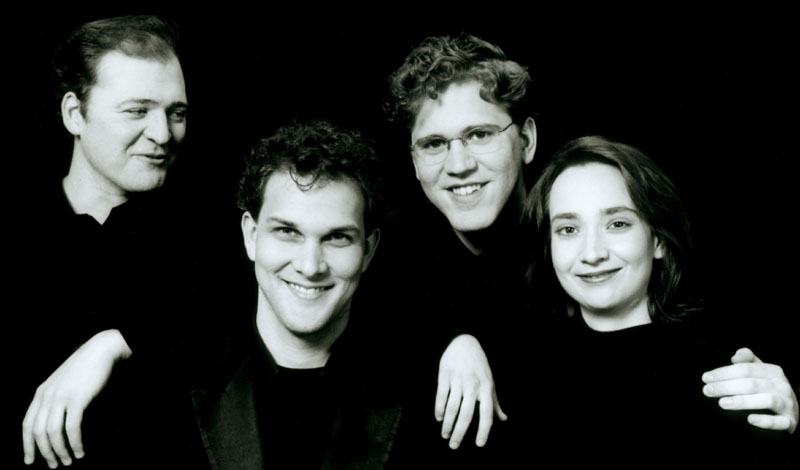
Cuarteto Casals, photo by Jo Schwartz
When the Cuarteto Casals came to the Library of Congress last year at about this time, we were not able to review their concert. However, we heard enough good reports of their playing that we were not going to make the same mistake this year. In their concert Saturday night at Dumbarton Oaks, on the Friends of Music series, the talented, young Spanish string quartet joined with oboist Thomas Gallant in an exceptional program of 18th- and 19th-century music. First, an oboe quartet by Josef Fiala (1748-1816) was an exotic amuse-gueule meant to wake up the palate. The composer was an oboist in the Salzburg court orchestra and a close friend of the Mozart family, and the piece is mostly for the oboe, essentially replacing first violin in a string quartet formation (Vera Martínez Mehner played the lone violin part), to show off on lots of runs. With sensitive playing and nice touches added on the repeats, this was a gracious first course, especially the melancholy Andante third movement, not least because it was such a rarety.

Cuarteto Casals:

available at Amazon
Influencias: Ravel, Toldrá, Turina (2007)


available at Amazon
Debussy/Zemlinsky, Quartets (2005)


available at Amazon
Mozart, Early String Quartets and Divertimenti (2005)


available at Amazon
Arriaga, Quartets (2003)
A twin course of better-known Classical music served as substantial antipasti, beginning with the entire Casals Quartet on Haydn's C major quartet (op. 54, no. 2). This quartet is a sunny, folk-inflected work with the composer's typical jollity subsumed more subtly than in some of his other quartets. For example, in the light-hearted sonata-allegro form first movement, the first violin humorously tacks an extra little triadic iteration on to the first theme at the recapitulation, handled with grace by Abel Tomàs Realp, who sat first violin for this quartet. Tomàs Realp also brought a ruddy Gypsy quality to the Hungarian variations in the spicy slow movement. The fourth movement, uncharacteristically serious for Haydn, included exhilarating sparkle in the Presto section and soaring line in the Adagio sections.

Gallant then returned with his oboe for the Mozart oboe quartet in F major (K. 370, from 1781). Written for the Mannheim oboe virtuoso Friedrich Ramm, while Mozart was in Munich working on Idomeneo, it is a daring work. Thomas Gallant has collaborated with many well-regarded chamber groups, including the Kronos, Lark, Calder, and Colorado String Quartets, and it is easy to see why. Gallant's striking technique, combined with careful shaping of lyrical lines, was impressive and even more so on this most difficult piece. The soft, purely intoned high F (the one way off the staff) that concludes the final movement was as pretty as such a note could be on the oboe, and the extremely virtuosic runs, even when they broke into ultra-rapid triplets, were flexible and accurate.

Previously at Dumbarton Oaks:

Hopkinson Smith, lute (November 4, 2006)

Paolo Pandolfo, viola da gamba (January 23, 2006)

Musica Alta Ripa (May 10, 2005)
As charming as the pieces in collaboration with Gallant were, the two works featuring the Cuarteto Casals alone were a shade more pleasing, because the four players work together so cooperatively. This was most true of the devastating main course, Schubert's final string quartet (G major, D. 887), which as American-born violist Jonathan Brown mentioned in his introduction, featured prominently in Woody Allen's Crimes and Misdemeanors. The group's performance of its first movement, a counterpoint of light and darkness, was so emotionally powerful that a woman in the audience exclaimed when it was over, "Such music..." (in a whisper audible enough for the players to turn briefly to look at her). One has the feeling that Schubert's music would come across that way even if the performance were merely good, but this was several steps above. The Schubert was the high point of the concert (Brahms and Arriaga had been announced), even if the first half of the fourth movement, played very fast, never quite notched itself into place as it should have. All in all, this was another superb concert at Dumbarton Oaks, where chamber music is played as it was intended, with a small audience elbow to elbow with excellent performers.

The Cuarteto Casals will play later this month -- parts of this program plus the first Ligeti quartet -- at Carnegie Hall (February 23). The remaining concerts on the Friends of Music subscription series at Dumbarton Oaks this season will feature the Katona Twins (March 2 to 4), two guitar-playing brothers from Hungary, and the French ensemble La Fenice with Jean Tubéry and Spanish soprano Arianna Savall (April 20 to 22). To subscribe to the series, contact Cindy Greene by phone (202-339-6436) or e-mail (GreeneC at doaks dot org). Ionarts is hoping to catch the second one especially.

The Jenůfa Year Continues


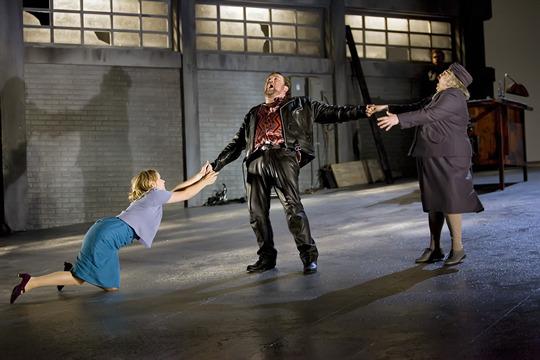
Jenůfa, directed by David Alden, English National Opera, 2006,
photo by Clive Barda
The final performance of the Met's production of Leoš Janáček's Jenůfa was broadcast on the radio on Saturday afternoon. I heard the first half or so before heading off to hear Jean-Yves Thibaudet's recital at the Kennedy Center, but I had listened to an earlier performance, too, thanks to Sirius radio. Musically, it was a knockout, but how much better an experience it will be to see and hear this opera in a live staging in the spring at Washington National opera.

This weekend, the production by David Alden that will be brought to Washington in May (co-produced with Houston Grand Opera and English National Opera) won the 2007 Laurence Olivier Award for Best New Opera Production (hat tip to All about Opera). Go to the Opera Critic for links to reviews of the London production last fall. Catherine Malfitano, who sang the role of the Kostelnička in London, will also sing in Washington, but our Jenůfa will be Patricia Racette, instead of Amanda Roocroft, who won an Olivier Award for Outstanding Achievement in Opera, too. Tickets are on sale now for performances on May 5, 10, 13, 16, 19, 21, and 24, and all signs indicate that this may be the highlight of the Washington season. Tell your friends!

In related news, Houston Grand Opera, where this production premiered in 2004, will mount the composer's Cunning Little Vixen, unfortunately adapted in English for children but still one of my favorite operas.

Light Surplants Shadow at Thibaudet Recital

Jean-Yves ThibaudetJean-Yves Thibaudet’s piano recital at the Kennedy Center’s Concert Hall was oddly separated into two parts of vastly different quality. There was Chopin – and then there was everything else. But unlike one might expect from “the finest exponent of French pianism since the heydays of Aldo Ciccolini and Jean-Marie Darré” (LA Times), it was the Chopin that was infuriatingly mediocre and the rest – Liszt, Satie, Debussy, and Messiaen – that gave the greatest enjoyment.

The opening segment was an uninspired noodle-doodle run-through of Chopin’s ‘greatest hits’, two Nocturnes (op.9, nos. 1 and 2) that didn’t ebb and flow but were rather stop’n’go like a car stalling, than lurching forward again. It came in a languid, un-probing, gentle package with one, very narrow, dynamic band. Instead of a steady, powerfully moving rubato there were only nervous twitches; straggling notes that sounded like trying to catch up with the ones that had gotten away. French and sensitive, an unarguably excellent pianist – perhaps that is good enough a precondition to present Chopin in such a way and get away with it. Everything was either faultless in the same predictable ways (and nothing else) or displayed this utterly erratic rubato. Étude op.25, no.1 was pleasant enough, though, Étude op.25, no.3 muddy but sprightly. The Grande Valse Brilliante in A-Minor, op.34, no.2 was ‘just played’. There may be much thought behind Thibaudet’s notes, phrasing, tempi etc. in this work, but you couldn’t have told from the performance. It sounded, for better or worse, as if an immensely prodigious student sight-read the music with tremendous, but ‘standard-issue’ feeling. Alas, the final Chopin, the actually brilliant Grande Valse Brilliante in E-flat Major op.18, was a different story and hinted at better things to come. Showy, flashy, immensely appealing, even if the attacks were clanky here or there.

If this did not bode well for the offerings to come, Thibaudet now started on a path from redemption to apotheosis. It began with Liszt’s Après une lecture du Dante , an exciting “fantasia quasi sonata” that stands very well on its own (as opposed to being the conclusion of the second book of Anées de pèlerinage) and is then often referred to as the “Dante Sonata”… more because of its title and substantial nature than its form. Admittedly less often heard in concert and more difficult to compare than the Chopin, none of what made the latter less than ideal to these ears intruded into this genuine Liszt performance. Pomposity, grandeur, élan, also rigor: Everything that makes for good Liszt was present. A few painfully missed and wrong notes in the helter-skelter finale were gladly forgiven. Thibaudet risked something here – which is infinitely better than timidity in performance and brings ample rewards in its own right.

Other Reviews:

Tom Huizenga, Thibaudet In His Native Musical Language (Washington Post, February 19)

Charles T. Downey, Jean-Yves Thibaudet at the Kennedy Center (DCist, February 21)
The second half started with a Thibaudet speciality: Satie. (Some pianists might consider it a put-down to be known for ‘good Satie’, but if you do it as well – and successfully – as Thibaudet, that could hardly be the case.) Gymnopédie no.1 was first. It’s a delight full of (usually gay) little birds on a rainy day on the beach, kicking and skipping stones – forlorn in melancholic thoughts. One long cinematic sigh. These same birds are up to no good and more turbulent stuff in Gnossienne no.7. Although tainted with melancholy as well, they are now showing a mischievous, if not malevolent, bent. Still kicking those stones, thoughtlessly, but now in the direction of your dog or window panes. That Dreamy Fish is as Zappaesque as its title suggests. And instead of aquatic somnambulism you get a fishy polka interspersed with absentminded rambling. Smile-inducingingly played.

If there are elevators in heaven, Debussy’s 11th Étude would play in them. Sweetly and innocuously played, it swirled deliciously toward the subconscious of the ears (except for a few exclamation marks). Étude no.7 was appropriately light and bubbled away in a showcase of Thibaudet’s fleet fingers; no.5 was jaunty, athletic, impressive.

Nothing was as pleasing and powerful as Olivier Messiaen’s XX. Regard de l’Église d’amour (from Vingt Regards sur l’Enfant-Jésus). Hymnic, free-flowing, unbound: this is music that might be difficult on the ears for some (dissonance, compared to ‘traditional’ works abounds – but nothing that should much offend after having heard Debussy); it is music that needs space to unfold to impress those uninitiated ears. It is music that, outside of Bach, is one of the best ways ever devised to sing the praises of Jesus. Simply divine, to pun badly… but in all seriousness this was the recital’s apotheosis. Emphasizing the boldness and the vigor, Thibaudet’s was an exciting rendition that more than made up for the Chopin. No doubt there were many audience members who felt exactly the opposite way, but the enthusiastic applause (eliciting two encores: Debussy’s L'isle joyeuse and the rare Shura Cherkassky 1925 Prelude Pathetique) suggested that that last of the Vingt Regards was not lost on many.

18.2.07

Thomas Adès at Présences Festival

Thomas Adès, composer, b. 1971We are fans of Thomas Adès at Ionarts, after hearing his opera The Tempest in Santa Fe, as well as some of his piano music played by Louis Lortie. This month the 30-something British composer is being honored at the 17th Présences Festival in Paris (recent honorees include Krzysztof Penderecki, in 2006, and Marc-André Dalbavie, in 2005). An article by Pierre Gervasoni (Thomas Adès, jeune tête d'affiche du festival Présences, February 9) for Le Monde has the details (my translation):

Who is Thomas Adès really? This Englishman is one of the headliners of the 17th edition of the Présences Festival, whose average age he has lowered considerably, from February 9 to March 4 at Radio France. Born in 1971, Adès has dominated, for more than a decade, the racetrack of contemporary music as composer and performer. The young composer refuses to give any interviews. His work is published by two companies (Faber for score and EMI for recordings) that hold exclusive contracts. So, it is only through his music that one can hear Thomas Adès' voice. Or rather his voices, so much does the composer's style change from work to work. Not through militant eclecticism, but as a way of finding in each case the appropriate form of expression for a specific project. In this sense, Adès represents the archetype of today's composer, precocious, brilliant, prolific, and more concerned with serving an idea promptly than a cause globally. [...]

At the heart of Adès' already full catalogue is Powder Her Face (1995), the first of his two operas, which drew attention to the English prodigy, not always for strictly musical reasons. Based on the true story of the Duchess of Argyll, whose sexual escapades shocked the world, this stage work as licentious in its libretto (which requires the lead female role to intone an air "with mouth closed" because it simulates fellatio) as by its instrumentation (rich in accessories like fishing rod reels) sums up the problem with this composer without ever answering it, while always whispering into the listener's ear: who is Thomas Adès really?
The program has more music by Thomas Adès than you could shake a stick at, much of it with Adès conducting or playing the piano. Ah, France.