CD Reviews | CTD (Briefly Noted) | JFL (Dip Your Ears) | DVD Reviews

26.3.06

Das Mississippigold: Sound Production Looks Like Zambello, Smells Like Chéreau

Das Rheingold - as found in Iowa Public Radio Pronouncing Dictionary

available at Amazon
R. Wagner, Das Rheingold, Barenboim/Kupfer/Bayreuth
Preview
Saturday night, the Washington Opera has raised the curtain to one of its more ambitious undertakings today: The staging of its own, complete Ring Cycle. So as not to choke on the size of the 13 to 15 hour tetralogy, it will take it in bite-sized portions; one opera -sorry: Musikdrama at a time. Director is Francesca Zambello who has become a bit of a house-director for Washington and the production team is the same as that of Die Walküre two years ago at DAR Constitution Hall. The production here is, mercifully, a different one in all respects. Instead of warmed up, self-plagiarizing Euro-trash, we will get a new, modern, original (slightly harmless) interpretation, the American Ring.

There has been much speculation about how the production might look and work – a recent press conference with Zambello, Robin Leggate (the production’s Loge), Jane Ohmes (Freia) and Director of Artistic Operations, Christina Scheppelmann didn’t do much to give a better idea of how things would turn out. (But it did unearth some of the tension behind the scenes. Scheppelmann’s perfectly true point that inaudible text was a problem with lazy pronunciation of singers, not Wagner’s writing, surely did not go unnoticed… Zambello admitted that there was still wrangling as to whether to show or not show Wallhall. Zambello, by the way, favoring the latter solution, won, as it turns out.)
Yuba River Gold DredgingNow we have the first installment of an answer and we saw every thing that she had made, and, behold, it is very good. Over those 136 bars of E-flat with which the opera famously opens (always likened to the creation of the earth, the beginning of time itself – not unlike the opening of Beethoven’s 9th or, to an extent, Mahler’s 1st) we see colors and hazy images on a screen. From blue to brown/yellow to ‘light’ to ‘water’, at points reminding of cave paintings, at others 2001 Space Odyssey flights through the universe. These images – veering between hazy, frustratingly representational and the abstract – are used throughout the scene changes. Some imagery changes seem haphazard, others are a bit obvious (flying through the clouds to and from Wallhall) but the idea is fine. If only the images didn’t look like cheap computer renderings. Here, as in most places of this production, one decries the fact that the WNO is not a repertory company: The direction here so often presents great potential marred by some annoying or unnecessary detail. If Ms. Zambello had several years, not just days, to fine-tune this production (and more money to spend – which I am sure she might like and could put to good use), it would be the Washington National Opera’s pride.

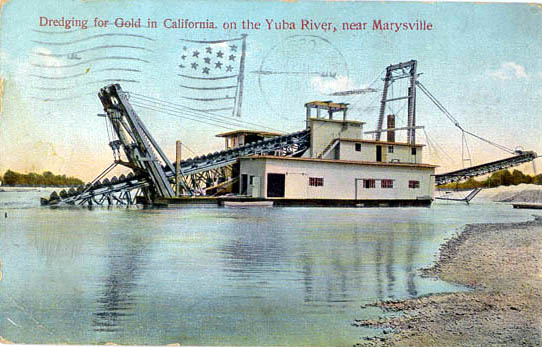
I try not to refer to it as Das Rheingold too much, because neither does the direction. Not only is the scene set out West (the curtain rises to Alberich panning gold in what might be the Yuba River), all references to the Rhine have been carefully excised from the supertitles. Rhinemaidens become Rivermaidens, Rheingold becomes “pure gold” (from the German homophone Rein(es)-Gold) and so on. These Rivermaidens climb and swing about a wooden contraption for sifting gold. It’s the rough cut American version of Chéreau’s Hydroelectric dam.
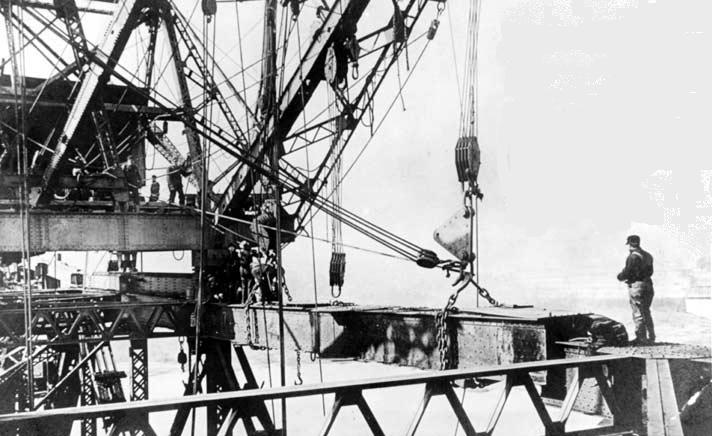
Steel Beam with WorkerThe gods are New England upper class with white V-neck sweaters, tea sets, garden parties. Wotan (Robert Hale in a white suite) takes a nap in his garden chair before being awoken by Fricka (chubby but seductively cute Elizabeth Bishop). Donner (with T-bar instead of hammer) and Froh are hapless hobby architects. Anyone for tennis? Fasolt and Fafner have a great, inspired entrance by use of one of the most quintessentially American images. Lowered unto stage, the two giants are clad in jeans overalls, having their lunch sitting on a steel I-beam. Walking on huge, oversized shoes covered by wide trouser legs they towered, if not by a whole lot, above the other characters; the hands were Edward Scissorhands-like contraptions and a hook, in Fafner's case.

Loge, arguably the most important – certainly the most interesting – character of the first Ring opera came across as a shady advocate/lawyer with a pinch of car-salesman. Arriving on the scene, he looks like he just stepped out of his 1920’s race car (including driver gloves). You could detect the attempt to make him a seedy character, but he is shifty at the most; more cunning for a good cause and very confidently so. He doesn’t toady like the brilliant, ingenious Heinz Zednik in the Chéreau production, but he is also not quite as cynical, not quite as aloof. Same words, same music: Two completely different characters; and Loge can be done in yet many more, more different ways. A continuously fascinating character.

The mine in which the Niebelungs are put to work look like a more or less realistic coal mine (without the sense of claustrophobia), the Niebelungs are an assortment of black children (make-up helps where nature didn’t) which makes a general point about American slavery and exploitation and then raises the far more delicate subject of black slave holders. Alberich, after all, is played by Porgy-cum-Schwarz Albe Gordon Hawkins. His transformation into a snake is projected onto the wall.

available at Amazon
R.Wagner, Das Rheingold, Chéreau/Boulez/Bayreuth
In the fourth, final scene Wotan carries a spear (a wimpy thing with feathers dangling from it) for the first time and the second overt ‘American West’ reference emerges: Elena Zaremba (so impressive as Fricka back then) as Estsanatlehi or something of that sort. Freia, meanwhile, has developed a case of the Stockholm syndrome and cares an awful lot about fallen Fasolt. (Then again, Fasolt truly loved her, as we can tell from the music in the second scene, where he gets the most tender line of the Ring to the words “ein Weib zu gewinnen, das wonnig und mild bei uns Armen wohne…”) Lightning is summoned by Donner (although it blinks about on screen for half a minute before the actual thunder comes out of the pit) and the Gods cross the bridge into Wallhall (not visible, off stage) which descends like an ocean-liner’s boarding stairs (E la nave va comes to mind).

Filled with good (not always perfect) acting and hopefully good singing, this is, will be, a promising start to the Washington Opera's very own ring cycle... an achievement that offers plenty criticism - but more enjoyment still. I, for one, was positively surprised. It's neither hackneyed nor radical, it's something that hasn't been done that way, even if it reminds of other productions in several moments. Within the limits of calculable risk, this is a definite winner.
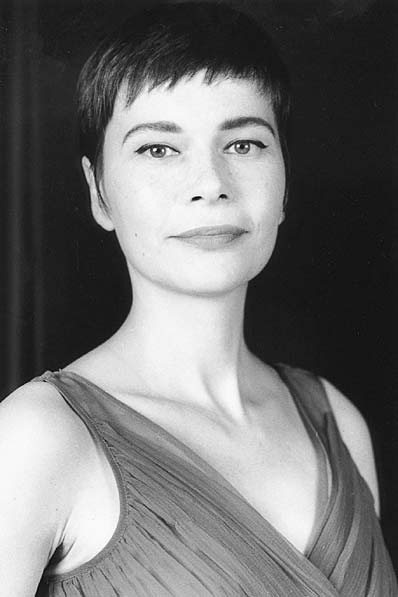
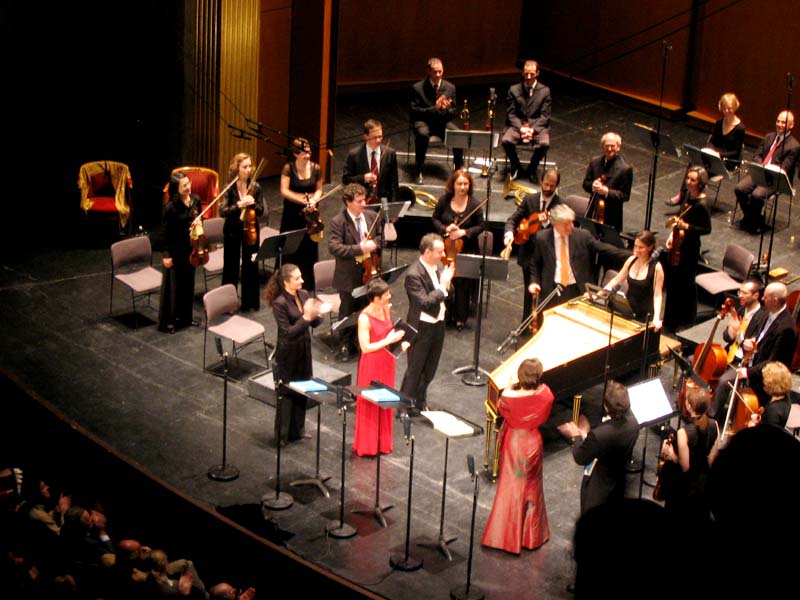
Sandrine Piau at the Théâtre des Champs-Elysées

Sandrine Piau, sopranoThere were several concerts that I had hoped to hear during my trip to Paris. One cannot do everything, but I definitely was not going to miss the chance to hear French soprano Sandrine Piau, whose recent CD of Handel arias I so admired, sing live. She was scheduled to sing the role of Elisa in Mozart's early opera Il Rè Pastore (Salzburg, 1775) in a concert performance at the Théâtre des Champs-Élysées on Monday night. Jean-Louis Validire wrote a preview (Le retour de Sandrine Piau au baroque, March 20) for Le Figaro (my translation):

One cannot speak about Sandrine Piau returning to the Baroque in the sense that she never really left it. Her incursions into operetta, Romantic music, or even contemporary music are nothing but escapades. Wanda in La Grande-duchesse de Gerolstein or Ninette in L'Amour des trois oranges did not manage to detach her from her major field. Still, the young harpist was rather drawn to Bartók, Berg, and Schoenberg. It was her encounter with William Christie, who was teaching vocal performance practice, at the Conservatoire national de Paris who sent the singer into this world, where she has conquered both the audience and critics.

"The Baroque is for me the possibility of taking advantage of the sadness and melancholy inside me. It led me to the 18th-century French music, for which I had neither love at first sight or vocal enthusiasm," she admits. It was with Christophe Rousset that she would undertake the intellectual work that would lead to the discovery of the possibilities offered by Handel's operas. "I did not want to be limited to the coloratura roles of the traditional repertoire, to which I did not relate psychologically. In Baroque opera, the interplay of voices and characters give, in addition, a great liberty." [...]

Mozart is like her old friend, since she has already sung in The Magic Flute and The Abduction from the Seraglio, but "there are not many roles for me, besides Pamina, in the Da Ponte trilogy," she states, even though she has twice been offered Donna Anna. That's a project that might happen one day if certain conditions, notably the use of old instruments and ideas, as well as a vocal casting, in accordance with her convictions are brought together. For authenticity remains one of her demands, even if she is still very pragmatic, notably about the problems of tuning. "Twenty years ago with Christie, A was at 415. Now, we have organs tuned at 392, which makes me very comfortable especially in Les Leçons de ténèbres. But we should not forget that what was historic was freedom. It's a mistake to fix rules in stone without taking account of the place where you are singing. In Mozart, in my opinion, the ideal is 430," she says.
From Jean-Louis Validire, La fraîcheur du jeune Mozart (Le Figaro, March 23):

As the interpreter of Elisa, who wants to join her destiny to that of the shepherd Aminta -- who does not know yet, as the work's title indicates, that he is in fact the king of Sidon liberated by Alexander from Strato's tyranny -- Sandrine Piau is at the height of her career, agile in melismatic passages, with a projection comfortable in the character's palette. Aminta, a role originally created by the castrato Tommaso Consoli, is entrusted in this version to Céline Ricci, less comfortable than she promised to be. On the other hand, the English tenor Paul Agnew sang Alexander with a beautiful diction and delicate timbre. He gave him all the majesty he could, based on what the librettist, Metastasio, allowed.

Sophie Karthäuser made a pleasant Tamiri, the tyrant's daugther who disguises herself as a shepherd to escape from Alexander, from whom she wrongly fears vengeance. Tenor Sébastien Droy completed the group in this concert version by portraying Agenore, the emperor's counselor, who is in love with Tamiri. Metastasio classically opposed the virtues of rural life to those of the city and exalted the goodness of Alexander who, despite the blindness that characterizes leaders, winds up by matching up each one with his beloved in the happiness of a very beautiful final ensemble, whose sounds were perfectly rendered by the singers.

The Orchestre des Folies Françoises, directed by violinist Patrick Cohën-Akenine, gave much freshness to this score, contemporary with the composer's violin concertos. The old flutes of this ensemble dedicated to Baroque music, who play on early instruments, were particularly beautiful. As usual, the natural trumpets and horns did what they could not to transform the thunder that accompanies Alexander's arrival into a pétard mouillé [wet firecracker], to the great pleasure of lovers of authentic instruments.
The Théâtre des Champs-Élysées hosts the best sequence of musical events -- staged operas and ones in concert versions, chamber music, symphonic music, recitals -- in Paris. As I learned, you can buy rather inexpensive tickets -- senior citizens and students can wait until the last half-hour before curtain and get most seats at half-price, too -- but those inexpensive seats are small, uncomfortable, and without leg room. Where I sat on Monday night, in the back row of the second tier, I could hear very well and had a moderate enough view of the musicians. No seat is terribly far from the stage, and just about every seat as far as I could see was filled, and in this auditorium, that means that people are fairly well piled on top of one another. The attraction of this performance -- Sandrine Piau -- became clear when a voice came on the loudspeaker just before curtain: "Madame Sandrine Piau is the victim of a nasty cold." An exasperated groan was audible from the audience, but when the speaker continued, "But in order to enable this performance and recording to continue, she has agreed to sing." The audience emitted an even louder sigh of relief, none louder and more relieved than yours truly.

Pietro Metastasio wrote this very popular libretto in 1751, for a private performance to celebrate the birthday of the Empress Maria Theresa at Schönbrunn Palace, in which her children played the leading roles. He adapted the story from an episode in the history of Alexander the Great's conquest of Phoenicia, not as the title character might make us think, from the famous pastoral by Torquato Tasso, Aminta (or in italiano, from 1581). When the son of Empress Maria Theresa, Archduke Maximilian Franz, visited Salzburg, Mozart took up this libretto for a performance in the Archduke's honor in the Archbishop's palace. Mozart and his father had seen a performance, a few years before this at the Haymarket in London, of Felice Giardini's opera based on Metastasio's text, which may have given him the idea to set it. A writer in Salzburg, Gianbattista Varesco, trimmed down Metastasio's libretto for Mozart.

We've been hearing a lot of Mozart lately (Lucio Silla in Santa Fe last summer, Marriage of Figaro in Paris this week, Così Fan Tutte and Abduction from the Seraglio back in Washington, and La Clemenza di Tito coming up soon), but I welcomed the chance to hear Il Rè Pastore again. Mozart was only 19 when he composed it, and while it has some Baroque characteristics (the young man's first visit to Mannheim was not until 1777), you can hear definite signs of what we cherish in Mozart's mature operas.

Mozart, Il Re Pastore, Théâtre des Champs-Élysées, March 20, 2006The Orchestre des Folies Françoises does not have the same reputation outside of France as some other early music ensembles, but it gave a sound performance. All players stand while playing, and there is no conductor, only cues given by music director Patrick Cohën-Akenine, who is also lead violin. For the most part, this arrangement worked, although there were a few moments where a non-playing conductor could have kept the ensemble together. They sounded quite good, especially the strings and woodwinds, and in some cases the brass -- not all, due to the notoriously unpredictable nature of those instruments.

The first act ends with an excellent duet between Piau's Elisa and Aminta, sung by mezzo-soprano Céline Ricci, whose rich, dark voice and animated demeanor reminded a little of Cecilia Bartoli, although she had some trouble at the top of the part's range. A remarkable moment of acting occurred just before that duet, when Aminta asks, "È sogno?" (Is this a dream?), and Elisa replies, "Ah no," with the same look of bemused incredulity. Paul Agnew sang brilliantly as Alessandro, negotiating the difficult runs especially with grace, although the voice is on the dark side and the vibrato a little excessive. Sophie Karthäuser sang well as Tamiri, particularly in her vengeance aria in Act II ("Se tu di me fai dono"), as did Sébastien Droy as Agenore.

The closing quintet, a rather extended ensemble involving all of the characters, is neither as fully developed nor as individually characterized as the later examples in Mozart's operas. For much of it, a pair of characters sing together in homophony, but there are moments of contrapuntal definition and simultaneous characterization. In particular, one aspect stood out as I listened, a phrase that gets repeated several times: "No, che ad amore un cor / Resistere non sa" (No, there is no heart / that can resist love). It sums up the joy with which Mozart infused this finale, a happy confidence in the power of love to conquer all. It is still infectious.

After additional performances on March 23 in Orléans and on March 25 in Avignon, the Théâtre des Champs-Elysées concert will be broadcast on France-Musiques this Wednesday, March 29, 8 pm.

Classical Week in Washington (3/26)

Last week | Next week

Classical Week in Washington is a weekly feature that appears on Sundays, at the same time as my Classical Music Agenda for DCist. If there are concerts that you would like to see included on our schedule, send your suggestions by e-mail (ionarts at gmail dot com). Plan your winter concert schedule with our 2006 Concert Preview and Classical Month in Washington (March), or your opera listening with our Opera Preview 2006.

Monday, March 27, 8 pm
London Philharmonic Orchestra (Kurt Masur, music director)
Kennedy Center Concert Hall

Wednesday, March 29, 8 pm
Murray Perahia, Peter Serkin, piano
Music Center at Strathmore (WPAS)

Thursday, March 30, 6 and 7 pm
Sound artists Richard Chartier and Taylor Deupree
World premiere of a new musical work, Specification Fifteen, created especially for the Hiroshi Sugimoto exhibition
Lerner Room
Hirshhorn Museum and Sculpture Garden

Friday, March 31, 7:30 pm
Vadim Repin, violin, and Nikolai Lugansky, piano
Joseph Meyerhoff Symphony Hall (Baltimore, Md.)

Friday, March 31, 8 pm
Takács Quartet
Mozart, String Quartet No. 19 in C Major, K. 465 “Dissonance”; Bartók, String Quartet No. 2, Op. 17; Schubert, String Quartet No. 14 in D Minor, D. 810 “Death and the Maiden”
Corcoran Gallery of Art

Friday, March 31, 8 pm
Judith Bettina (soprano), Robert Taub (piano), Curtis Macomber (violin) [FREE]
Chamber Music of Milton Babbitt
Library of Congress

Friday, March 31, 8 pm
Baltimore Symphony: What Dreams Are Made Of
Sibelius, Swan of Tuonela; Stravinsky, The Firebird; Michael Daugherty, Hell's Angels
Symphony with a Twist Series
Music Center at Strathmore

Friday, March 31, 8 pm; Saturday, April 1, 5 and 8 pm; Sunday, April 2, 2 pm
Folger Consort: Landini and Machaut, with Trefoil
Folger Shakespeare Library

Saturday, April 1, 7 pm; Tuesday, April 4, 7:30 pm; Thursday, April 6, 7:30 pm; Sunday, April 9, 2 pm
Donizetti, L'elisir d'amore
Washington National Opera
Kennedy Center Opera House

Saturday, April 1, 8 pm
Merce Cunningham Dance Company
Kennedy Center Eisenhower Theater

Saturday, April 1, 8 pm
Yundi Li, piano
Music by Mozart, Schumann, Chopin, and Liszt
Music Center at Strathmore

Sunday, April 2, 2 pm; Wednesday, April 5, 7:30 pm; Saturday, April 8, 7 pm; Monday, April 10, 7 pm; Friday, April 14, 7:30 pm
Wagner, Das Rheingold
Washington National Opera
Kennedy Center Opera House

Sunday, April 2, 5 pm
Natasha Mah, piano
Phillips Collection

Sunday, April 2, 6 pm
Rossini, Tancredi
Washington Concert Opera
Lisner Auditorium

Sunday, April 2, 6:30 pm
Kronos Quartet, with Wu Man, pipa player
Music by Rahul Dev Burman, Michael Gordon, Terry Riley, and John Zorn
National Gallery of Art (East Building Auditorium)

Sunday, April 2, 7:30 pm
Sequenza (piano trio)
Kennedy Center Terrace Theater (Fortas Chamber Music series)

——» Go to the previous schedule, for the week of March 19.

25.3.06

Orff‘n’Bach

J. Reilly Lewis (a few years back)WPAS invited to the Kennedy Center for a program of Bach cantatas and the choral hoopla, the inextinguishable, ever delighting Carmina Burana. Think of it as “Orff‘n’Bach” was J. Reilly Lewis’s painfully funny quip from the rostrum. The program was split between his two teams in town, the Washington Bach Consort in the first half and the Cathedral Choral Society in the second. In a football match, the Cathedral Choral Society would have won, not only because they fielded ten times more players, but because they were on home turf. The fact of the matter is that the small, authentic instrument-playing forces of the Washington Bach Consort get lost in the Kennedy Center Concert Hall’s already unflattering acoustic. Without being arranged properly, they sound wimpy.

Still, that didn’t keep them from performing the Choral Overture of the Christmas Cantata Unser Mund sei voll Lachens with panache. Sounds familiar, because it’s the fourth orchestral suite’s overture with throats thrown in. This short work gave Reilly Lewis the opportunity to ‘plug’ some of the singers of his choir as soloists. Soprano Rebecca Kellerman Petretta and countertenor Roger Isaacs made the most of that opportunity with very fine, unmannered performances; tenor Ole Hass and bass Jon Bruno were a bit lost and sounded overwhelmed.

Other Reviews:

Grace Jean, When Johann Met Carl: Beautiful Music Together (Washington Post, March 23)
Because it’s the exciting Bach piece these days, the “new” soprano aria Alles mit Gott…, BWV 1127 (see Ionarts review of the first recording under Gardiner) was offered as the concert’s opener. The work didn’t sound any less the whimsical, beautiful ditty it is here; Elizabeth Futral, radiant, sounded a little heavier than ideal, more earthbound – especially in the ornamentation. A clearer, more focused sound might help in that repertoire. Good to hear this little gem live for the first time – it will be better yet to hear it in a more appropriately intimate space. (Perhaps it will be performed at one of the Tuesday Noontime Cantata concerts, assuming it wasn’t when I skipped the last such performance.)

available at Amazon
J. S. Bach, Tönet Ihr Pauken..., Herreweghe/CVG
The Wedding Cantata, BWV 202, Weichet nur, betrübte Schatten offered some pitch ambiguities on Ms. Futral’s part and sounded scraggly in what is essentially a succession of soprano arias strung together with recitatives and prominent oboe participation. BWV 214, the Birthday Cantata (Tönet, ihr Pauken), is familiar stuff from another of its incarnations – the Christmas Oratorio. (It also gives the title to the latest of the outstanding Philip Herreweghe Bach discs on Harmonia Mundi.) The flutes in their long exposed passage were absolutely outstanding and stole the show from Futral, despite the latter’s glamour and effulgent beauty or the fact that here she was in better form than in the previous works. Mezzo Rosemarie van der Hooft was vocally very charming in a dry, humble way; soft when low and very good. Bass-baritone Stephen Powell was outstanding, ditto the natural trumpet player.

Elizabeth FutralCarmina Burana, oft-performed as it is, was a hoot. For one, the quantity of decibels involved goes a long way, and its primitive appeal (I don’t mean that derisively at all) rarely fails to move. And some 170 singers can make an awful lot of noise. When you do Carmina, you might as well go over the top, be sufficiently grandiose… and in acting their parts out, tenor Robert Baker (Baron Jacobi, Pedrillo, ...) and Stephen Powell did just that. If I thought Baker was a great roasted swan (Cygnus ustus cantat), running about in a feather-fuming frenzy, Powell’s piss-drunk Cockaignean abbot was even more hilarious (Ego sum abbas) with laughter rippling throughout the concert hall. Ms. Futral as siqua sine socio: you can’t go ooze erotically charged deliciousness in that cappuccino-golden silk dress on stage and have us believe you the part of ‘girl without a lover’. In trutina was wonderfully, movingly done – Ms. Futral making up for what might have been missing in the Bach and the strings in complete harmony with her voice. With Carmina you know more or less what you’ll get and can choose whether to attend or not. Those who did got all that and a little bit more.

24.3.06

No Motive for Melody - The Complementary Troubles of M. Wagner and S. Rachmaninov

Once again we thank Robert R. Reilly for lending ears, pen and wit to ionarts - and congratulate his courage to face down all lovers of Rachmaninov.


Leonard SlatkinThursday night, Leonard Slatkin and the NSO were in top form for a largely Romantic evening of Edward Elgar and Sergei Rachmaninoff, interspersed with the Washington première of a new Piano Concerto, Extremity of Sky, by Melinda Wagner.

Slatkin excels at Elgar (recall the luminous performance of the Enigma Variations last year), so it is a surprise to realize that this was the NSO’s very first go at the Introduction and Allegro for String Quartet and String Orchestra. Slatkin began with a dreamy, gentle, rippling sort of approach, laying a lyrical base for the intensity that develops later. Despite the clogged drain potential of massed strings simulating a Baroque Concerto Grosso style (Handel), the performance was close to diaphanous, with a fleet kind of Mendelssohnian quality in parts of the latter half. Slatkin did not let emotion swamp the exquisite lyricism.

Wagner’s Concerto, composed in 2001, had a raucous opening movement, with winds gurgling and brass whooping, which kept the audience in suspense for the main theme to develop out of the opening motif, announced by Emanuel Ax at the piano. It was a long wait. After showing off the orchestral colors, enhanced by all sorts of percussion – bell tree, bongos, chimes, bell plates, water gong, wood blocks, etc. (we are so far into the computer age, I had not heard the ‘ding’ of typewriter return simulated in a long time) -- the show turned to rhythm, complete with notes of jazz. A more nocturnal mood descended and, then more syncopated rhythms, accentuated by sharp, orchestral snaps and crackles.

Other Reviews:

Tim Page, From NSO, Another Heaping Helping of Rachmaninoff (Washington Post, March 24)
The tease continued. Still no main theme, only fragments, with long scalar runs on the piano, offset by percussive attacks. With the second movement, the word “gestural” occurred to me, which I later saw in Wagner’s notes as referring to the first movement. After a subdued opening, Ax hammered away at the suggestion of big, pseudo-Romantic theme. A wonderfully doleful line developed in the cello, the closet to a long-lined theme Wagner allowed. Unfortunately, I did not hear it again. The ‘Prayer-chain” movement brought to mind “chain” as the operating idea – a succession of effects. There is no question that Wagner has an ear for brilliant orchestration and an enlivening sense of rhythm but, without thematic coherence, where does all this go? Maybe Janáček could pull something like this off with only brief motifs, but he was, well, Janáček. As far as I could tell, Ax played well.
In a small survey at half time, the consensus seemed that this was a.) a concerto lacking a theme, b.) better than most recently played new music (Ramírez, Sierra, Higdon, Schwantner) and c.) more tepidly received than plenty worse music has been.


available at Amazon
S.Rachmaninoff, Symphony No.2,
M.Pletnev / RNO,
DG

After Wagner, any nostalgia for long-lined themes was satisfied by the beautiful performance of the Rachmaninov Second, though with the attendant danger of a glucose overdose. Slatkin and the NSO were able to throw around giant slabs of sound when called upon to so, and played pianissimo so exquisitely that the audience could not restrain itself from applauding – and not by mistake! – at the end of the Adagio movement. It was a very fine performance of a symphony Slatkin clearly loves. [Last year’s performance was a strong point of the season, too. –jfl.]

Now, I will commit heresy. This is gorgeous music, but it is too gorgeous. It does not make me swoon so much as make me feel that I am supposed to be swooning. I find the epiphanies in Rachmaninoff to be emotionally flabby – more spine needed. He never descends into hysteria like the worst of Tchaikovsky, but neither does he achieve the depth nor reach the transcendent heights of, say, Sibelius, whom he occasionally sounds like. Sometimes, I think, with Rachmaninoff, the music is in service to the melody, rather than the melody being in service to the music. I understand how close he gets to greatness. I only wish he got there.

Francis Poulenc Trio at the Polish Embassy

Francis Poulenc TrioIn the absolutely delectable Salon of the Polish embassy – replete with Corinthian pilasters and frize that quickly make you forget the unfortunately looming metal detector downstairs – the Embassy Series presented the Baltimore based Poulenc Trio consisting of oboist Vladimir Lande (see Ionarts review from a New York Bachanalia Festival), bassoonist Bryan Young and pianist Irina Lande. Wind trios are rare enough, dedicated ones rarer still – so it was no surprise to be confronted with works that were, Poulenc’s trio apart – entirely new to me and like most other attendees.

Mikhail Glinka’s Trio Pathetique in d-minor opened the evening with its unisono introduction to give way to a very un-russian, at first Germanic then more Italianate trio where melancholic sounds softly lapped ashore only to be undermined by an occasional lively sprint. Outside Russia, it is Glinka’s fate to be known for the influence on the music of others, not for his own. (His most important work is probably his opera “A Life for the Tsar” – and that is hardly ever programmed in American – or West-European – houses.) The trio may not change that any time soon, but it makes for an exquisite chambermusic-making. Certainly when played so well as did the present trio… especially oboe and bassoon, pleasing with great precision and a good, clear tone. Vladimir Lande, already benefactor of the best melodic lines in all of these works, managed one stand-out performance after another. Irina Lande’s playing, too, was near-flawless, but it was also monochromatic, a bit stilted and never went above mere accompaniment, not even in later, more virtuosic sections.

A lighter charmer was Polish-German Maurice Moszowski’s Suite in g-minor for two violins and piano (arranged accordingly) from which the Lento assai and the Allegro moderato were played. Nothing dramatic in either of those two movements, but plenty fun, both. A potpourri from Rossini’s L’Italiana in Algeri (on the WNO’s program this season) was forced into woodwind trio shape by Parisian oboe and bassoon players Eugene Jancourt and Charles Tribert: a brilliant little thing. André Previn, German born American of Franco-Russian descent, is musically no less a melting pot than culturally. Having started out a jazz player and film music composer, it’s not surprising that he should well be able to combine the popular, jazz and classical idioms. The stimuli behind his compositions usually have long legs. Some guys buy flowers, André throws off a little composition for the lasses. A violin concerto sealed the deal recently, in 1994 it probably did the trick with a Pittsburgh Symphony bassoonist he coveted. Still, if the resulting Trio for Oboe, Bassoon, and Piano with its movements Lively, Slow, Jaunty had the desired effect on his double reed de jour, it doesn’t yield much, musically, to these ears. Maybe the long solo-piano passages could have been played in a more freewheeling, jazzy style – but even then they would unlikely have been a snug fit with the rest of the music. The ‘jazz parts’ felt contrived and never part of the whole. Composing in a jazz style is apparently very difficult – and when it is done well (not often – but for example with Nikolai Kapustin) it is murderously difficult to play.

Someone who was more successful at that idiom than Mr. Previn was Francis Poulenc… and tellingly without the later ever even trying hard. Perhaps being around the whimsical, irreverent music of his mentor and friend Eric Satie (to whom Poulenc’s trio is dedicated) was enough… the result, at any rate, as in most of Poulenc’s chamber music, is a precious work that is very much classical music while never taking itself too serious. The easygoing, natural charm of Poulenc’s music and this trio in particular is disarming. Beautiful but not denying its 1926 birthdate, it’s earnest – but winks at you throughout. I wouldn’t go as far as ascribing ‘silliness’ to it, but the trio understands a good joke as much as it likes to tell one. Outstanding fun, outstandingly played: Little wonder the group christened itself after this gem… little wonder the audience demanded an encore to which the three players obliged, despite the seductive wafts of a fabulous buffet from the adjacent room already tickling their noses. That Handel was good; the reception easily its equal. Its thoughtfulness and attention to detail reflected well on the Polish embassy, creating many a fuzzy thought about Poland, even as Polish Government and Central bank are trying everything to ham it up at the home-front.

Ionarts Goes to Artparis (Part 2 of 2)

This is a continuation of a review from my recent visit to the Artparis show here in Paris, on March 20. Here is Part 1.

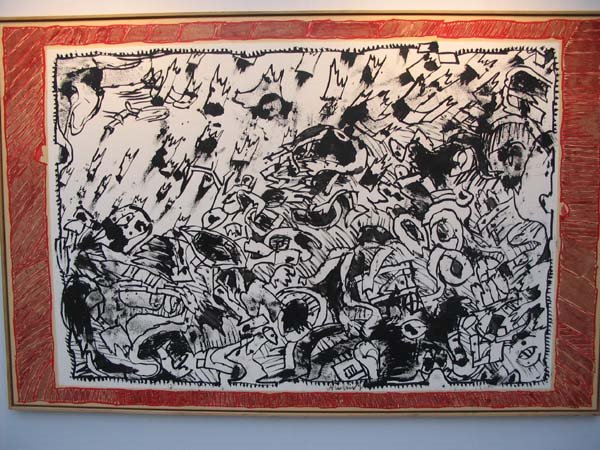
Pierre Alechinsky, Evènement géologique, 2004/05, Galerie LelongAfter yesterday's installment on sculpture, you can be sure that Mark is asking, "What about the painting?" It's true that painting is not dead. In fact, it may be not only resurrected from the dead but gaining strength. I admired Pierre Alechinsky's Evènement géologique (Geological event, 2004/05), from Galerie Lelong. He made it with acrylic applied to a large piece of paper, giving it a sort of comic book look, taped down on a canvas. It looks like crushed pieces of stuff, the detritus of an earthquake, but the overall visual effect was less specific.


Helsinki's Galerie Forsblom had this oil painting by Eric Freeman, Sagaponack (2006). The title refers, I assume, to the town on Long Island, but I liked the idea of transferring work like Dan Flavin's light sculpture into oil.Eric Freeman, Sagaponack, 2006, oil on canvas, Galerie Forsblom


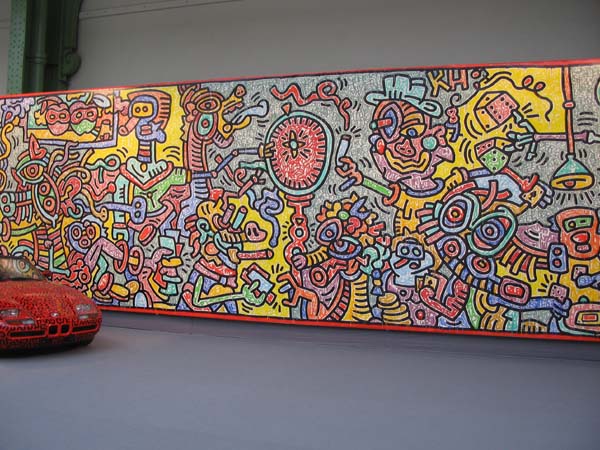
Keith Haring, Knokke Casino, 1997, Enrico NavarraThe Paris-based gallery Enrico Navarra was showing a large Keith Haring mural, Knokke Casino (1997), which struck my fancy because of the connection of the casino at Knokke-le-Zoute with Jacques Brel. The mural captures the grotesquerie of a casino with half-Mayan, half-cartoon imagery.


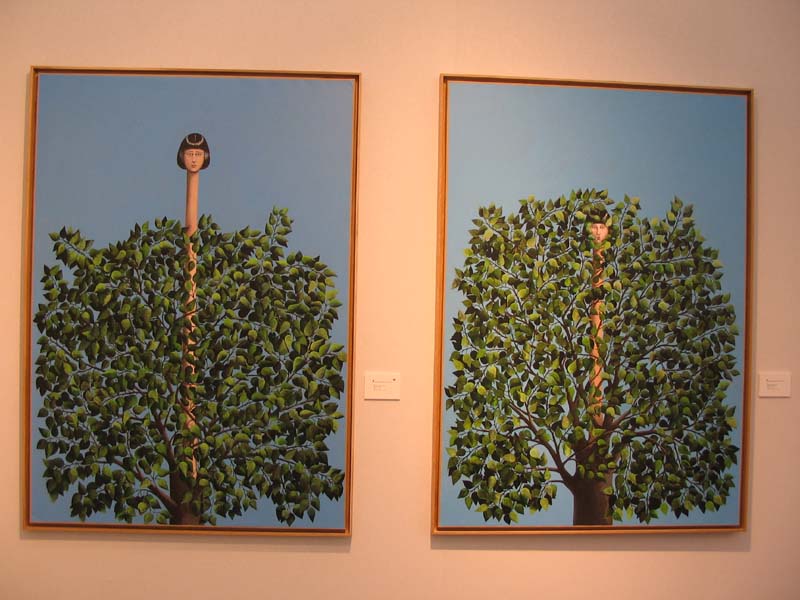
Catherine Lopès-Curval is a painter based in Paris, and Patrice Trigano was showing several of her paintings derived from Alice in Wonderland, with a black-haired woman in a bowl cut, which may be based on her self-portrait. There is a Magritte-inspired surrealist tinge to the work, as in this 2005 pair showing Alice in a tree.Catherine Lopès-Curval, Alice paintings, 2005, Patrice Trigano


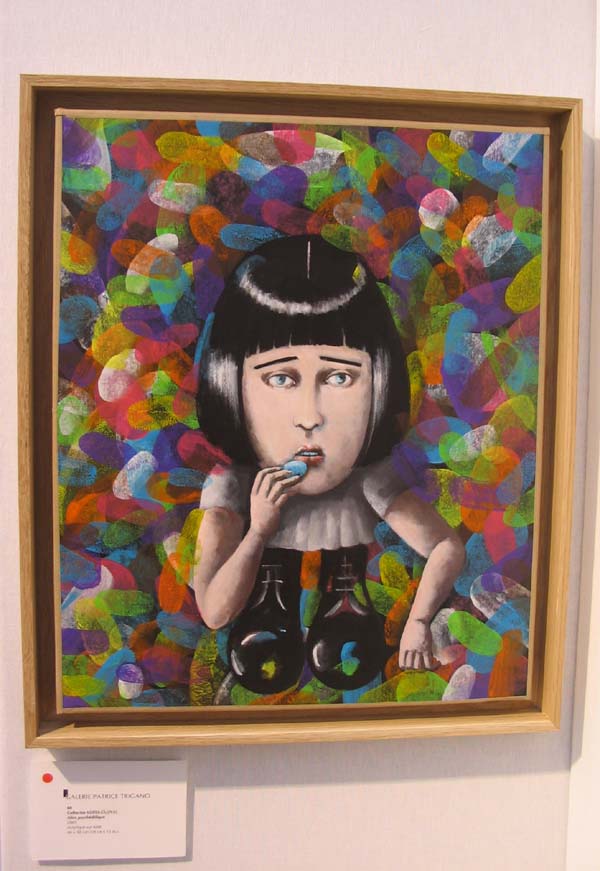
Catherine Lopès-Curval, Alice psychédélique, 2005, Patrice TriganoMy favorite of Catherine Lopès-Curval's Alice paintings was Alice psychédélique (2005), which combines the Alice story with psychedelic drugs. The background is based on the colorful designs of medications that also fascinated Fred Tomaselli and Damien Hirst. The little orange dot on its card means that it sold.


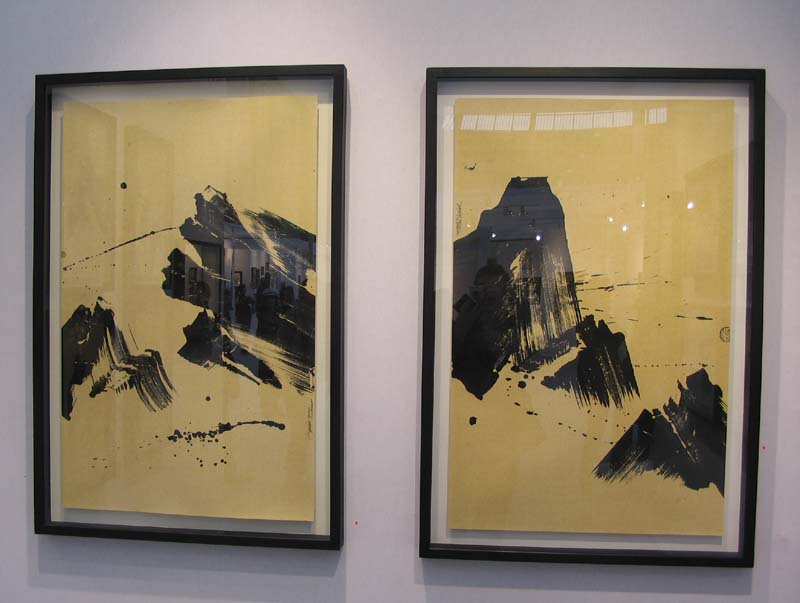
According to the review (Art Paris, l'effet Grand Palais, March 23) by Valérie Duponchelle for Le Figaro, Alice Pauli was selling the landscapes of Fabienne Verdier like hotcakes. Indeed, her simple paintings have great appeal, inspired by Japanese Zen and traditional Chinese landscape, with just a few broad strokes of black paint to suggest shapes. Many of them had orange dots.Fabienne Verdier, landscapes, Alice Pauli


Richard Estes, Avenue of the Americas at Spring Street, oil on canvasI really admire the technical skill of photorealist painters, as I have many times in the work that Anna Conti writes about on her blog. It is the sort of virtuosic painting that inspires awe. The best example I saw in this show was an oil painting by Richard Estes, Avenue of the Americas at Spring Street, which may be an older work.


Jenny Watson's Mother and Dog (2004) is painted on wrapping paper with a gold-star pattern, loosely wrapped over a canvas, which is a common element of her work, along with her childlike drawing style. There is an art brut quality that I enjoy.Jenny Watson, Mother and Dog, 2004


Fernando Adam, Registros de silencio 4, 2006, mixed media on canvasI admired several of Fernando Adam's surrealist paintings, beginning with the female portraits that were only suspended dresses, accompanied by words in Spanish. Shown here is one of the empty interiors I also liked, Registros de silencio 4 (2006). These are in mixed media on canvas.


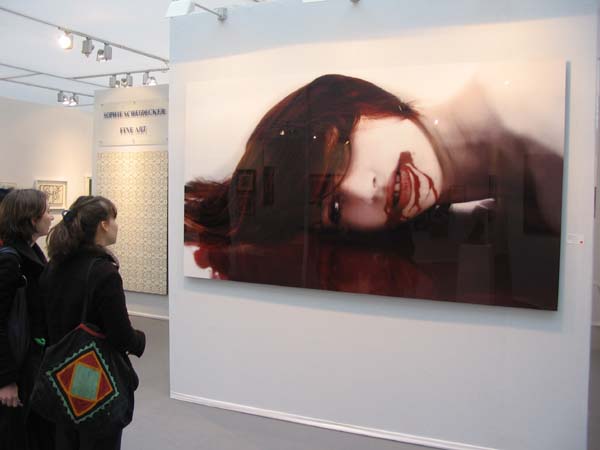
Ximo Lizana has a great name for an artist, and if her parents gave it to her, they did her career a big favor. Valencia's Galería Punto was showing her large digital photograph Frágil espejismo (2006), which is a beautiful and stomach-turning image. It fits right into her recent work, dealing often with violence against women, such as in her Crucified Woman (2004), shown on the entry page of her Web site.Ximo Lizana, Frágil espejismo, 2006, digital photograph, Galería Punto


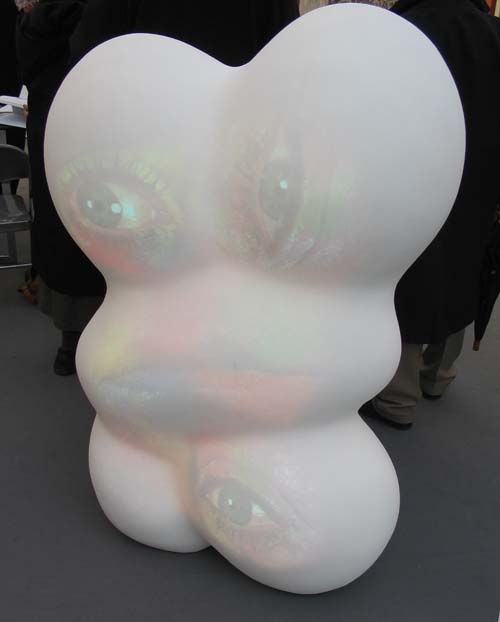
Tony Oursler, Bow, 2003, fiberglass with sound and projectionBy far, the creepiest piece in the show was a sound and projection sculpture by Tony Oursler called Bow, from 2003. It is a white fiberglass blob with several bulbous parts. A projector made eyes and a mouth appear in several different directions, and a sound track of murky speaking really brought the piece to life. In a disturbing way.

Valérie Duponchelle's review (Art Paris, l'effet Grand Palais, March 23) for Le Figaro had some good comments about what the move to the Grand Palais means for Artparis (my translation):
The "Parisian fair" has done so well thanks to the Grand Palais phenomenon. Some 37,000 visitors, of whom a third were paying to get in (15€), jostled over five days to rediscover this lost sensation, art in the Grand Palais and in zenithal light. Jostling is a euphemism given the considerable security restrictions -- no more than 5,500 visitors at one time in the 13,000 restored square meters -- were a drawback for this return to historic Paris.
I agree wholeheartedly about experiencing the show in the Grand Palais: what a beautiful spot to view art, and what a tradition to which to be connected.

23.3.06

Faux Paris


OK, call it pure jealousy, and I do. If Charles could be in Paris, I could be in faux Paris. Sure Versailles had better moments of debauchery, but the Biltmore did as well as a Yankee baron could. I was actually troubled visiting both versions.