CD Reviews | CTD (Briefly Noted) | JFL (Dip Your Ears) | DVD Reviews

26.4.08

Tallis Scholars Continue Complete Josquin Edition

available at Amazon
Josquin des Prés, Missa Sine nomine / Missa Ad fugam, Tallis Scholars

(released March 11, 2008)
Gimell CDGIM 039


Other Josquin Masses:
available at Amazon
M. Pange Lingua / M. La Sol Fa Re Mi / L'homme armé Masses
(half-price 2-CD set)
To all those choir directors out there willing to program Palestrina, Victoria, and Byrd, you need to branch out and try some Josquin. By all accounts, Josquin des Prés (c. 1440-1521) was the Beethoven of his age, the undisputed "master of the notes, which must express what he desires, while other composers have to do what the notes dictate." To get to know the glories of the most contrapuntal era, there are fewer better ambassadors than the Tallis Scholars, who with this recent release have announced their plan to record a complete cycle of the Mass settings of Josquin (two older discs have been rechristened as the first and second parts). And to appreciate Josquin's mastery of the notes, what better repertoire than his two Mass settings based entirely on canonic imitation?

Josquin gives a tribute to his teacher, the contrapuntist par excellence Johannes Ockeghem, when he quotes from his own funeral chanson for Ockeghem, Nymphes des bois in the "Et incarnatus est" section of the later of the two Masses recorded here, Missa Sine nomine. It is presented first, the summa of Josquin's composition using strict canons, with his youthful attempt at the process in Missa Ad fugam. In a nice touch, Peter Phillips has made a recording of a rare surviving Renaissance revision, transcribed from a manuscript in the Jena University library, more concise versions of the Sanctus and Agnus Dei from Missa Ad fugam. The sound, captured in Norfolk's Church of St. Peter and St. Paul, is warm and full. The singing hews to the Tallis Scholars standard, full-throated and impeccably tuned, straight of tone and nicely balanced. My recent complaints about the occasional mixture issues are in evidence here, too, as here one voice or there another growls obtrusively instead of yielding to the ensemble. Those concerns are negligible in what is a most pleasing account of this complex music.

25.4.08

Witches and Wizardry with the BSO

Yuja Wang, pianist, photo by Christian Steiner
Yuja Wang, pianist
(photo by Christian Steiner)
The Baltimore Symphony Orchestra opened this week's series of concerts last night to a well-sold house in the Music Center at Strathmore. A major part of the excitement about this program was the latest appearance of the sensational young pianist Yuja Wang. Returning to the BSO after a well-received 2005 outing with the first Liszt concerto, Wang's ferocious technique has become seasoned and more formidable, as was displayed during her Terrace Theater recital in January. This time, it was the compact and daring first piano concerto (D-flat major, op. 10) by Sergei Prokofiev, and if it was an uneven performance, it was not due to Wang's technique. Plowing through the masses of notes with urgency, she pushed the tempo of the first movement (Allegro brioso) from the start. There were not many noticeably dropped notes, it seemed, until the third movement, where the issues of pacing and alignment between soloist, conductor, and orchestra became most pronounced.

Guest conductor Yan Pascal Tortelier clearly had the BSO feeling energized, but his unusual gestures and unorthodox beat proved confusing among sections throughout the evening. This was most disastrous at the return of the first-movement theme toward the end of the third movement, which took considerable time to settle into the right tempo. The balance between the orchestra and the Strathmore Steinway, which seemed too mellow in voicing for the work, was weighted toward the former direction. Wang can pack a wallop for such a slight young woman, but there was much wizardry from her hands that was simply lost in the wash. Most regrettably, the audience, although clearly impressed by the show, did not have enough stamina in its applause to coax an encore from Wang. To get an idea of what we may have missed, watch the video embedded below.

UPDATE:
Yuja Wang played two encores at the Friday performance, including the Mozart-Volodos.


Sarasate-Horowitz, Carmen Fantasy, played by Yuja Wang
(see also her Mozart-Volodos, Rondo alla Turca)

The headline of the program was saved for the second half, Berlioz's incendiary Symphonie fantastique, op. 14. This is music of theatrical appeal, the combination of the composer's hallucinatory autobiographical program and his legendary mastery of orchestration. Falling desperately in love with English Irish actress Harriet Smithson, only to be rejected, Berlioz worked out his frustrations by writing a symphony about his obsessive love and bizarre opium-induced dreams of murdering her, being guillotined for his crime, and watching his soul tormented during a Black Mass celebrated by a coven of witches, including his beloved. Against all odds, Smithson later heard the work and sought out Berlioz. Although they eventually were married, they divorced not long afterward -- who could have seen that coming?


Yan Pascal Tortelier, conductor
(photo courtesy of IMG Artists)
Here Tortelier used no score, which allowed a greater freedom of communication with the players but also tends to reinforce idiosyncratic interpretative choices. In the first movement, the Tempo I marking at measure 28 was not really observed until the Plus vite tempo was re-established at the marking sans rallentir (measure 49), and the long rest (three measures dramatically marked SILENCE at measure 231) seemed cheated. Quibbling aside, the playing was often richly colored and arresting, especially the first statement of the idée fixe (the melody that represents the object of the artist's love throughout the piece), over percussive string attacks, and the confusion of sounds in the wild passion of the recapitulation. The coda, marked Religiosamente (Tout l'orchestre aussi doux que possible), could have been much closer to ppp. The second-movement Bal was a feverish dance, a waltz to drive you mad (before Ravel's La Valse), and the English horn and off-stage oboe duet in the pastoral third movement was pleasingly rustic (quite demanding for the oboist filling in for the principal, reportedly on maternity leave).

The memorable parts of the symphony, of course, are the opium hallucinations in the final two movements. Tortelier turned in a "forced march" to the scaffold, set at a harried pace that seemed to unsettle the brass a little, leaving the performance less solid that it should have been. As is most commonly done, the two ophicleide parts were played by tubas, a change that Berlioz himself sanctioned in later revisions of the score. I missed a little more splat from the third trombone on those low B-flats in the blaring sections conjuring revolutionary bands, but the dynamic indicated is only mf. The fifth movement was the high point, with bone-chilling bells tolling, the gloomy strains of the Dies Irae, and cackling solos from the E-flat clarinet and other woodwinds for the witches.

Other Reviews:

T. L. Ponick, Fantastic sounds on piano dazzling (Washington Times, April 26)

Anne Midgette, The BSO's Freaky 'Favorites' (Washington Post, April 28)

Tim Smith, Vibrancy of Tortelier, BSO resonates loud and clear (Baltimore Sun, April 28)
The opening of the concert was given to an attempt to revive the neotonal music of Richard Yardumian, with the revised version of the Armenian-American composer's Armenian Suite. If, as the program notes by Janet E. Bedell put it, the piece does refer to the "sad history of the Armenians, especially in the early 20th century when hundreds of thousands were slaughtered by the Turks" (just don't call it a genocide!), it gives a fairly saccharine view. Bedell also inform us that "in our post-serial, neo-Romantic era, [Yardumian] seems ready for rediscovery," coinciding with recent pronouncements that serialism is indeed dead. If the music of Elliott Carter is to be succeeded by facile, bottom-drawer fluff like the Yardumian suite, we will be the poorer for it. A couple of percussion swells, brass fanfare, some Hollywood string writing -- it could have been the soundtrack of a grand historical drama on the big screen. Please put it back in the drawer where you found it.

This concert will be repeated tonight (8 pm), Saturday (8 pm), and Sunday (3 pm), in Meyerhoff Symphony Hall in Baltimore.

24.4.08

Leif Ove Andsnes @ Strathmore

Leif Ove Andsnes, pianist (photo courtesy of NRK)
Washington Performing Arts Society brought Leif Ove Andsnes to Strathmore on Tuesday night. While the Norwegian pianist may be less famous than some of the musicians who are reliable WPAS favorites, he drew a respectable audience who impressed by their silent attention, the sort who glare at a dropped program. Although we have recommended several recordings by Andsnes, including his Mozart concerti, Schubert (with Ian Bostridge), and Bartók (with Christian Tetzlaff), this is the first live review at Ionarts, and it was worth the wait.

After opening with Bach's E minor toccata (BWV 914), Andsnes launched into Beethoven's E-flat major sonata (op. 27, no. 1 -- see this online score). The work has been often in my ears recently, in recordings by András Schiff and Paul Lewis and, most importantly, on Alfred Brendel's farewell recital. Like Brendel and Lewis, Andsnes took the indication of "Quasi una fantasia" as a prompt for a detached, dreamy style for much of the piece, with a gentle approach to the first movement's first subject and aloof wonder at those unexpected C major chords. By contrast, the Allegro section was a wash of very fast notes and hammered accents. The second movement was even and clear-themed, and after holding the final note for a long time, Andsnes proceeded into an easy, straightforward third movement, as if it were marked attacca. The only complaint was related to the register shifts of the fourth movement's theme, which sounded a little hammered, although Andsnes never gave ground on the fast tempo.

Aspen eye
Birch, the national tree of Finland
The high point of this program was at the end of the second half, a set of lesser-known Scandinavian works, introduced with brief and entertaining comments by Andsnes. Four short pieces by Sibelius, left off the official program, gave glimpses into the Finnish composer's sound world, known primarily for orchestral works and less for the piano. The final piece of Kyllikki (op. 41, based on an episode from the Kalevala) was a flighty account of the inveterate party girl's late night adventures, with a murky ballad in the middle. A waltz marked Elegiaco (op. 76, no. 10) recalled a tragic memory, leading into The Birch (op. 75, no. 4), a folk-inspired evocation of Finland's national tree. Oscillating chords seemed to recall quivering leaves, and the pentatonic melodic snippets were redolent of the mythic north (once, visiting rural Sweden, I was struck by how much it looked like my own home state of Michigan where, above the tree line, white birch and conifers dominate). A gloomy Barcarola (op. 24, no. 10) was more appropriate to a skiff among icy floes than to a gondola, Venice by way of Finland.

Concluding the set was the G minor ballade by Grieg, which Andsnes has played everywhere since the Grieg centenary last fall, including on top of a Norwegian mountain (the video of the piano being lifted up there by helicopter -- to the strains of Grieg's piano concerto, of course -- is a hoot). Composed after Grieg's parents had died, it is akin to Chopin's ballades (and their connection to the poetry of his native Poland) in its nostalgia for family and home. However, much like Grieg himself, the piece joins together Scandinavian folk elements and more southern, extended harmonies that would fit in with Ravel, Debussy, or even Poulenc.


Grieg, Ballade in G minor, op. 24, Leif Ove Andsnes

Other Reviews:

Anne Midgette, Pianist Andsnes, Better Than the Hype (Washington Post, April 24)
To seal that connection, Andsnes closed with a second-half selection of less familiar Debussy preludes, mixed together from Books 1 and 2. Was it my imagination or were preldues chosen for their possibly nordic connection? There were murky chromatic clouds of fog that wrapped the listener in veils of ambiguity (Book 2/1), jerky melodic bits tossed up by the wind in the plain (1/3), footsteps on white snow in dusky silence (1/6), and a glacially beautiful Ondine (2/8). Andsnes was at his best creating a varied palette of color, as in the ethereal enigma of Canope (2/10), the Spanish dance and clanging guitar of La Puerta del vino (2/3), the playfully interrupted serenade (1/9), and the bucolic heather lea of Scotland (2/5). In pure virtuosic displays, as in the wild toccata of Ce qu'a vu le vent d'ouest (1/7), he was formidable but slightly constrained toward squareness. This detracted not in the least from an innovative program, one of the high marks of this season's piano recitals.

For the next WPAS concert, Kurt Masur will lead the Orchestre National de France next Monday (April 28, 8 pm), in the Kennedy Center Concert Hall. Beethoven (Piano Concerto No. 2) and Bruckner (Symphony No. 7) are on the program.

23.4.08

Tharaud's Preludes

available at Amazon
F. Chopin, Preludes / F. Mompou, Alexandre Tharaud

(released March 11, 2008)
Harmonia Mundi HMC 901982


Scores: Chopin's First Editions Online
Alexandre Tharaud's top-notch recordings of Bach, Couperin, and Rameau might make you think that this French pianist is a Baroque specialist. Add to this music of the 18th century a stunning complete Ravel recording (as yet unreviewed, only out of laziness), an extraordinary, understated set of Chopin waltzes, and as yet unheard, a complete Poulenc chamber music set and a Milhaud disc, in collaboration with the composer's widow. This is not to mention his duo recordings with cellist Jean-Guihen Queyras and a number of earlier discs harder to come by in the U.S. We hope, perhaps unrealistically, that Tharaud will make a recording of the original piano-only version of Pelléas et Mélisande, which he played at the Musée d'Orsay in 2004. Tharaud's twice-postponed return to Washington, promised by La Maison Française (the cultural attaché, Roland Celette, assures me that he is working on it), will eventually allow me to atone for missing his 2005 WPAS recital.

For the time being, this new Chopin recording will have to suffice. This program, no less inventive than Tharaud's previous ones, is centered on the op. 28 preludes, mostly conceived during Chopin's fatal trip to Majorca. Schumann described these quasi-fragmentary pieces as "sketches" or "ruins" of more fully developed etudes. The ambiguous name chosen for them (preludes to what?) gives the impression of paired major-minor improvisations that lead only to each other, in an endless cycle of fifths always circling back on itself. Tharaud writes in the notes about how he sees the Preludes only as a set, and that comes across, for example, by the way he takes no. 22 attacca from the end of no. 21. The most curious point to my ears in the cycle's continuity is the cadence on an F dominant seventh chord at the end of no. 23, setting up not B-flat but no. 24 in D minor.

In the liner notes, Tharaud describes the set as "shot through with violence and death," restless with a sense of fear even in the most serene movements. The doom of mortality reaches its most overt expression in no. 14 (E-flat minor), which Tharaud plays like a deathly shudder. Uneasy echoes resonate in the booming bass pedal point of no. 17 (A-flat), the low fz notes phrased in a hairpin over the concluding minute, as the other voices float above, disembodied. The only, very minor reservation about Tharaud's pianism is that his technical mastery weakens just a bit in the most demanding passages. Yes, no. 16 (B-flat) is appropriately on fire and in no. 24 (D minor), he produces electric and impassioned shrieking runs up and down the keyboard (marked con brio, con impeto, impetuoso, con audacia, brillante -- [ridiculously, by some later editor -- Ed.]). It is only with comparison to other slightly more flawless performances that one even notices (as with Tharaud's rendition of Couperin's Tic Toc Choc -- with hip-hop video -- compared to the just slightly more technically mind-blowing Grigory Sokolov).


Alexandre Tharaud, pianist
Some of Tharaud's choices are unpredictable, which is one of the qualities that makes listening to his playing so rewarding. The fff final chords of no. 18 (F minor) are attacked like vicious axe-strokes, and he treats the opening anacrusis of no. 7 (A major) as if it had an unseen fermata over it. Although in no. 15 (D-flat), Tharaud wisely avoids all sentimentality, it's not clear he really observes the midpoint Poco più animato marking at all [Probably because it is not in the first edition -- Ed.], but he does bring out a detail unnoticed before, in measure 17, where he has the top of his left hand echo the right-hand motif in the previous measure.

Tharaud has rounded out his op. 28, clocking in at just over 38 minutes, with five other similar works by Chopin, the op. 45 prelude, the A-flat major Petit Prélude, and the Trois Nouvelles Etudes ("which one can well imagine Chopin might have called 'Preludes'," Tharaud writes in the booklet). Finally, as he has done to brilliant effect on his other solo discs, he has added a later composer's tribute to the program's subject. Here, as on his Chopin waltz CD, it is music by Federico Mompou (1893-1987), all of it worth knowing, especially in this context. The melody of op. 28, no. 4, is the basis for Música callada no. 15, and Chopin is the obvious model for Mompou's preludes, of which Tharaud selects no. 9. A more extended Mompou prelude, El Lago (The lake), concludes the disc, which Tharaud often plays as an encore to op. 28 in concert. "Whenever I do," he writes, "I'm always struck by the quality of silence in the audience."

22.4.08

Stephen Hough's Mozart Album

available at Amazon
Stephen Hough, A Mozart Album (music by Mozart, Cramer, Friedman, Hough, Liszt)

(released March 11, 2008)
Hyperion CDA67598


Online Mozart scores (Neue Mozart-Ausgabe)
British-born pianist Stephen Hough generally does not disappoint in terms of programming. His latest CD, A Mozart Album, combines two fantasias (K. 396/385f and 475) and one sonata (K. 333) with pieces derived from Mozart by later composers, including himself. Hough's Mozart is exemplary, with the Fantasias approached with a free sense of tempo and a careful attention to the dynamic contrasts and articulations in the score. Hough has a precision touch and smashes the idea that the often reduced textures in Mozart equate with preciosity. Yes, there are crystalline soft passages, delicate enough to crack if mishandled, but there are also flights of fancy and operatic excesses. The pendant piece is the Liszt-Busoni fantasia on themes from Marriage of Figaro, in which Hough displays his considerable technical wizardry and whimsical attention to details.

The genesis of this program was in the 2006 Salzburg Festival when, for the big anniversary year, Hough gave a recital with the intention of joining Mozart to the contemporary (as Gloria Coates did with her 15th Symphony). He composed his Mozart Transformation (after Poulenc) for that event, in three movements based on Mozart juvenilia (the K. 1 Minuet and the K. 33 Klavierstück) and a later song, salvaged from the K. 595 piano concerto. Although the melodies are quoted exactly as Mozart wrote them, the harmony is tarted up with all kinds of trashy colors. Introducing it are two Romantic tributes to Mozart, Johann Baptist Cramer's Hommage à Mozart and Ignaz Friedman's Menuetto in D major, a refashioning of a movement from Mozart's K. 334 divertimento for string quartet and two horns.

Hear Stephen Hough for yourself this week, when he appears as soloist with the National Symphony Orchestra (April 24 to 26), even if he is playing one of the Saint-Saëns concerti (no. 5, "Egyptian").

21.4.08

Guarneri Quartet and the Grosse Fuge

available at Amazon
Arnold Steinhardt, Indivisible by Four: A String Quartet in Pursuit of Harmony
(1998)
Friday evening, the Guarneri String Quartet, in their 26th year in residence at the University of Maryland, performed an all-Beethoven concert as part of the school’s Scholarship Benefit Series (postponed from Leap Day, due to a player injury). The program included the “Harp” String Quartet No. 10 (op. 74, E-flat major) and String Quartet No. 13 (op. 130, B-flat major), which featured its original finale, the Grosse Fuge. Hearing the venerable ensemble, now in their 44th year and penultimate season, should be a high priority on one’s cultural to-do list. Their final season, 2008-2009, is anticipated to be heavy.

The “Harp” is unique in that it lacks the torrential quality often expected of Beethoven. In its place, Classical charm filled the ideally wet, yet intimate acoustic of the Dekelboum Concert Hall, with its tall ceiling and narrow breadth. Pizzicato notes in the first movement (Poco adagio allegro) were expertly passed between the players amid gentle flutters. The movement became beautifully expansive as it neared its end, in a settled tempo seemingly neither fast nor slow. The Guarneri’s tempos are always just right. Beethoven’s good humor extended through the following three movements, in particular, the third (Presto: Piu presto quasi prestissimo), where the Quartet created a crack intensity without becoming heavy or bogged down.

Other Reviews:

Joan Reinthaler, Guarneri String Quartet (Washington Post, April 21)
Overall, the quality of the first half of the concert was not sustained into the second half. This was due to some tuning issues in the inner voices that prevented harmonies from fully locking into place and textures from sparkling like sapphires in the sun, as they had before. Additionally, the rather low-energy performance of op. 130’s six movements made one yearn for the complete Guarneri experience, such as their program of Bartók, Haydn, and Smetana last January.

Regardless, hearing the Grosse Fuge as the final movement of op. 130, instead of the easier replacement movement requested by Beethoven’s publisher, is a unique journey. The bouncy dotted theme and contrastingly piercing four-note theme are overtly kept away from each other until the very end. The point of this tour de force is finally revealed when these subjects simply, and magically, merge with the first violin and cello at the work's end. Alas, the subjects were meant to be together all along.

The Guarneri Quartet will hold its next open rehearsal, free and open to the public, at the University of Maryland next Wednesday (April 30, 5 pm).

Ionarts at Large: Satyagraha at the Met


Philip Glass, portrait by Chuck Close (left) and recent photograph (right) -- see the exhibit of Chuck Close portraits of Philip Glass in the Met lobby
Arguably, the most significant difference to arrive with the Peter Gelb era at the Metropolitan Opera is a greater openness to contemporary opera (also the unforeseen success of the HD broadcasts, although that has had both positive and negative effects). Rather than a real step toward the future, however, the shift in favor of new operas, however slight, is actually a return to the great house's historical tradition, during the period that ended approximately with the premiere of Howard Hanson's Merry Mount. The repertorial concretization at the Met of recent years was actually a dangerous flirtation with provincialism, meaning that the wealthiest American company was regularly being upstaged by smaller, more adventurous outfits like Santa Fe Opera, in terms of world premieres and American premieres.
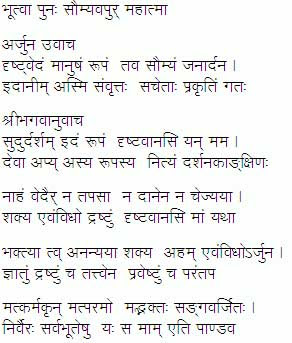
Sanskrit text from the Bhagavad-GitaAs a result, the recently opened production of Philip Glass's Satyagraha was a cause for celebration, and critics descended from far and wide for opening night last week (including Washington's own Tim Page, who spoke eloquently on the Sirius broadcast) to witness the Met turning this important page (next season will have Adams's Doctor Atomic, reportedly with The Ghosts of Versailles and Golijov's new Daedalus to follow). Ionarts was able to get there for the third performance of the run, Saturday's matinee.

The Met's first and, until now, only experiment with Philip Glass, the 1976 performance (not really production) of Einstein on the Beach, was a watershed event in opera history. That work, more experimental theater than real opera, is often described as a one-time test case, but Satyagraha, premiered only four years after Einstein, has much more in common with its predecessor than not. Its libretto (in Sanskrit -- it may as well be numbers and solfege syllables, in terms of audience comprehension), adapted by the composer and Constance DeJong from texts in the Bhagavad-Gita, does not actually tell the story of its purported subject, the years that Gandhi spent in South Africa. The audience is required to familiarize itself with that story beforehand, and the tableaux of stage action refer to it and connect it with other stories, both ancient and modern, religious and secular.


Satyagraha, Metropolitan Opera, 2008, photo by Ken Howard
The work's title indicates that the opera is not really about its central character, Gandhi, at least not exclusively. Satyagraha, a Sanskirt word usually translated as "truth force," is how Gandhi described his tactic of nonviolent protest, and three historical figures who influenced it or were influenced by it (Leo Tolstoy, Rabindranath Tagore, and Martin Luther King, Jr.) look down on the three acts like guardian angels. The paradox of the work is that it sprawls so widely, passing without borders from mythology to the modern and back again, and yet does so immersed in an enveloping stasis. There may be more of an actual story than Einstein, at least in the background, but the process of relating it -- or not relating it, perhaps -- is remarkably similar.

Other Reviews:

Ronald Blum, Glass' 'Satyagraha' Reaches Met (Associated Press, April 13)

Anne Midgette, 'Satyagraha': Simplicity & Splendor in the Glass (Washington Post, April 14)

Anthony Tommasini, Fanciful Visions on the Mahatma’s Road to Truth and Simplicity (New York Times, April 14)

Daniel J. Wakin, Puppets enliven Metropolitan production of opera 'Satyagraha' (International Herald Tribune, April 14)

Jeremy Eichler, Gandhi at the Met, Glass in transition (Boston Globe, April 14)

Mark Swed, Live: 'Satyagraha' (Los Angeles Times, April 14)

Patrick Cole, Selling Gandhi, Glass: `Satyagraha' Uses Posters, Yoga Teachers (Bloomberg News, April 16)

Tim Smith, Glass' hypnotic opera at Met (Baltimore Sun, April 17)

Vibhuti Patel, Gandhi’s Wonder Years (Newsweek, April 17)

Heidi Waleson, History and Hypnotic Magic (Wall Street Journal, April 19)

Karren L. Alenier, Satyagraha (Culture Vulture, April 20)

Other Articles:

Matt Blank and Stephen Kent, Satyagraha: Can Opera Help Fight Climate Change? (Playbill Arts, April 3)

Elena Park, Metropolitan Opera: The Force of Truth (Playbill Arts, April 11)

---, Philip Glass: The Message in the Music (Playbill Arts, April 21)

David Cote, Puppet Regime (Opera News, April 2008)
This performance is anchored by the astounding interpretation of tenor Richard Croft as Gandhi. Whenever Glass's score was metered unevenly, the other singers seemed to be changing notes more on the cues of the conductor than on a sure internal pulse. Croft was not only rock solid from his first note (unaccompanied, he opens the opera, just after he has been famously thrown from a train), no matter how complex the rhythms, but his line always sounded like a melody, lyrical and flowing. Conductor Dante Anzolini had his work cut out for him, keeping the complicated and regularly changing meter with one hand, cuing all of those singers' entrances and cutoffs with the other, and even mouthing words to the chorus. That Anzolini was able to keep the largest parts of the score together at all was remarkable. When the chorus, after a solid start in the indelibly memorable Ha-Ha scene of Act II, began to rush, however, he was not able to retain control.

All members of the supporting cast are to be congratulated for surviving the score's grueling demands, especially soprano Rachelle Durkin (Miss Schlesen) who sang so many high notes again and again (not always right where they needed to be, but still), it was hard to keep track. Of the quartet that often sings together, baritone Earle Patriarco (Mr. Kallenbach) was the most consistently impressive. As Parsi Rustomiji, bass-baritone Alfred Walker was too easily covered by other sounds when he was anywhere but near the apron. Mezzo-soprano Mary Phillips had a grand presence as Mrs. Alexander, the wife of the regional governor, who protects Gandhi with her umbrella. Phelim McDermott's direction emphasized statis, sapping all of the personality from the characters, as they mostly stood in place or walked in slow motion with no impetus or direction.

The production, which comes to New York from English National Opera, is beautiful, monumental, and puzzling. Julian Crouch's set is a raked stage surrounded by a ring wall of nondescript color, and the largely monochromatic costumes designed by Kevin Pollard follow the course of Glass's score, towards a more and more austere set of colors. Thankfully, an element of whimsy and menace was added by the puppeteers and supernumeraries of the Improbable Theatre Company, the only thing that saved Glass's ponderous, philosophical opera from its own sententious seriousness. Most of the evening's visual souvenirs involved the puppeteers, creating a halo for Richard Bernstein's Lord Krishna, crumpling newspapers to form heads and limbs, flying on wires, manipulating the over-sized capitalist goons behind the Ha-Ha chorus in Act II and the giant bird puppet, and unrolling undulating bands of packing tape across the stage.

Photo by Ken Howard
Satyagraha, Metropolitan Opera, 2008, photo by Ken Howard

Eventually, one gives up caring about the words being sung, as the text just flows over the listener (in spite of the beautifully realized projections). Someone should make a video like the Carmina Burana with alternate lyrics, with the Sanskrit of Satyagraha replaced with nonsense (beginning with "Raja, naba do wa, gola wookie, nipple pinchie?," the gibberish spoken by Jaba the Peter in Family Guy). This Buddhistic relinquishing of conscious comprehension is likely part of Glass's strategy in the third act, where he prolongs the plainest music (all those endless unison string arpeggios!) to separate the listener from harmonic expectations. That austerity sets up the memorable conclusion, with Gandhi repeatedly intoning that ascending phrygian scale (heard earlier, in the flute, in the first act) over more complex orchestral textures that blossom in the final bars.

The production of Satyagraha, which is an event not to be missed, continues for four more performances (April 22, 25, 28, and May 1), at the Metropolitan Opera in New York.

Feast of St. Anselm


Manuscript of opening of Anselm's Monologion,
with illumination of St. Anselm in his pallium
April 21 is the feast of a favorite saint, Anselm of Canterbury, not least because he is the patron of a certain beloved Benedictine abbey in Northeast. He was an Italian, born in Aosta in 1033, and received a calling to the monastic life when he was still a young man. His father prevented him from joining a monastery, after which Anselm fell into a life of dissolution and wandering, abandoning the vocation of monastic learning for a time. Fleeing his father's severity, Anselm set out on foot across the Alps, wandering north all the way to Normandy. He was taken in as a student and later a monk at the Abbey of Bec, where he finally found a mentor in the scholar Lanfranc, who was the prior. Anselm was to succeed Lanfranc in many positions, first as prior (and eventually abbot) at Bec and later as Archbishop of Canterbury in England.

Anselm is often cited as the founder of the Scholastic movement of philosophy and was in later years given the rank of Doctor of the Church for his theological and philosophical writings, especially the treatise quoted below. He staunchly opposed the interference of the state in church affairs but just as staunchly opposed the crusades as wars sponsored wrongly by the church. He died in peace on April 21, 1109.
Excerpt from Cur Deus Homo (Why God Became Man, completed in 1098), Book II, ch. 13
But tell me whether, in this likeness to men which he ought to have, he will inherit also our ignorance, as he does our other infirmities? [...] For why will he not be like them in their ignorance, as he is in their mortality?

That union of humanity with the Divine person will not be effected except in accordance with the highest wisdom; and, therefore, God will not take anything belonging to man which is only useless, but even a hindrance to the work which that man must accomplish. For ignorance is in no respect useful, but very prejudicial. How can he perform works, so many and so great, without the highest wisdom? Or, how will men believe him if they find him ignorant? And if he be ignorant, what will it avail him? If nothing is loved except as it is known, and there be no good thing which he does not love, then there can be no good thing of which be is ignorant. But no one perfectly understands good, save he who can distinguish it from evil; and no one can make this distinction who does not know what evil is. Therefore, as he of whom we are speaking perfectly comprehends what is good, so there can be no evil with which he is unacquainted. Therefore must he have all knowledge, though he do not openly show it in his intercourse with men.

In his more mature Years, this should seem to he as you say; but, in infancy, as it will not be a fit time to discover wisdom, so there will be no need, and therefore no propriety, in his having it.

Did not I say that the incarnation will be made in wisdom? But God will in wisdom assume that mortality, which he makes use of so widely, because for so great an object. But he could not wisely assume ignorance, for this is never useful, but always injurious, except when an evil will is deterred from acting, on account of it. But, in him an evil desire never existed. For if ignorance did no harm in any other respect, yet does it in this, that it takes away the good of knowing. And to answer your question in a word: that man, from the essential nature of his being, will be always full of God; and, therefore, will never want the power, the firmness or the wisdom of God.
See also these Other Works by St. Anselm of Canterbury.