CD Reviews | CTD (Briefly Noted) | JFL (Dip Your Ears) | DVD Reviews

27.10.07

Ionarts at Large: Strauss with Thielemann

The first thing that impresses the ears in an orchestral concert is – ideally – the sound. Especially so when the piece being played has as impressive an opening as Richard Strauss’ Don Juan. Christian Thielemann can get that sound and the Munich Philharmonic, his principal toy for Germanic, late-romantic musical excursions (does he do any other ones?) can deliver it.

And so they did in this run of all-Strauss concerts, the first to be conducted by Generalmusikdirektor Christian Thielemann this season and the last before the Orchestra goes on their Japan tour.

Preparing for a tour also means having an encore ready, and so the Munich audience was treated to this rare event.

Wagner’s prelude to Die Meistersinger snarled and caroused about to the delight of the crowd. Thielemann too, enjoyed himself visibly, conducting with passion, tender care, and ebullient energy. He seems to fall in love every time he conducts Wagner, though whether with himself or the music, I cannot tell.

But before Wagnerian frivolities could begin, there was work to be done. And this came in form of Don Juan, Tod und Verklärung, and Also sprach Zarathustra. The aggressive and abrupt opening of Don Juan had the angular, tight, and clear cut ’pang’ that Thielemann is great at giving Strauss. There was nothing muddled here, details were clearly audible, and the structure wasn’t lost under rounded edges or a flabby musical midriff.

This is not to say that Thielemann is averse to luxuriating and basking in the sumptuousness of the score. The boldly impressive Don Juan offered all that, too. Thielemann’s extreme fluctuations of tempi never seem obvious or gratuitous with the rallentandi being well hidden within the diminuendi. Even though he and the Philharmonic seemed somewhat more cohesive - or at least impressive - when the music got quicker and louder, many of the slower and calmer passages benefited tremendously from Thielemann's stubborn and determined refusal to let the orchestra's energy slacken at any point.

Whenever a 'resting phase' was just temporary, there was always a bit of tension and restlessness in the undercurrents which allowed the players to catapult themselves into the next climax with ease. I suspect few smiles went into the making of this Don Juan, but many came out of it, as far as the audience was concerned.

While the trumpet work was outstanding in Don Juan, a glaring trombone glitch here and other, minor, infelicities later in the concert suggested that it was probably a good idea to play these pieces through a few more times before taking them on tour.

Tod und Verklärung sounds more like the work of an old(er) man, not a 24 year old Strauss who had not even finished his first opera (Guntram). I cannot help but wanting to hear in it some of the wisened efficiency and tautness of Metarmophosen, or the condensed ethereal yet whispy nature that the 25 year old Schönberg created with Verklärte Nacht. But consiseness is not yet a virtue of Tod und Verklärung which errs on the side of sprawl and can be a tad maudlin at times. Especially if the tension slackens , as it did here, the mind is quickly elsewhere. This was a performance beautiful in detail, but with room for improvement as far as the long lines and cohesiveness go.

Also sprach Zarathustra, burdened by one of the three most famous openings in classical music, fascinated early on (the first notes of the excellent double bass section sounded like hovering helicopters) with its gradual ratcheting up of tension. The violas and cellos accompanying the first violin solo ("Of the Great Longing") made a beautiful articular, harmonium-like noise. The entry of the strings in the "Song of Science" - from bottom to top, assisted with assorted woodwinds - felt like watching a haunting silent film of a slow-motion ballet of an extinct species. Then the Philharmonic gently (and not always as impeccably as in Don Juan) waltzed into the Dance- than the Night-Song sections that foreshadow most of the Rosenkavalier's language.

The - sometimes interminable – "Night Wanderer’s Song" (which Nietzsche later changed to ”The drunken Song”) and its non-ending was very nicely done but could not hide the fact that Also sprach Zarathustra is probably not the most entertaining of Strauss' tone poems, and certainly not the most shameless one. (Which is why we love them so much, in the first place.)

The constant tension between two keys (B Major and C Major, depicting Man and Nature, respectively) makes for that subtly uneasy feeling. That irritating, waiting, expecting (and never quite getting) last chord, however, is vicious genius. But if Strauss didn't give us the tonic, that's just what Thielemann and his orchestra provided for the Strauss-loving crowd in Munich.

26.10.07

Alsop Leads Ohlsson and the BSO

Marin AlsopMarin Alsop is back in town to lead this weekend’s Baltimore Symphony Orchestra concerts. Judging from Thursday evening’s performance at the Meyerhoff, the musicians are becoming better able to read Alsop’s gestures and mind. Whereas previous performances often had Alsop persistently demanding output from the orchestra, last night’s performance showed that with time, the musicians will eagerly respond to a lighter touch. We are pleased to report further good news in that attendance was exceptional, with a large amount of good will felt from the audience, especially during Garrick Ohlsson’s encore. There was a traffic jam of concert-goers leading to the Meyerhoff before the concert, and a boisterous crowd having a chat and drink during intermission.

The concert opened with Brahms’s Tragic Overture, written as a companion to the Academic Festival Overture, which featured excellent balance and dynamic gradations. Garrick Ohlsson’s performance of Samuel Barber’s Piano Concerto left one desiring a more unified composition. The outer movements of the work are very similar and constantly switch back and forth between technical, modern material and Barber’s characteristic neo-Romantic style. By adding a multitude of ideas, one after another, instead of expanding on just a few, Barber’s concerto lacks cohesion as a whole and seems to be generally missing something. In fairness, the Rachmaninov-like passagework here and bitonality there is appealing on the surface. Ohlsson, appearing as a giant on stage when standing near Alsop, played very well and took over where the orchestra left off in the second movement (Canzone) by impressively matching their volume and texture so perfectly one was almost fooled. Ohlsson’s encore, Chopin’s Waltz in C# Minor was enjoyable, though with rather jolting aberrations of tempo.

Other Reviews:

Tim Smith, Stirring, engaging program from BSO, Alsop (Baltimore Sun, October 27)
Is Tchaikovsky’s Symphony No. 5 in E Minor one of the BSO’s war horses? Their fluency was remarkable. The bar has been raised even higher from their opening concert last month at Strathmore. The symphony begins with a clarinet leading a chorale-like tune containing many deceptive cadences, thus giving the audience an anxious sense of a long journey ahead. Throughout the work, smooth wind lines rise through the texture and the final movement conveyed the affect of nobleness. The oboe solos of Katherine Needleman were always warm and full. One shortcoming of this ensemble is the low brass, which have a recurring tendency to splat any note above piano. Tuesday’s performance by the St. Petersburg Philharmonic featured smoother, rounder brass playing that was still full. Gentler, more beautiful attacks by the BSO brass would be generally welcome, and when there is an appropriate time to splat, it will be all the more effective.

This concert will be repeated this evening (October 26, 8 pm) and Sunday afternoon (October 28, 3 pm) at Meyerhoff Symphony Hall in Baltimore, as well as Saturday evening (October 27, 8 pm) in the Music Center at Strathmore.

Let Me Sing You a Waltz

Available at Amazon:
available at Amazon
Brahms, Liebeslieder-Walzer, M. Petersen, S. Doufexis, W. Güra, K. Jarnot, C. Berner, C. Radicke
(released on September 11, 2007)
The repertory for piano, four hands, is a delight to play, but it almost seems a shame to record it. If this music were not available in recordings, one could hear it only as it was intended, among a small gathering around the family piano or, even better, only by playing it yourself. (Think of that scene in Richard Taruskin's favorite composer biopic Impromptu where Liszt and Chopin, played by Julian Sands and Hugh Grant, play a four-hands arrangement of a Beethoven symphony.) The same is true of the vocal quartet genre favored by Johannes Brahms, a rarefied kind of Hausmusik and rarely more memorably accomplished than in the Liebeslieder-Walzer, op. 52, eighteen miniatures for various combinations of SATB voices and piano, four hands (later grudgingly released by Brahms in a piano-only version).

This recent release comes about as close to a perfect interpretation of these songs as one might reasonably expect. The quartet is a balanced group, four tasteful and independent voices but no one overpowering, with only the excellent tenor Werner Güra perhaps obtruding slightly from the ensemble by a vibrato-heavy sound. Soprano Marlis Petersen has a light, bell-like tone and floats on top of the ensemble with ethereal presence. Mezzo-soprano Stella Doufexis and baritone Konrad Jarnot round out the quartet with rich colors and somber varnish. Jarnot, who is featured alone on only one song, is a fine Lieder singer who will give a Vocal Arts Society recital later this year (Kennedy Center Terrace Theater, December 3). The piano playing by the duo of Christoph Berner and Camillo Radicke is full-bodied and impressively virtuosic. To round out the disc, the pianists split two other quartet sets by Brahms, the Drei Lieder, op. 64 (Berner), and the Neue Liebeslieder, op. 65 (Radicke). In particular, An die Heimat (To the homeland), from the former set, will not leave a dry German eye in the house.

Harmonia Mundi HMC 901945

Matisse: Painter as Sculptor


I myself have done sculpture as the complement of my studies. I did sculpture when I was tired
of painting...But I sculpted as a painter. I did not sculpt like a sculptor. Sculpture
does not say what painting says... They are parallel ways, but you can’t confuse them.

Henri Matisse, 1951

If there is any one artist to whom I most relate, it has to be Henri Matisse. Not because of a particular subject matter but because of process, the process of working through ideas of and about painting. The subject is of interest, of course, but it is often just the beginning, with no end. The middle is one great excuse to push, scrape, wipe, and mold paint, the same with drawing and printing and in the case of Matisse, clay.

Matisse: Painter as Sculptor, a new exhibit at the Baltimore Museum of Art, explores this process in great depth by juxtaposing some 160 sculptures, paintings, drawings, and prints, as well as the work of a few contemporaries, such as Rodin, Degas, Cézanne, and Picasso. This exhibit is a rare studio visit allowing us, as closely as possible, to envision a work in progress, step by step.

This exhibit exposes a Matisse seemingly in perpetual exploration of singular themes, whether it’s a reclining nude, a standing nude, or a series of heads; he pursues a continuous flow from drawings to paintings to the sculpted form and back. Always adjusting and simplifying. The process could carry on for years, often returning again and again, moving us from the classical figure of the Serf to the flattened forms in the painting Large Reclining Pink Nude and eventually to his paper cutouts.


In between all of that is pure joy, and this exhibit has many fine examples, including a generous loan from the collection of the Hammer Museum at UCLA, an edition of the four Backs (shown above). This is a perfect example of Matisse returning to and refining an image, and it's a very interesting story. BackI was produced in 1909 but not cast until 1965, while BackII was produced in 1913 and cast in 1962; BackIII was produced in 1916 while WWI was in progress and Matisse was forced to give up his home to soldiers. Luckily, he had a plaster cast made and after the war he returned to it, filling the mold with clay slab and reworking the image: even in the plaster form he gouged and chiseled away, making adjustments until it was cast in 1964. The last version, Back IV, was made in 1930 and then cast in 1964. All the same image and format but an incredible transition to the smooth simplified form of the final version.

Matisse never saw these cast versions; he traditionally would cast his work only after there was an order from a patron and rarely exceeding an edition of ten. The casting of the series in this exhibit was undertaken by his heirs, as there was a burgeoning market for outdoor sculpture gardens in the late 50s and 60s, such as the Hirshhorn Museum’s.

Available at Amazon:
available at Amazon
D. Kosinski, A. Boulton, S. Nash, and O. Shell, Matisse: Painter as Sculptor
Another aspect to this exhibit is that the staff of the BMA undertook a process known as technical art history, during which conservators and curators examined more than 120 sculptures at 13 different institutions, recording casting methods, mold lines, tool marks, and surface finish. They also did a laser scan to analyze structural variations. It kinda takes the fun out of pushing clay around, but it is interesting to see the results. A hands/mouse-on computer program developed in association with UMBC, How to Look at Sculpture, and a video display of the scanning of Reclining Nude (Aurora) are available for study.

Matisse: Painter as Sculptor opens this Sunday, October 28 (free admission on opening day!), and runs through February 3, 2008. I recommend the exhibit catalogue (available through Amazon via the link at right) and my Flickr site for more exhibit images and details.

The BMA also announced a gift this past week, of 77 Matisse prints from the Pierre and Maria-Gaetana Matisse Foundation. In addition to the Cone Collection, this will make the museum one of the finest collections of the artist's work in the country. The new prints are expected to go on view in 2009.

25.10.07

Concerto Italiano: L'Orfeo

Available at Amazon:
available at Amazon
Monteverdi, L'Orfeo, F. Zanasi, A. Simboli, S. Mingardo, Concerto Italiano, R. Alessandrini
(released on October 30, 2007)
On February 24, the world's first real opera, Claudio Monteverdi's L'Orfeo, had its 400th birthday. Sitting in the audience for the live performance of Monteverdi's L'Orfeo in Siena this past July, the hope for a recording of Concerto Italiano's version was paramount in my mind. This recording was put down in February at Rome's Accademia di Santa Cecilia, just before the group undertook a tour of concert performances of Orfeo, including the one that I heard in Siena. As one might expect from Concerto Italiano's recordings of the Four Seasons or Monteverdi's madrigals (see my reviews of Book 6 and Book 8), this is an interpretation of one of the most famous and beloved pieces of music designed to keep you at the edge of your seat and occasionally knock you off it altogether.

Monteverdi, Orfeo:
available at Amazon
Le Concert d'Astrée
($17.97)

available at Amazon
English Baroque Soloists
($33.98)

available at Amazon
Concerto Vocale
($43.98)
For years, the version in my CD player has been John Eliot Gardiner's from 1985, which has been remarkable ever since it came out for combining excellent voices with fine playing (English Baroque Soloists and His Majesties Sagbutts -- *snicker* -- and Cornetts). Rinaldo Alessandrini's jagged exploration of the unexpected makes Gardiner seem almost disappointingly complacent and placid. Not that the Gardiner is not worth owning, which it certainly is, but if you are going to own only one of the two (at the moment, they are at the same prize from Amazon), Concerto Italiano is more exciting listening. If you are going to buy only one Orfeo (why would anyone do that?), then the recording by Le Concert d'Astrée is the best value for the price, almost half of either Gardiner or Alessandrini. It has the most impressive cast list, too: Ian Bostridge, Patrizia Ciofi, Natalie Dessay, Véronique Gens, with Emmanuelle Haïm conducting. The Concerto Vocale recording, with René Jacobs at the podium, has nice turns by Jennifer Larmore and Andreas Scholl. At its prohibitively high price, however, one would hope for a better Orfeo than Laurence Dale provides.

Alessandrini does not approach any measure in the score with anything but the greatest care for texture, ensemble, and verve. With a care for impelling the recitation of the text, he accompanies recitatives that are never dull or limp. Seeing him conduct in Siena helped me to understand how he gets his musicians to make such exciting sounds, by lunging toward the singers or instrumentalists, indicating with his agitated dancing or gentle gestures the musical spirit he wanted to create. A vivid sense of florid embellishment further decorates the score, shocking an ear familiar with the melodies, by the the awe-inspiring cornetti, played by Doron Sherwin and Fiona Russell, in the famous opening toccata or by singers, as in La Musica's strophic prologue by Monica Piccinini. Tempi are often either unexpectedly fast (the opening ritornello to "Io la Musica son") or surprisingly languid (sections in "Lasciate i monti"). Alessandrini shaves off three to four minutes from the overall performance time set down by Gardiner.


Sara Mingardo, contralto
The cast is generally extraordinary and, at worst, very good. Contralto Sara Mingardo is a steely messenger (who announces the news of Euridice's death) and La Speranza (who accompanies Orfeo to the gate of hell, where he must obey Dante's inscription and abandon her -- a thrilling moment at the top of Mingardo's range). With an equally attractive voice, tenor Furio Zanasi is a potent and suave Orfeo. His rendition of the celebrated serenade of Charon ("Possente spirto" in Act III) is heart-meltingly beautiful, especially as accompanied by different combinations of instruments, including a lovely section for harpist Loredana Gintoli. The crescendo to full volume on the repeated line "Rendetemi il mio ben, tartarei Numi!" (Give me back my love, gods of Tartarus) can raise the hair on my arms. Just a few times, the goat trills and shuddering runs by Zanasi and the other male singers edge uncomfortably close to ludicrous in sound.

Monica Piccinini is a lyrical La Musica in the prologue, and Anna Simboli is subtle and luscious as Euridice and Proserpina. Among the men, bass Sergio Foresti stood out as a terrifying and resonant Caronte, with projection that slices nicely through the thick accompaniment of trombones and regale. Tenor Luca Dordolo is appropriately celestial as Apollo in the astrological duet that follows Orfeo's echo aria in the fifth act. The bound booklet features a fascinating and over-complete essay by Alessandrini, which in laying out the conductor's reasons for scoring the performance as he did, surveys all of the relevant sources of information about L'Orfeo. Accompanying it is a puzzling piece by Camille Laurens, its psychological speculations irksome in inverse relationship to the interest of Alessandrini's essay. Do not even bother reading it. There are more than a few favorite performances in my concert-going experience that I would love to be able to replay all the time. Here is one example of a recording that actually makes that possible. Pre-order your copy from Amazon for its release next week.

Naïve OP 30439


Furio Zanasi as Orfeo, Liceu, directed by Jordi Savall

Julia Fischer and the St. Petersburg Philharmonic

Julia Fischer, violinistWashington Performing Arts Society’s presentation of the St. Petersburg Philharmonic and Julia Fischer, Gramophone’s new Artist of the Year, was indeed memorable. At the Kennedy Center on Tuesday night, Yuri Temirkanov provided Fischer support in the Beethoven Violin Concerto by neither allowing textures to become overly heavy nor fast. With sparklingly clear tone and a fast, narrow vibrato, Fischer acted as an extension of the exceptionally earthy string sound supplied by the St. Petersburg Philharmonic. However, in the first movement (Allegro non troppo), Fischer’s intonation was near the limit of being too high. Each of the concerto’s three movements contained satisfying motifs that were repeated three times, either expanding upward or, in the case of the third movement, containing two repetitions with a tail. Fischer’s phrasing possessed lots of fantasy by using both dynamics and time to exploit this material – the orchestra followed her every step of the way. Indeed, the orchestra and conductor appeared to be listening equally as much as playing. Fischer’s chords in the final cadenza locked remarkably well.

Other Reviews:

Tim Smith, The Temirkanov Touch (Baltimore Sun, October 25)

Robert Battey, St. Petersburg Philharmonic, A Program of High Notes (Washington Post, October 25)

Jens F. Laurson, Setting the Perfect Tone: Julia Fischer with the Baltimore Symphony Orchestra (Ionarts, May 26, 2006)
Prokofiev’s Symphony No. 5 (1945) provided Temirkanov a platform for more creative conducting, as what had been observed prior to it were mainly large horizontal gestures. Thus, the wry Russian humor and pointed clarinet solos of the second movement (Allegro marcato) stood out, while the third movement’s stern, cold Adagio character warmed up – perhaps by passing around a bottle of vodka – near the end of the movement and became sentimental. The final movement’s positive theme (Allegro giacoso) flipped around in an amusing way while the entire symphony ended with the entire ensemble in a bright, upward run. The ensemble virtuously never sounded loud, just powerfully full and wide.

The audience was treated to a well-orchestrated encore by Elgar. One wishes success to the St. Petersburg Philharmonic, especially since, according to a Russian friend, not so long ago its musicians were rarely paid.

The next concert sponsored by WPAS is a recital by Murray Perahia (October 28, at Strathmore), which inaugurates the new Piano Masters series.

Julia Fischer on Disc:
available at Amazon
Bach, Sonatas / Partitas
available at Amazon
Glazunov, Khachaturian, Prokofiev, Violin Concertos
available at Amazon
Mozart, Violin Concertos 1,2&5
available at Amazon
Mozart, Violin Concertos 3&4
available at Amazon
Tchaikovsky, Violin Concerto

24.10.07

Czech Philharmonic Chamber Orchestra @ LOC

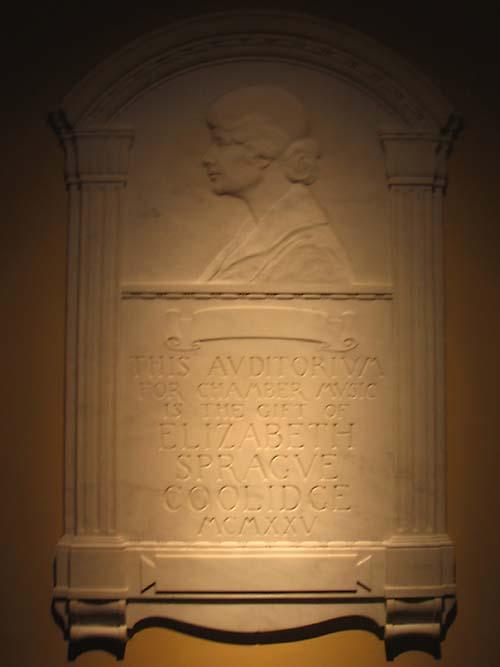
This Auditorium for Chamber Music is the Gift of Elizabeth Sprague Coolidge, 1925
It has taken until this week for Ionarts to review a concert on the Library of Congress series, although I would have liked to attend the concert by the Moscow Sretensky Chorus last month. While the venue's winter-spring schedule is full, with 21 events we hope to review, the fall is a little sparse (I count 8 worth attending). True, there are three string quartets on the roster before Christmas: the Quatuor Ysaÿe (November 16), the Jerusalem Quartet (December 8) -- both admired by Ionarts in the past -- and the Formosa Quartet (December 14). Even better, the lineup of top historically informed performance ensembles continues this season, with Café Zimmermann and Céline Frisch (November 3), followed by Concerto Copenhagen (February 1), Ensemble Matheus and Jennifer Larmore (February 9), Fabio Biondi and Europa Galante (April 16), and John Holloway, Jaap ter Linden, and Lars Ulrik Mortensen (April 17). The total of 29 concerts is a marked improvement over last season's 21 review-worthy concerts, but other than the great early music lineup, there are fewer must-see concerts on their schedule. Today also happens to bring the disturbing news that the Library has lost track of an alarming portion of its vast collection.

Other Reviews:

Robert Battey, Czech Philharmonic Chamber Orchestra (Washington Post, October 24)

John Terauds, Czech orchestra falls flat on first Canadian tour (Toronto Star, October 16)
What finally drew me to the Library was Monday night's concert by the Czech Philharmonic Chamber Orchestra. The score of musicians, playing without a conductor, got a rough start on the opening work, Antonio Rosetti's Sinfonia in G Minor. This was a welcome discovery from the ensemble's homeland (it turns out that Rosetti was born in Bohemia as Franz Anton Rössler), with fast and sinuous outer movements that often reminded me of Mozart's 25th symphony. The third movement has a charmingly rustic Fresco B section, featuring the fine playing of the group's principal oboist, Jana Brožková. She also appeared as soloist in Alessandro Marcello's D minor oboe concerto on the second half, with grace, accuracy, and bubbling embellishments.

Mozart Violin Concerti:
available at Amazon
Leonidas Kavakos


available at Amazon
Christian Tetzlaff
The rest of the program consisted of much more mainstream Classical repertoire, none the less welcome for it. Young violinist Barbora Kolářová, not coincidentally a student of the CPCO's concertmaster and director, Pavel Prantl, had an amiable outing in Mozart's third violin concerto. She played well, but her tone was nondescript, making the performance come off as a little polite, capable certainly but hardly memorable. The CPCO's playing was the best in the final selection, Haydn's 8th symphony (G major, "Le Soir"), especially in the brisk and perky first movement with noteworthy solos by flutist Jiři Valek, as well as the windswept encore, the fourth movement of Mozart's 29th symphony. All of this promise was overwhelmed by decidedly unpolished playing from the ensemble overall, including far too common intonation issues and missed notes, splats in the horns, and sometimes dolorous E string playing from concertmaster Pavel Prantl in the Haydn. This was not a concert that lived up to the group's reputation.

You are advised not to miss the upcoming concert at the Library of Congress by Café Zimmermann and harpsichordist Céline Frisch (November 3).

23.10.07

Maxwell Davies Concludes Naxos Cycle

Naxos Quartets:

available at Amazon
1 and 2
(2004)

available at Amazon
3 and 4
(2005)

available at Amazon
5 and 6
(2006)

available at Amazon
7 and 8
(2007)
We have been enjoying the Maggini Quartet's complete cycle of Naxos Quartets, composed for them by Peter Maxwell Davies, whose pre-eminence among British composers was recognized when he was appointed Master of the Queen's Music in 2004. (Maxwell Davies dedicated no. 8 to the Queen.) The cycle of ten string quartets was the commission of Naxos's founder Klaus Heyneman, and the regular installments on recording were recommended by Jens as among the best discs of the year in 2005 and 2004. The news has come from London that the cycle has been completed. Once the discs are all together on my desk (or Jens's), it will be time for a complete assessment. Andrew Clark has a review of no. 10, premiered at Wigmore Hall last week (Maxwell Davies’ 10th Naxos Quartet, Wigmore Hall, London, October 17) for the Financial Times:
With the premiere on Tuesday of his 10th and final Naxos String Quartet, Sir Peter Maxwell Davies came to the end of what must surely rank as one of the most impressive musical statements of our time. From the intimate exchanges of four string players Max has drawn a language that contradicts the prevailing notion of music as a medium that needs size and/or volume to make an impact. He has gone back to the classic models, Haydn and Beethoven, and somehow found within himself a creative wellspring that can withstand comparison with theirs. No mean achievement.

For those of us who have followed this journey, it has been an immensely rewarding experience. Naxos is to be congratulated for its enterprise – the CDs of each successive quartet-pairing have followed soon after the premiere – and the Maggini Quartet deserves equal recognition for learning so much new and often complex music. The finale, nevertheless, was an anti-climax, with Max himself apparently at a loss to know how to round off the series. His conclusion – to draw a temporary line, with the intention of returning to a medium that has stimulated so many creative juices – seems appropriate, but the 10th Naxos Quartet finds him hovering uneasily, as if his mind is already impatient to move on.
Also see the review from Andrew Clements (Maggini Quartet, October 19) for The Guardian. The end of the series is further complicated by a recent personnel change in the Maggini Quartet, in the person of their new first violinist Lorraine McAslan (recently enough that her predecessor, Laurence Jackson, is still listed in the group's Naxos biography). She will presumably be on the recording of no. 10, too.