CD Reviews | CTD (Briefly Noted) | JFL (Dip Your Ears) | DVD Reviews

14.12.06

Move Over, Jay Greenberg

Other Articles:

An Inspiration for His Peers (Washington Post, November 8, 2005)

Daniel Ginsberg, Apple Hill Chamber Players (Washington Post, March 21, 2005) [Review of initial version of From One World to Another, performed at Dumbarton Concerts]
Blogville has had periodic spasms of interest in the music of young composer Jay Greenberg the last couple years. There is an article on another young composer of great promise, Tudor Dominik Maican, in the Washington Post this morning ('A Very Rare and Unusual Talent', December 14) by Katherine Shaver, complete with a beautifully produced video online. I admit that I am not impartial when it comes to this young man, as I have been informally following his progress for several years. His father is a school colleague of mine and a dear, dear man, and I have been glad to hear regular reports of Dominik's accomplishments amid the wearying schedule of all the Saturday trips up to Juilliard. I have read through a few of his compositions for chorus, all of them charming, skilled, and of exceptional interest. You can hear some audio samples of Dominik's compositions at the Post's Web site: D'un Monde à l'Autre -- Prelude for Orchestra, Trio for Flute, Clarinet and Bassoon, and Reflections on James Joyce. We wish him and his family all the best.

Does This Make My Sackbutt Look Big?

Available at Amazon:
available at Amazon
Samuel Scheidt, Ludi Musici (excerpts), Les Sacqueboutiers (released on October 31, 2006)
Samuel Scheidt (1587-1654) is one of those composers at the periphery of general awareness. Born in the generation after Monteverdi, he wrote music that often looks backward to the Renaissance. The fascination he and others in Germany had with the contrapuntal style of their predecessors, perpetuated in Scheidt's organ music especially, is partly responsible for the vogue of the fugue in the Baroque period. Shortly after Scheidt, the student of Dutch organist and composer Jan Sweelinck, was appointed Kapellmeister to the Margrave of Brandenburg, in Halle, he published this set of light instrumental pieces, the Ludi Musici (Musical games), in four volumes (only the first survives complete). That was in the early 1620s when the Margrave's court could afford to pay for light music to be played at dinner, but the troubles of the Thirty Years' War were about to put an end to the joyful spirit we hear in these pieces. In 1625, Scheidt's employer left Halle to fight alongside the King of Denmark for the Protestant cause, while the composer continued in his position but without a salary. As war, famine, and plague ravaged Halle (the disease claimed the lives of all of Scheidt's children), he remained, subsisting on income from teaching.

The Toulouse-based historically informed performance wind ensemble Les Sacqueboutiers has here recorded just over half of the pieces in what remains of the collection (17 of 32). Most of the instruments you hear are cornetti and sackbuts (one of the ancestors of the trombone, from which the group takes their name, from the word for a player of this instrument). Other sounds come from an organ, theorbo, and occasional percussion for the dance pieces. The members of the group have played with many of the leading HIP groups, and they play masterfully. For specialists this short disc (55:08) may not be able to compete against complete recordings of the Ludi Musici, like that released by Musica Fiata earlier this year on CPO, although that was a mixed-instrument ensemble. Scheidt left few instrumentation specifications with this music, meaning that a performance requires many decisions and much adaptation for whatever forces one chooses. The joyous, plaintive, evocative readings by Les Sacqueboutiers bring some much-needed life to this music. One hopes that they will record the remaining pieces for a second disc in the future.

Ambroisie AM9996

13.12.06

Dip Your Ears, No. 73 (Bruckner 5th)

available at Amazon
A.Bruckner, Symphony No.5,
G.Wand/ MPhil
Profil PH06012

Bruckner’s Fifth Symphony was so daunting a challenge to Günter Wand, that foremost of Brucknerian conductors ever to have wielded the baton, that he did not dare tackle it until he was 62 years old. With the cathedral of the Eighth Symphony and the visionary Ninth Symphony, the Fifth is perhaps the most important, if not the most popular of Bruckner’s works… and just like those other symphonies, it does not necessarily reveal itself easily. I know that I tried numerous times, in vain, to grasp or even cherish the work, listening to Daniel Barenboim’s second recording. It was not until I heard excerpts of the Fifth in an interview with Wand (where the almost 90-year old man protested in shocking vigor against the “crime” that is the Schalk-Edition of the Fifth) that I was hooked. Since then the Fifth has become a small obsession of mine, which included tracking down most of the Wand recordings – none of which were available in the U.S., except as part of the complete WDR set.

With the latest release in Profil Hänssler’s new Günter Wand und die Münchner Philharmoniker Edition, this has finally changed. Recorded in 1995 and never issued until now (as it would have interfered with his own commercial recordings and commercial recordings of the Munich Philharmonic), this Profil Hänssler disc should be most welcome by music fans well beyond the small circle of aficionados that most of that label’s releases appeal to. (I have, for example, just sampled their issue of a superbly recorded 1949 (!) Katja Kabanova from Dresden – in German with the libretto translated by none other than Max Brod. A delightful curiosity that may, despite its qualities, not merit a review for the English-speaking readership of Ionarts on account of being too much of a curiosity item.)

The Munich Philharmonic might well be my favorite Bruckner Orchestra; my particular love for just about anything of Günter Wand is no secret. The result of this combination naturally comes with the highest expectation – and it matches them to a large degree. The sound is very good, if not necessarily much better than on the 1974 recording (issued on EMI/deutsche harmonia mundi as CDC 7 47746 2 in 1977). But what the live-atmosphere (subtle coughs and other audience/conductor noises are audible; as is ‘the space’ around the music) takes away, incredible orchestra detail makes more than up for.

The interpretation in this account is a little weightier than the early recording or his 1996 recording (live) with the Berlin Philharmonic (RCA 09026 68503 2), even though the timings scarcely differ between the three recordings. (The Introduction takes 20:10 in ’74, 20:55 in ’95, and 21:31 in ’96. The Adagio clocks in at 15:49, 15:38, and 16:26, respectively. The Scherzo lasts 14:13, 14:02, and 14:20; the Finale 24:08, 25:02, and 24:57.)

Except in his interpretations of the Eighth, where he is unsurpassed, anyway, Wand never stoops to particular slowness to achieve gravitas. Or, for that matter, his Bruckner is never particularly grave in the first place. Rather, it’s well organized and structured, impossibly compelling… and all while remaining unassuming in a way that Sergiu Celibidache – the other great Bruckner conductor with the Munich Philharmonic – never is or tries to be. This is particularly notable in the Adagio (after all marked “sehr langsam” – very slow) where Wand is faster than most other conductors. Take Sinopoli, at 18:48, for example, or Karajan (DG) at 21:26, or at the very extreme, Celibidache (EMI – made two years before this recording) at 24:14 (!) who all allow for a much, much broader take.

It happens to be broadness that I very much like in the Fifth – and not surprisingly I think that Celibidache’s “slow burn” interpretation is the finest for my ear’s palate. Of course, that recording, too, is currently unavailable in the U.S. (as is, for the time being, Sinopoli’s ‘dark horse’ of a Fifth, also recommendable). Since Thielemann’s Fifth is nearly as slow as Celibidache, but does not keep the music together quite as well, I recommended it as a good, if not ideal, choice for this symphony in a recent review. Nikolaus Harnoncourt’s RCA recording would be the other obvious choice of what is available in good record stores in this country (to the extent there are any left of those…).

With Wand’s recording entering the fray, this choice has been happily enriched with another top contender that anyone who loves Wand (in Bruckner or outside) can happily grab. (Unlike with the Profil Hänssler issue of his 9th,(stunning some critics, more of modest quality to others) there no serious complaint about sound quality or orchestral playing to be made here. Choosing between the three Wand recordings (a bit of a mute point for the American shopper), there is little to give or take between them. Berlin, too, has audience noises – which are obviously absent from the ’74 recording. The resonance is greater than in the Munich recording, the orchestra more present and closer… almost too close. At the same effort or expense, I would probably go for Berlin before Munich, followed by the Cologne account – but the difference is slight. Too slight to resist holding out for the Berlin recording when the Munich one is at a good record store around your corner.


P.S. Volume Three in this series features another work Wand has excelled with on record: Schubert's Ninth Symphony. A "must" for the Wand-fanatic, but the RCA recording is in print, easily available, less expensive, and with better sound quality... leaving it untouched as one of the very best available modern recordings of that symphony.

12.12.06

Stephanie Blythe at Shriver Hall

Stephanie Blythe, mezzo-sopranoMezzo-soprano Stephanie Blythe gave a solo recital on Sunday evening at Shriver Hall, which meant another trip to Baltimore for Ionarts. We last heard Ms. Blythe with Washington Concert Opera in Rossini's Tancredi. Her voice is just as puissant, silky, and dark chocolate as it ever was, but giving a recital of songs is not the same as powering one's way through an opera in a large hall. Blythe has assembled a varied program, in three languages, all of which she sings capably, if some sit more comfortably than others. The results were uneven but still with much to enjoy.

The best match for Blythe's musical personality was the disappointingly short set of three mélodies by Henri Duparc. Matched in exotic color by the full-voiced accompaniment of Warren Jones, Blythe took us into the ambivalent world of these unusual songs, set to poems whose meaning is not always clear, or that we may not really understand until the final line. Chanson triste was gorgeous, with a sustained vocal line wrapped in a murky, murmuring accompaniment. Au pays où se fait la guerre (poem by Théophile Gautier) is one of my favorite Duparc songs, especially in the second stanza, when Duparc's accompaniment turns chromatic. Blythe's huge voice burst forth in the final lines, embodying the narrator's despair, the perfect vehicle for overwhelming sound.

Other Reviews:

Tim Smith, Mezzo-soprano Blythe dazzles (Baltimore Sun, December 12)

Jay Nordlinger, Stirring Moments, But Off Night for Blythe (New York Sun, December 11)

Anne Midgette, Power First Restrained, Then Set Free (New York Times, December 9)

David Patrick Stearns, A big voice - minus the meaning (Philadelphia Inquirer, December 6)
Manuel de Falla's Siete Canciones Populares Españolas is perhaps the best adaptation of folk music in the song repertory. Who knows what some of these old texts mean? In Asturiana, the narrator sings about a green pine that weeps in sympathy. De Falla takes something exceedingly simple, a tune sung with tender, uninterrupted line by Blythe, and stitches a gentle piano accompaniment around it. The tonally rather ambiguous Nana, a hushed lullaby, was disarmingly sweet. That quiet was then obliterated in the final song, the unsettled lover's complaint Polo, with its pulsating accompaniment and yowling exclamations. For her single encore, Blythe stayed in Spanish, with the carnavalesque Canto negro, from Xavier Montsalvatge's cycle Cinco canciones negras.

Least satisfying was the first half of Brahms Lieder, for which we may be tempted to blame Brahms as much as Blythe. The first set of five songs had many high points, and Jones's piano captured the tear and pull of Brahmsian anguish. What is it about switching from accompanying to playing alone? In his set of Brahms short piano pieces, Jones's sound was mostly loud and percussive, with the emphasis in the Capriccio (op. 76, no. 5) definitely not on lyricism. With Hélène Grimaud's strangely light reading of the G minor Rhapsody still in my ears from last month at Shriver Hall, Jones's interpretation of the same piece seemed heavy on power and pedal but lacking in subtlety.

To reach the sort of muffled, interior reading she wanted, Blythe had to get in touch with the soft side of her voice. The good news is that she has one, and her approach here was subtle, if a bit underwhelming. There were moments when she reached that sort of intense, compressed sound I think she wanted, as in the gorgeous second half of Der Tod, das ist die kühle Nacht. Blythe's reading of the Vier ernste Gesänge, those four serious songs on Biblical texts, was frankly disappointing, although as always with Blythe there were delicious moments. The death march pulse of Denn es gehet was more agitated and irregular than steady. Still, this recital was a virtuosic display of a first-rate voice.

The next concert at Shriver Hall will feature cellist Lynn Harrell and pianist Victor Santiago Asuncion (January 28th, 5:30 pm). Ionarts will definitely be back there in April, for concerts by the Tallis Scholars, with an all-Renaissance program (April 1, 5:30 pm), and pianist Louis Lortie, playing all of the Chopin etudes (April 29, 5:30 pm).

Leonardo Drops by Washington

For two days last week, Washingtonians had the chance to view a small sketch by Leonardo da Vinci, from the collection of the Galleria degli Uffizi. In Share the Perspective of Genius: Leonardo's Study for the Adoration of the Magi (December 7 and 8 only), the tiny piece of parchment (about 6 x 11 inches) was accompanied by some technological bells and whistles in its small room on the upper floor of the Jefferson Building's exhibit space. Many of those digital enhancements can be viewed at the online exhibit hosted at the Library's Web site.

Leonardo da Vinci, study for Adoration of the Magi, Galleria degli Uffizi, Florence
Leonardo da Vinci, study for Adoration of the Magi
Galleria degli Uffizi, Florence

The sketch is a partial study, for the upper background of the artist's Adoration of the Magi, a wood-panel altarpiece intended for the monastery of San Donato a Scopeto. However, like so much of Leonardo's work, it was never finished. Worse, later hands obscured much of what Leonardo had finished with other layers of paint. Recent work with non-invasive scanning technology, carried out comparatively on this sketch and the wood panel, have given scholars a more complete understanding of what Leonardo was planning to make.

What stands out in viewing the study by itself is the mathematical rigor of Leonardo's working out of perspective in the scene. The orthogonal lines are reinforced with sharp edge and ink, almost like the computerized grid you see behind digital images. When you transfer the image mentally to the wood panel, in which the orthogonal lines are mostly hidden, the vanishing point is slightly off center, behind the trunk of that obtrusive tree. That adds to the shift of the background, in general, to the right, unsettling the symmetry of the scene in the foreground. The sketch, by itself, does little to make sense of the crazy scenes Leonardo had in mind for the background: an architectural ruin with staircases, a battle scene swarming with horses. It becomes a little clearer in some of the infrared scans of the study. Happily, you can still examine those online, but the sketch has gone back to Florence.

11.12.06

Nicola Benedetti Plays the Mendelssohn

Available at Amazon:
available at Amazon
Nicola Benedetti, Mendelssohn Violin Concerto (Mozart-Schubert-MacMillan), Academy of St. Martin-in-the-Fields, James MacMillan (released on November 14, 2006)
Earlier this year, I wrote about Nicola Benedetti's first disc with Deutsche Grammophon. The young violinist, the daughter of a Scottish millionaire, was the BBC Young Musician of the Year in 2004, a competition she won by playing a rare and delightful work, Szymanowski's first violin concerto (1915-16). The 17-year-old subsequently signed a major contract with DG, to make six recordings for the impressive salary of £1 million. The Szymanowski was the major reason to buy that first recording. Although Benedetti is a great talent, this CD seems like a step backward from the promise of her first recording. In an interview-article earlier this year (Nicola Benedetti: from prodigy to professional, May 10), by Tim Cornwell for The Scotsman, Benedetti announced that she was switching managers, something that has happened since this recording was made in January:
I'm working with someone who will help me control things a lot more and, I think, halt my diary slightly more. Hopefully, I'll gain control over the next couple of years and be able to fit in everything I'd like to do. The ideal situation would be to do slightly less, and everything slightly better, and have more time to practise, more time to develop, more time to learn.
Other Reviews:

Geoff Brown, Nicola Benedetti (The Times, May 12)

Colin Clarke, Nicola Benedetti & James MacMillan (The Classical Source, August 6)

Marc Geelhoed, Nicola Benedetti (Time Out Chicago, November 29)

The problem Benedetti has on this new disc is that the main attraction is a rather familiar work, Mendelssohn's E minor violin concerto, op. 64. It does not sound like she was quite ready to record the piece, technically or interpretatively. (One has only to read the page of her comments in this CD's liner notes, spelling errors and all, to appreciate Benedetti's youth.) Her recent performances of the Tchaikovsky concerto have come in for similar criticism. The rest of the program is a series of inconsequential miniatures -- some pretty Mozart, two Schubert arrangements (including a saccharine Ave Maria with harp accompaniment), and a piece composed for Benedetti by the talented Scottish composer James MacMillan -- all of which, except the last, feel like padding.

Benedetti has lovely moments, in some of the soft passages of the Mendelssohn, for example. MacMillan guides the Academy of St. Martin-in-the-Fields, an ensemble that has seen its reputation slide somewhat in recent years, in a capable and full-bodied performance. In the end, however, Benedetti's bravura and impetuous youth are not enough. On the other hand, it is good to hear her confronting more recent music. The MacMillan work, given its premiere recording here, is titled From Ayrshire, a reference to the region of Scotland where Benedetti grew up. Especially in its languorous first movement, it takes advantage of Benedetti's strengths, long lines, soft playing, and exotic, coloristic effects, the same characteristics that made her performance of the Szymanowski concerto so lovely. Judging from her own words quoted above, Benedetti knows what she needs to do at this point in her career, to let her remarkable talent blossom as it should. I am willing to keep listening, but you should feel free to skip this recording and hope for better things down the road.

Deutsche Grammophon B0007682-02

The Bible by Hand

Logia Jesou, Oxford, Bodleian Library, MS. Gr. th. e. 7 (P), 3rd century CE
The Bible is a fundamental text, even today and even for those who do not share any of the beliefs associated with it. Two excellent exhibits in Washington right now examine both ends of the history of this set of books. The Arthur M. Sackler Gallery is showing In the Beginning: Bibles before the Year 1000 (through January 7, 2007), which brings together over 70 early examples of the Bible's written tradition. The ancient papyrus and vellum pages are so fragile that the museum has to show most of them under faint and rather diffuse light, and always in sealed cases. Cosponsored by the University of Oxford's Bodleian Library, and probably quite expensive because of insurance costs, this exhibit is a blockbuster, in a low-key way. Treasures have been loaned by the Bodleian, the British Library, the Bibliothèque nationale de France, the Monastery of St. Catherine on Mt. Sinai, and others, many of them shown for the first time ever in the United States.

The Bible has changed so much over the centuries, in language, in content, in the way it was copied and transmitted, in how people interacted with it. The show begins with some of the oldest fragments, Egyptian papyrus bits from around the year 200, like the Egerton Gospel and the Chester Beatty papyri. The pages in the first few rooms, in mysteriously dim light, are mostly devoid of visual imagery and, on the surface, may not be of great interest for visitors who do not read Greek, Latin, Hebrew, Arabic, Syriac, Armenian, Ethiopian, and Coptic. For this reason, the informative and well-produced audio tour is certainly worth your $5, especially since the exhibit itself is free. It adds some much-needed context about the significance of the pieces on display, for example, explaining the importance of the Nag Hammadi Codex II and related fragments, now known to contain portions of the so-called Gospel of Thomas, and the Codex Sinaiticus.

Greater artistic interest is found in the later rooms, which include manuscripts from early Christian Europe. The most important is the Rabbula Gospels, a striking and lavishly illuminated manuscript made in 586 at the monastery of Saint John in Beth Zagba, Syria (now owned by the Biblioteca Laurenziana in Florence). It is one of the best surviving examples of early Christian painting, which you may remember from your art history textbook. Of equal historical importance is the so-called Alcuin Bible, produced at the monastery of St. Martin in Tours under the direction of Alcuin of York, in the reformed lettering known as Carolingian minuscule, to be presented to Charlemagne. From around the same period is an exquisite carved codex cover, the Douce Ivory from the Bodleian Library, made at Aachen, the capital of Charlemagne's empire, around the year 800. If you are not able to go to this exhibit in person, the Sackler Gallery has made a particularly good online exhibition, which includes short audio-video clips that explain the various parts of the show.
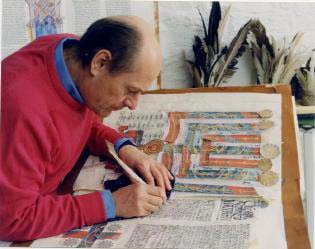
At the same time, pages from the latest example of a fully handwritten and lavishly illustrated copy of the Bible, the Saint John's Bible, are on display at the Library of Congress as Illuminating the Word: The Saint John's Bible (open until December 23). As I described in a post earlier this fall (Remembering the Codex, October 16), calligrapher Donald Jackson dreamed up this quixotic project, to create a modern manuscript of the Bible, copied entirely by hand on vellum using traditional materials. He convinced the monks of St. John's Abbey, the Benedictine house that runs St. John's University in Collegeville, Minn., to fund his dream. Once again, for only the most recent time in its 1,500-year history, the Order of Saint Benedict demonstrates its devotion to the preservation of learning.

The English text, taken from the NRSV translation, does not look medieval, although the script that Jackson developed is based on older lettering. Although the St. John's Bible is a Catholic book, the illuminations draw from other religious traditions and modern sources. In striving to be universal, however, Jackson and his team have made something neither fish nor fowl. Art history creeps in with an ox from the walls of the Lascaux cave in the Nativity illumination; science manuals make an appearance in the illuminations of butterflies and other insects; the Tree of Jesse, illustrating the genealogy of Jesus, morphs into a menorah. It is a modern and universal work (that quality of being all things and therefore no one of those things), built on a medieval foundation.

The Library of Congress has put together a small companion exhibit from its own collection of Bibles, in a couple small cases at the end of the exhibit. The manuscript tradition is represented by a tiny Latin Bible made in England in the 13th century and a 15th-century codex from Venice. For the final stage of the Bible's evolution, from the individualized and handwritten to the uniform and printed, there is a rare exemplar of the King James Bible (1611) and the Eliot Indian Bible (1663), the first Bible printed in America. With the Saint John's Bible's return to a manuscript form, albeit with a standardized text, the circle is complete.

10.12.06

Dip Your Ears, No. 72

available at ArkivMusic
S. De Brossard, Les Grand Motets, EBL, Christophe Coin
Touches of Charpentier again – but also German baroque can be found on the second recording of the Laborie label. This time the Ensemble Baroque de Limoges under Christophe Coin comes up with the three Grand Motets of early musicologist Sébastien de Brossard (1655 – 1730). “In Convertendo Dominus”, “Miserere”, and “Canticum Eucharisticum Pro Pace” are three works by this French/Alsatian composer that add up to over an hour of very fine early baroque music, bound to please anyone who wishes to look beyond Bach cantatas and Charpentier’s Te Deum. The singing is excellent (especially basses Olivier Lallouette and Jérôme Corréas) – and so is the playing of the Ensemble Baroque de Limoges. Not essential, of course, but a delightful second issue from this enterprising label and group. (That it is in fact a re-issue doesn't deter... although that factoid is more hidden than offered. This disc originally came out on the Astrée label in 1997.)

LABORIE LC02. You can read the review of LABORIE LC01 here.