CD Reviews | CTD (Briefly Noted) | JFL (Dip Your Ears) | DVD Reviews

1.6.06

Get In On Baltimore's Museums This Fall

Jacqueline Trescott reports (Art Museums In Baltimore To Drop Fees, June 1) on this lovely June day in the Washington Post that the art museums of Charm City will soon be open free of charge to visitors:

The Baltimore Museum of Art and the Walters Art Museum announced yesterday that both museums are eliminating admission fees, a step made possible by an $800,000 gift from the city and county. Anne Arundel County also gave each museum $30,000 for the effort. Free admission starts Oct. 1 and marks a return to a time 24 years ago when it didn't cost anything to get into the two museums. In recent years, they charged $10. The directors acknowledge they are taking a risk in financially tight times, but said they wanted to make the museums cultural destinations for locals and out-of-towners, as well as to increase diversity. "We wanted to do something innovative," said Gary Vikan, director of the Walters Art Museum.
As someone who is utterly spoiled by living in Washington, where the Smithsonian museums are all free of charge, I have to say that I think free admission, or at least the possibility of free admission (as at the Metropolitan Museum of Art) is the appropriate way to make art available to all. Unfortunately, the American Visionary Art Museum did not receive any funds. However, you will not regret any of the cost of your ticket to that place. Also, the Chairperson of their Board of Directors is a great lady.

31.5.06

What's under Versailles?

In March, I posted about the latest work to restore the Château de Versailles to its Baroque state. The government has decided to recast the royal grille, a fence that separated the king's part of the courtyard from the common area. Designed by Jules Hardouin-Mansart, this barrier created a sort of royal clôture, a space set apart, and it was melted down during the Revolution. A new article by Marie-Douce Albert (Les dessous de la cour de Versailles, May 30) for Le Figaro describes the current state of work, which has revealed much of what is underneath that famous courtyard's cobblestones (my translation):

Several vestiges of the destroyed grille remained hidden in the ground and have been uncoverd during archeological excavation. By peering over the barricades, these days visitors can see a little bit underneath the courtyard of Versailles. You see the edge of the grill constructed by Jules Hardouin-Mansart and the placement of one of the posts. You can make out little blocks of red wall, the remains of the preceding fortified wall, built by Le Vau. "These excavations have allowed us to demonstrate that the historical pictures we have preserved are accurate," says Frédéric Didier, chief architect of historical monuments. Placed solidly on those historic stones, the new grill will be finished by the end of 2007.
This sort of thing doesn't happen very often, so historians of Versailles are all watching with great interest.

Classical Month in Washington (June)

Last month | Next month

Classical Month in Washington is a monthly feature that appears on the first of the month. If there are concerts you would like to see included on our schedule, send your suggestions by e-mail (ionarts at gmail dot com). Happy listening!

Thursday, June 1, 7 pm; Friday, June 2, 1:30 pm; Saturday, June 3, 8 pm
National Symphony Orchestra, with Kurt Masur, guest conductor
Beethoven's Leonore Overture and Symphonies 1 and 7
Kennedy Center Concert Hall
See the review by Jens F. Laurson (Ionarts, June 2)

Thursday, June 1, 8 pm
Baltimore Symphony Orchestra: Russian Romance
Khachaturian's violin concerto with concertmaster Jonathan Carney
Music Center at Strathmore
See the review by John Henry Crosby (Ionarts, June 2)

Friday, June 2, 7:30 pm; Saturday , June 3, 7:30 pm
W. A. Mozart, Idomeneo
Opera Lafayette (Washington Early Music Festival)
Clarice Smith Performing Arts Center (College Park, Md.)
See the review by Charles T. Downey (Ionarts, June 4)

Friday, June 2, 8 pm; Saturday, June 3, 8 pm
Gilbert and Sullivan, Pirates of Penzance
New York Gilbert and Sullivan Players
Filene Center, Wolf Trap

Friday, June 2, 8 pm; Saturday, June 3, 5 and 8 pm; Sunday, June 4, 2 pm
Folger Consort and Concord Ensemble
Music by Marenzio and Morley (Washington Early Music Festival)
Folger Shakespeare Library
See the review by Stephen Brookes (Washington Post, June 5)

Saturday, June 3, 7 pm
Rossini, L'Italiana in Algeri
Washington National Opera
Kennedy Center Opera House
See the review by Jens F. Laurson (Ionarts, May 16)

Saturday, June 3, 7:30 pm
Brothers, Sing On!
Washington Men's Camerata
Kennedy Center Terrace Theater
See the review by Cecelia Porter (Washington Post, June 5)

Saturday, June 3, 8 pm
Spanish Treasure (Granados, Montsalvatge, and Mompou; Sephardic songs, Andalusian folk songs, Zarzuela)
Wolf Trap Opera Company (with Steven Blier)
The Barns at Wolf Trap

Saturday, June 3, 8 pm
National Philharmonic: Mozart's Great Mass
With Elizabeth Bishop, mezzo-soprano
Music Center at Strathmore
See the review by George A. Pieler (Ionarts, June 8)

Sunday, June 4, 2 pm
Kennedy Center Chamber Players
Mozart's Piano Quartet No. 1 in G minor, K. 478; Hindemith's Clarinet Sonata in B-flat major, and Strauss's Piano Quartet in C minor, op. 13
Kennedy Center Terrace Theater
See the review by Jens F. Laurson (Ionarts, June 6)

Sunday, June 4, 2 pm
Frederick A. Peterbark, tenor, and Audrey Peterbark-Ross, piano
Unity Presbyterian Church (Temple Hills, Md.)

Sunday, June 4, 3 pm
Carmina, Floating Notes: Venetian Choral Music by Lotti and Caldara
Washington Early Music Festival
St. Mary Mother of God Catholic Church

Sunday, June 4, 6:30 pm
National Gallery Chamber Players String Quartet [FREE]
Quartets by Mendelssohn and Shostakovich
National Gallery of Art

Sunday, June 4, 8 pm
Sumi Jo, soprano: Beautiful Challenge
Opera arias and sacred songs, with Vincenzo Scalera, piano
Kennedy Center Concert Hall
See the review by Jens F. Laurson (Ionarts, June 7)

Wednesday, June 7, 7 pm
Outdoor Concert: American Symphonic Clarinet Choir [FREE]
On the Lawn at Strathmore

Wednesday, June 7, 7:30 pm
Tchaikovsky, Iolanta
Opera Bel Cantanti
The Lyceum (Alexandria, Va.)
See the review by Charles T. Downey (Ionarts, June 9)

Thursday, June 8, 7 pm; Friday, June 9, 8 pm; Saturday, June 10, 8 pm
National Symphony Orchestra, Mahler's Symphony of a Thousand
With Jane Eaglen, Christine Brewer, Christine Brandes and other soloists
Joined by Cathedral Choral Society, Children's Chorus of Washington, Choral Arts Society of Washington, Master Choral of Washington, and the Washington Chorus
Kennedy Center Concert Hall
See the review by Jens F. Laurson (Ionarts, June 9)

Thursday, June 8, 7:30 pm
Lydia Rathkolb, soprano, and Frank Conlon, piano [FREE]
Children's Songs and Love Songs by Wolfgang Amadeus Mozart and Ivan Eröd
Embassy of Austria

Friday, June 9, 7:30 pm
The American Chamber Players (Miles Hoffman, artistic director)
Weber, Trio for flute, cello piano; Armand Merck, Dialogue for violin and viola (world premiere); Bach, Sonata for flute and piano, BWV 1031; Mozart, Piano Quartet in G minor
Kreeger Museum June Chamber Festival
Kreeger Museum (2401 Foxhall Road NW)

Friday, June 9, 7:30 pm
Tchaikovsky, Iolanta
Opera Bel Cantanti
La Maison Française
See the review by Charles T. Downey (Ionarts, June 9)

Friday, June 9, 8 pm
Hesperus, Ecco la Primavera
Washington Early Music Festival
St. Columba's Episcopal Church

Saturday, June 10, 9 am to 4 pm
Secrets of the Sistine Chapel, workshop by Philip Cave
Washington Early Music Festival
St. Columba's Episcopal Church

Saturday, June 10, 4 pm
Concert of Sistine Chapel Workshop, Philip Cave
Washington Early Music Festival
St. Columba's Episcopal Church

Saturday, June 10, 8 pm
Ground (early 17th-century Italian ostinato bass pieces)
Ignoti Dei Ensemble (Elizabeth Baber, soprano; Brian Cummings, countertenor; Daniel Boothe, violin; Charlie Weaver, lute-theorbo-guitar; Daniel Rippe, Viola da Gamba)
Washington Early Music Festival
St. Columba's Episcopal Church

Saturday, June 10, 8 pm
Baltimore Symphony Orchestra: A Maestro's Finale
Mahler, Symphony No. 2 ("Resurrection"), last concert with Yuri Temirkanov
With soprano Janice Chandler-Eteme, mezzo-soprano Nancy Maultsby, Baltimore Choral Arts Society and Morgan State University Choir
Music Center at Strathmore
See the review by Jens F. Laurson (Ionarts, June 12)

Saturday, June 10, 8 pm
Gloria Italia: Palestrina and Monteverdi
Chantry and the Orchestra of the 17th Century (Washington Early Music Festival)
St. Mary Mother of God Catholic Church
See the review by Cecelia Porter (Washington Post, June 12)

Saturday, June 10, 8 pm
Two Weddings and a Funeral: Herbert Howells, Requiem; Benjamin Britten, Wedding Anthem, Andrew Simpson, A Crown of Stars (world premiere)
Cantate Chamber Singers
Bradley Hills Presbyterian Church (Bethesda, Md.)
See the review by Mark J. Estren (Washington Post, June 12)

Saturday, June 10, 8 pm
National Orchestral Institute
Wagner, Siegfried's Funeral March; Britten, Sinfonia da Requiem, op. 20; Mahler, Symphony no. 5
Michael Stern, conductor
Clarice Smith Performing Arts Center (College Park, Md.)
See the review by Joan Reinthaler (Washington Post, June 12)

Sunday, June 11, 6:30 pm
Sara Davis Buechner, pianist [FREE]
Music by Debussy, Friml, Gershwin, Mozart, and Munz
National Gallery of Art
See the review by George A. Pieler (Ionarts, June 14)

Sunday, June 11, 8 pm
Palestrina Choir, Princeps Musicae (Last. Concert. Ever.)
Washington Early Music Festival
St. Columba's Episcopal Church

Monday, June 12, 6:30 pm (press conference precedes at 5 pm)
Roundtable discussion on Francesco Cavalli's opera La Didone
Italian Cultural Institute (2025 M Street NW)
In collaboration with Ignoti Dei Opera
RSVP required (202) 223-9800 ext. 1

Tuesday, June 13, 7:30 pm
The American Chamber Players (Miles Hoffman, artistic director)
Milhaud, Suite for clarinet, violin, and piano; Beethoven, Trio for Clarinet, cello, piano, op. 11; Martinů, Serenata for two violins and viola; Mozart, Quintet for clarinet and strings
Kreeger Museum June Chamber Festival
Kreeger Museum (2401 Foxhall Road NW)
See the review by George A. Pieler (Ionarts, June 15)

Tuesday, June 13 to Saturday, June 18, 7:30 pm; June 17 and 18, 1:30 pm
Kirov Ballet (Valery Gergiev, Artistic Director)
Kennedy Center Opera House
See the review [Forsythe] by Oksana S. Khadarina (Ionarts, June 16) and the review [Giselle] by Jens F. Laurson (Ionarts, June 20)

Thursday, June 15, 7 pm
Malin Nilsson, soprano, and Maria Orlovskaya, piano
Jenny Lind Scholarship Winners
Corcoran Gallery of Art (co-sponsored by the Embassy of Sweden)

Thursday, June 15, 7 pm; Friday, June 16, 7 pm; Saturday, June 17, 7 pm
National Symphony Orchestra, Composer Portrait: Mozart
With Jennifer Casey Cabot, soprano, and Benjamin Butterfield, tenor
Kennedy Center Concert Hall
See the review by Andrew Lindemann Malone (Washington Post, June 16)

Thursday, June 15, 8 pm; Friday, June 16, 8 pm; Saturday, June 17, 11 am (Casual Concert, without Rachmaninov)
Baltimore Symphony Orchestra, with violinist Joshua Bell and Marin Alsop, guest conductor
Kabalevsky, Colas Breugnon Overture; Rachmaninov, Symphonic Dances, op. 45; Corigliano, Violin Concerto, "The Red Violin"
Meyerhoff Symphony Hall (Baltimore, Md.)
See the review by Jens F. Laurson (Ionarts, June 16)

Friday, June 16, 7:30 pm
The American Chamber Players (Miles Hoffman, artistic director)
Pierné, Sonata da camera, for flute, cello piano; Piston, Duo for viola and cello;
Poulenc, Sonata for flute and piano; Mendelssohn, Piano Quartet in B minor, op. 3
Kreeger Museum June Chamber Festival
Kreeger Museum (2401 Foxhall Road NW)

Friday, June 16, 8 pm; Saturday, June 17, 8 pm; Sunday, June 18, 2:30 pm
Cavalli and Busenello, La Didone (staged, with orchestra)
New World premiere
Ignoti Dei Opera Company
Washington Early Music Festival
Harold and Sylvia Greenberg Theatre (American University)
See the review by Jens F. Laurson (Ionarts, June 18)

Friday, June 16, 8 pm; Sunday, June 18, 2 pm; Friday, June 23, 8 pm; Sunday, June 25, 2 pm
Telemann, Orpheus
Wolf Trap Opera Company
The Barns at Wolf Trap
See the review by Charles T. Downey (Ionarts, June 18)

Saturday, June 17, 7:30 pm
Glorystar's Children's Chorus Festival
Glorystar Children's Chorus, Children’s Chorus of Washington, Frederick Children’s Chorus, and the Maryland State Boychoir
Music Center at Strathmore

Saturday, June 17, 8 pm
National Orchestral Institute
Weber, Overture from Der Freischutz; Sibelius, Symphony no. 6; Stravinsky, The Firebird (1910, complete)
Stefan Sanderling, conductor
Clarice Smith Performing Arts Center (College Park, Md.)
See the review by Tim Page (Washington Post, June 19)

Sunday, June 18, 1 pm and 3 pm
National Symphony Orchestra Family Concert: The Magic of the Firebird
Recommended for ages 7 and up
Kennedy Center Concert Hall

Sunday, June 18, 6:30 pm
National Gallery of Art Vocal Arts Ensemble [FREE]
Madrigals by Verdelot, Arcadelt, Rore and other Italian masters
Washington Early Music Festival
National Gallery of Art, West Building, West Garden Court

Monday, June 19, 7:30 pm
Mathias Hausmann, baritone, and Betty Bullock, piano [FREE]
On the Occasion of Freud's 150th Birthday
Freud’s Vienna: Lieder by Johannes Brahms, Gustav Mahler, Hugo Wolf, Alexander Zemlinsky, Franz Schreker, Arnold Schönberg, Franz Lehar
Embassy of Austria
See the review by Cecelia Porter (Washington Post, June 21)

Monday, June 19, 8 pm
The Metropolitan Chorus, Music Under the Summer Stars
Free outdoor concert (no ticket required)
Lubber Run Amphitheater (Arlington, Va.)

Monday, June 19, 8 pm
The North Wind and the Sun: Vivaldi's Venice
Modern Musick (with Matthias Maute, recorder, and St. Mark's Chancel Choir)
Washington Early Music Festival
St. Mark's Episcopal Church (Capitol Hill)
See the review by Charles T. Downey (Ionarts, June 20)

Tuesday, June 20, 12 noon
Tom MacCracken and Vera Kochanowsky, harpsichord duo
17th-century Italian music for one and two harpsichords by Frescobaldi and others
Washington Early Music Festival
St. Mark's Episcopal Church (Capitol Hill)

Tuesday, June 20 to Saturday, June 24, 7:30 pm; June 24 and 25, 1:30 pm
The Royal Ballet (Great Britain)
Tchaikovsky, Sleeping Beauty, and other selections
Kennedy Center Opera House

Tuesday, June 20, 8 pm
Il Quattro Stagioni: Italian Music in Europe (Bach's flute partita, Marais's La Follia, Vivaldi's Spring concerto)
Matthias Maute, recorder and flauto traverso
Washington Early Music Festival
St. Mark's Episcopal Church (Capitol Hill)
See the review by Charles T. Downey (Ionarts, June 21)

Wednesday, June 21, 12 noon
Two Gents of Venice and Fusignano: Vivaldi and Corelli (trio sonatas)
Ensemble Gaudior
Washington Early Music Festival
St. Mark's Episcopal Church (Capitol Hill)

Wednesday, June 21, 8 pm
Suspicious Cheese Lords, "Boot"-elicious: The Music of Renaissance Italy
Washington Early Music Festival
St. Mark's Episcopal Church (Capitol Hill)

Wednesday, June 21, 7:30 pm; Sunday, June 25, 2:30 pm
Mozart, The Magic Flute
Robert Baker (Tamino)
Summer Opera Theatre Company
Hartke Theater (Catholic University)
See the review by Tim Page (Washington Post, June 20)

Wednesday, June 21, 8 pm; Friday, June 23, 8 pm
Bellini, I Capuleti e i Montecchi (abridged concert performance, with piano)
Meghan McCall (Giulietta), Jose Sacin (Romeo), Matthew Osifchin (Lorenzo)
Chamber Opera of Washington, D.C.
Patricia M. Sitar Center for the Arts (1700 Kalorama Road, NW, Suite 101)

Thursday, June 22, 12 noon
Voci di amori (17th- and 18th-century Italian solo and duet cantatas)
Tresorino (Jennifer Ellis, soprano; Jay White, countertenor; Michelle Roy, harpsichord)
Washington Early Music Festival
St. Mark's Episcopal Church (Capitol Hill)

Thursday, June 22, 8 pm
Countertop Quartet and The Baroque Band, Music of the Venetian Ospedali
Washington Early Music Festival
St. Mark's Episcopal Church (Capitol Hill)

Thursday, June 22, 8 pm
Baltimore Symphony Orchestra: Music for Hollywood Film Epics
Jack Everly, conductor
Music Center at Strathmore

Friday, June 23, 12 noon
The Virtuosos of Rome, Venice, Ferarra and Naples
Atsuko Ikeda, harpsichord
Washington Early Music Festival
St. Mark's Episcopal Church (Capitol Hill)

Friday, June 23, 7:30 pm
Recital in Memory of Ignacy Jan Paderewski
John Robilette, piano
Embassy of Poland (2460 16th Street NW)

Friday, June 23, 8 pm
Amor l'ali m'impenna (Love Feathers My Wings): Passionate Music of the Italian Middle Ages and Renaissance
Armonia Nova
Washington Early Music Festival
St. Mark's Episcopal Church (Capitol Hill)

Friday, June 23, 8 pm
Pittsburgh Youth Symphony Orchestra
Music Center at Strathmore
See the review by George A. Pieler (Ionarts, June 27)

Saturday, June 24, 3 pm
ArcoVoce, Desiderio d'amore
Washington Early Music Festival
St. Mark's Episcopal Church (Capitol Hill)

Saturday, June 24, 7:30 pm
Georg Philipp Telemann, Cantatas
Washington Kantorei
The Falls Church (Falls Church, Va.)

Saturday, June 24, 8 pm
Deuce (Garry Clarke, Baroque violin; Michelle Roy, harpsichord), The Italian Job
Washington Early Music Festival
St. Mark's Episcopal Church (Capitol Hill)

Saturday, June 24, 8 pm
National Orchestral Institute
Prokofiev, Classical Symphony, op. 25; Hindemith, Symphonic Metamorphosis of Themes by Carl Maria von Weber; Strauss, Don Quixote
Eri Klas, conductor
Clarice Smith Performing Arts Center (College Park, Md.)

Sunday, June 25, 3 pm
Gay Men's Chorus of Washington, 25th Anniversary Concert
With Barbara Cook (music from Broadway musicals)
Kennedy Center Concert Hall

Sunday, June 25, 3 pm
DC3: Washington Music, the Way It Was And Is!
Washington Musica Viva
Atlas Performing Arts Center (1333 H St NE), Theatre II

Sunday, June 25, 6:30 pm
Tempesta di Mare and Drew Minter, countertenor [FREE]
Music of the Late Renaissance and Early Baroque in Italy
Washington Early Music Festival
National Gallery of Art, West Building, West Garden Court
See the review by George A. Pieler (Ionarts, June 30)

Thursday, June 29, 6 pm
National Symphony Orchestra, Season Preview Concert [FREE]
Millennium Stage performance
Kennedy Center Concert Hall
See the review by Tim Page (Washington Post, July 1)

Thursday, June 29, 7 pm
Edith Piaf: Her Passionate Life and Music
Simone Marchand, French singer (narrated by Professor Joan Keefe)
Corcoran Gallery of Art

Friday, June 30, 8 pm; Saturday, July 1, 8 pm; Sunday, July 2, 3 pm
Ground (multimedia theater work using 17th-century ostinato bass pieces)
Ignoti Dei Opera
Baltimore Theater Project
See the review by Charles T. Downey (Ionarts, July 1)

30.5.06

Opera on DVD: "Idomeneo"

Available at Amazon:
available at Amazon
W. A. Mozart, Idomeneo, Luciano Pavarotti, Hildegard Behrens, Frederica von Stade, Ileana Cotrubas, Metropolitan Opera, James Levine (re-released on April 11, 2006)
The picture on the cover of this DVD's box tells most of the story: it was the Met, it was the 1980s, a man named Joseph Volpe was only an assistant general manager, and the premier American opera company was finally getting around to performing Mozart's Idomeneo. This production made Mozart's early work popular with mainstream opera audiences, and it did that by showing that the big stars of the day -- Ileana Cotrubas, Hildegard Behrens, Frederica von Stade, and, God help us, Luciano Pavarotti (does that cast list take you back two decades or what?) -- wanted to sing it and actually did a nice job.

available at Amazon
Idomeneo, Glyndebourne Festival, T. Nunn, B. Haitink, P. Langridge, Y. Kenny


available at Amazon
Idomeneo, Drottningholm Slottsteater (released May 16, 2006)
Now, for my money, this would not be the way I would optimally want Idomeneo immortalized on my DVD player. I would lean toward one of the smaller productions, informed more by early music practices, like the 1983 Glyndebourne Festival version (with Trevor Nunn, Bernard Haitink, Philip Langridge, and Yvonne Kenny) actually set in Crete (strangely not the version chosen to be re-released as part of a Mozart Year Glyndebourne set this year, like this DG set of Mozart I have been reviewing here, beginning with La Clemenza di Tito). Even better, I am guessing, would be the Drottningholm Slottsteater version, with the added benefit of the beauty and authenticity of that remarkable theater, just released by Arthaus Musik this month (which I am hoping to see soon).

What will you get with this Deutsche Grammophon re-release? A vast production by Jean-Pierre Ponnelle, whose Met staging of L'Italiana in Algeri was just unearthed again here in Washington and whose "on location" film version of La Clemenza di Tito I recently reviewed. The set is mostly dominated by a massive mask, representing the ever-present menace of Neptune and based, it seems to me, on the Bocca della Verità in Rome. At other times, there are huge backdrops based on the engravings and drawings by Piranesi and others in the 18th century, showing the classical ruins of Greece and Rome. Ponnelle's costumes are all from Mozart's time, 18th-century Vienna, a conceit also found in the Clemenza film, meant to show that although the story is classical, Mozart was actually creating a work about his own age. This is another one of those operas about a ruler stepping down from power to avoid the death of the innocent.

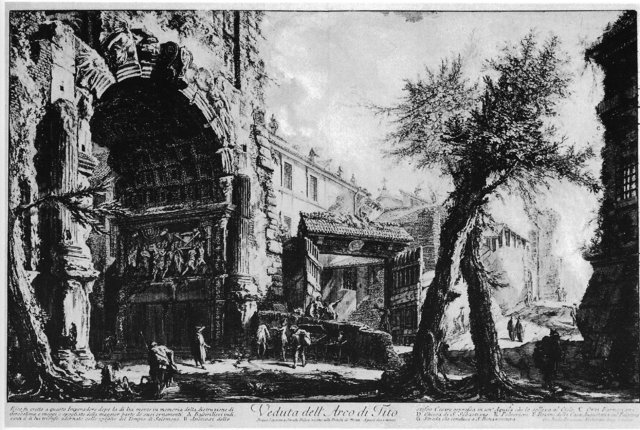
Giovanni Battista Piranesi (1720-1778), Veduta dell'Arco di Tito, image scanned by René SeindalThe Elector of Bavaria commissioned Idomeneo for his court theater in Munich, where it was premiered in 1781, using an Italian libretto by Giambattista Varesco. The story is drawn from the legends of the Trojan War: Homer describes Idomeneos, king of Crete and the grandson of Minos, in the Iliad as the general who led the soldiers of Crete to fight with the Greeks (and doing some pretty kickass things on the battlefield in Book XIII). Virgil and others told the story of his return home, when he was nearly killed in a storm at sea. Poseidon saves Idomeneos, as he had helped him throughout the war, but requires the sacrifice of the first person Idomeneos lays eyes on when he gets to land, and that turns out to be his own son. Of course, in the Greek and Roman versions, Idomeneos carries out the god's demand and slays his own son, only to be cursed by the gods for filicide and driven further from Crete. In ancient Greece, you were damned if you did and damned if you didn't. You were just damned.

Mozart himself recycled the opera later in life, in a severely cut and reshaped version. (As stated in the liner notes, the composer's wife reported after Mozart's death that his time working on this opera in Munich was one of the happiest in his short life, probably filled with hope that he would soon have a court position that would allow him to create opera. Life does not always turn out as we hope.) I congratulate the Met because, although they took long enough to get around to performing Idomeneo, they used the critical edition by the excellent Mozart specialist Daniel Heartz for the Neue Mozart-Ausgabe, reconstituting the (almost) complete score for the first time. Hooray for musicology! This nearly full version is three hours long, and the only major omission (an unfortunate one) is the ballet that Mozart composed to conclude the opera at Munich. I wish that we could get over the modern operatic aversion to lengthy ballets, as they are an essential and glorious heritage of the court origins of the genre.

The singing is, with few exceptions, absolutely stellar. Luciano Pavarotti, for all of his dramatic impediments, is powerful in the title role, a voice that always impresses in spite of its occasional imprecision and ugliness. Frederica von Stade gives one of her most convincing performances in a pants role ever, as Idomeneo's son, Idamante. Her Act III duetto ("S'io non moro a questi accenti") with the exquisite Ileana Cotrubas (as the Idamante's beloved Trojan princess, Ilia) and the subsequent quartetto (with Pavarotti and Hildegard Behrens as Elettra, who is also in love with Idamante) are all wonderful. The standout performance is Hildegard Behrens, as the obsessed and cracking Elettra: her unhinged performance of "Oh smania! oh furie!" at the end of the third act, in a frizzy, bright orange wig is one for the ages, incendiary singing married to frenetic acting. Instead of following the libretto's stage direction ("parte infuriata"), she is carried off, frozen where she falls prone, arms sticking up above her head. The only (slight) disappointment is older tenor John Alexander as a warbly and poorly accented Arbace, the confident of Idomeneo.

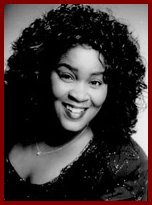
Millicent Scarlett, sopranoThe huge Met chorus sings Mozart's weighty choral numbers with enough heft for Tannhäuser. The Act III choral scene ("Oh voto tremendo!") is one of Mozart's best, leading into the appearance of La Voce, the voice of Neptune that suspends Idamante's death sentence if Idomeneo will abdicate as King of Crete. Neptune's voice is heard, of course, accompanied by trombones. Mozart knew his Gluck, who had used trombones to supernatural effect in Orfeo ed Euridice (Vienna, 1762) and four later operas, all of which were probably familiar to Mozart by the time he was working on Idomeneo. He would use the instruments later, to much greater effect, in the "stone guest" scene in Don Giovanni. Monteverdi also used trombones in a similar way, in the Hades scene if L'Orfeo and accompanying the anger of Poseidon in Il ritorno d'Ulysse in patria, although I doubt that Mozart knew those 17th-century operas. James Levine conducts a fine reading of this beautiful score with the Met orchestra. The sound and picture, captured digitally from a VHS recording, are not perfect but fine enough.

All of this is by way to telling our Washington readers to attend the upcoming live performance of Mozart's Idomeneo this Friday and Saturday (June 2 and 3, 7:30 pm) by Opera Lafayette at the Clarice Smith Performing Arts Center in College Park. It is a concert performance, but with dance provided by the New York Baroque Dance Company (hopefully, with that concluding ballet). The singing should be quite good, including Robert Baker as the High Priest, François Loup as the Voice of Neptune, and Millicent Scarlett as Elettra (I heard her powerful voice in excerpts from this role last October). This is the first concert in this summer's Washington Early Music Festival. Ionarts will be there.

Il Viaggio a St. Petersburg

Ionarts contributor Oksana S. Khadarina has just returned from a trip to St. Petersburg. She will be relating some of her cultural experiences over the next several days.


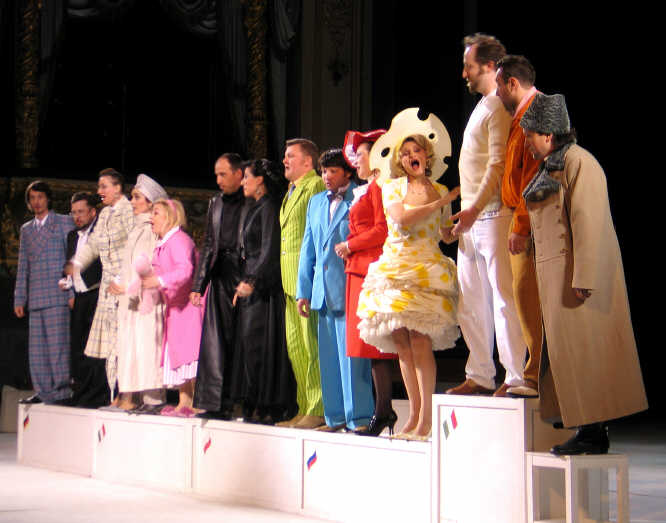
Gioachino Rossini composed the opera Il Viaggio a Reims (The Journey to Rheims) in 1825 for the coronation of French King Charles X. It was a “for the event” opera, and shortly after the premier the composer withdrew it from further performances. French producer Alain Maratrat and designers Pierre Alain Bertola and Mireille Dessingy decided to shake the dust from this old and forgotten Rossini work. The new production of Il Viaggio a Reims premiered at the Mariinsky Theater proved to be a huge success with the audience. This opera was composed for the finest bel canto singers of the 1820s and requires considerable vocal resources. This fact didn’t worry the soloists of the Mariinsky Academy of Young Singers. They tackled their parts like pros. This is a comic “party opera,” and this is exactly what the young cast of the Mariinsky demonstrated last Sunday: Il Viaggio is not so much about the traveling, it’s about fun and sheer entertainment.

The members of the Mariinsky Orchestra dressed in identical white tuxedos left the orchestra pit and were comfortably situated in the back of the stage. The young guest conductor Tugan Sokhiev, who stepped in for the ever absent Valery Gergiev, skillfully navigated the Big Band through marvelous Rossini’s score.

The opera has no direct narrative. It begins with a procession of unusual arrivals of European aristocracy to the small Golden Lily Inn. Russian officer Count di Libenkof (tenor Mikhail Latyshev) made a triumphant entrance on a white horse. A health specialist, Don Prudenzio (Mikhail Kolelishvilli), was carried on stage in a white box decorated with red crosses. The poetess Corinna used a “fashion runway” (installed on the orchestra floor as a part of set decorations) to get in. At first, these mysterious arrivals reminded the setting of the Agatha Christie story And Then There Were None. But when the series of vocal solos, duets, and ensembles began, what happened on stage looked more like the operatic “European Idol,” except no one was voted off. (The ladies definitely outsang the gentlemen.)

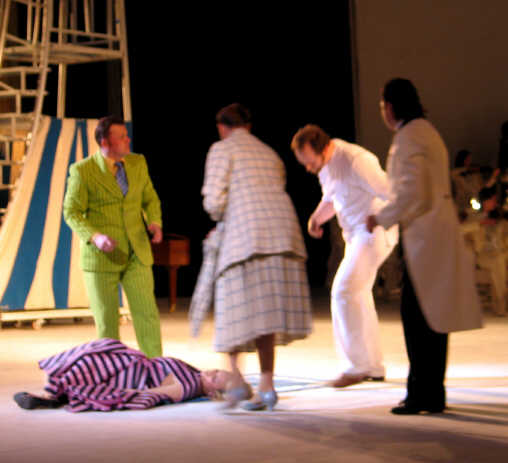
The grand prix of the evening without doubt went to Marilyn Monroe look-alike, soprano Larisa Yudina. She was vocally stunning and brilliant as an actress portraying a fashion-obsessed French Contessa di Folleville. Her voice was luminous and crystal clear. She was charming and funny when she fainted and was proclaimed dead after learning that her finest wardrobe got lost on the way; and a little cute hat rescued by her maid “saved her life.” Clearly, she was the audience favorite. Golden Lily Hotel owner, Madam Cortese (soprano Anastasia Belyaeva), in her stylish red dress not only was a wonderful hostess but also gave a five-star performance as a singer. Queen-sized poetess Corinna was gorgeous in her simple yet elegant long white dress. The timbre of her voice was rich and warm. No wonder, she was able to calm down rowdy Count di Libenskof, who was contemplating starting a duel with Spanish Don Alvaro (Vladimir Tulpanov).

When all travelers had finally arrived, Baron di Trombononok (Vladislav Uspensky) broke the news that no horses could be found to travel to Reims and all travel plans would have to be cancelled. No horses? Not a problem! Golden Lily’s guests decided to stick around for a while and resolve some of their love issues, chat about art, fashion and politics, and then go to Paris to party at the house of Madam Cortese. (The Russian Count was totally smitten by Corinna’s singing and beauty, and he completely forgot that he actually did have the horses.)

One of the most successful duets was performed by Dmitry Voropayev (Cavalier Beliore) and Irma Gigolashvily in the beginning of the Act II, and in the finale of the opera, the “farewell number” called Improvisation en Mi bémol by Anastasia Belyaeva (Madam Cortese) and Nikolai Kamensky (Don Profondo) was good.

Not all solos were perfect, but singing together the Mariinsky Opera apprentice team made a superb ensemble. The final number of the opera, dedicated to the glory of France, was a musical triumph for Rossini and a definite victory for these young artists.


With a dozen singers to perform and a bunch of suitcases as a decoration set, Il Viaggio a Reims is a perfect portable opera. Valery Gergiev conducted this production in Paris last December. In January 2007 it will travel to Washington, D.C., and be performed at the Kennedy Center as a part of the Kirov's traditional annual visit.

Music Tonight: Amsterdam Klavier Trio

If you haven't any music plans for tonight, but a sudden craving, you might want to go to La Maison Française for a performance of the Amsterdam Klavier Trio (most recently reviewed at the Corcoran in January - this time with their regular pianist, Klára Würtz) who will present the Mozart B-flat, Mendelssohn's second, and Ravel's trio. I missed their concert at the Lyceum on Friday, but after just hearing them in the Mozart-Mendelssohn-Ravel program on Saturday I recommend this concert even more warmly than I did their Lyceum concert. Klára Würtz really is a marvelous pianist who can get great beauty even from lesser pianos. No wonder she has been invited to play alongside Brendel and Pollini in the Salzburger Festspiele recital series. La Maison Française will be the usual gracious host (that's code for "good wine afterwards"); tickets are $20 - although you'll want to shoot an e-mail to culturel.washington-amba[AT]diplomatie[dot]gouv[dot]fr before you go.

29.5.06

Bartók and Schoenberg at Covent Garden

There are quite a few loose ends from my survey of interesting opera around the world from last season. Reviews are trickling in for the fabulous double-bill offered by the Royal Opera at Covent Garden this weekend: Bartók's Duke Bluebeard's Castle and Schoenberg's Erwartung (May 26 to June 17). We start with a review by Andrew Clements (Duke Bluebeard's Castle/Erwartung, May 29) for The Guardian:

The two one-act masterpieces of early modernism have become a standard operatic double-bill. They make a logical pairing, but it's usually Erwartung, Schoenberg's soprano monodrama, that is performed first, providing a fiercely concentrated preface to Bartok's more expansive two-hander. Willy Decker's Covent Garden staging, revived for the first time, reverses that order and, by using the same setting for both, convincingly makes the expressionist Erwartung the nightmarish consequence of Duke Bluebeard's Castle's dark-hued symbolism.

So the protagonist in the Schoenberg wears a tattered version of the red dress that the parade of Bluebeard's wives had all sported, and emerges through the same door that had shut them away from the world at the end of the Bartok. The unnamed woman is, Decker's production suggests, a refugee from that claustrophobic world; perhaps a wife (perhaps like, as Maeterlinck suggested, Debussy's Melisande was) who had escaped from its horrors and was seeking catharsis. The silent man who stalks her in this production (played by Barry Callan), and whom she repeatedly stabs, may be Bluebeard, but equally he may be some other totally innocent victim who is only guilty of being male.
Second, we have Richard Morrison (Bluebeard's Castle/Erwartung, May 27) for The Sunday Times:
At the end of Bluebeard, Judith — the wife with the fatal need to peel away her husband’s psyche and reveal the murderer within — is dragged away, seemingly for ever, through the seventh door. But, at the start of Erwartung, recognisably the same red-frocked character emerges, but now mentally unhinged and stalked by a seedy old man who is, equally clearly, Bluebeard’s doppelgänger. And she proceeds to turn the tables on him, very painfully. Even the musical transition works. Bartók’s spooky, ominously glinting score — its pentatonic contours continually poisoned by insidious dissonances, just as Bluebeard’s castle walls continually drip with blood — seems to find its natural sequel in Schoenberg’s jittery, hyper-tense atonality.
Finally, there is Dominic McHugh (Double Bill: Duke Bluebeard's Castle and Erwartung, May 26) for MusicOMH.com:
Albert Dohmen is the embodiment of Bluebeard, a very imposing figure on the stage whose mental agony is astoundingly vivid. What really sticks in the memory, however, is his voice, which is a beautiful, true bass-baritone that reaches to the centre of the low notes and shines lyrically at the top.

His physical engagement with Judit is remarkable: at different points, the two writhe about the stage, stand in confrontation and cannot bear to look at one another. It's great to have so intelligent a singer-actor paired with so apt a female counterpart: Petra Lang adds yet another impressive role to her Royal Opera repertoire, breathing life into the music and believably standing up to even so immense a Bluebeard as Dohmen. There's a huge shift of focus in the opera, from Judit's domination of the opening of the doors to the final, anguished monologue for Bluebeard; both singers give each other space to shine, and the curtain fell on the opening night to a huge cheer.
This is a revival of the 2002 production at Covent Garden. I am looking forward to seeing Duke Bluebeard's Castle next season at Washington National Opera, sadly paired not with Erwartung but inexplicably with Gianni Schicchi.

UPDATE:
See also --

Decoration Day

America's Memorial Day, a tribute to the nation's war dead past and present, was born in the wake of the Civil War between North and South -- historically the costliest in American lives lost, both sides being "American" of course. Originally called Decoration Day, in honor of the custom of decorating graves of fallen soldiers with flowers and flags, the observance was a small but symbolically important step towards reconciliation, honoring the sacrifices of Blue and Grey alike.

That observance has since grown into a day of remembrance for soldiers of all wars in which the US has fought, hence "Memorial Day." It has also moved from the traditional date of May 30 to the fourth Monday in May, creating the three-day weekend we know so well.

Marches, anthems, and dirges aside, there are few pieces of serious music that hew to the original concept of Decoration Day, with its specific reference to the Civil War. There are some, however, three of which (only one by an American) surely merit hearing more often. The most obvious choice, Decoration Day by Charles Ives, is quintessential Ives and quintessential Americana, an elegiac, small-town-America feel disrupted by competing marching bands ignoring both consonance and dissonance. Each more serious in tone, and each written to the (sometimes overwrought) poems of Walt Whitman, are Paul Hindemith's When Lilacs Last in the Dooryard Bloomed for chorus, orchestra, and soloists, using lines commemorating the death of President Lincoln and the soldiers he sent to battle, as well as the fallen of World War II and the death of FDR; and Ralph Vaughan Williams' Dirge for Two Veterans.

All fine ways to remember the origins of Memorial Day on its true 'Decoration Day' date of May 30.

The above photo of the 'American Pillar' rose is from the Heritage Rosarium, Brookeville, MD, whose Memorial Day weekend Open House is one of the hidden treasures of the Washington area.