CD Reviews | CTD (Briefly Noted) | JFL (Dip Your Ears) | DVD Reviews

26.2.06

Meredith Monk, Impermanence
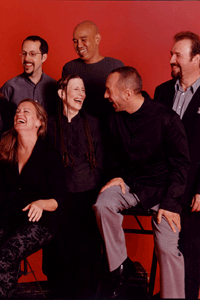
Meredith Monk and members of her Vocal Ensemble, photograph by Stephanie BergerI'm not sure why experimental vocalist and composer Meredith Monk chose Fairfax for the Washington-area performance of her new multimedia work, Impermanence (2004-2005). Perhaps the venue at the George Mason University Center for the Fine Arts had the video, sound, and lighting capabilities required for the piece, but what it meant, inevitably, was a meager audience filling, by a rough estimate, one-third of the Concert Hall. Some left after only a few minutes, visibly perplexed or turned off, and many more left at intermission. This is unfortunate, because the impact of this multifaceted performance piece -- like much of Monk's œuvre, combining voice, movement, video, rhythm, and light -- should be universal, but it can be so only when it falls upon open minds.

As we took our seats, we heard recordings of a tune, Mieke's Melody #5, composed by choreographer Mieke van Hoek, Meredith Monk's partner, who died of cancer in 2002. Shortly after that tragic event in her life, Monk received an invitation from Rosetta Life, a group in England that connects patients in hospice care with artists. (This reminds me of another group I wrote about here in 2004, Musicians on Call, that brings classical musicians to play for the homebound.) Monk went to England, met with several patients, played her music for them, and talked to them. The recording we heard was of their timorous voices, singing the melody composed by Mieke van Hoek, each with an independent sense of pitch and rhythm. This was matched visually by video shots of faces, large silent closeups that melted from one into the next, which opened the performance.

Other Reviews:

Georgia Rowe, Monk's poignant 'Impermanence' teems with life (Contra Costa Times, February 9)

Allan Ulrich, Meredith Monk's eerie vocals have led her to unique synthesis of arts (San Francisco Chronicle, February 13)

M. C- (who will join my audience of one), Impermanence (The Standing Room, February 16)

Steven Yi, Meredith Monk: Impermanence (Kunstmusik, February 16)

Joshua Kosman, Monk's newest work an ode to loss: 'Impermanence' meditates on the passage of time (San Franciso Chronicle, February 17)

Stephen Brookes, Meredith Monk Ensemble (Washington Post, February 27, under the heading of "Pop Music")
Impermanence is a sequence of scenes or sketches, beginning most memorably with Meredith Monk alone at the piano for Last Song, a series of minimalistic chords over which she riffs hypnotically on every possible combination of words implying finality ("last song, last breath, last ditch, last minute") and the frenzied disintegration of those words into phonemes. The eight members of the ensemble all sing at some points, and three of them -- Bohdan Hilash on clarinet and other wind instruments, John Hollenbeck on percussion instruments of many kinds, and Allison Sniffin on piano and violin -- were found mainly in the stand of instruments to the left of the stage. The next scene, Liminal, featured a recitation of the sometimes nonsensical actions, presumably to be attributed to the patients: "she called tofu pillows," "she called the bed a nest," "he talked back to the radio." This was just one example of how the first half of Impermanence evoked the individuality of each person confronting death, that is, all of us. The performers all wore clothes of different types both casual and formal, jeans and blouse, a ball gown, shorts and a sleeveless T-shirt. A vibrant scene, Particular Dance was the only real light-hearted moment of joy in this rather somber work, where recorders, pan flute, train whistle, and every kind of percussion that could be shaken or struck accompanied the wild, silly gyrations of the dancers.

In the second half, the whole group appeared again in the same cuts of clothing they had worn in the first half, but now all the costumes were of the same light gray or lavendar, recalling the "hospital gown" color we associate with the end of life all the "characters" have in common. That common nature is emphasized again by the video images shown in this half, again closeups of impassive faces, over which the camera hovers and then zooms in upon for a tight view of the right eye, all in the same way. That process is then reversed, beginning with a very close magnification and gradually zooming out to reveal the thing we could not recognize before, a cog, a leaf. At one point, some of the performers sat on the floor and looked, as the audience did, toward images of historical photographs, which always evoke the frailty of life, all those aspirations and proud personalities, vanished like the wind. In the closing scene, the music is reduced voice by voice (perhaps a tribute to the "Farewell" Symphony) as the performers sink to the floor and roll slowly off to the right side of the stage, like human waves back to the sea.
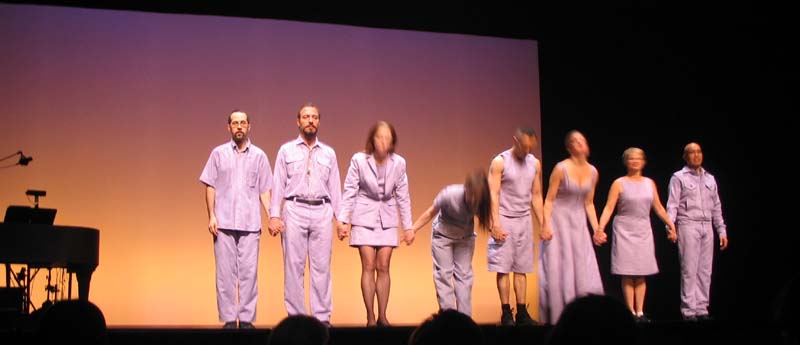
Meredith Monk and Vocal Ensemble, Impermanence, George Mason University Center for the Arts, February 25, 2006
The best singing came from Katie Geissinger, who has a pure and pretty soprano voice and works also in "good old classical music" (an upcoming concert with the Orpheus Chamber Orchestra, for example). Theo Bleckmann has a nice baritone voice, too, and had far too much fun zooming around on roller skates at one point in the second half, to the sounds of a train horn. (He wore those shoes with hidden skate rollers in them that my friends and I loved in the 1980s.) John Hollenbeck's performance with mallets on a bicycle tire, silhouetted on the big screen by a light behind him, was a memorable Dada moment. The best group moment came at the opening of the second half, when the whole group gathered around the piano, playing at the keyboard or strumming or plucking the strings manually. Under a bright spot, they proceeded to reproduce the same music they had been playing but with their voices only. It was a good reminder of Meredith Monk's start, working exclusively with voice, a sound world that she has now considerably expanded with this latest work.

Here we are again, face to face with the crossover issue, but from a different angle. Monk's creative style combines many idioms and therefore is none of them. Listeners expecting any one of them alone -- classical composition, jazz extemporaneity, operatic singing, pop vocals, experimental dance, theater -- are likely to be disappointed. In effect, what I see as the major drawback of the crossover impulse for the high culture side of the equation is that it may actually decrease one's audience rather than increasing it. Here were singers, most of whose voices -- all of them assisted by microphone -- are not traditional classical voices, singing music that does not have any of the thorny, serial qualities that supposedly distance audiences. Indeed, the harmonic palette is -- like Adams or Glass -- a not particularly challenging vocabulary providing a basis for meditative repetition. Isn't that familiarity of the sounds of popular music exactly what should interest audiences? That being said, where Meredith Monk is concerned, I don't care. I will be an audience of one, if need be.

Classical Week in Washington (2/26)

Classical Week in Washington is a weekly feature that appears on Sundays, at the same time as my Classical Music Agenda for DCist. If there are concerts that you would like to see included on our schedule, send your suggestions by e-mail (ionarts at gmail dot com). Plan your winter concert schedule with our 2006 Concert Preview and Classical Month in Washington (March), or your opera listening with our Opera Preview 2006.

Monday, February 27, 8 pm
Jerusalem Symphony with Leon Botstein, conductor
Martinů, Památník Lidicím (Memorial to Lidice); Copland, Appalachian Spring; Prokofiev, Symphony No. 5 in B-flat major, Op. 100
Music Center at Strathmore

Wednesday, March 1, 7:30 pm; March 2 and 3, 7:30 pm; March 4 and 5, 1:30 and 7:30 pm
New York City Ballet (various programs)
Kennedy Center Opera House

Thursday, March 2, 8 pm
Baltimore Symphony: Khatchatryan’s Award-Winning Sibelius
With violinist Sergey Khatchatryan and guest conductor Andrew Constantine (replacing Yuri Temirkanov, unable to return from Russia for personal reasons)
Music Center at Strathmore
[On March 3 and 4, 8 pm, and March 5, 3 pm, at Meyerhoff Hall in Baltimore]

Friday, March 3, 8 pm
Ensemble Corund (Stephen Smith, Artistic Director)
A cappella choral music on Shakespeare texts
Library of Congress

Friday, March 3, 8 pm
Parker String Quartet
Tower, Quartet "Nightfields"; Schumann, Quartet in A Minor, Int.; Mozart, C Major Quintet, K. 515 (with Roger Tapping, viola)
Corcoran Gallery of Art

Friday, March 3, 8 pm; Saturday, March 4, 8 pm
Matthias Soucek, piano
Embassy Series
Embassy of Austria

Friday, March 3, 8 pm; Sunday, March 5, 2 pm
Mozart, Così Fan Tutte
Directed by Joe Banno
Opera Theatre of Northern Virginia
Thomas Jefferson Community Theatre (Alexandria, Va.)

Friday, March 3, 8 pm; Saturday, March 4, 5 and 8 pm; Sunday, March 5, 2 pm
Folger Consort: Hildegard and Jaufre
Folger Shakespeare Library

Saturday, March 4, 1:30 pm
Gounod, Roméo et Juliette
With Natalie Dessay and Ramón Vargas
Metropolitan Opera Radio Broadcast

Saturday, March 4, 8 pm
Leslie Savoy Burrs, Vanqui
Opera in concert version
Clarice Smith Performing Arts Center (College Park, Md.)

Sunday, March 5, 3 pm
Spiritus!: A Choral Celebration of the Spirit, with baritone Steven Combs
Music by Vaughan Williams, Tallis, Rutter, Finzi, and David McCullough
Free subscriber-only concert
National Presbyterian Church

Sunday, March 5, 5 pm
Alan Mandel, piano [FREE, with admission to museum]
Phillips Collection

——» Go to the previous schedule, for the week of February 19.

25.2.06

Redemption the Conductor (Gergiev's Verdi Requiem)


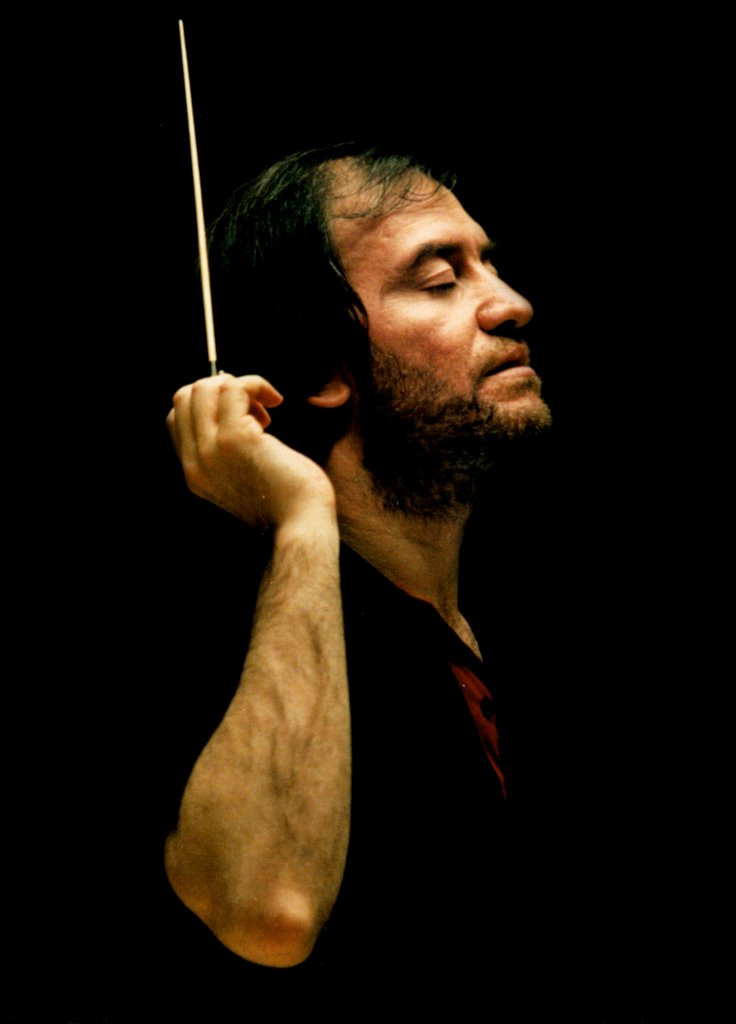
Valery GergievPerforming the Verdi Requiem in the Opera House – which is where the Kirov Orchestra under Valery Gergiev played on Friday night – is a musical smirk (even if there was also a more practical reason behind that choice of venue: next door played Midori), given that it already has the reputation of being a “sacred opera.” It does so, because of its highly dramatic, even bombastic nature and the demands it makes on the singers. Verdi doing what he did best, such an outcome should not have been surprising.

There are now many hundreds of pages written in the attempt to free the Verdi Requiem from that early and allegedly cheap pun (coined by none other than Hans von Bülow) that some see a stigma sticking stubbornly to the work. Leave it to Gergiev and his band to obliterate any and all such efforts with a performance like the one conducted at the Kennedy Center. With brilliant support from his four soloists – as even a cast as that work could reasonably expect live – Gergiev delivered a performance of proportions such as I have not heard at the Kennedy Center (or anywhere else, for that matter) in a long, long time. The NSO’s performance last year – which didn’t impress me then, either – was a malnourished urban pussy next to Gergiev’s Liger. The orchestra may not have known quite what to do with the oddly spiritual sound world of Wagner’s Bühnenweihfestspiel (too religious?) – but this language they could believe in and respond to with their best and most dedicated playing all week. Every nervous hand-flicker of Gergiev’s was responded to, their trademark sloppiness all but gone. The timpani attacks in the Dies irae and again the Tuba mirum were ripping through the Opera House with intimidating force in an acoustic that revealed itself as not only superior to the Concert Hall’s but altogether good.


Ekaterina SemenchukThe soloists make or break a performance of the Requiem. Whether they are up to the challenge (and a challenge it is) is established right off the bat as Verdi has them all ‘present themselves’ in the Kyrie, right after the Requiem aeternam in the order of tenor, bass, soprano, mezzo soprano. Daniil Shtoda was first with the fiendishly difficult tenor part, and he kept the portamento within reason and proved honey-voiced and good. The voice could have been a bit more open or forceful, but it sounded fine by all accounts. If he was the weakest link in the soloist chain, it was a strong chain. Ildar Abdrazakov, in a slightly more comfortable, easier range, upped the ante a bit further... very good, indeed. An absolute strong point amid many strong points in the whole performance, solid and reliable like a rock, supple and with a beautiful tone. Olga Kondina – a dark silver snow-queen next to her younger colleague’s black penitential dress – was clean, clear, flawless. Her voice rang, she didn’t narrow on the high notes (especially important toward the end) and performed with an admirable mix of pure skill and experience. And then Belarussian Ekaterina Semenchuk opened her mouth to a low growl that had your blood freeze. An animal of the kind that immediately said: “Kundry.” Where were you, last Tuesday, when we needed you?

Other Reviews:

Philip Kennicott, The Kirov Delivers a Requiem Full of Life (Washington Post, February 25)

Tim Smith, Kirov Opera presents a stirring version of Verdi's 'Requiem' (Baltimore Sun, February 28)

What. A. Voice! Low notes like I’ve not heard hurled at me since Waltraud Meier; nor sung like that since Anna Larsson. A spine in her voice, a fierce brilliance, unfailing confidence, and an unfailing sound: beautiful, tasteful, note perfect; if anything a little too subtle at the beginning of the Agnus Dei. It had a quality that was so immediately outstanding that it wanted to make me shout “Brava” mid-Liber Scriptus, blow kisses at the sounds that swooshed by my ears. Her lower register easily challenged Daniil Shotda’s higher. You couldn’t have foreseen such a performance by her CV as of yet, but it should be easy to project her future career based on it.

Take that and a choir that – a slightly ‘sticky’ beginning apart – performed as well as one might expect from this crack ensemble and the elements combined for a lavish splendor fit for no other venue than an opera house. (Which itself is, of course, the successful combination of arts temple and bordello.) A Requiem is supposed to soothe and appease the heavens on behalf of the deceased: Gergiev unrepentantly raised hell. Even the searing soft moments were devilishly good, a tail of sulphur flames never far from his frock. Let him be the most overrated conductor of our times, in the hour and-a-half of the Verdi Requiem he redeemed himself from all past and future musical sins, as far as I am concerned. Bravi!


available at Amazon
Gergiev / Fleming, Borodina, Bocelli, D'Arcangelo
available at Amazon
Giulini / Schwarzkopf, Ludwig, Gedda, Ghiaurov
available at Amazon
Gardiner / Orgonasova, von Otter, Canonici, Miles
available at Amazon
Harnoncourt / Mei, Fink, Schade, D'Arcangelo

Gergiev has a recording out with the Requiem. Resist the urge to buy it, though. While the heft and thunder and glory (which I hoped to gain when I bought it a few years ago) is more or less present in the orchestra, it’s hopelessly ruined by Andrea Bocelli, who turns in one of his worst, most egregious performances. Step on a cat’s tail and you’ll likely get a better opening “Kyrie.” The rest of the starry cast (pre-mannerism Fleming, Borodina, D’Arcangelo) is good but can’t make up for the sonic crimes committed on this recording. Gardiner has the most impressive chorus and incredibly deft touches; Giulini a feel for theater and stupendous soloists (Schwarzkopf – Ludwig – Gedda – Ghiaurov); his recording on EMI is rightly a classic. Harnoncourt’s is the least operatic, the voices unmannered (Michael Schade very open sounding, but stretched after a while, D’Arcangelo brooding but not very deep, Fink with unusual affectation). The violins come through in astounding detail, nuances can be heard - in part due to glacial tempi - that are quite revealing. My current choice – although that’s in good part because of my personal dislike of portamento. Although impressive, it's quite a different kettle of fish than the type of performance Gergiev gave.

Martinů's Juliette in Paris

I don't really need any more reasons to move to Paris, but one that certainly keeps occurring to me is that the Opéra national de Paris, now under the direction of Gérard Mortier, keeps producing operas that I would love to see and hear. Most recently, it was Bohuslav Martinů's Julietta, directed by Richard Jones. Originally scheduled from December 31 to February 16, the premiere was cancelled because one of the lead singers was unexpectedly not able to perform. An article (Bastille : première annulée de "Juliette ou la clé des songes", January 26) from Abeille has the story (my translation and links added):

The interpreter of the lead male role Michael, American tenor William Burden, called it quits at the last minute. He was replaced by John Graham-Hall who -- imagine! -- needed a week to learn his role. He will be responsible for the other performances in February.
The strange circumstances seem to have caused the production not to be reviewed. Anywhere, as far as I can tell. The libretto was adapted from a surrealist play by Georges Neveux, which Kurt Weill was apparently also interested in setting as an opera. You can find out more about the Paris production, which was premiered in 2002, in an article by Hugh Canning (Julietta, or the Key to Dreams, November 2002) for Andante.com:
Martinu's Julietta was first performed in Prague in a Czech-language version in 1938, but it is based on a 1930 surrealist play by Georges Neveux, Juliette, ou la clé des songes; this brilliant new production was — amazingly — the opera's local stage premiere, and the Opéra sensibly opted to sing it in the version française closely based on Neveux's original text. (The first French performance was only in 1976, in Rouen.) Juliette may have been a long time coming, but it was worth the wait, for this was one of Richard Jones's most imaginative and beautiful stagings.

Martinu's opera is a dreamscape of illusion, obsession and bizarre incongruity: the hero, Michel, arrives in a French port town seeking his ideal fantasy woman, Juliette, whom he claims to have met three years before — but it may have been in a dream. This kind of piece is meat and drink to the director responsible for such remarkably phantasmagoric productions as the Welsh National/Bologna Queen of Spades and the famous Bregenz Festival production of Un ballo in maschera with a 20 meter-high skeleton rising out of the lake, leafing a huge book of choreographic notation.
William Burden sang the role of Michel in that premiere, so I am not really sure what happened this year.

The Frenzy

24.2.06

What to Hear in March

Classical Month in Washington is a monthly feature that appears on the first of the month. If there are concerts you would like to see included on our schedule, send your suggestions by e-mail (ionarts at gmail dot com). Happy listening!

Wednesday, March 1, to Sunday, March 5
New York City Ballet
Kennedy Center Opera House

Thursday, March 2, 8 pm
Baltimore Symphony: Khatchatryan’s Award-Winning Sibelius
Music Center at Strathmore

Friday, March 3, 8 pm
Ensemble Corund (Stephen Smith, Artistic Director)
A cappella choral music on Shakespeare texts
Library of Congress

Friday, March 3, 8 pm
Parker String Quartet
Tower, Quartet "Nightfields"; Schumann, Quartet in A Minor, Int.; Mozart, C Major Quintet, K. 515 (with Roger Tapping, viola)
Corcoran Gallery of Art

Friday, March 3, 8 pm; Saturday, March 4, 8 pm
Matthias Soucek, piano
Embassy Series
Embassy of Austria

Friday, March 3, 8 pm; Sunday, March 5, 2 pm
Mozart, Così Fan Tutte
Directed by Joe Banno
Opera Theatre of Northern Virginia
Thomas Jefferson Community Theatre (Alexandria, Va.)

Friday, March 3, 8 pm; Saturday, March 4, 5 and 8 pm; Sunday, March 5, 2 pm
Folger Consort: Hildegard and Jaufre
Folger Shakespeare Library

Continue reading Classical Month in Washington (March).

Rachel Barton Pine and Maud Powell

The National Museum of Women in the Arts is a dynamic place, which regularly offers interesting exhibits, film screenings (like the Agnès Varda film I saw last year with an introduction by the filmmaker herself), and other events. They host only a small number of concerts, but these often showcase musicians well worth hearing, as was the case with the recital by Christine Brewer I reviewed last spring. So, I was not surprised last night to find myself in the audience with some high-profile Washingtonians like Supreme Court Justice Ruth Bader Ginsburg, Leonard Slatkin (conductor of the National Symphony Orchestra), and Neale Perl (president of Washington Performing Arts Society). Slatkin has a family connection, since his wife, Linda Hohenfeld Slatkin -- who is a soprano, heard recently on the recording of William Bolcom's Songs of Innocence and of Experience -- is one of the artistic directors of this series, the Shenson Chamber Music Concerts. The reservation list was full, but everyone who was waiting on stand-by, myself included, got in to the little concert hall on the museum's fifth floor.

Joseph Guarnerius del Gesu 'ex-Soldat' violin, Cremona, 1742, with Rachel Barton PineAmerican violinist Rachel Barton Pine was in town for the first of those concerts this season. Here was a prominent woman violinist playing an ingenious concert in tribute to the first great violinist in the United States, Maud Powell, who also happened to be a woman. If you have never heard Powell's name before, you should get familiar with the piles of information now available from the Maud Powell Society in North Carolina. For the latter part of her career, she was regarded around the world as the best female violin player anywhere and the best American master of the instrument, man or woman. Karen A. Shaffer, the society's president and founder, was also in the audience last night, clearly thrilled that Rachel Barton Pine was drawing attention to the subject of her life's work.

As an example of Maud Powell's prominence, she gave the American premieres of violin concerti by Dvořák, Tchaikovsky, and Sibelius, with the first of those composers working with Powell directly to prepare the score. Barton Pine began her fascinating program with one movement from each of these three concerti, to show off the range of technical demands that Powell confidently took onto her shoulders. The broad bowstrokes and roaring melismas up and down in the first movement of Dvořák's A minor concerto, op. 53 ("Allegro, ma non troppo"), quickly stripped strands of horsehair off Barton Pine's bow. It's a fiercely difficult movement, with lots of passages in octaves and other multiple stops. Often the movement featured the raw, throaty low register of Barton Pine's instrument, the "ex-Soldat" violin made by Giuseppe del Gesù Guarneri in Cremona in 1742. Tchaikovsky's D major concerto, op. 35, offered its slow movement ("Canzonetta: Andante"), a gorgeous gypsy-flavored melody, in which Barton Pine was at her lyrical, long-lined best. The final movement came from Sibelius's D minor concerto, op. 47 ("Allegro, ma non tanto"), which is a sort of mad dash full of exciting syncopations, a few short parts of which slipped ever so slightly out of Barton Pine's control.

Maud Powell, 1867-1920Powell championed her own countrymen's music as much as she could, and several American composers dedicated works to her. Barton Pine gave us two examples, the second of which was a pretty but fairly unremarkable Romance for Violin and Piano, op. 23, that Amy Beach wrote for Maud Powell and herself to play at a Women's Congress. Far more interesting to me was a piece by Marion Bauer called Up the Ocklawaha, Tone Picture for Violin, op. 6. It began on one of Powell's concert tours in Florida, during which she played in a small town accessible only by an overnight boat trip up a small river. Powell wrote a poem about the experience, which describes the efforts of the "dusky crew" to keep the frightening night at bay. (For someone who was apparently quite forward-thinking about race, she also called the black boatmen the "Trusting darkies guiding the boat / With stealthy instinct, true, unerring.") Barton Pine brought a most evocative sound to this short work of program music: "The arrowed flames / Trick and cheat the eye: / Wanton shapes infest the trees / (Hanks of poisonous moss in the air)."

Powell was the first white soloist to program arrangements of black spirituals, and Barton Pine played a few of Maud Powell's arrangements of these tunes, beginning with her version of Samuel Coleridge-Taylor's Deep River. Powell often played these arrangements for American troops during World War I, because the familiar melodies mean home. As an encore, Powell sometimes played her own arrangement of four plantation melodies, all of which began life in minstrel shows, the infamous blackface vaudeville acts that grotesquely sentimentalized American plantation life. (uTopianTurtleTop had a couple of great posts about the familiar melody "Jimmy Crack Corn" and the gradual, insidious process by which racist minstrel tunes like it become children's songs. In the same vein, I wrote this post about what Debussy's piece Golliwog's Cakewalk really means.)

Other Reviews:

Gail Wein, A History of Violins (Washington Post, February 25)
The final set were pieces that Maud Powell played on her tours with John Philip Sousa's band, including Max Liebling's Fantasia on Sousa Themes, which used melodies mostly from Sousa's operas. (Yes, he wrote operas. Liebling studied with Franz Liszt.) This was some of the most difficult playing for Barton Pine's partner at the piano, Matthew Hagle, whose playing was sensitive, if somewhat understated, all evening. Herman Bellstedt, Jr., one of Sousa's cornet players, composed the Caprice on Dixie for Unaccompanied Violin as a virtuosic tour-de-force, which it certainly was in Barton Pine's hands. (I don't have a problem with her playing a piece based on that controversial tune, but Barton Pine's explanation of the tune's origin -- named for a kind slave owner in Manhattan named Dixie -- does not have any historical basis, as far as I can determine. The original minstrel lyrics clearly seem to depict -- perversely, as so much about minstrel shows -- a freed slave longing to return to the life of his plantation.) The encore was another Maud Powell arrangement, of Nobody Knows the Trouble I've Seen, which Powell was playing when she had a heart attack on stage, not long before she died. Rachel Barton Pine offered a most fitting tribute to her memory.

If you missed this excellent concert, you will have the chance to hear Rachel Barton Pine next month, also for free, at one of the Sunday concerts (March 26, 6:30 pm) at the National Gallery of Art. The program will be different, with music by Heinrich Ignaz Franz von Biber, John Corigliano, Mozart, and Schumann, but the team of Rachel Barton Pine and Matthew Hagle will be the same. Ionarts, of course, will be there.

NSO and Midori in Mozart, Schwantner, Hindemith and Tchaikovsky


available at Amazon
W.A.Mozart, Symphonies Nos.36 & 38,
C.Mackerras / Prague ChO
Telarc


US | UK | DE
Not surprisingly, Mozart pops up on programs with great regularity this year, which makes for a wonderful opportunity to check in on the progress that the orchestras are making in playing the music of this easiest, most difficult, composer. The choice of the Prague Symphony (no. 38, K. 504) was a good one for the National Symphony Orchestra – it is the first of the late symphonies of Mozart, bigger than preceding opera in that genre. The slow opening of the first movement underscores the novel character only further, employed only once before, in the "Linz."

It was all well played, except woodwinds, which were uninteresting and shy. I guess they may not have even been audible at the back of the house. The orchestra didn’t impress with light-footed playing, although that wasn’t all that necessary since the musicians had been set on a good course, followed it with some aplomb and vigor, and produced a mostly faultless performance that was enjoyable, more coherent than the recent Linz (despite full strings), and a bit boring.

available at Amazon
J.Schwantner, Orchestral Works,
A.Litton / DSO
Hyperion


US | UK | DE
Other Reviews:

Daniel Ginsberg, Years Have Been Kind to Former Prodigy (Washington Post, February 24)

Meet the Composer:

This afternoon (Friday, February 24, 2 to 4 pm), composer Joseph Schwantner will speak at the Catholic University of America School of Music (Ward Hall, Room 127), as part of the Music Visiting Composers Series, followed by a master class with composition students. For more information, contact Andrew Simpson, associate professor, at 202-319-5564 or simpson@cua.edu.
I was happy to see a work of American Joseph Schwantner on the program, especially since a lovely disc with his music (“Angelfire” and other orchestral works – hyperion) had just crossed my desk, recently. His bombastic, tamely tonal, and sweeping orchestral prelude Morning’s Embrace was a rousing, pleasant world premiere to witness. A Heldenleben-sized orchestra and an almost Missa Latina-proportioned rhythm section (far more tastefully employed!) combined for a twenty-minute-long abstract tone poem that started with a touch of late minimalism, then stuck largely to a musical language not far from, say, Hovhaness, and ended with sounds where I was – literally – reminded of Messiaen. Inspired by nature, New Hampshire sunrises, to be precise, it is an NSO commission for its 75th season and was finished just last November. Most of its power is derived from build-ups that place layer upon layer (Shostakovich, Glass) to ratchet up the pressure. All subsides in an elongated pastoral episode where the threats and thunders are mere hints and reminiscences… before the final leg is a triumphant, strong-faced cruise into timpani-infested waters from which the strings emerge unscathed. Only then does it wither away to a rather cheesy section that loses coherence over the last few dozen bars. A fine addition to the catalogue of one of our finest contemporary composers… if not his best.

available at Amazon
P.Hindemith, Orchestral Works
cpo


US | UK | DE
Written for the Boston Symphony Orchestra’s 50th anniversary, the 1930 Concert Music for Brass and Strings, op. 50, is a gorgeous workout for brass with friendly and at times virtuosic support from their string colleagues. Once among the most important composers of the 20th century, Hindemith has fallen somewhat out of favor. In part because he turned his back on the avant-garde when such a move was still risky for a composer’s reputation. Not quite as unique and lushly Romantic as Richard Strauss (whose music and career took a similar turn), he hasn’t recovered in estimation since. Anyone who listened to the iron boots of the Concert Music dancing away so smoothly, pulsating so vigorously, shimmering so seductively as they did under the very fine direction of Leonard Slatkin will have changed their mind. It’s undoubtedly conservative music that Hindemith wrote for the American audience and orchestra under Koussevitzky – but nothing sugary about it, if less angular than works by Hartmann, Fortner, or Egk. The mouth waters for more Hindemith from the NSO, who have already presented the Mathis der Maler Symphony earlier in the season.

available at Amazon
P.I.Tchaikovsky, "Music that stinks to the Ears"
V.Repin / V.Gergiev / Mariinsky
Philips


US | UK | DE
For the Tchaikovsky Violin Concerto, the soloist was Ryo Goto’s older sister, Midori Goto – known in the western world symply as “Midori.” Gentle in the first few notes, she soon squeezed everything out of Tchaikovsky; fond of extremes in speed and with deliberate ac- and de-cellerandi. Along with that came a supple tone from her instrument (around which she wrapped herself like a python with digestive difficulties) that perfectly fit the expectations one might have of the ‘Tchaik’. The orchestral accompaniment had delightfully detailed moments. It was the Romantic blockbuster everyone must have hoped for. And while sans particular new insights or novel touches, it was miles from routine noodling. A grand performance of the kind people hope for when they go to the Kennedy Center with Tchaikovsky heading the bill. I saw few, possibly none, of the audience leave with something other than a big smile. Smile again, if you wish, tomorrow, Friday, or Saturday at 8PM.