CD Reviews | CTD (Briefly Noted) | JFL (Dip Your Ears) | DVD Reviews

14.2.04

Díaz Trio at the Library of Congress

The string trio combination of violin, viola, and cello is not all that common, and the Díaz Trio is unusual among performing chamber music ensembles in that they have chosen to focus on the rather narrow range of music composed for it. After a hiatus since the end of December, the series of free concerts from the Library of Congress resumed Friday night with a program presented by the Díaz Trio. The concert began with a piece that did not inspire me and appeared not to have inspired the players either, Ludwig van Beethoven's String Trio in G Major, op. 9, no. 1. Composed in 1797 to 1798, this is the work of a young Beethoven who, after moving on to the string quartet genre after the three trios of op. 9, never wrote another string trio. There are moments of great beauty, and the performers gave an impressive performance, but something about their rendition left me cold. Perhaps it was the overzealous con brio on the part of cellist Andrés Díaz: maybe there are a lot of sforzandi in the score, but from where I sat I heard more percussive bowstrikes than pure tone more often than I would have liked.

My slight disappointment with the Beethoven was quickly overcome by the next piece on the program, the world premiere of a new piece by Puerto Rican composer Roberto Sierra. Kandinsky is a suite of eleven movements for various combinations of violin, viola, cello, and piano, commissioned by the McKim Fund. For this work, the Díaz Trio was joined by a guest artist, Chilean pianist Luz Manríquez, who like the group's violinist, Andrés Cárdenes, teaches music at Carnegie Mellon University in Pittsburgh. This piece was inspired by three paintings by abstract painter Vasily Kandinsky. On the left below, Lyrisches [Lyrical] painted in 1911, and on the right, Launisches [Capricious], from 1930, are both now in the Museum Boijmans Van Beuningen (Rotterdam, The Netherlands). In the center, Schwarze Striche I [Black Strokes I] dates from 1913 and is now owned by the Guggenheim Museum in New York.
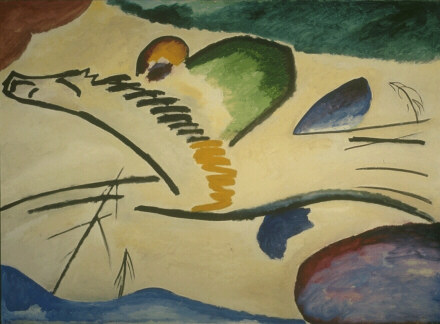
Kandinsky, Lyrisches, 1911, Museum Boijmans Van Beuningen</a>, RotterdamVasily Kandinsky, Schwarze Striche I, 1913, Solomon R. Guggenheim Museum, New YorkKandinsky, Launisches, 1930, Museum Boijmans Van Beuningen</a>, Rotterdam

Sierra has drawn inspiration from painting before, in a piece for flute, clarinet, violin, cello, and piano called Turner. In his program notes on Kandinsky, the composer writes, "The bold strokes, colors, and capricious nature of the paintings are translated in the rhythms, melodies, and harmonies of my work." I have read good things about Sierra's music, which has been rather popular with audiences. What I loved about this piece is that it embraced many idioms, such as a dissonant and Webernesque pointillism in the first movement ("Lyrisches," for violin and piano, inspired by the first painting above); strange instrumental effects familiar from the music of Bartók in the second movement ("Improvisation 19," for violin, piano, and cello; see Kandinsky's Improvisation 19 from 1911); ultrafast runs, harmonics, and other harsher sounds in the daring viola solo of the third movement ("Bild mit schwarzem Bogen" [Picture with a black arch]; see Kandinsky's painting Mit dem schwarzen Bogen), played excellently by violist Roberto Díaz, who seemed to me the surest and best of this excellent group's members. Happily, Sierra believes that even modern music can be fun and even pleasant listening, as he showed in the sixth movement ("Schwarze Striche I," for violin and piano, inspired by the painting in the center above), which had both a cool sound, inspired by jazz and Latin music, and a delicate, pretty grace that could have come from Debussy. I think the most successful composers of the early part of this century, like Sierra, will be willing to use the many styles available to us now, not ignoring more "modern" or harsh sounds but not limited to them either.

The most successful movements in the piece were the two featuring all four performers, the fifth movement ("Kleine Freuden" [Small pleasures]; see Kandinsky's delightfully vivid Kleine Freuden from 1913) and the final movement ("Buntes Ensemble" [Colorful ensemble]; see Kandinsky's Buntes Ensemble from 1938). The former is marked "ritmico" and the latter "Con sabor latino." It is that Latin rhythmic element, which pervades these movements, that made them so pleasant to listen to, music that sounded like it was part Heitor Villa-Lobos and part Sergei Prokofiev. This was especially true of the final movement, which was in 7/8, not the frantic Precipioso of the last movement of Prokofiev's seventh piano sonata, but the late-night experiment of a cool-headed dance band. The constant piano ostinato, a beboppy chromatic line in the bass (sol-sol-si-la-la-li-ti-ti-te-la-la-le-sol, in the pattern of dotted quarter-quarter-quarter), is gradually undermined and knocked off its stride by the addition of extra beats. The effect is not unsettling but freeing. It was truly a fun listening experience.

The Kandinsky paintings that correspond to the other movements are Improvisation 26 (Oars) (1912) (fourth movement), Weisser Strich (White Stroke, 1920) (seventh movement), Kleine Welten III (Small worlds III, 1922) (eighth movement), and Composition VIII (1923) (ninth movement).

After intermission, the concert concluded with a piece that is naturally the bread and butter of this group, Mozart's Divertimento for String Trio in E-flat Major, K. 563, the only piece for this combination of instruments that can be reliably attributed to that composer. It is a challenging and rewarding work that belies its title, since it is not typical of the light, diverting music written under the name of divertimento: it is a sort of extended four-movement sonata, just with two menuetti and two slow movements to make a total of six movements. Composed in 1788, this work shows Mozart at the height of his powers, just after completing his last symphony. It was dedicated to Mozart's friend from the Masons, Michael von Puchberg, in gratitude for the large amounts of money he had loaned to the composer, whose financial situation was deteriorating rapidly. In this piece that Mozart himself premiered and performed more than once, playing the viola part, the composer displays all of his skills in creating a joyous German dance (4th movement), writing joking but graceful melodies (for himself on the viola in the fifth movement), in breaking apart and developing melodic motifs (sixth movement), and in conceiving contrapuntal complexity (first and fourth movements).

Finally, I was reminded of why we need more concert series like this in the United States. At the end of the concert, a young woman, who I think was a music student, gave the three performers bouquets of flowers and was obviously moved by what she had heard. Even more touching, a young man perhaps in the eighth or ninth grade went up to the stage at the intermission and collected a stray piece of bowhair that had been left on the floor there by one of the players. Perhaps a dream was born or encouraged in a young person last night, and that is an important thing. If you don't live in Washington and you would like to be able to hear these concerts, you should join me in writing to the Library of Congress or to a radio network like NPR to ask that someone make all of these concerts, which are recorded, available in recorded form either over the radio or by Internet.

13.2.04

Elitism and the Arts

After all the complaining I have been doing lately about the subject of money and creating a cultural life, this article (Lottery cash 'subsidises arts for rich', February 13) by David Hencke in The Guardian gave me some new fat on which to chew. I don't know much about the background of the story, but it concerns how profits from the British lottery system are spent:

The upper and middle classes are enjoying a night out at the opera, theatre and ballet in new modern facilities, courtesy of the national lottery, at the expense of the working class, a report by MPs finds today. It attacks Arts Council England for wasting lottery and taxpayers' money to bail out venues such as the Royal Opera House and Sadler's Wells in London, and for not putting enough cash into working-class areas or attracting more diverse groups to theatres.

The report from the Commons public accounts committee criticises the Arts Council for being slow to provide figures which proved that the 15 biggest projects were mainly benefiting the better-off. It found that in only one city in England—Stoke-on-Trent—do audiences accurately reflect those who buy lottery tickets. In London, 70% of lottery cash distributed to the arts went to high-profile arts projects.
Of course, it is difficult not to agree that a lottery is a stealth tax on the poor, but I had never really considered trying to make sure that profits from a lottery somehow matched the interests of the people who buy most of the tickets. I would like those profits to go to symphonies, museums, Artotheks, and so on: should they really be supporting NASCAR races and the next reality TV show instead?

Art Libraries in Canada

Ionarts reader Chris Hand (who lives in Montreal and blogs at Zeke's Gallery) wrote to me recently about my post on the Artothek phenomenon in Germany (see The Perfect Use for the Lottery, February 2). As you may recall, I was shocked to learn that people in Germany, Austria, the Netherlands, and so on could borrow artwork from an artothek in the same way you could borrow a book from a library. Chris writes:

Here in Montreal, pretty much all the museums rent out work, and the Canadian Government actually has an art lending bank. All of them are cheap (although not as cheap as the Artothek). I did not realize that this was not standard practice in other cities. Pity.
He also sent the following two links: the Artbank (site in French, La banque d'œuvres d'art), run by the Canada Council for the Arts, and the Rental Gallery of the Montreal Museum of Fine Arts. Since we already loved the city of Montreal, one of the beautiful and interesting places of this world, Ionarts does not need to hear too many more reasons before relocating to Canada or Europe becomes not only desirable but imperative.

If the National Gallery of Art ever catches up with its enlightened Canadian counterparts, Mark Rothko's Man Smoking (1933) is going to be the perfect addition to my music room. For a few months. Then, maybe I would go for Kandinsky's Small Worlds I (1922). Turner's drawing A Yorkshire River (c. 1827) or Vuillard's Vase of Flowers on a Mantelpiece would also be nice.

I'm quite serious when I say that one of the presidential candidates (how many of them are left now?) should jump on this issue. I could actually regain some interest in the primary race. (This goes against our inclination: see the Ionarts motto in the upper righthand corner.)

12.2.04

Ionartium (Ir)

Thanks to David Sucher at City Comforts for drawing my attention to Humbug's Periodic Table of Blogs. In the latest version (updated February 5), David's blog and yours truly appear in the Arts and Entertainment section. Thanks for the link!

11.2.04

How Much Do You Love Balzac?

In an article (Honoré de Balzac en version numérique [Digital edition of Honoré de Balzac], February 10) in Le Figaro, Marie-Douce Albert describes what one fan of Balzac's novels has done (my translation):

This is one thing Balzac could not have imagined. That there could exist a devoted Japanese reader of La Comédie Humaine [in English, The Human Comedy]. A Japanese fan, so full of fervor that one day he would have the idea of listing all the words of his favorite author. This unusual person really and truly exists. Now retired from the Saitama University, in the Tokyo metropolitan area, Kazuo Kiriu was a professor of French literature for 32 years, and more than 20 years ago he began digitalizing the works of Balzac in order to study the vocabulary used by the writer in La Comédie Humaine, as well as in his first novels and in his letters to Mme. Hanska.

From this word hunt, he completed an alphabetical list which, from "abîmer" to "Zuzino," brings together all the nouns, proper and otherwise, found in the writer's work. This probably gave the professor a precise understanding of the word "work," which Balzac used no fewer than 5,542 times in La Comédie Humaine. And the results of his labor are furthermore free for all to use, on the Web site of the Maison de Balzac. It's a crazy undertaking, as this 69-year-old gentleman admits. To understand its origin, we have to go back to Japan after World War II and to an adolescent looking for "a third way" between the destruction of traditional Japanese ideals and the refusal of the American model. The young man threw himself into European literature: Dickens, Heine, Gide. Up to the day when his high school librarian, "with whom I was perhaps a little in love," he admits, suggested he read Le lys dans la vallée [in English, The Lily of the Valley]. From the emotion provoked by a "white shoulder," he made the work his whole life. He learned French and became a professor. Then he undertook this research that no one else, in seems, has dared. All this, "because I do not read Balzac very well," claims the former professor, who in perfect French asks his interlocutor to correct his mistakes.

François Truffaut, Les Quatre Cents Coups"That is extreme modesty," say Nicole Mozet and Isabelle Tournier, of the Groupe international de recherches balzaciennes (Girb) [International Group of Balzac Studies]. "We also had need of this index. It offers extremely fast and precious information, on big things as well as the smallest." Thanks to the Maison de Balzac Web site, designed by Claire Scamaroni, you can worry about the comings and goings of Lucien de Rubempré in the different volumes, wonder about the absence of the word "syphilis" (which was after all one of the great ills of the period), or undertake a gigantic study of urbanism in Balzac by tracing the squares, the avenues, the bridges.
You can read Mme. Mozet's official announcement of Mr. Kiriu's work here. You should also check out Balzac Text Data Mining: How to pick apart Balzac's Comedie Humaine with a computer, which shows you how to use Python to analyze Balzac. In all this furor about Balzac, I am reminded of François Truffaut's Les Quatre Cents Coups (1959), in which young Antoine Doinel, the director's alter ego, nearly burns down his parents' apartment because he lights a candle in a homemade shrine to his favorite writer, Honoré de Balzac (image shown above).

10.2.04

New Building from Imre Makovecz

Imre Makovecz, the Stephenaeum, Piliscsaba, HungaryI may be one of the few people left who was not familiar with the work of Hungarian architect Imre Makovecz. As I learned in an article (Ideal dome exhibition, February 9) by Jonathan Glancey in The Guardian:

His most sensational new building is unquestionably the Stephenaeum (shown here), an auditorium and the cultural heart of the Pázmány Péter Katolikus Egyetem [Péter Pázmány Catholic University] of the Sacred Heart's faculty of humanities at Piliscsaba, some 20 km north of Budapest. The Makovecz design—and, yes, it is real—takes the form of two circular buildings, one adopted from the form of a traditional Magyar jurta (yurt), the other a Renaissance tempietto, crashing into one other. Here, it appears, are two opposite worlds, urban and rural, rational and romantic, national and international, trying to match and marry.
There are designs for this and other buildings in an exhibit called Hungarian Architecture Today: Modernist and Organic, at the Royal Institute of British Architects in London until February 26. This exhibit is part of a series of cultural events, Magyar Magic: Hungary in Focus 2004, sponsored by the Hungarian Cultural Centre to honor the entry of Hungary into the European Union this coming May. Mr. Glancey also describes another Makovecz project, at Farkasreti-temeto (Wolf's Meadow Cemetery):Imre Makovecz, Lutheran church in Siófok, 1986–1990
Here, among hilly acres of horse chesnut and ash trees, are the much-visited graves of former dissidents and refugees, among them the composer Bela Bartok and the conductor Sir Georg Solti. Matyas Rakosi, Hungary's Stalinist dicatator, is buried here, too. Before he was removed from power in 1956, Rakosi had executed some 2,000 of his fellow citizens and incarcerated at least 100,000 more. Yet, the reason an increasing number of visitors ride the yellow and white trams from Moszkva ter in the centre of town to this wooded grave yard is to witness its extraordinary and unprecedented mortuary chapel. The winged doors of this architectural cave open to reveal a timber simulacrum of the human torso. The dead rest in caskets where the heart would be, if this building, designed by Imre Makovecz, was alive. On quiet days, and with candles flickering, it is easy to imagine the building breathing.
Now, if that description does not make you want to see an image of this chapel (the architect claimed his inspiration for the interior was the human rib-cage), nothing will. It took a little searching, but here are some pictures of Makovecz's mortuary chapel at Farkasréti temeto, completed in 1975, which is absolutely beautiful and yet creepy. So this got me interested, and I started looking for other buildings by Makovecz. The most attractive, I found, are the Visegrád Forest Education Center (1982–1988), a Catholic church at Paks (more pictures here) (1987–1990), a Lutheran church at Siófok (1986–1990; see image above), and the Villa Tibor Jacob (1988–1991). (The latter looks now like the guest house at Rivendell.) Outside of Hungary, there is a set of commercial buildings called Naturata in Überlingen, Germany (1992), and the famous Hungarian pavilion for the 1992 World's Fair in Seville, Spain. There are also images of several other Makovecz buildings available from a site in Denmark called Research into Organic Design. Several other pages are available, mostly in Hungarian or other inscrutable (for me) languages, but sometimes with good images (you can see pictures of Makovecz here and here, for example). The architect's official Web site is "Üdvözöljük," which I'm guessing means "under construction."

UPDATE:
Brian Micklethwaite blogged about this article yesterday (When buildings collide – to make a building, February 9) in his Culture Blog.

9.2.04

Anonymous 4

This winter I am participating in a team-taught seminar at Catholic University, called "Sacred and Secular Music in Medieval Culture," which is being cosponsored by the Benjamin T. Rome School of Music and the Department of Medieval and Byzantine Studies, thanks to the leadership of Professors Joan Grimbert and Grayson Wagstaff. I will be giving a lecture this Wednesday on Gregorian chant in the medieval Divine Office and its impact on the life and creative culture of the Middle Ages. Much more exciting, however, the renowned performing ensemble Anonymous 4 will be giving master classes on performing medieval music to the class as part of a residency this semester at Catholic University. They will inaugurate their involvement with a concert this Saturday in the Crypt Church of the Basilica of the National Shrine of the Immaculate Conception. If you will be in Washington this weekend, you should attend, since the group has announced that this year's tour of performances will be their last. Their program for this concert, "La bele Marie," features a new selection of 13th-century French music in honor of the Virgin Mary: according to their Web site, "conductus—marvelously varied one-, two- and three-voice songs in Latin—and popular medieval chansons in honor of 'la bele marie'." (The group will give another concert in Washington on March 14.) If you won't be in Washington, try to see them in another city on the tour.

8.2.04

Correction

In my complaining about ticket prices at the Kennedy Center (see post on February 4), I overlooked a service called Ticketplace. This is not the perfect solution to the problem, but it is the "only half-price, day-of-show ticket outlet" in Washington: on the day of a concert at the Kennedy Center, you can buy unpurchased tickets for half the asking price. It's something.