CD Reviews | CTD (Briefly Noted) | JFL (Dip Your Ears) | DVD Reviews

29.1.04

Snow Art — by Mark Barry

I’d much rather be thinking of paintings with a warm climate theme—think Paul Gauguin; however, you have to deal with what is before your eyes. A beautiful white carpet of snow has been covering the mid-Atlantic region and I have been inspired. Maligned by commuters, romanticized by lovers and musicians, thrilling sledders and snow angel enthuthiasts, snow leaves an indelible impression.

Looking out my studio window, maybe too much this past week, I love how the stark winter trees cast long shadows of purple and blue across the white snow pack. Nature is rarely this graphic: an opportunity for some very straightforward imagery. Think Alfred Sisley (Snow at Louveciennes, 1875, Musée d'Orsay, shown at left; or Road under Snow, Louveciennes, c. 1876, Private Collection), Claude Monet (The Cart; Snow-Covered Road at Honfleur, with Saint-Simeon Farm, c. 1867, Musée d'Orsay), or Pieter Bruegel the Elder (detail from The Hunters in the Snow (January), 1565, Kunsthistorisches Museum, Vienna), a favorite of mine: these are not paintings made gazing out the window of a warm studio, they are easel stuck in a snowbank, frozen palette paintings, the original arctic explorers.

Several years back The Phillips Collection had a fabulous exhibit of snow paintings (Impressionists in Winter: Effets de Neige, 1998; and at the Yerba Buena Center for the Arts in San Francisco in 1999). It was a gem of a show that is still talked about to this day, a refreshing look at snow through artists' eyes, and there were many. (See also the selection of snow paintings from the BBC online exhibit Painting the Weather.)

So let it snow, let it snow. Enjoy, it’s a gift.

Mark Barry (www.markbarryportfolio.com) is an artist working in Baltimore.

28.1.04

Delacroix in Karlsruhe (as seen from snowbound Washington)

If one snow day is good, three snow days are even better. We are on Day 3 of the annual winter disaster in Washington, and there has been no school since last Friday. Far be it from me to complain about getting too many days off because of a little snow and ice, but last year we had so many that we lost part of our spring break.

Eugène DelacroixJean Pierrard's little article (Sang pour sang Delacroix, January 9) in Le Point is an appreciation of an exhibition of the works of Eugène Delacroix at the Staatliche Kunsthalle in Karlsruhe, Germany, which will end on February 1. (You can read the Web site for the show, Eugène Delacroix, in German or French, but not in English.) According to Pierrard, the selection of more than 200 paintings, watercolors, drawings, and engravings reveals a dark but edifying Delacroix:

"Lac de sang hanté des mauvais anges" [Lake of blood, haunted by the fallen angels], as Baudelaire saw it so well. Messy assassinations, large-scale abductions, shipwrecks, a persistent anguish. Glorious corpses between dust and flags and others, more interesting, drawn from mythology under the heading of crimes of passion, like Medea stabbing her children. As shown by the impeccable retrospective exhibit of the Karlsruhe museum, the work of Eugène Delacroix (1798–1863) reads like the darkest of crime novels.
The opening of the article refers to Charles Baudelaire's essay on Delacroix, written in response to seeing his paintings at the 1855 Universal Exhibition. The line of poetry was quoted by Baudelaire in the essay from his own poem Les phares (in English, The Beacons), published in his collection Les fleurs du mal (in English, The Flowers of Evil). The Medea painting Pierrard mentions (Médée sur le point de tuer ses enfants [Medea about to kill her children]) was begun by Delacroix in 1838 and not finished until just before he died in 1862. It is now in the Louvre and is indeed a dark painting on the horrifying subject of infanticide.
The monster of pride in a strangling tie whom we make out in daguerrotypes of 10 square cm [1.5 square inches], the dandy with narrow shoulders petting his cat in the comfort of his studio was a man with a single obsession: death. He whom Cézanne credited with the most beautiful palette of French painters adored cadavers. The macabre was part of his preferred medium. Was he terminally shaken by the news of the death of his older brother, Henri, killed in Friedland in 1807? Was his childlilke sensibility shocked too often by the Te Deum which, with great ringing of bells, regularly called the populace to celebrate the Corsican ogre's latest victory? As soon as he could, Delacroix painted the unspeakable: a soldier stretched out ingloriously between two dead horses on a battlefield abandonned by Marshal Marmont. To better understand the simultaneously tragic and banal character of this scene, Delacroix even went to the place in 1824 with two of his friends.
I would love to link you to an image of this work, but I have yet to identify it.
The following year, it was with a picturesque touch that he reset the table, depicting a mortally wounded Mediterranean brigand [c. 1825], busy quenching his thirst in a stream, the ruffian's blood mingling with the mud. As connaisseurs of Romantic things, the Germans appreciated the Voyage d'hiver, a picture from the borders of despair, in which the colors sound the knell with as much conviction as in Schubert's darkest songs. Even women were not really able to distract the artist from these morbid tendencies. He was not attached to Aspasie [c. 1824], a mulatto woman who, at one time, was his model. He hardly came back to the nude, which he had once tasted with a salacious look, as shown by a splendid page from 1818 to 1820, rarely shown in public. From 1827, avoiding marriage and happy soon to be knocking up his maid, the future head of the Romantic School dreamed of odalisques, like this Femme au perroquet vert [Woman with green parrot, 1827], lolling about in a sultana's pose. Only the happy trip to Morocco in 1832 appeased the artist and freed him momentarily from his nightmares. The light, the colors of the countryside, the languid attitudes of a calm populace had a soothing effect on him. Of course, a lion escaped from a hunt bites from time to time, between two fantasias, an unfortunate wanderer in the bush [Cavalier arabe attaqué par un lion, 1849]. But, for the most part, Morocco inspired peaceful images to the creator of the Massacre of Chios. He was enchanted by the festivities of a Jewish wedding [Jewish Bride, 1832; or Saada, the Wife of Abraham Benchimol, and Préciada, One of Their Daughters, 1832], he noted with care the ritual accompanying the the Tournament of the Caïd [Moroccan Caid Visiting His Tribe, 1837], during which one extends a plate of milk as a sign of peace—so many images that will permit him later to evoke Morocco once more.
You can see some Delacroix's sketches of Moroccan scenes taken from his journals.
Ten, twenty, or thirty years after his African expedition bursts of fire from the Moroccan paintings will rise up again. From the Marchand d'oranges [Orange merchant, 1852] to the Vue de Tanger prise de la côte [View of Tangiers taken from the coast, 1858], they appear like oases of tranquility amid a body of work often knotted up like a python in fury as one sees in the Louvre, on the ceiling of the Galerie d'Apollon [Apollo vanquishing the Python, 1850–1851]. And of which this exhibit offers the hallucinatory sketch.
What I have tried to do here is reconstruct in images what is in this exhibit. Since many of them are from private collections, such a goal is ultimately impossible. Although you can also see fourteen images from the exhibit through the official Web site, I renew my call for museums to make more comprehensive online versions of their exhibits. Sadly, I am not likely to make it to Karlsruhe before Sunday.

27.1.04

Marcel the Judge

As you probably know, I have been reading Marcel Proust's À la recherche du temps perdu and, worse than that, subjecting the Ionarts faithful to posts about scenes and characters in the novel as I try to pick them apart in my mind. The book is a first-person narrative, meaning that the real subject is the author himself, or rather a somewhat dishonest transformation of him, since much of Proust's real experiences are embedded in other characters. In the fourth volume, Cities on the Plain (in French, much more evocatively, Sodome et Gomorrhe [Sodom and Gomorrha]), Proust lets us know quite explicitly that he knows the game he is playing, by fictionalizing his own life and the people he knew to make a book. Faced with the gift of manuscripts of three Ibsen plays, the Duc de Guermantes reveals his uneasiness about knowing authors:

The Duc de Guermantes was not overpleased by these offers. Uncertain whether Ibsen or d'Annunzio were dead or alive, he could see in his mind's eye a tribe of authors, playwrights, coming to call upon his wife and putting her in their works. People in society are too apt to think of a book as a sort of cube one side of which has been removed, so that the author can at once 'put in' the people he meets. This is obviously disloyal, and authors are a pretty low class. Certainly, it would not be a bad thing to meet them once in a way, for thanks to them, when one reads a book or an article, one can 'read between the lines', 'unmask' the characters. After all, though, the wisest thing is to stick to dead authors.Le duc de Guermantes n'était pas enchanté de ces offres. Incertain si Ibsen ou d'Annunzio étaient morts ou vivants, il voyait déjà des écrivains, des dramaturges allant faire visite à sa femme et la mettant dans leurs ouvrages. Les gens du monde se représentent volontiers les livres comme une espèce de cube dont une face est enlevée, si bien que l'auteur se dépêche de <<faire entrer>> dedans les personnes qu'il rencontre. C'est déloyal évidemment, et ce ne sont que des gens de peu. Certes, ce ne serait pas ennuyeux de les voir <<en passant>>, car grâce à eux, si on lit un livre ou un article, on connaît <<le dessous des cartes>>, on peut <<lever les masques>>. Malgré tout le plus sage est de s'en tenir aux auteurs morts.
Jacques-Émile Blanche, Sketch Portrait of Robert de MontesquiouA sort of cube with one side removed, so that the author may at once put inside it the people he meets. The narrator Marcel is indeed a shameless voyeur. The major revelation about the Baron de Charlus, mentioned toward the end of the third book but delayed until the opening of the fourth, is discovered quite randomly by Marcel. Standing on a stairway, he observes, unnoticed, the mutual identification of Charlus and the tailor Jupien, part of what is called "cruising" in our day. (At this point in the story, Proust was probably picturing the older, fatter Robert de Montesquiou, as shown in the sketch portrait by Jacques-Émile Blanche shown here. Thanks to Gabriella Alú's comprehensive and beautiful Marcel Proust site for the image.)
I was about to change my position again, so that he should not catch sight of me; I had neither the time nor the need to do so. What did I see? Face to face, in that courtyard where certainly they had never met before (M. de Charlus coming to the Hôtel de Guermantes only in the afternoon, during the time when Jupien was at his office), the Baron, having suddenly opened wide his half-shut eyes, was studying with unusual attention the ex-tailor poised on the threshold of his shop, while the latter, fastened suddenly to the ground before M. de Charlus, taking root in it like a plant, was contemplating with a look of amazement the plump form of the middle-aged Baron. But, more astounding still, M. de Charlus's attitude having changed, Jupien's, as though in obedience to the laws of an occult art, at once brought itself into harmony with it. The Baron, who was now seeking to conceal the impression that had been made on him, and yet, in spite of his affectation of indifference, seemed unable to move away without regret, went, came, looked vaguely into the distance in the way which, he felt, most enhanced the beauty of his eyes, assumed a complacent, careless, fatuous air. Meanwhile Jupien, shedding at once the humble, honest expression which I had always associated with him, had—in perfect symmetry with the Baron—thrown up his head, given a becoming tilt to his body, placed his hand with a grotesque impertinence on his hip, stuck out his behind, posed himself with the coquetry that the orchid might have adopted on the providential arrival of the bee. I had not supposed that he could appear so repellent. But I was equally unaware that he was capable of improvising his part in this sort of dumb charade, which (albeit he found himself for the first time in the presence of M. de Charlus) seemed to have been long and carefully rehearsed; one does not arrive spontaneously at that pitch of perfection except when one meets in a foreign country a compatriot with whom an understanding then grows up of itself, both parties speaking the same language, even though they have never seen one another before.
This encounter leads ultimately to a casual tryst between the two men in the tailor's empty shop, for which Charlus tries to pay Jupien, overheard by Marcel who sneaks into the vacant shop next to that of the tailor. As the two men talk in the shop, Charlus inquires about other targets he has been eying in the neighborhood, including Marcel himself ("at the present moment my head has been turned by a strange little fellow, an intelligent little bourgeois who shews with regard to myself a prodigious want of civility. He has absolutely no idea of the prodigious personage that I am, and of the microscopic animalcule that he his in comparison," he says). Marcel writes after revealing all this dirt:
Now the abstraction had become materialised, the creature at last discerned had lost its power of remaining invisible, and the transformation of M. de Charlus into a new person was so complete that not only the contrasts of his face, of his voice, but, in retrospect, the very ups and downs of his relations with myself, everything that hitherto had seemed to my mind incoherent, became intelligible, brought itself into evidence, just as a sentence which presents no meaning so long as it remains broken up in letters scattered at random upon a table, expresses, if these letters be rearranged in the proper order, a thought which one can never afterwards forget.
This sets the tone for the fourth book, literally the central volume of the seven-volume series, the suspicion and outing by Marcel of the homosexual and lesbian proclivities of major characters. In what I have already identified as the self-hating attitude of the closeted homosexual (see post on December 29), Charlus and his various liaisons are exposed as ridiculous and grotesque. Marcel continues:
I now understood, moreover, how, earlier in the day, when I had seen him coming away from Mme. de Villeparisis's, I had managed to arrive at the conclusion that M. de Charlus looked like a woman: he was one! He belonged to that race of beings, less paradoxical than they appear, whose ideal is manly simply because their temperament is feminine and who in their life resemble in appearance only the rest of men; there where each of us carries, inscribed in those eyes through which he beholds everything in the universe, a human outline engraved on the surface of the pupil, for them it is that not of a nymph but of a youth.
Marcel's scorn for the aging homosexual Charlus only becomes harsher throughout the course of the fourth book.

26.1.04

But Will They Make Psychotropic Drugs for Art Appreciation?

Alfred Sisley, Jardin à Louveciennes - effet de neige, 1874, Phillips CollectionOne of the best things about being a teacher (besides the edification of young minds, of course) is the snow day, and when Washington gets anything more than a dusting of snow (and sometimes even just the threat of snow), I get to sleep in and read all day long. (See Alfred Sisley's appreciation of fallen snow to the right, Jardin à Louveciennes - effet de neige, from 1874.) So, after shoveling the 6 to 8 inches of white stuff from the sidewalk this morning, I stumbled across Blake Gopnik's article (Science, Trying to Pick Our Brains About Art, January 25) from the Sunday edition of the Washington Post. I know that this has already gotten coverage in Arts & Letters Daily and probably on every other artsblog, but you really should read it.

The ideas in the article come from scientific papers presented at the Third International Conference on Neuroesthetics, Emotions in Art and the Brain, held on January 10 at the Berkeley Art Museum, in California. To paraphrase Bill Murray: "Scientists, artists, and art historians conversing together: mass hysteria!" (Scientists, I know from personal experience working with them and having them as family members, are really a culture-sensitive lot, and they like to poke their heads out of their laboratories from time to time to get involved in art, music, and reading.) The research presented at the conference has to do with what happens in the brain when people create and experience art. When we get that figured out, perhaps a drug company somewhere will make a Ritalin cousin that worried parents can have administered to students when they have to take my Humanities course and display an aversion to learning about the history of art, literature, and music. Such a development would surely take half of the challenge and interest out of my teaching experience.

From scanning the papers at the conference, I found one of those that Gopnik did not mention, "Patterns that Connect—The Self-Organizing Landscape and the Brain," presented by Robert Steinberg, a former NASA scientist who has returned to earlier interests to work in art. Here is the abstract:

I will describe a new way to create art that evokes a rich variety of perceptions and emotions by using a medium that can self-organize and provide feedback. The evolving patterns reflect a natural order that invites artist participation and control, producing a sense of recognition in the brain that is heightened by the excitement of the unexpected. Most images are complex, nonrepeating, nonrandom and fractal—and are created by maintaining the medium as an open system far from equilibrium (energy and matter are added). Feelings of wonder during the act of painting, provide a robust, though temporary shield against self- doubt.

This approach to painting uses ideas from a new field in science called Soft Condensed Matter Physics. The dynamic qualities of soft matter seem to be tailor-made for art, conferring the spontaneous formation of coherent order and unprecedented flow properties on fluids. Artists now have a new way to challenge their imagination using an endless array of patterns that capture the aggregate artistry of nature. Aesthetically motivated curiosity, that most important stimulus to discovery for early artisans, may be about to make a comeback. I will show several slides of paintings that exemplify this new concept.
I haven't been able to locate any online images of this type of art, but I will keep looking.

25.1.04

Sale of Surrealist Books and Artifacts

In an article (La collection de livres surréalistes de Daniel Filipacchi va être dispersée, January 21) in Le Monde, Harry Bellet reports on an upcoming auction at Christie's in Paris on April 29. American readers may remember that some pieces of Daniel Filipacchi's celebrated collection of surrealist manuscripts and related material, part of which will now be offered for sale, was shown in the exhibit Surrealism: Two Private Eyes at the Guggenheim Museum in New York in 1999. How Filipacchi ended up with his collection is recounted in the article, here in my translation:

Paris, 1938. A ten-year-old kid, looking for a mystery novel when he got out of school, passed by the display of Pierre Béarn, a bookstore in the Rue Monsieur-le-Prince. A title jumped out before his eyes, which seemed like part of the noir series he was reading: Le Revolver à cheveux blancs [The White-Haired Revolver, 1932]. He bought it without thinking that the author, André Breton, had nothing to do with Dashiell Hammett. "When I got back home and opened it up, I was a little disappointed. The typesetting was odd, with letters of different sizes and strange words aligned in no apparent order and without any obvious meaning..."

Then the war came: in occupied Paris, the teenager, having become a typesetter, was setting in lead a text titled Au rendez-vous allemand [Appointment with Germany, 1944]. Paul Eluard was leaning over his shoulder to correct his typos. He had missed three of them: "I have a copy of this book with the three errors corrected in Eluard's hand," recounts the young man grown old, now himself an editor and newsman, Daniel Filipacchi. "I cherish it."
The collection numbers 200 hundred items and is expected to fetch a price of at least 5 million euros ($6.3 million). It includes valuable books by Apollinaire, Duchamp, Tzara, and the other surrealists. Some of the most precious volumes include:
The first published copy of the Prose du Transsibérien et de la petite Jehanne de France [by Blaise Cendrars, from 1913], one of the only ones to have been signed by Cendrars in the time when he still had a right hand and to have been preserved in its original book jacket painted, like the illustrations, by Sonia Delaunay. Or hand-written war letters addressed to André Breton, Théordore Fraenkel, and Louis Aragon by Jacques Vaché.

There is also the Cornet à dés, a four-hand game played in 1917 by Max Jacob and Pablo Picasso, accompanied by 20 manuscript poems by Max Jacob which, according to the expert's research, remain unknown to this day. With them, the most celebrated Saint Matorel, published by Kahnweiler in 1911, one of the 15 principal copies, on Japanese paper. And also the Trésor des jésuites, manuscript and typescript of a surrealist, anticlerical play in three scenes and prologue, the product of a collaboration between André Breton and Louis Aragon, from the time when they still liked one another. Less spectacular, but still interesting, the little copy of the original edition of Ubu roi, accompanied by a portrait of Father Ubu, or rather of "Monsieur Hébert, profezzor of phyzzicks," painted in oil on wood by [Alfred] Jarry when he was still in high school [in 1896]. And let us not forget the copy of Sept Microbes vus à travers un tempérament [Seven Microbes seen through a temperament], given by Max Ernst to Man Ray.
You can see multiple versions of Picasso's etchings and sketches for Saint Matorel, made mostly in the summer of 1910, from the On-Line Picasso Project: Mademoiselle Léonie, Le Monastère, La table, and many others.

24.1.04

Renzo Piano on Luciano Berio

Italian avant-garde composer Luciano Berio, cofounder of the Studio di Fonologia Musicale and the new music journal Incontri Musicali, died in May last year. In an article (La merveilleuse inspiration d'un testament musical [The marvelous inspiration of a last will in music], January 23) in Le Monde, Renaud Machart reviews a concert on January 22 at the Théâtre Mogador in Paris. The Orchestre de Paris, under the direction of Christoph Eschenbach, was joined by the Chorus of the Orchestre de Paris and the French Army Chorus in a program featuring the world premiere of Berio's final composition, Stanze, which was completed two weeks before his death. The piece was introduced that night by Berio's friend, the architect Renzo Piano:

The composer's friend, to whom the piece was dedicated, said some of those poetic lies that only "nonmusicians" can say. "Architecture is heavy and slow; music is lively and light." He also said that Berio, architect of sounds that he was, made him jealous. Renzo Piano invited the public to enter "Berio's palace," a sound palace made of rooms, "true rooms, with doors and windows, like the living spaces of a building," the composer wrote in a short note of explanation on this suite of poems for baritone, three male choruses, and orchestra (2002–2003).

For my part, I have to write, to write about a composition that Pierre Boulez describes, in the program, like a "real last will"; to write as if the composer had died after the creation of this work, to write like one always did, while Berio was alive, saying as exactly as possible what one was feeling, what one was thinking, right or wrong. Berio knew he was sick and knew that this would be his last composition. And in this composition, he did, quite simply, what he had almost never done: setting poetry to music, as so many composers before him had done. Like them, Berio accomplished a logical, fluid, intelligible act of prosody, without proceeding to that deconstructive work toward which, like so many other avant-garde composers, he had been inclined. Here there were no phonemes, or unrelated noises, as in the famous Sequenza for solo voice, from 1966, written for his first wife, the mezzo soprano Cathy Berberian. With Stanze, Berio rediscovered, after all those years, the marvelous inspiration of what remains probably one of his masterpieces and his most often played opus, the Folk Songs from 1964.

Stanze, however, is of a completely different texture, a completely different appeal, which is open to multiple "interpretations": at once a suite of orchestrated melodies, an operatic scene, a symphony of Mahlerian scope (with adagios and scherzo, in the section on a poem by the pianist Alfred Brendel), an echo chamber of varied idioms (the German of Paul Celan and Dan Pagis, the Italian of Edoardo Sanguinetti and Giorgio Caproni, the English of Alfred Brendel), a vast elegy crossed in a grotesque and Viennese leap, and completed on an icy text: "With immense and distant eyes, with foreheads cracked at the graves' edge, the dead will gather."
Machart is less impressed with the acoustics of the Théâtre Mogador ("one would have liked to hear these sounds clearly in a concert hall worthy of this name, in an acoustic that does not level out and destroy the rich perspectives of this music. But Paris had only a bad-sounding theater to offer for the final work of one of the greatest creators of the 20th century. Shame and misery.") or on the rest of the program ("We would rather remain discreet about the impression left by the Ciaccona [2002] of Marc-André Dalbavie, probably one of the weakest works by its brilliant composer.")

23.1.04

A Proposal (Quasi-Serious)

On the drive home Wednesday, I enjoyed a brief commentary about the glory days of smoking (The Odor of a Bygone World, January 21) on NPR. According to the blurb from their Web site:

Robert Siegel, a former smoker, talks about the sensations and memories provoked by the scent of stale cigarette smoke. He says, "It was the smell of America in the 20th century, a century that has passed and has largely taken its odor with it to oblivion." Ralph Schoenstein talks about his father's habit and the glamour of New York City when cigarettes were everywhere [this piece is an adaptation of a column originally published in the New York Daily News as It may be bad for you, but smoking had a glamour on December 28]. Mary Jo Pehl is reminded of her wild college roommate. The entertainer Teller, of Penn and Teller, remembers how his dad's cigarette smoke once cured his car sickness. Daniel Pinkwater heads back to a Chicago dive, and Peter Freundlich remembers what cigarettes symbolized when he was young: life without consequences.
Those words about "stale cigarette smoke" might make you think that this was a negative assessment of the phenomenon of smoking, but the essays in this segment were more bittersweet nostalgia than the hysterical condemnation that reigns now. The online piece has two galleries of images, too, photographs related to the reminiscences narrated in the audio, as well as beautiful images of famous smokers from movies, ads, and photographs (wherever possible, of course, listing the year in which the subject died of lung cancer).

A WORD FROM OUR SPONSOR:
Kids, ignore what I am about to say, and stay away from cigarettes.

It is no secret that the glamourous image of smoking was largely created and manipulated by tobacco companies. (In case you think that the age of those sorts of advertising tactics is past, check out the strategies that one tobacco company was using just last year, in Tobacco firm offers celebs cigarettes for life, from August 7, 2003.) I understand this as an abstract concept; however, I have a hard time remembering it when looking at someone like Kate Moss smoking (or, in another era, Audrey Hepburn): are these images sexy and alluring because the women are smoking or are these women just sexy and alluring with or without a cigarette?

Eventually, I will be deported from the United States for saying this, but smoking is actually an intensely pleasureful activity. Yes, the well-known francophilia here at Ionarts extends to the guilty pleasure of the occasional cigarette. As with so many enjoyments in life, it is bad enough for you that it will eventually kill you. However, why are we focusing our efforts—as a society upset, quite justifiably, with the dangers of smoking—on a campaign to remove cigarettes from the ever shortening list of acceptable diversions available to us? We should instead, and here I am being at least somewhat serious, be spending money on research to make cigarettes noncarcinogenic. If we can avoid it at all, why would we give up the pleasure of having a smoke while strolling in the park? If you really don't think that sounds like fun, take a look at John Singer Sargent's painting Luxembourg Gardens at Twilight (1879, from The Minneapolis Institute of Arts), shown below.
John Singer Sargent, Luxembourg Gardens at Twilight, 1879, from The Minneapolis Institute of Arts

22.1.04

Robert Olsen

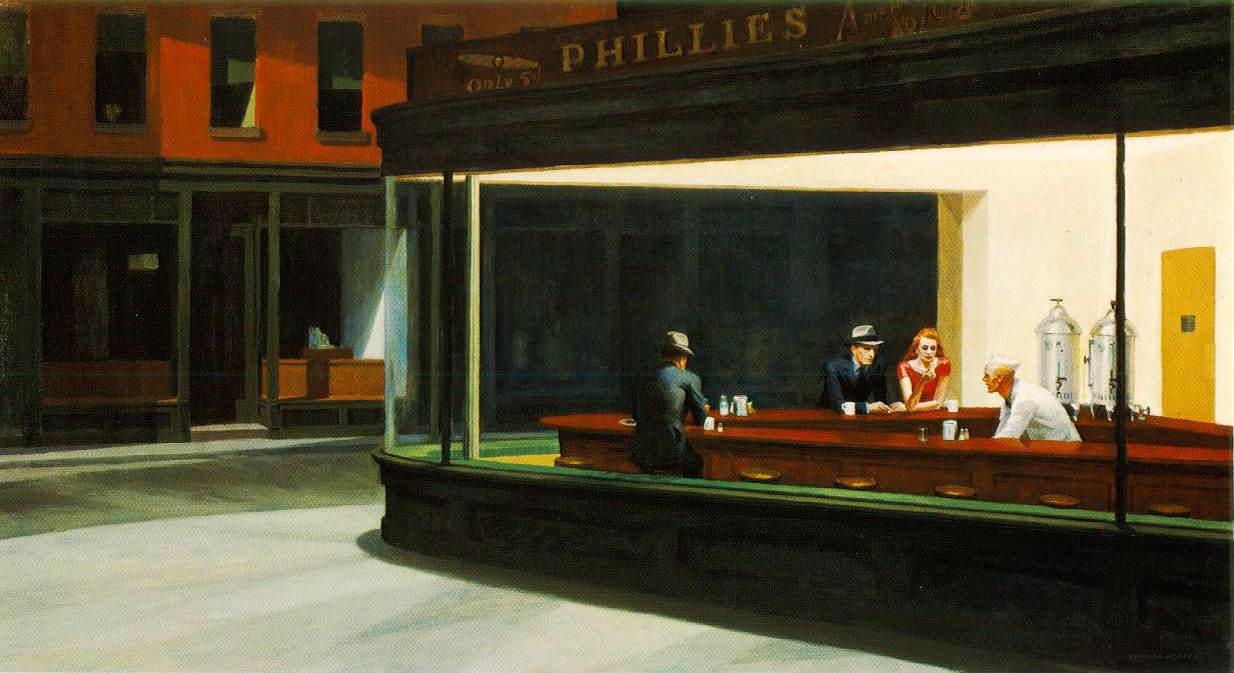
If you haven't yet, go to Modern Art Notes and read Tyler Green's review of a Robert Olsen show (Robert Olsen: Painter of Modern Light, January 20) at Plane Space in New York. This was my first exposure to this painter's work, and the images in Tyler's post were enough to make me want to see more. What is interesting about these paintings of the Getty Center is that scenes of modern desolation (elevators, parking lots, trams), which are truly ugly and illuminated by fluorescent light, are rendered lovingly, accurately, and transformingly. From what little I've read about him since reading Tyler's review, Olsen has been compared to Edward Hopper (for example, the artificial light of New York Movie, from 1939; Gas, from 1940; Nighthawks, from 1942) and Giorgio Morandi. For the style, process, and subject matter, I would also make a connection with the precisionism of someone like Charles Sheeler (for example, see Suspended Power from 1939).

Robert Olsen is a recent graduate of UCLA's MFA program. Some searching produced a few more images of his paintings: Untitled (Gasoline Pump, #4) (2003), Pump (Island) (2003), The Distance Between Two Cars, Version I (2003), The Distance Between Two Cars, Version II (2003), Reset (2002), New Order (2002), Topology (Mathematiques) (2002), Civic 4 (2002), and Parking Meter (Multi Station) (2001). Some of the Gasoline Pump paintings were featured in a show called "C6H6" last year at Susanne Vielmetter Los Angeles Projects, where most of Olsen's work is shown.