CD Reviews | CTD (Briefly Noted) | JFL (Dip Your Ears) | DVD Reviews
Showing posts with label Rachel Barton Pine. Show all posts

29.3.16

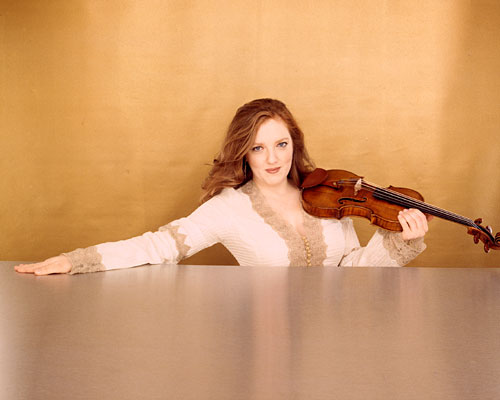
Rachel Barton Pine Recites Violin Bible

available at Amazon
Bach, Complete Sonatas and Partitas for Solo Violin, R. Barton Pine

(released on April 1, 2016)
Avie AV2360 | 125'33"
Violinist Rachel Barton Pine has long been an Ionarts favorite, although I have had to miss her last two local appearances, playing all of the Paganini Caprices in 2013 and on the Candlelight Concert series last year. Given her impeccable musicality, astounding technique, and beautiful tone, we were hoping she would get around to recording the six solo violin works of J. S. Bach, pieces known around here as the "Bible of music" (Gidon Kremer). Avie is about to release Barton Pine's top-notch account of the "Sei solo," as Bach put it on his manuscript copy of these pieces. I have only just started to listen to them, but her set is up there among my favorites of recent recordings, with Isabelle Faust (now available as a discounted 2-CD set) and Alina Ibragimova, although Viktoria Mullova and Rachel Podger still reign supreme in the Ionarts heart.

Barton Pine came home, in a way, in her choice of recording venue, to the sanctuary of St. Pauls United Church of Christ in Chicago, where she attended church as a child. She first performed Bach's music there, at the age of four, she explains in her booklet essay, and an image of Bach from one of the church's stained glass windows adorns the album. "You must practice Bach. It is the music of Gott!" Barton Pine recalls being told by elderly German ladies there. To accompany my delectation of the recording, Barton Pine chose Easter Sunday to be at the National Gallery of Art to give a live performance of the violin bible. So, after singing for an Easter Vigil and two Easter Day Masses, it was off to a different kind of sacred service for Ionarts.

Not all performers can speak with such easy authority about the music they play, but during this concert Barton Pine offered many insights about each sonata and partita, without ever abusing our attention. Introducing the first sonata, she described Bach’s written-out ornamentation as a way to prevent over-embellishment, but for the record Barton Pine’s excessively ornamented version, a fragment offered as an amusing way of being over the top, would probably make for great listening. After all, it is possible that Bach wanted to make sure that the performer did ornament these pieces, so he offered one plausible way of ornamenting, perhaps to encourage performers to go even farther.


Other Reviews:

Joan Reinthaler, Violinist Rachel Barton Pine brings joy to Bach’s ‘Chaconne’ (Washington Post, March 29)
In general, Barton plays this music with no vibrato, at one point in the first movement of the second sonata using a strong vibrato as an ornament, which had a striking effect. She played with her Baroque bow on her modernized 1742 Guarneri del Gesú instrument, so the sound was akin to what she achieves on the recording, with impeccable intonation, including in multi-stops, so that the fugal structures in the sonatas were precise and clear. One overarching facet of her approach was to keep meters strict, without becoming mathematical or mechanical. This makes her Ciaconna, the famous piece at the end of the second partita, feel again like a dance, a sense of rhythmic organization that can get lost in other performances, propelled at essentially the same tempo in all sections, including the shift to major. Each time that the opening section returned, sort of a "refrain" in the piece, she tightened the emotional impact of the piece.

Only the start of the second partita felt slightly dull in this performance, the only time my mind wandered slightly. As Bach intended in many of his pieces like this, designed as encyclopedic compendia, the third sonata and partita are climactic. The third sonata, with its most complex fugue, based on the chorale tune Komm, Heiliger Geist, was solemn and grand, followed by a simple, spare Largo as a moment of repose. Lest we take too seriously the God-minded side of Bach, he of the motto Soli Deo Gloria, the set ends with the much lighter third partita, here deft, sometimes thrilling, but without the heaviness of having to make too profound a statement. Life, after all, is far too serious not to dance.

22.5.15

Briefly Noted: Veracini's Sonate Accademiche

available at Amazon
F. M. Veracini, Complete Sonate Accademiche, Trio Settecento

(released on May 12, 2015)
Cedille CDR 90000 155 | 186'48"
The versatile American violinist Rachel Barton Pine leads an early music ensemble, Trio Settecento, heard at Dumbarton Oaks in 2011. The latest in the group's series of recordings of mostly 18th-century music for the Cedille label is a complete three-CD set of the Sonate Accademiche by Francesco Maria Veracini (1690-1768). The twelve sonatas in this set, published as opus 2 in 1744, are a mixture of the sonata da camera and sonata da chiesa varieties, including both dance movements and more serious contrapuntal movements Veracini designated as Capriccios. Veracini's love of counterpoint, noted by Charles Burney among others, makes him an interesting composer to compare to his near-contemporary, J.S. Bach.

Fabio Biondi and Rinaldo Alessandrini have already recorded these works (sample on YouTube -- the inclusion of theorbo on that recording is something missed here), as have the Locatelli Trio. Where Biondi favored a smooth and rhythmically stable style, Barton Pine and her colleagues play just a notch faster in most cases, and with an ear toward a slightly volatile, unpredictable way of playing with the tempo. In a particularly inspired move, she adds Scottish folk fiddle ornamentation to the Scozzese movement of no. 9 and gives a folksy color to other movements based on tunes Veracini likely took from John Gay's The Beggar's Opera, which he most certainly heard during his travels in Great Britain. Those Capriccio movements are probably the reason behind the identification of op. 2 as sonate accademiche, culminating in the studiously contrapuntal and excessively chromatic twelfth sonata (Passagallo, Capriccio Cromatico with two subjects, Adagio, and Ciaccona). The collection ends with a two-voice canon setting the text of a Latin epigram ("Ut relevet miserum fatum") for violin and cello set close together -- a rather Bach-like musical gesture.

20.1.12

Latest from Trio Settecento

This article was first published at The Classical Review on January 20, 2012.

available at Amazon
A French Soirée, Trio Settecento

(released on November 15, 2011)
Cedille CDR 90000 129 | 78'55"
Rachel Barton Pine has made a name for herself as a soloist in the big Romantic violin concertos, in concert and on disc, but she stands out from other violinists of her generation for her willingness to play music off the beaten path.

She has made recordings of lesser-known concertos by Franz Clément and Joseph Joachim, for example, pairing them with more famous contemporaneous repertoire warhorses by Beethoven and Brahms respectively. Her latest solo disc, Capricho Latino, is a recital of Spanish and Latin American music for unaccompanied violin, some of it adapted from pieces originally created for other instruments, including the guitar. She also plays in a heavy metal band, of all things.

At a concert of French music from the grand siècle, in Washington last year, I learned of Barton Pine’s interest in Baroque music. With John Mark Rozendaal on viola da gamba and David Schrader on harpsichord, she formed Trio Settecento in 1996, an ensemble devoted to 17th- and 18th-century music. That concert program informed this third recording by the group and follows earlier discs of Italian and German music, all on the Cedille Records label.

Barton Pine’s interest in early music goes back quite a while: she won a Gold Medal at the J. S. Bach International Violin Competition in 1992, and has performed with the Newberry Consort, the Baroque Band, and the Chicago Baroque Ensemble, all historically informed performance ensembles. In this repertory, Barton Pine plays on a most unusual and historically appropriate instrument, a violin made by Nicolò Gagliano in 1770 and preserved with almost no historical alteration to the present day.

The most striking piece in the Washington concert, the elder Jean-Marie Leclair’s Violin Sonata in G major, closes this recording. It perfectly showcases Barton Pine’s astounding virtuosity (Leclair was himself a virtuoso violinist), and shows her handling the devilish multiple-stop writing used to evoke trio sonata texture as if she were creating the sound of two violins on a single instrument.

Her Trio Settecento colleagues mostly serve as backup to Barton Pine’s fireworks, especially in the Leclair piece. It is combined with a fiery D minor Sonata by Jean-Féry Rebel, François Couperin’s Troisième Concert (distinguished by its folksy ‘Muzette’, a lively dance imitating the sound of a medieval bagpipe), and Jean-Philippe Rameau’s rollicking, harpsichord-centered Quatrième Concert, which includes a depiction of the chaos of the composer’s home, the slapstick lazzi (‘jokes’) of the Italian commedia dell’arte, and the prattling chatter of an indiscreet gossip.

John Mark Rozendaal sounds in better form on the disc than he did live, perhaps because he plays here on a superior bass viol from the 18th century (made by Jean Ouvrard in 1743). The famous gamba solo La Guitare, by the virtuoso Marin Marais, is quite beautiful. The Marais pieces are among several excerpts grouped together under the title of Divertissement representing the vast body of music composed for the royal ear, which includes dances from Jean-Baptiste Lully’s Ballet Royal de Flore (the last court ballet in which Louis XIV personally took part as a dancer in 1669), and suite movements by François Couperin and Marais. Each of these movements strikes a mood, often in the rhythmic pattern and tempo range of a specific dance style, and holds the ear entranced for their short durations.

The exception is Marais’ delightful Chaconne, the longest of three examples of the genre, based on a repeated bass ostinato pattern, one of the most iconic compositional types of the French baroque. Along with the chaconnes, the two sarabandes, both from concerts (suites) by Couperin, offer some of the most delectable listening on this generally savory disc.

In a personal note in the CD booklet, accompanying thoughtful program notes penned by Rozendaal, Barton Pine describes her labors in finding and maintaining appropriate intonation on a recording in which the pitch is set at A=392 (somewhat similar to a modern G-natural). “Listening to the glorious, ornate, and refined music of the French Baroque,” she writes, “is like stepping into a fantasy world of elegance and opulence.”

Indeed, Barton Pine’s exquisite intonation is one of the reasons listening to her is so rewarding. To further complicate matters, the harpsichord (a 1983 Lawrence G. Eckstein copy of a Dumont-Taskin instrument, with a charming lute stop, heard in the Couperin Sicilienne) has been tuned in an unequal temperament.

The Trio Settecento threesome, accustomed to one another from years of playing together, form a pleasing, unified whole, with careful, historically based attention given to matters of phrasing and ornamentation.

15.2.11

Trio Settecento at Dumbarton Oaks

Trio Settecento:
available at Amazon
A German Bouquet


available at Amazon
An Italian Sojourn
This review is an Ionarts exclusive.

We have been admirers of the playing of violinist Rachel Barton Pine since hearing her in Washington, twice, in 2006. In addition to the music we have already heard her play, it turns out that Barton Pine also has an interest in the Baroque violin repertory. She plays with a group called Trio Settecento, which made its Washington debut on Sunday night in a refined concert featuring music by French composers of the grand siècle. This French program, called A French Soirée, will be released on a disc this fall by Cedille, continuing a recent series of albums that has featured selections of German and Italian music.

The first half began with a mélange of music for the combination of violin, viola da gamba, and harpsichord, mostly dances from the 17th century, by Lully, Couperin, and Marin Marais. In this repertory, Barton Pine plays on a most unusual and historically appropriate instrument, a violin made by Nicolò Gagliano in 1770 and preserved with almost no historical alteration to the present day. Gagliano's father, Alessandro, trained in the Cremonese workshops of Amati and Stradivari, and he founded a Neapolitan tradition of violin making. The way she played these works, with a slender and precise tone, sweet and meaty but never forced, is another indication of one of the best results of the historically informed performance movement: real violin virtuosos combined with historical instruments and techniques make for more exciting renditions than those by some of the earlier specialists. (Viktoria Mullova also comes to mind.) Barton Pine's tuning was impeccable, and her left hand remarkably agile even as she added little embellishments to already florid lines. Standout pieces in the set included a forlorn sarabande (taken from Couperin's Concerts royaux) and a chromatically rich chaconne by Marais.

John Mark Rozendaal was a talented partner to Barton Pine on the gamba, often in rhythmic dialogue with her. In the pieces that featured him as a soloist, as in the technically demanding Les guitares by Marais, one noticed shortcomings more than being wowed by virtuosity, with some infelicities of intonation on the high strings and finger tangles here and there. At the harpsichord (a William Dowd copy of an instrument made by Blanchet), David Schrader was rigorous and reliable but not all that noteworthy, until he had more to work with in the demanding pieces by Rameau, from the Deuxième Concert, and Antoine Forqueray's dazzling harpsichord solo La Leclair, an evocation of the violin virtuoso whose work concluded the concert. For the most part, though, this was the Rachel Barton Pine show, nowhere more than in the astounding performance of Leclair's G major violin sonata (op. 3, no. 1). In all of the movements except the elegiac Largo, Leclair seemed to be trying to recreate the texture of the trio sonata in this work -- with both of the violin parts taken by the one violinist in extremely difficult double stops. Barton Pine treated these movements as the contrapuntal tour de force they were, giving both of the lines independence and beauty.

The next concerts on the Friends of Music series at Dumbarton Oaks will feature the Altenberg Trio from Vienna (March 27 and 28).

28.3.06

Rachel Barton Pine at the National Gallery

Rachel Barton Pine, violinistSometimes in a place like Washington, you get spoiled musically. (Let's not even talk about what it is like in Paris.) It was only a month ago that I heard American violinist Rachel Barton Pine in a recital at the National Museum of Women in the Arts (Rachel Barton Pine and Maud Powell, February 24). Shortly after my return from Paris, she was back to play another recital at the National Gallery of Art on Sunday evening.

To my delight, she opened this time with something Baroque, the G minor passacaglia by Biber. The echo-chamber acoustic of the West Garden Court caused Ms. Barton Pine to bellow her spoken program notes, in which she introduced this piece as the guardian angel passacaglia. It is, in fact, the conclusion to Biber's magnificent Rosary Sonatas (c. 1674), which I last heard live in Manchester two summers ago. Each of the fifteen sonatas was published with an engraving of one of the mysteries of the Rosary, and the concluding passacaglia was accompanied by the illustration of a guardian angel leading a child. I have written before about the hypnotic effect of this kind of piece, built over a descending bass pattern. This was a gorgeous rendition, perhaps not particularly baroqueux in terms of rhythm or embellishment, although she did use a Baroque bow. What Barton Pine brought to the piece, however, was a soaring tone and a careful manipulation of the various voices. It was the high point of the concert for me. (Barton Pine recorded this piece, along with other Baroque solo violin music by Bach and others, on her 2005 CD, Solo Baroque, available from Cedille Records.)

Other Reviews:

Stephen Brookes, Darkness and Light, From One Violinist (Washington Post, March 28)


Additional Commentary by Jens F. Laurson:

Bubbly, talkative, cherubic-rubenesque, Rachel Barton Pine comes across as the Drew Barrymore of violinists. But whatever you may think of former Miss E.T.’s acting abilities, Rachel Barton Pine’s skill at the violin is absolutely unquestionable. In great repertoire she delights, in less-than-great music she still impresses. On Sunday night at the surprisingly empty National Gallery of Arts West Garden Court she did both.

Starting with a Passacaglia by Biber: vibrato-free and in absolutely perfect pitch (and modern, not natural tuning – the latter which can be rather off-putting to our ears), with heft and passionate energy she worked her way through this most simple, yet so searing work. It was the opener to a varied and interesting program, spanning over 300 years – progressing chronologically from Biber to the Mozart obligato to Schumann to Perkinson to contemporary John Corigliano.

Changing from Baroque to regular bow she skipped the programmed Mozart Adagio in E (she had been too optimistic in what to cram into the given time) and landed at the Kreisler-arranged Mozart Rondo in D K382… played as “Kreisler on a theme of Mozart.” And so it sounded: delectable confection, a little bit of which delights, more of which would still be enjoyable, too much of which would require a Schnapps.

Schumann’s Sonata No. 1 saw her with pianist Matthew Hagle as a very sensitive partner (who didn’t get the due credit for his excellent contribution in this and the Corigliano) who also knew how to navigate around the pitfalls of the West Garden Court’s acoustics while Ms. Barton Pine delighted with her smooth, entirely convincing, and warmly Romantic performance in which her 1742 Ex-Soldat Del Gesu had a good part. It was the kind of performance that sold this little semiprecious as a rare gem; just the way you’d want Schumann to sound.

The 1972 Coleridge Taylor Perkinson Blue/s Forms (“Plain Blue/s” – “Just Blue/s” – “Jettin’ Blue/s”) had Bach in the first notes and then rubbering, slippin’ and slidin’ through the notes with bluesy elasticity. Very catchy and superbly composed – and played. “Jettin’…” was pure joy to listen to. The craving of Ms. Barton Pine’s to play American music whenever in Washington is commendable so long as it brings us Taylor Perkinson or John Corigliano’s sonata. But it’s getting out of hand with the fiddle-ho-humm muzak of Mark O’Connor. Perhaps if you shut “classical” mode off it might become more interesting, but I can’t shake the notion that it sounds like Jeff Foxworthy had become a composer. The idea of tracing American fiddling from inception to modernity is not bad – but the result just doesn’t live up to it. Reducing the pianist to a chord-pressing automaton surely didn’t underwrite the compositional brilliance of this work.

If brevity… Corigliano’s fun sonata has plenty of wit and employs it with refreshing efficiency. Whether in the wild outer first movement or the Andantino (lyrical on shifting axes with a sense of violence underneath a calm surface and occasional stormy interludes), this is plain good music that sounds fresh despite or because of being hopelessly reactionary (yet also decades ahead) at the year of its inception, 1963. Barton Pine Yankee-Doodled around with Henri Vieuxtemps's Souvenir d'Amérique for an encore. Nifty, at best: but a violinist so truly impressive as her, the snob will easily forgive all programming choices.
The other real find of the concert was John Corigliano's Sonata for Violin and Piano (1963), a tour de force that the composer wrote for his famous violinist father, the former concertmaster of the New York Philharmonic. It's a damn exciting piece that required all of Barton Pine's considerable technical skills on her "ex-Soldat" violin, made by Giuseppe del Gesù Guarneri in Cremona in 1742. You can hear New York in the 1960s in the opening movement (Allegro), which has Leonard Bernstein written all over it, not to mention fairly overt references to Prokofiev's 7th piano sonata in the piano's left hand. In Barton Pine's hands, the second movement (Andantino) was a California jazz film score, and the fourth movement (Allegro) was a raucous circus tune, with a nod toward Shostakovich. In the brutal third movement (Lento), the full-throated tone of Barton Pine's violin vividly depicted the sense of emotions rubbed raw. It was a worthy performance, strong and even, of a piece that should be played more often. This was equally due to the virtuosic playing of pianist Matthew Hagle, who reacted to the difficult writing with a sense of adventure, in a sense on even footing with Barton Pine, in a way that I had not appreciated his playing up to this point.

Most of the program was equally entertaining if not quite as striking. Fritz Kreisler's arrangment of Mozart's Rondo in D Major, K. 382, is of sentimental value to Ms. Barton Pine, she explained in her comments (she played it often when she was "in the single digits," as she put it). It was a seductive reading, outrageous cadenzas and all. I would not be surprised if Mozart approved of the sense of showmanship. I was impressed by Barton Pine's reading of the Schumann first sonata, op. 105, a piece that does not always impress. The end of the first movement (Mit leidenschaftlichem Ausdruck) was magnificently dramatic and powerful, to the point that the audience applauded, and rightly so. The second movement (Allegretto) was, by contrast, all interior monologue and understatement.

The other two works on the program were examples, good and bad, of how to incorporate popular music into a classical work. Coleridge Taylor Perkinson, a scholar at the Center for Black Music Research, used blues idioms in his Blue/s Forms for unaccompanied violin (1972), but the jazz sounds have been fully digested and the resulting sound is not merely jazz played on the violin, but something new and interesting. (A historical example of this "good crossover" is the quodlibet that concludes the Goldberg Variations, where Bach quotes snatches of beer-hall ditties and other tunes, but as part of an incredibly complex piece that is much more than just popular song quotations.)

On the negative side was the concluding piece, Strings and Threads by Ionarts bête noire Mark O'Connor. Ms. Barton Pine charitably described the work as "13 short pieces" that give a "history of fiddling in America." All I can say is that I wish it had been a whole lot shorter. A judicious selection of movements -- let's say two? -- would have been preferable to the whole deadly thing. I thought poor Matthew Hagle, whose talents were squandered on a series of chords and vamps, was going to fall asleep. O'Connor does his old schtick, conjuring various popular styles, often with terribly difficult playing for the violinist (all handled with aplomb by Barton Pine). It is some of the most repetitive and derivative music ever to enter my ears. Little matter, in what was an excellent recital.

24.2.06

Rachel Barton Pine and Maud Powell

The National Museum of Women in the Arts is a dynamic place, which regularly offers interesting exhibits, film screenings (like the Agnès Varda film I saw last year with an introduction by the filmmaker herself), and other events. They host only a small number of concerts, but these often showcase musicians well worth hearing, as was the case with the recital by Christine Brewer I reviewed last spring. So, I was not surprised last night to find myself in the audience with some high-profile Washingtonians like Supreme Court Justice Ruth Bader Ginsburg, Leonard Slatkin (conductor of the National Symphony Orchestra), and Neale Perl (president of Washington Performing Arts Society). Slatkin has a family connection, since his wife, Linda Hohenfeld Slatkin -- who is a soprano, heard recently on the recording of William Bolcom's Songs of Innocence and of Experience -- is one of the artistic directors of this series, the Shenson Chamber Music Concerts. The reservation list was full, but everyone who was waiting on stand-by, myself included, got in to the little concert hall on the museum's fifth floor.
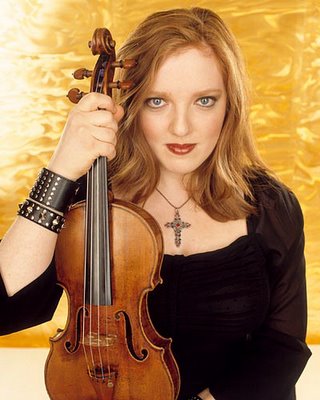
Joseph Guarnerius del Gesu 'ex-Soldat' violin, Cremona, 1742, with Rachel Barton PineAmerican violinist Rachel Barton Pine was in town for the first of those concerts this season. Here was a prominent woman violinist playing an ingenious concert in tribute to the first great violinist in the United States, Maud Powell, who also happened to be a woman. If you have never heard Powell's name before, you should get familiar with the piles of information now available from the Maud Powell Society in North Carolina. For the latter part of her career, she was regarded around the world as the best female violin player anywhere and the best American master of the instrument, man or woman. Karen A. Shaffer, the society's president and founder, was also in the audience last night, clearly thrilled that Rachel Barton Pine was drawing attention to the subject of her life's work.

As an example of Maud Powell's prominence, she gave the American premieres of violin concerti by Dvořák, Tchaikovsky, and Sibelius, with the first of those composers working with Powell directly to prepare the score. Barton Pine began her fascinating program with one movement from each of these three concerti, to show off the range of technical demands that Powell confidently took onto her shoulders. The broad bowstrokes and roaring melismas up and down in the first movement of Dvořák's A minor concerto, op. 53 ("Allegro, ma non troppo"), quickly stripped strands of horsehair off Barton Pine's bow. It's a fiercely difficult movement, with lots of passages in octaves and other multiple stops. Often the movement featured the raw, throaty low register of Barton Pine's instrument, the "ex-Soldat" violin made by Giuseppe del Gesù Guarneri in Cremona in 1742. Tchaikovsky's D major concerto, op. 35, offered its slow movement ("Canzonetta: Andante"), a gorgeous gypsy-flavored melody, in which Barton Pine was at her lyrical, long-lined best. The final movement came from Sibelius's D minor concerto, op. 47 ("Allegro, ma non tanto"), which is a sort of mad dash full of exciting syncopations, a few short parts of which slipped ever so slightly out of Barton Pine's control.
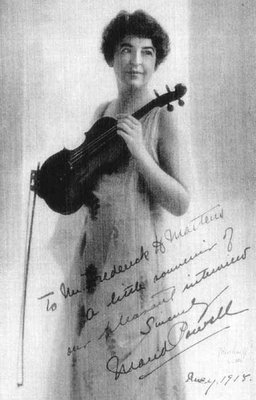
Maud Powell, 1867-1920Powell championed her own countrymen's music as much as she could, and several American composers dedicated works to her. Barton Pine gave us two examples, the second of which was a pretty but fairly unremarkable Romance for Violin and Piano, op. 23, that Amy Beach wrote for Maud Powell and herself to play at a Women's Congress. Far more interesting to me was a piece by Marion Bauer called Up the Ocklawaha, Tone Picture for Violin, op. 6. It began on one of Powell's concert tours in Florida, during which she played in a small town accessible only by an overnight boat trip up a small river. Powell wrote a poem about the experience, which describes the efforts of the "dusky crew" to keep the frightening night at bay. (For someone who was apparently quite forward-thinking about race, she also called the black boatmen the "Trusting darkies guiding the boat / With stealthy instinct, true, unerring.") Barton Pine brought a most evocative sound to this short work of program music: "The arrowed flames / Trick and cheat the eye: / Wanton shapes infest the trees / (Hanks of poisonous moss in the air)."

Powell was the first white soloist to program arrangements of black spirituals, and Barton Pine played a few of Maud Powell's arrangements of these tunes, beginning with her version of Samuel Coleridge-Taylor's Deep River. Powell often played these arrangements for American troops during World War I, because the familiar melodies mean home. As an encore, Powell sometimes played her own arrangement of four plantation melodies, all of which began life in minstrel shows, the infamous blackface vaudeville acts that grotesquely sentimentalized American plantation life. (uTopianTurtleTop had a couple of great posts about the familiar melody "Jimmy Crack Corn" and the gradual, insidious process by which racist minstrel tunes like it become children's songs. In the same vein, I wrote this post about what Debussy's piece Golliwog's Cakewalk really means.)

Other Reviews:

Gail Wein, A History of Violins (Washington Post, February 25)
The final set were pieces that Maud Powell played on her tours with John Philip Sousa's band, including Max Liebling's Fantasia on Sousa Themes, which used melodies mostly from Sousa's operas. (Yes, he wrote operas. Liebling studied with Franz Liszt.) This was some of the most difficult playing for Barton Pine's partner at the piano, Matthew Hagle, whose playing was sensitive, if somewhat understated, all evening. Herman Bellstedt, Jr., one of Sousa's cornet players, composed the Caprice on Dixie for Unaccompanied Violin as a virtuosic tour-de-force, which it certainly was in Barton Pine's hands. (I don't have a problem with her playing a piece based on that controversial tune, but Barton Pine's explanation of the tune's origin -- named for a kind slave owner in Manhattan named Dixie -- does not have any historical basis, as far as I can determine. The original minstrel lyrics clearly seem to depict -- perversely, as so much about minstrel shows -- a freed slave longing to return to the life of his plantation.) The encore was another Maud Powell arrangement, of Nobody Knows the Trouble I've Seen, which Powell was playing when she had a heart attack on stage, not long before she died. Rachel Barton Pine offered a most fitting tribute to her memory.

If you missed this excellent concert, you will have the chance to hear Rachel Barton Pine next month, also for free, at one of the Sunday concerts (March 26, 6:30 pm) at the National Gallery of Art. The program will be different, with music by Heinrich Ignaz Franz von Biber, John Corigliano, Mozart, and Schumann, but the team of Rachel Barton Pine and Matthew Hagle will be the same. Ionarts, of course, will be there.