CD Reviews | CTD (Briefly Noted) | JFL (Dip Your Ears) | DVD Reviews
Showing posts with label Erkki-Sven Tüür. Show all posts

29.11.25

Critic’s Notebook: RSO & Poschner - The Harmonists Strike Back


Also published in Die Presse: Poschners Gebet für die Seejungfrau: Das RSO im Musikverein

available at Amazon
E-S.Tüür, Piano Concerto, Sy.#7,
P.Järvi / Frankfurt RSO, NDR Chorus / L.Mikkola
ECM

available at Amazon
Erkki-Sven Tüür
Symphony No.5,
Prophecy (Accordion Concerto)
Nguyên Lê, Mika Väyrynen
Olari Elts, Helsinki PO
(Ondine, 2007)


US | UK | DE

Moussa and Tüür, Wagner & Strauss: An ear-friendly Vienna RSO Concert of the New and the Old


Ear-friendly modernism and Romantic staples with the RSO under Poschner


Having a premiere is easy; getting three performances in four years (in Vienna alone) is decidedly not. Yet that’s the trick Samy Moussa pulled off with Elysium, now played by the RSO in the Konzerthaus under Markus Poschner after being premiered by the Montréal Symphony Orchestra in ’22 and included on a program of the Vienna Philharmonic under Thielemann last year. From its first catchy chords—with glissandi floating back and forth so thickly, they acted like opulent portamenti—Moussa’s work wants to please. Not a lot actually happens within the dense sonic surface, but that hardly matters—no more than the fact that one often feels reminded of very good film music.

More substance is found in the more demanding Lux Stellarum by Erkki-Sven Tüür, one of the most interesting composers of the last several decades: a genuinely individual voice, ideology-free and fully his own. The flute concerto crackles and rattles; its solo part, played by dedicatee Emmanuel Pahud, shifts between acrobatic whistling and lyrical introspection. Here, too, sound-plates slide over one another, but of a smaller, more varied sort—broken up by rhythms that, time and again, provide little jolts of surprise.

Tüür the symphonist (he’s written ten so far; Nos. Five and Seven are essential listening) never panders. The modernity of his music is never concealed or coyly muffled, yet it remains consistently consonant. That this aspect, in this 14th of now 16 RSO-commission concerts, falls largely to the orchestra may be due to the solo instrument: it doesn’t wander far from the conventional contemporary flute vocabulary, even though Tüür is himself a flutist. (Checking it out for yourself will be possible soon enough: together with his newest concerto, the Oboe Concerto, Lux Stellarum will be released before long with the Tonhalle-Orchester under Paavo Järvi on Alpha.) Both works do the RSO’s mission proud and reflect the orchestra’s heartening tendency not to cede the terrain of ear-friendly modernism to the ivory-tower avant-garde. For that, Poschner is just the right man—there’s so much beautiful music to un- and rediscover that other orchestras rarely, if ever, touch. (Is it too much to hope now, for an RSO Hartmann-Symphony Cycle and a Karl Höller Focus?)

The more conventional second half offered Wagner’s Parsifal Prelude and Richard Strauss’s Death and Transfiguration. The Wagner—apparently the fourth-place finisher when it came to rehearsal time but not much more often played by this orchestra than either new piece —was, despite largely lovely string sound, not quite as polished as aimed-for. But in the seamlessly ensuing Strauss everything snapped back into place. The way early Strauss rises from stillness and quiet into a gloriously Straussian racket, only to come to rest in nostalgic sweetness, was wonderfully shaped and admirably delivered by the orchestra—both as a collective and in its individual contributions.


Dip Your Ears: No. 282 (Erkki-Sven Tüür’s Indelibly Interesting Symphonies)


available at Amazon
Erkki-Sven Tüür
Symphony No.5,
Prophecy (Accordion Concerto)
Nguyên Lê, Mika Väyrynen
Olari Elts, Helsinki PO
(Ondine, 2007)


US | UK | DE

Erkki-Sven Tüür’s Fifth for Orchestra, Big Band and Electric Guitar


Erkki-Sven Tüür’s ongoing cycle of interesting symphonies (in 2017 he arrived at No. 9) makes him – by quality more significantly than quantity – the premiere symphonist of our time. Always good for the inclusion of seemingly eclectic instruments (electric guitar, accordion, big band, percussion, tape, synthesizer) in his orchestral works, he expands the tonal palate much the same way a Gustav Mahler did when the latter threw the mandolin or guitar or castanets or xylophones or a hammer into his symphonies, all before perfectly unsuspecting audiences. (Happily, this is much easier on the ears than when other composers stick with the traditional instrumental apparatus only to then make these instruments generate every sound except those they were meant to produce in the first place.)

In this Fifth Symphony, premiered in 2005 at the Stuttgart Eclat New Music Festival, the electric guitar has some particularly lyrical quasi-cadenzas in the second movement. The fact that we might find it curious is only a consequence of our aural associations and expectations with and of an electric guitar. But all the rest of the symphony is pretty classical, down to the four-movements and their structure, which goes to show that there’s still much left in the old form and ‘old’ – i.e. tonal – modes, if only a composer can muster sufficient imagination.

Erkki-Sven Tüür does. In fact, his works are bursting with originality and phantasy, freed of all academicism and perceived “ought-to’s”. Not all of them as successful as this Fifth (or the Seventh) Symphony, perhaps, but always full throttle and never displaying originality for its own sake. The groove of the third movement is befitting any classical Scherzo; the Big band gets its moment in the spotlight, backed by a percussive, happy but firmly embedded, organic beat (sound clip) – not as artificially superimposed and faddish as large percussion sections can sound in too many contemporary works (Higdon, Sierra, Widmann, Golijov et al.).

It’s possible that connoisseurs of conventional symphonies wrinkle their brow in disapproval of these allegedly foreign ingredients. This brings to mind a beverage-related spoonerism of composer and linguistic genius Franz Mittler: “I would rather have a boot in my rear / Than a root in my beer.” But Tüür’s symphonies are not symphonies-in-name only, they are decidedly real beer; just a modern variant of the classic original. Maybe something Dogfish Head Brewery would concoct.

Rounding out a fabulous disc is the accordion concerto Prophecy, a substantial concerto in four continuous movements, which often ends up a swarm of sound with intermittent, hallmark Tüür moments (dry timpani before a canvas of dark quiet, for example). In it, the accordion is less folksy than it is grave; the whole thing more redolent of an organ concerto than a polka. As a card-carrying accordion-lover, I dig it muchly.


This review had been previously published on Classics Today.

23.7.18

On ClassicsToday: Tüür’s Splendid New Wine In Old Wineskins

Major Discoveries: Tüür’s Splendid New Wine In Old Wineskins

Review by: Jens F. Laurson

TUUR_Symphony-5_Prophecy_ONDINE_jens-f-laurson_classical-critic
Erkki-Sven Tüür’s ongoing cycle of interesting symphonies (in 2017 he arrived at No. 9) makes him--by quality more significantly than quantity--the premiere symphonist of our time. Always good for the inclusion of seemingly eclectic instruments (electric guitar, accordion, big band,... continue reading


Erkki-Sven Tüür, Symphony No.5, 3rd movt., excerpt


28.5.18

On ClassicsToday: Erkki-Sven Tüür’s Whistling Desert-Fowl

Erkki-Sven Tüür’s Whistling Desert-Fowl

by Jens F. Laurson
TUUR_Symphony-8_Tapiola-Sinfonietta_ONDINE_jens-f-laurson_classical-critic
The Estonian composer Erkki-Sven Tüür is one of those composers whose music is both uncompromisingly modern and above-average accessible. He roughly follows the line of fellow, compatriot symphonist Eduard Tubin (1905-1982) and Finnish “Fauvist” Einojuhani Rautavaara (1928-2016). Tüür is up to eight symphonies by now,... Continue Reading

19.4.18

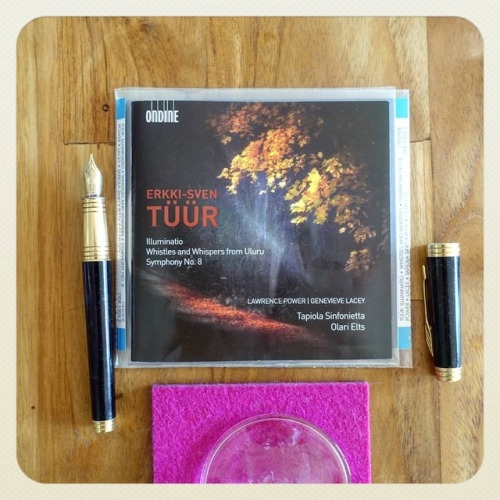
#morninglistening to @erkkisven w/@TSinfonietta under @OlariElts...


#morninglistening to @erkkisven w/@TSinfonietta under @OlariElts on @ondineRecords

Amazon: http://a-fwd.to/7KsHO8X

#Symphony No.8, #violaconcerto w/#LawrencePower, +
#WhistlesAndWhispers from #Uluru, a #flute #concertino.

This Eighth Symphony notwithstanding, Tüür is one the most important symphonists of our time.

#Tüür #classicalmusic #classicalmusiccollection #classicalcdcollection #contemporarymusic #21stCenturyMusic #concertos #symphonies #ViolaMusic #Estonianmusic


https://ift.tt/2J8DNLg
via Instagram

15.2.18

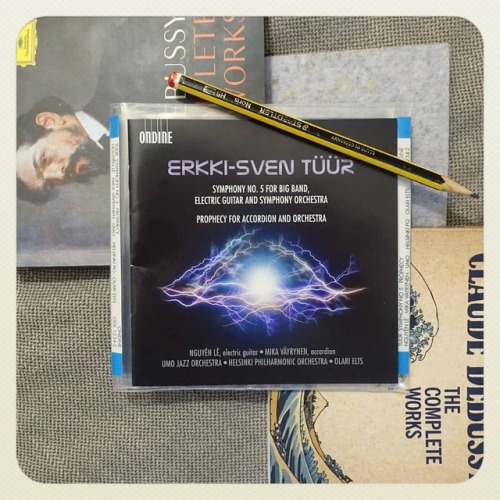
#morninglistening to @erkkisven w/@helsinkiPhil under @OlariElts...


#morninglistening to @erkkisven w/@helsinkiPhil under @OlariElts on @ondineRecords

http://a-fwd.to/6fxBsfm

#Symphony No.5 for #BigBand, #ElectricGuitar & #SymphonyOrchestra +
#AccordionConcerto “Prophecy”

Here are two works I love and which are much more effective (at least on record) than the Eighth Symphony. That experience notwithstanding, Tüür is clearly on his way - or more likely: already there - of becoming one the most important symphonists of our time.

#Tüür #classicalmusic #classicalmusiccollection #classicalcdcollection #contemporarymusic #21stCenturyMusic #concertos #symphonies #AccordionMusic #Estonianmusic


http://ift.tt/2o7c3Of
via Instagram

11.2.18

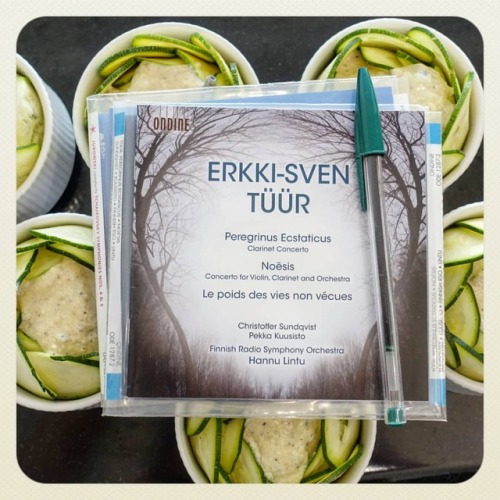
#morninglistening to #erkkisventüür w/@YLE_RSO under...


#morninglistening to #erkkisventüür w/@YLE_RSO under @hlintu:

http://a-fwd.to/7iFGabo

#ClarinetConcerto “Peregrinus Ecstaticus”
#DoubleConcerto “Noēsis” et.al


#Tüür #classicalmusic #classicalmusiccollection #classicalcdcollection #contemporarymusic #21stCenturyMusic #choralmusic #symphonies #Estonianmusic


http://ift.tt/2Bojglj
via Instagram

22.9.12

From the 2012 ARD Competition, Day 7

Day 7, String Quartets, Semi Finals

Six string quartets (performers) and 18 string quartets (compositions) in just under nine hours is something you will not likely experience anywhere outside the ARD Music Competition. It’s a marathon, exhausting and gratifying, and particularly insightful when it comes to the ARD commissioned competition that participants of the semi final are required to play.

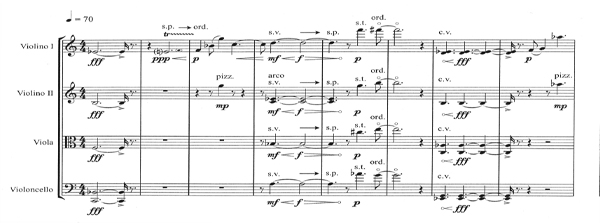
For the String Quartets in 2012, that was a composition by Erkki-Sven Tüür, Lost Prayers—his second string quartet, which is quite easy on the ears, comprehensible, not all too novel, and full of musical references that the ear consecutively grasps after one, two, three hearings. Notably there is a general kinship with Gregorian, or Schütz-like sentiments (not surprising if you know his Wanderer's Evening Song), there are long dramatic arches that emerge, and also hints—but just half a second long—of extreme romanticism. It’s a work that pays homage to the string quartet tradition, and continues it… written expressively for the instruments, not against them. If it’s a little tedious in its constant stymied run-ups that are lost in flageolet notes before the whole shebang starts over again until it finally reaches fruition after the eleventh or so time… well, it’s also a lot better than this commissioned piece could have been. The voices—this year and those from 2009—should know what I mean.


The Acies Quartet (Benjamin Ziervogel & Raphael Kasprian, violins, Manfred Plessl, viola, Thomas Wiesflecker, cello), experienced favorites, were the first to go—which meant the world premiere performance for Lost Prayers. Every hearing of a new work is a learning experience, even with the very readable score on one’s lap, but the Acies’ transparent, nuanced, gently lit account was just about ideal for a first listening. Rather than single-mindedly reciting the text in front of them, they made their own (though perhaps not Tüür’s) musical sense of it, even if that meant not slavishly following every dynamic marking, or lack thereof.

The Novus Quartet (Jae-young Kim & Young-Uk Kim, Violins, Seung-won Lee, Viola, Woong-whee Moon, Cello – from the Korea National University of Arts) went about it differently, informed perhaps by a desperate instinct to get as much sentiment out of the work as it lends itself to—which is a