Fresh back from a Easter Parsifal performance (review forthcoming), I figure it seems only (in)appropriate, on this Easter Sunday, to resurrect the two meandering 'Easter Pilgrimage bits' I wrote for WETA in 2008... which was a wonderful trip through Europe with the goal of getting as many Parsifal and Matthew Passion performances into a fortnight. (An unforeseen link: Attila Jun, then a Dutchman in Stuttgart, filled in this night as Gurnemanz.)
Easter Pilgrimage – Dutchman Detour
Classical WETA, Wednesday, 4.2.08
On the way from Amsterdam to Vienna, the Easter Pilgrimage of Matthew Passions and Parsifals I also picked up two performances of less topically related Wagner works: The Flying Dutchman in Stuttgart and Tristan & Isolde in Vienna.
Of course, just about any Wagner opera can be made to fit Easter without straining too much, given the abundance of death through redemption and redemption through compassion (and more death). Senta and Isolde, the Dutchman and Tristan: Surely there is room in their stories to see (or force) analogies to “The Greatest Story Ever Told”.
This is certainly not what Calixto Bieito sees in the Dutchman for his new production at the Staatsoper Stuttgart. Instead, Bieito takes it to be an allegory of isolation in modern society, a critique of the economic system, consumer culture, and essentially a critique of a loss of values and morality. As expected, Bieito does this in his trademark brash, genital-touting style that sells out opera houses, enrages critics, and sends – especially North American – commentators into apoplectic fits of “Eurotrash” bashing. In doing so the culture-pundits often are guilty of precisely what they fault Bieito and his ilk with: They get stuck at superficialities, unable or unwilling
Here is your regular Sunday selection of links to online audio, online video, and other good things in Blogville and Beyond. (After clicking to an audio or video stream, press the "Play" button to start the broadcast.)
For Easter Sunday, here is the Berlin Philharmonic performing Mahler's second symphony at Carnegie Hall in February 2012, with Camilla Tilling and Bernarda Fink, plus some Wolf songs. [Österreichischer Rundfunk]
Or there is the performance of Wagner's Parsifal at Salzburg's Easter Festival, with Christian Thielemann conducting the Staatskapelle Dresden and Chorus, with Johan Botha (Parsifal), Wolfgang Koch (Amfortas), and Michaela Schuster (Kundry), recorded on March 23. [Österreichischer Rundfunk]
Add to that the Vienna Philharmonic performing Olivier Messiaen's Éclairs sur l'au-delà, recorded in Vienna in January 2008. [Österreichischer Rundfunk]
Listen to a concert of medieval music performed by Ensemble Musica Nova, centered on Guillaume de Machaut's Messe de Nostre Dame, at the Abbaye de Bonmont. [France Musique]
Watch Daniel Harding conduct the Orchestre Philharmonique de Radio France in a performance of Grégoire Hetzel's opera La Chute de Fukuyama. [Cité de la Musique Live]
Music for Holy Week by Monteverdi and Gesualdo, performed by Gambe di Legno. [Österreichischer Rundfunk]
Listen to a concert by the Quatuor Varèse, performing quartets by Mozart and Schumann. [France Musique]
A performance of Handel's oratorio Judas Maccabaeus, with Laurence Cumming directing the Choir and Orchestra of the Age of Enlightenment, with John Mark Ainsley, Christine Rice, Mezzosopran, Alastair Miles, and Rosemary Joshua, recorded at the Proms last summer. [Österreichischer Rundfunk]
Watch a new production of Mozart's Don Giovanni, directed by Jean-Yves Ruf for the Opéra de Dijon, with Gérard Korsten conducting the Chamber Orchestra of Europe and the Chœur de l'Opéra de Dijon. The cast is led by Edwin Crossley-Mercer (Don Giovanni), Josef Wagner (Leporello), Diana Higbee (Donna Anna), and Ruxandra Donose (Donna Elvira). [Medici.tv]
Ton Koopman conducts the Orchestre Philharmonique de Radio France in music by the Mozarts (Wolfgang and Leopold) and Haydn, at the Opéra Comique. [France Musique]
Ondreij Lenárd conducts the Prague Radio Symphony Orchestra in music by Wagner (with mezzo-soprano Veronika Hajnová), Tchaikovsky, Fauré, and Mahler, recorded in Prague last month. [Österreichischer Rundfunk]
String quartets by Haydn, Bartók, and Beethoven performed by the Tetzlaff Quartet at the Auditorium du Louvre earlier this month. [France Musique]
More from the Salzburg Easter Festival, with Christian Thielemann conducting the Brahms German Requiem, with the Staatskapelle Dresden and Bavarian Radio Chorus and vocal soloists Christiane Karg and Michael Volle. [Österreichischer Rundfunk]
Pianist Adam Laloum, violinist Alexandra Soumm, and cellist Victor Julien- Lafferière perform trios by Brahms and Zemlinsky. [France Musique]
A recording of Bellini's Il pirata, conducted by Marcello Viotti at the Deutsche Oper in Berlin, with Roberto Frontali (Ernesto), Lucia Aliberti (Imogene), and Stuart Neill (Gualtiero). [Österreichischer Rundfunk]
Watch Paavo Järvi conduct the Orchestre de Paris in music of Rachmaninoff, including the third piano concerto with soloist Jorge Luis Prats, at the Salle Pleyel. [Cité de la Musique Live]
Pianist Cédric Tiberghien joins the Orchestre National d'Ile de France and conductor Enrique Mazzola for a concert with music by Beethoven, Tchaikovsky, Andrzej Panufnik, and a world premiere by Svitlana Azarova. [France Musique]
Listen to a performance of Verdi's Requiem, with Jean-Claude Casadesus conducting the Czech Philharmonic Chorus of Brno and the Orchestre National de Lille, with soloists Veronika Dzhioeva, Lilli Paasikivi, Stuart Neill, and Roberto Scandiuzzi, at the Salle Pleyel in Paris. [France Musique]
Organist Mathias Lecomte joins the Choeur de Radio France for a program at the Salle Gaveau, including music by Bach, Walther, Sandstrom, and Moëne. [France Musique]
A concert of Croatian folk music and chant by Ensemble Dialogos, directed by Katarina Livljanić. [France Musique]
Cellist Mario Brunello performs at the Festival Présences, in the Grand Théâtre de Provence, with music by Bach, Judith Weir (b. 1954), and Giovanni Sollima (b. 1962). [France Musique]
As mentioned earlier this week, you can watch the production of Benoît Mernier's new opera La Dispute, from the Théâtre de la Monnaie in Brussels. [De Munt]
Marek Janowski, the music director of the Rundfunk-Sinfonie Orchester Berlin, may have conducted the National Symphony Orchestra before this weekend, but Friday night's performance was the first time we have reviewed him here in Washington. Violinist Arabella Steinbacher, who has collaborated with Janowski on a couple of recordings, joined him again for Beethoven's violin concerto (op. 61). The audience was perhaps a little thin, a danger on Easter weekend, but it was an excellent concert, especially the second half.
Steinbacher played the Beethoven concerto, hardly an unfamiliar work after all, just a year ago with the Baltimore Symphony Orchestra. This performance left much the same impression, not as immaculate a rendition as Julia Fischer because of too many intonation issues and occasional squawks of tone (the first in the solo's opening set of rising notes), but Steinbacher has a puissant, sweet tone on the E string. She takes a lot of rhythmic freedom, and Janowski assisted by pushing and pulling back tempos, giving the piece some unpredictability, quite slow in the development and then speeding up considerably at the recapitulation. Steinbacher played the cadenzas by Fritz Kreisler, which have a lot of virtuosic flair, especially in the third movement, but are not exactly a daring choice in a large field of possibilities. The high point for Steinbacher was the slow movement, in which she was like a soprano floating above a beautifully balanced orchestra, exquisite in the orchestral pizzicato section, like a lute accompanying the soloist. (The ovation was not strong enough to merit an encore from Steinbacher, who reportedly played Kreisler's Recitativo and Scherzo on Thursday night, the same encore she played with the BSO last year.)
Janowski gets credit for bringing the Orchestra-Variations on a Theme of Paganini by Russo-German composer Boris Blacher (1903-1975), a composer reviewed live only once so far in Ionarts history. Blacher composed this piece in 1947, shortly after he returned to teaching in Germany, after being declared "degenerate" by the Nazis. Although both the concertmaster and associate concertmaster had sat out the Beethoven concerto, Nurit Bar-Josef was back for the second half, to play Paganini's original solo violin theme that introduces sixteen variations for orchestra, several less than a minute in duration and none longer than two minutes. Andrew McCredie, in his biographical sketch on Blacher in Music of the Twentieth-Century Avant-Garde: A Biocritical Sourcebook (ed. Larry Sitsky), calls these variations "a thesaurus of orchestration and contrapuntal devices." From the first variation, in which swirling woodwind runs flare away from the theme in a crazy vortex, it is a tour de force, given a varied and solid performance led with confidence by Janowski, conducting without a score. Highlights included the iridescent fourth variation, suavely chromatic; the guitar-like pizzicato eighth variation; the tenth variation, with its jazzy flute and clarinet solos, the heritage of Blacher's love for American jazz heard in Berlin; the sixteenth-note Offenbach patter romp of the eleventh variation.
Blacher's score stood up even by comparison to the final piece on the program, Tod und Verklärung (op. 24 -- last heard from the BSO last year) by the young, prodigiously talented Richard Strauss, one of the greatest masters of orchestration. Again working without a score, Janowski led a performance of striking softness and subtlety, the rasping breath of woodwinds and fading heartbeat of timpani at the opening, describing an artist on his deathbed, his mind flooded with memories. The haze of childhood recollections, dotted with sweet woodwind solos and the halo of harp arpeggiation, was followed by the rumble of the double basses and the sounds of artistic struggle, again all with excellent dynamic balances between sections. Strauss used a signature harmonic progression in this piece, heard very early in the piece and then in a more complete form at the moment of transfiguration -- I-ii-I-V7/V, over a tonic pedal. John Williams and every other film composer has copied it, but Strauss gives it a special power, altering it with many substitutions for the V7/V chord, delaying its final return until the final moments of the score. It was the sort of thing that this performance helped make clear.
This concert repeats this evening (March 30, 8 pm), in the Kennedy Center Concert Hall.
I have a soft spot for most of the irreputable Hans Pfitzner’s unabashedly romantic tone. But Palestrina, his supposed masterpiece, can be dull. While I suffered through a performance with Simone Young in Munich, the Frankfurt opera, too, performed Palestrina, and fortunately Oehms was there to capture it. Under Kirill Petrenko the score sounds the way I want to hear it: delightfully crisp, full of purpose, nuance, detail, and even joy. It turns Palestrina from admirable craftsmanship into a sanguineous musical drama. The quality singers add to the delight, but the Frankfurt Opera Orchestra and its conductor are the stars.
Fresh back from a Easter Parsifal performance (review forthcoming), I figure it seems only (in)appropriate, on this Easter Sunday, to resurrect the two meandering 'Easter Pilgrimage bits' I wrote for WETA in 2008... which was a wonderful trip through Europe with the goal of getting as many Parsifal and Matthew Passion performances into a fortnight. (An unforeseen link: Attila Jun, then a Dutchman in Stuttgart, filled in this night as Gurnemanz.)
Easter Pilgrimage - Bach in Narden
Classical WETA, Wednesday, 3.20.08
There is value in tradition itself and while I would not want to have to justify how, much less why, I know it to be so when I revel in a decorating a tree in late December or not eating Bavarian white sausage after the bells have struck noon, or walk on the street-side of the sidewalk. There are no compelling reasons – spiritual, gastro-hygienic, safety related – to any of these, yet I cherish and value them.
Listening to music for certain occasions, too, is a tradition for me. Some are simply private or regional ‘habits’: Baroque on Sunday morning, Die Fledermausfor New Year’s Eve. Others are contextually related. Among those is listening to Bach’s St. Matthew Passion or Wagner’s Parsfialfor Easter. I cherish the music on it’s own, of course, but I especially relish the sense of occasion and the tradition. This is something possible to experience whether you consider Easter’s significance to rest chiefly on the presence of Easter bunnies and marshmallow chicks or the Passion of the Christ.
One element of great art is that it taps into that “oceanic feeling” (Romain Rolland), our resonance to matters spiritual – whether dye-in-the-wool secularist, incense-wafting mysticist, or someone of (traditional) faith.
I don’t mind repeating myself when I say that Bach, more than any other composer, does that for me as well as many, maybe most, of those familiar with him. (Wagner: not so much… he seems rather to evoke a sort of cultism – which is related, but not as rarified.) So my trip to and through five European cities, chasing Matthew Passions (and Parsifals, more of which later), really is a Bachian pilgrimage for me.
Admittedly conveniently train-bound, with the musical pit-stops at its heart, rather than a distant shrine of a goal. But the route has always been an important part of any pilgrimage. Indeed, the words “roam”, “saunter”, and “canter” are derived from describing people on their pilgrimages to Rome, Sainte Terre, and Canterbury, respectively. At the end of it is not necessarily a cathedral, or temple, or menhir, or Stratford-upon-Avon, but renewed life or, more modestly, revitalized hope, rejuvenation. So priketh me nature in my courage and I longëd to go on this pilgrimage.
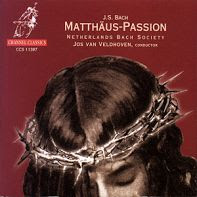
The little Dutch medieval fortress town of Naarden, completely surrounded by a wall and moat, was the first stop, a highlight unlikely to be topped by successive Matthew Passions this year. Since 1921 the Matthew Passion is performed at theGrote Kerk (“Great”, or “Large Church”) in Naarden. The Nederlandse Bachvereniging is responsible for the performance. That name and their current director Jos van Veldhoven are familiar to me from their recordings on Channel Classics. Their Mass in B-minor from last year not only made it onto my best-of-2007 list but has quickly become a favorite version.
High expectations were hardly disappointed. While I was not as moved and grabbed as I always hope for, that might have been due to recent overexposure. It was in any case so good – so exceptionally good – that the delight it brought made up fully for this. (Interestingly the memory of the concert has since only appreciated, and glows warmly in the Bachian recesses of my mind.)
From the first notes on, Veldhoven and his forces (two orchestras with altogether ten violins, a viola, one cello, one double bass, two traverse flutes, two oboes, a recorder, continuo organ, and bassoon each, and a theorbo, viola da gamba, and harpsichord) established this rendition as superior. The ensemble work was perfect with all six violins of the first orchestra playing, breathing, and living the music as one. The tone of this HIP (Historically Informed Performance) group sweet and sonorous like one could hardly expect from an indulgently romantic Viennese group, much less an original instrument band.
Johannes Leertouwer’s violin solo (“Erbarme Dich…”) was filled with warmth, a light vibrato on held notes, perfectly in tune and proved altogether better and more accurate than anything I have ever heard, say, Pinchas Zukerman do lately. The following duo with alto Matthew White (pleasantly masculine sounding, near his limits in the upper register but never of that whiney, namby-pamby quality that turns so many ears off counter tenors) had me in awe of the musical excellence. Antoinette Lohman’s solo for the opposing camp of violins was a study in contrast to Leertouwer’s mellifluous, sweet sound: Very engaged, wiry, agile, and energetic.
The boys’ choir employed for the chorals consisted of but three trebles. They may have been nervous, but either need not have been – or perhaps that nervousness actually aided their pinpoint accuracy. I have had my share of exposure to boys’ choir singing – active and passively – and I don’t think I heard three voices so together and accurate. In the generous but appropriately dry acoustic of the Grote Kerk they produced a sonorous, even voluptuous sound that I would not have thought possible. The fact that even the tiniest inaccuracies in their presentation were immediately audible only assured that the achievement was all theirs, not due to some unique acoustic phenomenon of the venue or their placement in front of conductor and orchestra, vis-à-vis the pulpit.
There were three, four very minor quibbles with the whole performance not worth the time or space to mention, since the overall excellence of Veldhoven’s and the Netherlands Bach Association’s achievement cannot be overstated. Of course the soloists had their part in this too: All were at least good, but next to Gerd Türk’s evangelist, Dorthee Mileds and Maria Keohane (sopranos), Matthew White and Williams Towers (countertenors), Julian Podger and Charles Daniels (tenors), and Wolf Matthias Friedrich (bass), it was Andrew Foster-Williams whose Jesus stood out for his very impressive, indeed: ideal rendition.
Towers could not quite match White’s performance, but he came close in the unrestrained and unconstrained, beautifully shaped aria “Können Tränen meiner Wangen…”. Türk had a few rough patches, his singing somewhere between lovely and routine, maybe both. Charles Daniels, recently heard in Koopman’s Mass in B-minor, was at the same high level of accomplishment without going beyond it – his colleague Podger rather excitedly sang the recitative “O Schmerz!” and found himself near his limits before the absolutely phenomenal, pitch-perfect oboe solo interrupted him. Dorothee Mields’ vibrato was a little heavier than I would have expected, but it was still clear and uncommonly beautiful, strong, and secure.
Ripienist Marjon Strijk’s Uxor Pilati, with an angelic ring to her strong soprano,proved on behalf of all her colleagues the high quality of the choir which sang the chorales together with the soloists. Together, they made for a group of 24 singers that sounded very sizeable in this venue and yet retained the clarity and precision rightly cherished in good HIP performances. Gerd Türk joined in as the finale chorale – “Wir setzten uns mit Tränen nieder” (“We sat down with tears…“) – let us back out into the clear night in Naarden, journeying back to nearby Amsterdam. A conspicuous beginning of the Easter Pilgrimage, indeed.
Impressive – or frustrating – in their own way were two performances at Amsterdam’s Concert-Gebouw. National Symphony Orchestra principal guest conductor Iván Fischer steered the – obviously reduced – forces of the Koninklijk Concertgebouworkest through a performance that was long on beauty and short on excitement. The performance made no pretensions of being authentic in any way, but even traditional performance did not escape the HIP trend: The strings were out in nearly twice the numbers that Veldhoven used, larger but still modest. The choirs boasted 42 throats and 27 trebles altogether. The soloists sang in a style cut from a more romantic cloth, more liberal with their vibrato and dramatic delivery.
This will either please or annoy. For me the sense of – and familiarity with – the occasion as such, made it pleasing. To sit in the Concert Gebouw early on a Sunday and to revel in the smoothed sounds of Bach, delivered with sheen and humble pleasantry, gave a sense of civilization being a wonderful thing… as if there was something fundamentally right with humanity, after all. This sense of gathering at a temple of the arts, of mimosas, of mothers using their heavy perfume, of the children hardly fidgeting for two hours: it’s a sort of Lake Wobegone idyll, except with culture instead of ice-fishing at its center.
Mark Padmore’s evangelist was in excellent voice, as were alto Bernada Fink, mezzo Wilke te Brummelstroete, and soprano Johanette Zomer. Kristinn Sigmundsson, who filled in as Jesus, was a wooly disappointment, his bass colleague Zeert Smits did better, but came close to belting with his huge voice.
All were very dramatic and employing a vibrato that will strike unrepentant HIPsters as inevitably inappropriate, but then the purpose of this performance was not to strive to an alleged ideal of authenticity but to aim for maximizing beauty. Where someone like Veldhoven can combine the two – absolute beauty as well as HIP explosiveness – that combination is always going to win out over just one. When excitement and beauty are an either/or proposition, the preference is subjective. The very gentle and genteel way this Passion was performed by choir and orchestra, with the corners rounded off and edges smoothed, appealed more to me than the performance later that Sunday, where the Combattimento Consort Amsterdam, the Nederlands Kamerkoor, and the Roder Jongenskoor under Jan Willem de Vriend presented the other alternative: More passion in the Passion, but a cast of soloists that was not terribly satisfactory, and orchestral forces that were enthusiastically engaged, but not precise.
I might have enjoyed this sweetly likeable performance more on any other day had I had fewer St. Matthew Passions preceding it and with less importance attached to the traditional element on the occasion. Especially so if Carolyn Sampson had not bowed out and if any other alto than the pseudo-operatic Ewa Wolak had taken those parts. Alas, that Sunday I was not inclined to appreciate freshness over smooth beauty.
From this dose of Dutch Bach, the pilgrimage went to Paris, where Parsifal under Hartmut Haenchen awaited at L’Opéra national de Paris – more about which I’ll get to write next week.
William Cornysh (1465-1523), Woefully Arrayed, Stile Antico
Woefully arrayed,
My blood, man, for thee ran, it may not be nayed;
My body, blo and wan;
Woefully arrayed.
Behold me, I pray thee,
with all thy whole reason
and be not hard-hearted,
and for this encheason,
sith I for thy soul sake
was slain in good season,
Beguiled and betrayed
by Judas false treason,
unkindly entreated,
with sharp cord sore freted,
the Jews me threated,
they mowed, they grinned,
they scorned me,
condemd to death as thou mayst see;
Woefully arrayed.
Thus naked am I nailed.
O man, for thy sake;
I love thee, then love me,
why sleepst thou, awake,
remember my tender heartroot for thee brake;
with pains my veins constrained to crake;
thus tugged to and fro,
thus wrapped all in woe,
whereas never man was so entreated,
thus in most cruel wise
was like a lamb offerd in sacrifice;
Woefully arrayed.
Of sharp thorn I have worn
a crown on my head.
So pained, so strained, so rueful, so red,
thus bobbed, thus robbed,
thus for thy love dead;
unfeigned, not deigned,
my blood for to shed,
my feet and handes sore
the sturdy nailes bore;
what might I suffer more,
than I have done, O man, for thee?
Come when thou list, welcome to me!
Woefully arrayed.
The performers in the embedded video, Stile Antico, will perform a program of Renaissance polyphony next month at the Library of Congress (April 17, 8 pm).
One of the most sought-after figures in classical music was heard in a concert at the National Museum of Women in the Arts on Wednesday night. The 1741 Vieuxtemps Guarneri del Gesu, a fabled violin valued at $18 million when it was up for sale in 2010, has staged a comeback, offering a demure program of mostly light music that showed off its mellifluous tone. After changing hands this year for an undisclosed sum paid by an anonymous benefactor, the instrument brought along its current player, American violinist Anne Akiko Meyers — who owns two other expensive Stradivarius violins — for the ride.
The Vieuxtemps has a striking sweetness of sound, capable of subtle beginnings and endings, heard in the simple and repetitive “Spiegel im Spiegel” by Arvo Part. Meyers drew out the instrument’s vocal side in Mozart’s K. 377 Violin Sonata, especially the winsome theme and variations, even while leaving out the repeats. [Continue reading]
The Théâtre de la Monnaie in Brussels has mounted the world premiere of La Dispute, the second opera by Belgian composer Benoît Mernier (b. 1964). It is based on the Marivaux play of the same title, with a libretto by Ursel Herrmann and Joël Lauwers. Patrick Davin conducts the staging directed by Karl-Ernst Herrmann, Ursel Herrmann, and Joël Lauwers. The cast features Stéphane Degout, Stéphanie d'Oustrac, Julie Mathevet, Albane Carrère, and Dominique Visse. Francis Carlin, writing in the Financial Times, found it "charming and uplifting," although it does use too much spoken dialogue:
Who is more prone to infidelity – man or woman? [La Dispute] is a delicious romp starring four Rousseauesque innocents who discover love and temptation while the fractious couple of a philandering Prince and his jealous consort Hermiane look on for inspiration. [...] The central question, of course, remains unanswered, as do our queries on Mernier’s real musical personality. His score for this mix of Così fan tutte and Britten’s A Midsummer Night’s Dream adopts the latter’s glissandi strings, is steeped in Debussy, imitates Bartók (particularly in hauntingly beautiful night music for the woodwinds) and looks to Berg for lyrical vocal expression.
Martine Mergeay interviewed the composer about the opera for La Libre Belgique, and he gave an interesting explanation of the prominence of spoken dialogue in his opera (my translation):
I use all possible vocal forms, from the speaking voice to the aria -- where singing has its maximum emotional power -- and including le mélodrame [Sprechstimme] (speaking voice notated like an instrumental part) and recitative, secco and accompagnato. As for the instrumentation, I want a very bright orchestra, able to give color to the French, which remains a rather non-tonal language. The pit has only 35 musicians, but the writing is such that through the many shifts one will hear large variations of timbre and texture.
The theater's ongoing series of online broadcasts features a Webcast of the opera, starting today, and there is a bunch of videos on the background of the opera and production.
Maria Kowroski (Odette) in Swan Lake, choreography by George Balanchine, New York City Ballet (photo by Paul Kolnik)
The New York City Ballet is in town this week, performing two different programs in the Kennedy Center Opera House. Last night was the opening of its all-Tchaikovsky sampler, three shorter works choreographed by George Balanchine, grounded on the legendary choreographer's one-act version of Swan Lake, premiered in 1951. These are heritage pieces, perfect to showcase the company on a tour that goes from Washington to the Royal Danish Theater in Copenhagen, and they looked beautiful in their current incarnation.
For this streamlined Swan Lake based on Lev Ivanov's choreography, Balanchine crunches most of Act II and part of Act IV together, leaving out the mirror role of Odile. Once you get past the jarring effect of the curtain opening with the iconic music that starts the second act, the compactness gives the work greater impetus. (Surprisingly, Balanchine left out one of the most famous sections of the score, the fourth movement, Allegro moderato, of the Dance of the Swans, but all the other popular sections are there.) Maria Kowroski was an elegant and tragic figure as the Swan Queen, matched by an athletic and warm Siegfried in Tyler Angle, although the most striking choreography is given to the corps, in their somber black costumes, entering in a snaking line to identical movements carefully timed to the music. The pas de deux, placed at the violin solo in the fifth movement of the Dance of the Swans, was particularly affecting, with Angle lifting up Kowroski, who had gone into a crouch, and propelling her about.
In the middle slot came the shortest work, Allegro Brillante, set to Tchaikovsky's one-movement Piano Concerto No. 3. In contrast to the ice-cave set for Swan Lake (designed by Alain Vaes), this taut, abstract work played out on a bare stage, with a blue-lit back screen, with vaguely folk-like costumes in pastel colors (costumes designed by Karinska, lighting by Mark Stanley). The extended solos were danced strongly, with the high-jumping Amar Ramasar partnering the lithe, spritely Tiler Peck, light as a feather in the long solo passage accompanied by the piano solo's cadenza (played ably by Elaine Chelton). The company is traveling with its orchestra, a fine ensemble that has been without a music director for a while. The night's guest conductor, David LaMarche, did fine, but one hopes that the ongoing search for a permanent leader bears fruit soon.
The longest work came last, Balanchine's ensemble choreography set to Tchaikovsky's Orchestral Suite No. 3. Balanchine, like all great choreographers, loved music and gives it pride of place: all of these pieces open with the music and nothing else, a closed curtain, swan models gliding past on the lake, an empty stage. Suite is about longing on one level, beginning with the first movement, Élégie, where a man pursues one woman of a group, in long hair and flowing purple dresses. The couple meet and are separated, most poignantly the last time, both bending over backward in a dramatic gesture to a forlorn English horn solo. A similar pattern is repeated in the second movement, Valse mélancolique, and the Scherzo third movement, with the dancers vanishing gradually like the music. All of the groups of women form a large corps de ballet in the grand fourth movement, the Tema con variazioni, in blue and white tutus with red accents, set in a large ballroom with three arches, revealed after the smoky scrim is lifted (scenery and costumes by Nicolas Benois). Variations, of course, are ballet's bread and butter, and it is no surprise that this movement, with its rapidly shifting musical qualities, makes such good ballet. The third variation, all woodwinds, received a choreography for twelve women, in four groups of three, hands held and making lovely patterns. Once again a violin solo, leading into Variation 10, inspired a lovely pas de deux, mesmerizing in its own way, leading into a grand conclusion for the corps.
This program will be repeated this evening and Sunday afternoon, with the B program -- Carousel, Glass Pieces, and Vienna Waltzes -- on March 28 to 30, in the Kennedy Center Opera House.
Film director Abbas Kiarostami made his first film outside his native Iran a few years ago, the puzzling, rewarding Copie conforme. From that movie's setting in Tuscany, with European actors speaking dialogue in French, Italian, and English, Kiarostami has gone to Japan for his latest film, Like Someone in Love. Written and directed by Kiarostami, the film was shot in Japan and the dialogue translated into Japanese (uncredited, perhaps the work of the actors, none of whom is likely familiar to non-Japanese viewers). While Copie conforme appealed to me as an "ambulatory philosophy film," mostly featuring its two stars driving, walking, and talking in squares and cafés, Like Someone in Love is noteworthy for its grand and often immobile silences. The dialogue is laconic, often trivial, and most of what is actually going on between the characters, or happening to them individually, goes unsaid or is learned obliquely. The three main characters are all tormented in different ways, but who knows exactly how, which probably has something to do with the film's critical failure at the Cannes Festival last year.
Akiko (Rin Takahashi) is a young woman from the provinces, now a college student in Tokyo, whose family has become worried about what might have become of her in the big city. They are right to be concerned, since Akiko has become involved with an overly possessive boyfriend (Ryō Kase), a mechanic who wants to marry her. What neither the boyfriend nor her family understand just yet is that Akiko has resorted to prostitution to make ends meet. In the first scene her pimp sends her in a cab outside the city to the house of Takashi (Tadashi Okuno), a retired professor of sociology, the subject that Akiko is studying at the university. This précis gives away almost nothing that happens in Like Someone in Love, not that all that much does happen. The film's title is taken from the jazz standard by Jimmy van Heusen (lyrics by Johnny Burke), made famous by Ella Fitzgerald, among others, music that the professor likes to play at home. Love makes people do strange things, but it is difficult to guess which of the three principals in this story is the "someone in love," who walks "as though I had wings, bump into things": the jealous, abusive boyfriend, the elderly john, or the seemingly hapless young woman.
It is also hard to discern an overarching theme in the movie, although on some level it may be about a culture that traditionally revered its elders gradually losing touch with its elders. The most moving scene in the film, by far, involves Akiko listening to messages left on her cell phone by her grandmother, who has come to Tokyo to check on her. I am on the way there, I am at the train station, I am waiting at such and such a place, I am going to get some noodles, maybe I will see you -- the messages go on. Visibly plagued by guilt, Akiko asks her cab driver to circle by the train station, but she does not stop. In a way, her elderly client takes the place of the grandmother, and for his part, Takashi seems to be just as cut off from the younger generation. Although most of their interaction is extremely awkward, Akiko and Takashi discuss a reproduction of a painting by Chiyoji Yazaki (1872-1947) hanging on his wall: Training a Parrot, from 1900, in the collection of the Geidai Museum (University Art Museum, Tokyo University of the Arts). It is, Takashi says, the first Japanese painting made in a European style, and the fading of Japanese traditions implied by that shift, in the years after Japan was reopened to the outside world, weighs heavily in the film's inter-generational conflict. Whether it is enough to keep your attention will vary according to the viewer.
This film is currently playing at Landmark's E Street Cinema.
The complete Dvořák Symphonies have gone through various changes in their numbering (best known is the fact that the Ninth Symphony used to be considered the "Fifth" (and Five was Three, Six was One…), since Dvořák had suppressed the first four. Those four are incidentally the real reason to get a complete set. (This is assuming you already have a Fifth, Sixth [something better than this one], and definitely assuming you have a Seventh and Eighth; if you don't have a Ninth, you stumbled upon the wrong website.) Dvořák might have thought them lesser efforts, and certainly the Second Symphony lacks conciseness and the veteran punch that the composer can deliver in the darkly grand, consciously ambitious Seventh, or the even-keeled, mature, charming Fifth with its Bohemian touch. Dvořák’s Third is “Wagner without Words” and terrific, too... you get the picture.
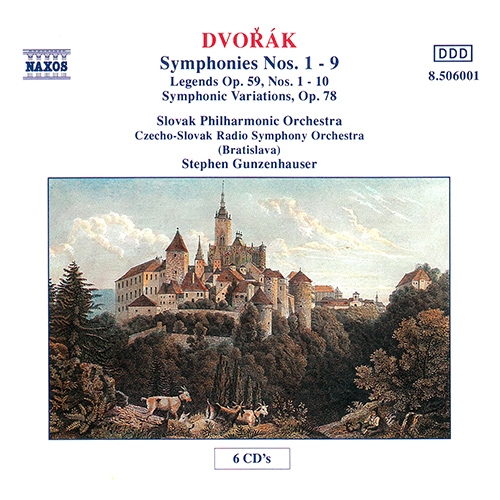
There’s plenty of choice out there, albeit less than with Sibelius or Bruckner. The big names—Kubelik and Kertész in this repertoire—are good, but not necessarily beyond criticism. Not every recording that is Czech is therefore idiomatic; nor every non-Czech recording at a disadvantage… and sometimes little underdogs (like Anguélov and his provincial Slovak Radio band, which has also recorded for Naxos with Stephen Gunzenhauser) can take a bite out of the big boys. That said, I do have a strong favorite, and that is Rowicki on Philips/Decca, currently out of print but probably soon back in.
Because I’ve not heard even half of the recordings I am very conservative with the “ionarts’ choice” recommendation… a recommendation for which superb treatment of the early symphonies is a prerequisite.
Edit May & June 2026: Wholesale stylistic overhaul of the survey to match the newest iterations (such as the Prokofiev Survey). This will be a work in progress, as I add information to the cycles in the style of those newer editions... If you scroll beyond the trusty ol' "Lorem ipsum" dummy-text, you will find commentary on most if not all cycles by now. I have added the Bělohlávek DVD-cycle, the Mácal-almost-cycle on Exton, and a few alternative iterations where they have become available.
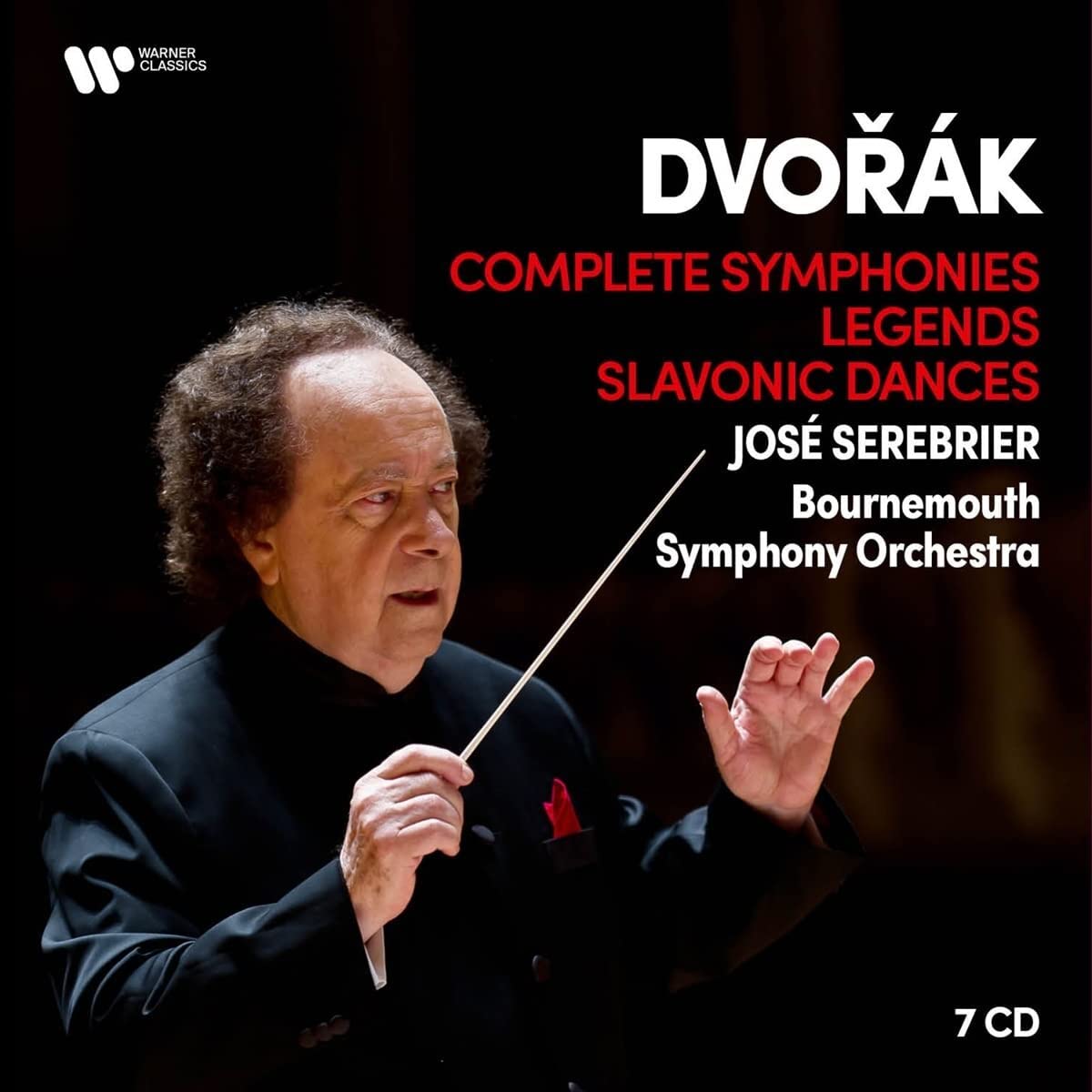
Edit 01/25/23: I have added Brilliant "Quintessence" budget-reissue of the Suitner and fixed some broken links. Serebrier's cycle has been re-issued and added. Please let me know what I am missing, as the last thorough update has been a while. We've dodged the bullet of a Chichon-cycle (see below), but he got to Nos.1, 3, 4 & 5. Chichon is gone but the cycle is being continued, now with the much, much better and promising Pietari Inkinen, and on the SWR Classic Label. Perhaps on its way to an odd mixed-conductor cycle or, if these volumes (2 & 6 have been released so far) go down well, re-recording the earlier takes. In 2016 Kertesz had been re-issued, remastered, and on Blu-Ray Pure Audio, but that set is already gone again.
Edit 12/12/18: The Bamberg Symphony under their MD Jakub Hrůšahave just started a cycle of Dvořák Symphonies - always coupled with a work of his mentor, colleague and friend Brahms. It will, when finished, be the firstEd.: second Dvořák cycle on SACD. Also: The Libor Pešek set has been re-released in a space-saving clamshell box on Erato. It seems I have eyed a cycle recorded by Marcus Bosch and the Staatsphilharmonie Nürnberg (completed this year) - which is therefore the first SACD cycle. His Seventh features the original edition (Dvořák tightened it a bit later), a world premiere recording. As far as almost-cycles are concerned: Dohnanyi/Cleveland unfortunately never went beyond Six (in the direction of the lower numbers, obv.), ditto Andrés Orozco-Estrada/Houston/Pentatone (so far) and Colin Davis/LSO (weak-sauce recordings on LSO Live), and Myung-Whun Chung also only recorded Nos.3 and 6-8 with the Vienna Phil. Meanwhile one hopes that Karel Mark Chichon (a.k.a. "Mr. Garanča") knows better than to record a cycle with the German Radio Philharmonic Orchestra Saarbrücken Kaiserslautern, now that he has stepped down from that post. (He was threatening already, having released a First Symphony on Hänssler Classic.)
Edit 21/04/16: Istvan Kertész’s cycle has been re-released on Decca Collector’s Edition. The good news is: It now comes with the non-symphonic works restored to their rightful place. The bad news is: In order to squeeze as much music on as few CDs as possible, Decca has now not only continued to split the Fifth Symphony but also split the Second. Ugh! Will they never learn?
Edit 24/11/15: José Serebrier’s cycle on Warner with the Bournemouth SO has been boxed and published and included below.
Edit 24/11/15: The new (German?/Eloquence) re-issue of the classic Kubelik cycle has finally undone the damage of splitting the Fourth Symphony among two discs. It is a good-looking slim slipcase with individual discs and includes the non-symphonic Kubelik Dvořák recordings with the BRSO. In that edition just about an "ionarts Choice" candidate! Also Ottmar Suitner’s Symphonies have been re-issued on Brilliant, in a box that also includes most of the orchestral non-overture work of Dvořák’s (in recordings from Kuchar and Doráti).
Ivan Anguélov
(2001 – 2004)
Slovak Radio Symphony Orchestra
Oehms
Includes the Czech Suite, op.39. Hurwitz really loves this for consisten, fiery, good performances. "It's a shocker; one of the great 'sleeper cycles'." Gramophone's Andrew Aschenbach more or less agrees in his review.
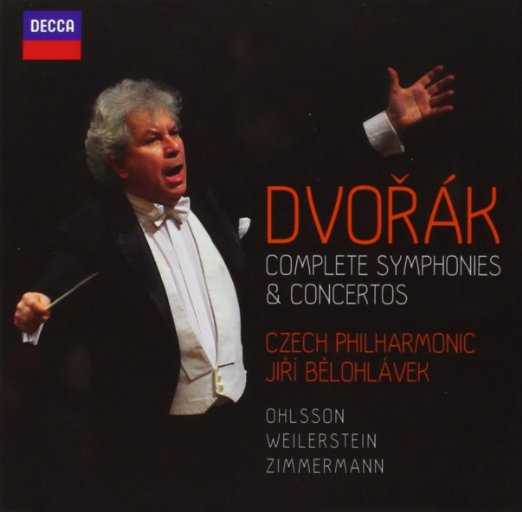
Includes the concertos with Alisa Weilerstein [CC], Frank Peter Zimmermann [VC], and Garrick Ohlsson [PC], the latter two of which were recorded explicity for this cycle (or in any case not released seperately). All, concertos and symphonies alike, are live performances, made between November of 2012 and December of 2013. "The dullest, most boring cycle ever made", as per Hurwitz' typically unhedged opionion. I have never made up my mind about it one way or the other, but it's equally true that when I grab a cycle, that's not the one I end up making a beeline for. If you want a different opinion: The cheerleaders at ClassicalNet hear "Jiří Bělohlávek [using] swift tempos and dynamic contrast to personalize this early work in a way that is wholly convincing... the whole set is beautiful performance after beautiful performance." In a way, this is Decca's symphonic twin-cycle to the Tchaikovsky cycle with Bychkov, also with the Czech Phil, which has equally lent itself to almost predictable praise from certain reviewing-types and (almost) equally predictable scathing from Hurwitz. (Bychkov, btw., has set down the last three symphonies with the same orchestra for Pentatone (which I haven't yet heard). Whatever the subjective response, the set is less taut, less fierce, more relaxed, more expansive - autumnal even? - throughout than some of the classic older recordings, at the head of which you would find Rowicki. (Qualitatively and stylistically.) So more like Pešek, who gets a bad rap for exactly that reason, rightly or wrongly.
In the year following the live recordings that make up the Decca-cycle above, these symphonies were given once again in concerts in 2014. The cycle also features the documentary "Sketches of Dvořák" by Baraba Willis Sweete and an introduction to each symphony by the conductor. Here's a MusicWeb review by Johnathan Woolf, which amounts to more or less unintentional damnation with faint praise: "If you want a visual record of the symphonies, these excellent performances, capably recorded, will prove very satisfying." Yikes. You will have guessed that this is the only such cycle available on "visual record". Here is a little introductory video to the thing.
This is one of the more 'over-complete' sets, including, as it does:The Serenade for Strings op. 22*, Serenade for Wind Instruments op. 44†, Slavonic Dances op. 46, Scherzo capriccioso op. 66, In Nature op. 91‡, Carnival Overture op. 92. (* Rudolf Kempe, Munich Phil. † Marcel Moyse, Marlboro FO. ‡ David Zinman, SWR SO.)
These symphonies, except for the Ninth, which preceded the others by a year, were recorded over the summer (and a bit of Fall) of 1987 at Henry Wood Hall in Glasgow. The fillers from the individual discs are not inlcuded in the box. Here's a short review on ClassicsToday. Here is a Gramophone-review of the Sixth.
This is, of course, the classic set of the Dvořák-Symphonies, still ahead of Kubelik. That's perhaps thanks to the power of the British music press, that favored Decca and the LSO over DG and the Berlin Phil, but that's not to say that the cycle isn't a worthy primary contender. It's been widely reviewed in all kinds of formats; here are two such reviews: MusicWeb, ClassicalNet.
The Ninth in the set is not to be mistaken for his earlier one, which had been recorded with the Vienna Phil at the Sofiensaal, in March 1961, as Kertész's prestigious recording debut for Decca. The Editor's and the Blu-Ray editions (both oop) contain the Requiem as well as the symphonic poems: The Carnival Overture, Scherzo capriccioso, My Home, Symphonic Variations, Husitska Overture, The Water Goblin, The Golden Spinning Wheel, Othello, The Noonday Witch, and the Serenade in D minor.
Slovak Philharmonic Orchestra / Royal Philharmonic Orchestra
Opus / Brilliant
Zdeněk Košler recorded a Dvorak cycle with the Slovak Philharmonic Orchestra for the Czechezlovak (?) Opus label and was issued on LP, withe a boxex set appearing in 1983. These recordings were regularly licensed in the West (RCA, Musical Heritage Society). He had recorded some Dvorak earlier, for Surpaphon, with the Czech Philharmonic which has not, apparently, made it into the digital age. The Opus recorings did, though, on the original label and eventually as part of the Brilliant box set which adds the Serenade op.22. However, Brilliant didn't trust Košler to do the job in (or didn't get the rights for) Nos. 8 & 9; those are taken by Menuhin and Paavo Järvi with the Royal Phil, respectively, both in 1994. The set also includes the Serenade op.22 (Menuhin), Carnival Overture op.92, Scherzo Capriccioso op.66 (Järvi), and the Symphonic Variations op.78, The Water Goblin op.107, The Noon Witch op.108, The Wild Dove op.110 (Košler).
Berlin Philharmonic, Bavarian Radio Symphony Orchestra
Deutsche Grammophon / Eloquence
The Kubelik-cycle is the second classic from the height of the LP days that has formed so much of the collective memory of record collectors. Fabulous ingredients, there's really no reason to think it inferior to any other cycle. It simply didn't have the same clout of the press behind it - and it came out a few years later, after Kertész had already had time to establish himself a little. The symphonies were made with the Berlin Phil. But the slim Eloquence-Box (no booklet, sadly) also includes the Symphonic Variations, Overtures (In Nature, Carnival, Othello, My Home, Hussites), the Scherzo capriccioso, symphonic poems (Water Goblin, Noon Witch, Spinning Wheel, Wood Dove), the Slavonic Dances opp.46 & 72, Serenade op.22*, Legends op.59* - all with the BRSO except for the latter two, with the *English Chamber Orchestra. Like Kertesz, Kubelik made earlier Dvořák-recordings with the Vienna Phil for Decca, but those are considered inferior to the Berlin re-makes. Certainly the Ninth was always very highly considered; the Hurwitzer considers it still the "Reference" recording. Very roughly, it oculd be said that Kubelik is better for the late symphonies and Kertesz for the earlier ones, which might make the latter set more interesting for those who already have performances of the late symphonies they love. (But then, why not go straight to Rowicki [see below]?!)
An Almost-Cycle from Mácal (No.1 is missing) recorded live at the Rudolfinum and issued on SACDs by the Japanese Exton label (that has done a lot of these kinds of recordings with the Czech Phil). They tend to be difficult and/or expensive to get your hands on, in physical form, but at lower resoultion, they are available to stream at the Naxos Music Library. The releases are a bit all over the place; Nos. 2 & 6, 3 & 7, 4 & 8, 5 & 9 appear coupled on three Twofers.
Czech Philharmonic Orchestra
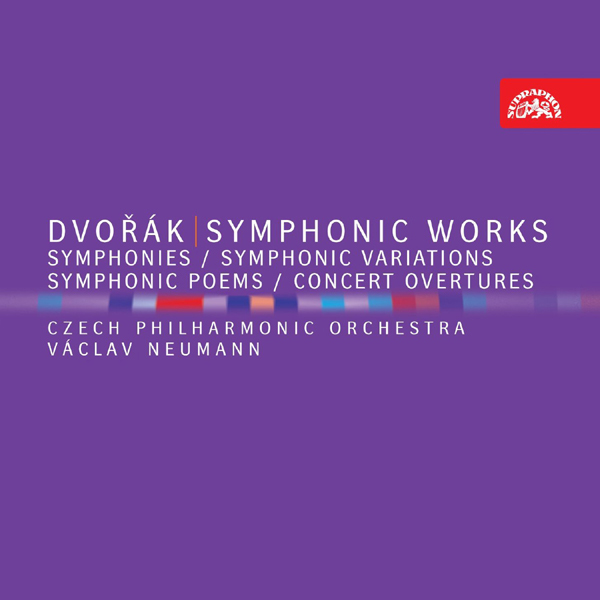
Supraphon — Analog 1970s Cycle
The analogy Neumann cycle had long not been availabel on disc. Until, in fact, this set was released in 2012. Some argued that this was actually the better Neumann-cycle and the best one-conductor cycle with the Czech Phil. Others say, no, the digital remake is actually better. It was not well received in the West when it came out on LP, but the West was busy fawning over Kertesz, Rowicki, and Kubelik.
The set also includes the Symphonic Variations op.78, In Nature’s Realm op.91, Carnival op.92, Othello op.93, The Water Goblin op.107, The Noon Witch op.108, The Golden Spinning Wheel op.109, and The Wood Dove op.110. Here's a MusicWeb review. Like Howell, I think this is an excellent set; really as goood as any, with (as far as my idiosyncratic tastes are concerned) possibly one exception.
Czech Philharmonic Orchestra
Supraphon — Digital 1980s Cycle
You know that Hurwitz did a video of what he thinks is the best cycle, right? Well, here it is. He's not wrong, to the extent we've heard the same performances. He loves the Seventh in this set. The ClassicsToday reviews (here, here, here) make this one of the sets to have (10/10). But then in the above video, he takes it back a bit and says, no, the analog set is the one to have, after all. Well, I suppose there's only one thing to do about it and that's to get both!
Royal Liverpool Philharmonic Orchestra, Czech Philharmonic Orchestra
Virgin / Erato
"Good, solid, exciting" - a strange trio of adjectives. It's how Hurwitz describes the set in his video. The written review on ClassicsToday is here and it's also very flattering. (8/9, "The recorded sound is warmer on the Czech than on the Liverpool recordings, which have a bit more clarity. While for me this won’t replace Kubelik’s masterful set (admittedly recorded in less ideally appealing sound), Pešek’s does provide a fine modern budget alternative to the three classic versions.") Interestingly, this set is split between the Czech Phil and the Royal Liverpool Phil. The couplings are generous: In Nature’s Realm op.91, Carnival op.92, Othello op.93, The Wood Dove op.110, My Home, the Scherzo capricioso, the Czech Suite, and the American Suite. Part of the set is reviewed (so-so) at Gramophone here. Generally, it's among the fine-but-not-great sets and not a first or even fourth choice.
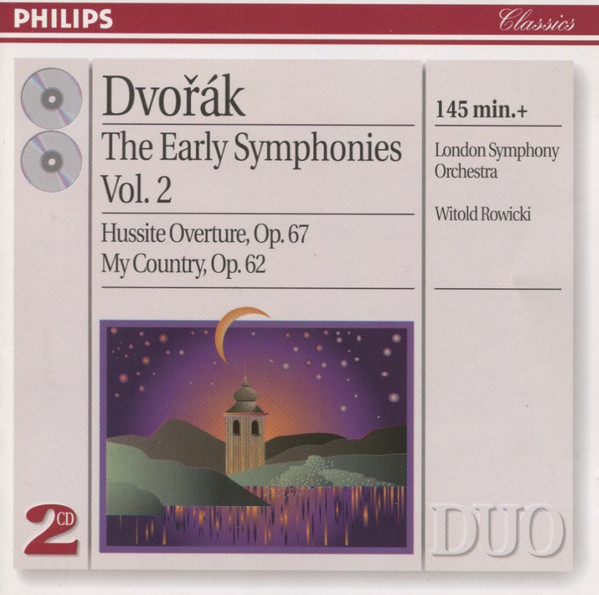
This came out right before the Kubelik but a few years after the Kertész sets, and although it was a set of one of the major labels at the time, it was on the smallest of these (certainly at the time), it featured a conductor who wasn't ever a big podium star (Witold Rowicki), and used the same orchestra as the cycle that had already established itself as the reference. It had something of a hard landing, never got much love, had been relegated to life on three Philips Duos, for most of the digital age.
The sets include the Othello, Hussite, Carnival, and My Country overtures. All three sets, annoyingly, split the 2nd symphony over two discs; the Twofer-set includes Leppards' Legends, which doesn't make a difference one way or the other.
Would you look at that: There's a fairly exhaustive review on MusicWeb - from my own pen! That's all the opinion you'll need then, isn't it?! (Actually, it might be, because I cite a lot of the other reviews in mine, makeing it something of a meta-review.) It's a very good cycle.
Vladimír Válek's Prague RSO cycle is perhaps the equivalent to the Prokofiev Cycle on Surpaphon with Zdeněk Košler; an under-the-radar digitally recorded cycle from the Czech Radio (Český rozhlas), except it hasn't got a 'dark-horse' status. ("Lousy, dismal" as per Hurwitz, actually.)
Royal Scottish National Orchestra, Czech Philharmonic Orchestra, Oslo Philharmonic Orchestra
Brilliant
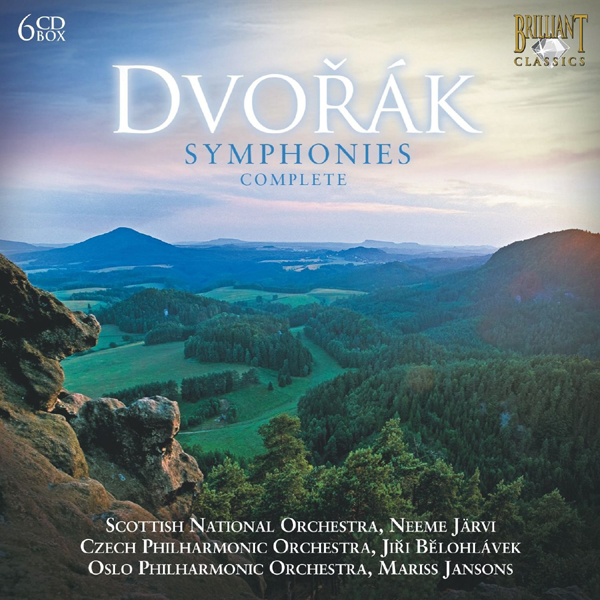
"The Mixer" (a turn of phrase I have taken from two brilliant Wodehosue short-stories, btw.) is a cycle that Brilliant put together as one of their cycles, presumably when they didn't have the Suitner-cycle around. It mixes and matches three condcutors and their Chandos-recordings of the respective works: Neeme Järvi (with the RSNO, Sys.1-4), Bělohlávek (with the Czech Phil, Sys.5-7) and Mariss Jansons (with the Oslo Phil, Sys.8 & 9). In times when just having this music on six discs in very good performances at a super price meant excellent value, that might have been a draw; in times like ours, it is a little more difficult to fathom why this cycle might be chosen over any of the ones above that, for better or worse, offer a coherent vision.




 Wholesale stylistic overhaul of the survey to match the newest iterations (such as the