Saint Francis of Assisi Is Wed to Lady Poverty Fresco attributed to Giotto di Bondone, c. 1330, Basilica di San Francesco (lower level, over the altar), Assisi
Even someone who teaches for the Benedictines can lay down his monastic loyalty and appreciate the extraordinary example of Saint Francis of Assisi, today of all days, his feast day, October 4. The Dante pilgrimage this summer included my first visit ever to the marvelous city of Assisi, a place so extraordinary that it makes perfect sense that Francis came from there. We spent a long time looking at the fresco cycle on the life of Francis in the upper church of the Basilica of San Francesco, formerly attributed to Giotto. In the lower church, the fresco shown here (still believed to be the work of Giotto) held my fascination for a long time, because it is so related to the sections on Francis in Dante's Paradiso (in which Francis becomes the bridegroom of Poverty, left alone in the world for 1,100 years after the death of Christ, who first loved her). Other highlights of the trip included placing a candle at the tomb of Francis, praying in front of the crucifix that spoke to Francis (now in the church of Santa Chiara), seeing the Temple of Minerva (in front of which Francis offered his cloak and all his money to a beggar), and visiting the outrageous Baroque church built over the site of the Porziuncola, near where Francis died.
"Not much time as yet had passed when he first lent his comfort to the earth by the greatness of his virtuous power.
"For, still a youth, he fought against his father's wish for the favor of a lady to whom, as to death, no one unlocks the door with gladness,
"and before his spiritual court et coram patre he joined himself to her and, from then on, each passing day, he loved her more.
"She, bereft of her first husband, scorned and unknown one thousand and one hundred years and more, remained without a suitor till he came.
"Nor did it profit her when men heard that she stood unmoved, with Amyclas, despite the voice of him who put the whole wide world in fear.
"Nor did it profit her when, being fiercely loyal and undaunted, while Mary stayed below, she wept with Christ upon the cross.
"But, lest I make my meaning dark, let it be understood, in all that I have said, that these two lovers are Francis and Poverty.
"Their happy countenances and their harmony, their love and wonder and sweet contemplation made them a cause for holy thoughts,
"so that the venerable Bernard was the first to shed his shoes and run, pursuing such great peace, and, running, thought himself too slow.
"O unknown riches and prolific good! Barefoot goes Giles, barefoot goes Sylvester, following the groom, so greatly pleasing is the bride.
"Then that father and teacher went his way in company of his lady and that family, each one girt with the same humble cord.
"Nor did an unworthy shame weigh on his brow for being Pietro Bernardone's son, nor for being an object of amazed contempt,
"but he regally laid bare his stern resolve to Innocent and, from him, he received the first seal of his order."
-- Dante Alighieri, Paradiso XI (lines 55-93), trans. Robert Hollander (courtesy of the superlative Princeton Dante Project)
The speaker is Thomas Aquinas, encountered among the great contemplatives in the Sphere of the Sun.
Just a quick footnote to Dante's view of the papacy of his day, which is a major subject in the poem, to which I will probably return. The article by Thomas Oestereich in the Catholic Encyclopedia (1907) on Boniface VIII does its best to show Boniface VIII in a way truer to the view of the papacy. After presenting the details of the pope's life in a sympathetic light, the author provides the following hilarious summation of Dante's attacks in the Commedia:
The memory of Boniface, curiously enough, has suffered most from two great poets, mouthpieces of an ultra-spiritual and impossible Catholicism, Fra Jacopone da Todi and Dante. The former was the "sublime fool" of spiritual love, author of the "Stabat Mater", and chief singer of the "Spirituals", or extreme Franciscans, kept in prison by Boniface, whom he therefore satirized in the popular and musical vernacular of the peninsula. The latter [Dante] was a Ghibelline, i.e., a political antagonist of the Guelph pope, to whom, moreover, he attributed all his personal misfortunes, and whom he therefore pilloried before the bar of his own justice, but in quivering lines of immortal invective whose malignant beauty will always trouble the reader's judgment [emphasis mine].
First of all, Dante was a Guelph, a member of the White Guelphs driven out of Florence partially thanks to the wiles of Boniface VIII. The author of the article points to one contemporary account of Boniface VIII that he deems the most balanced, which while praising some of the pope's personal qualities does admit that he was guilty of "explosive violence and offensive phraseology [in] some of his public documents" and "the occasional imprudence of his political measures." The same source says that Boniface VIII was a "lover of magnificence, but also arrogant, proud, and stern in manner, more feared than loved, too worldly-minded for his high office and too fond of money both for the Church and for his family. His nepotism was open." In spite of the author's attempts to castigate Dante, these accusations match very closely to the qualities that Dante criticizes most emphatically. Dante is also quick to condemn Philip IV's abusive treatment of the Pope, the attack at Anagni that certainly hastened Boniface VIII's death. While Dante despised Boniface VIII's political and self-serving abuse of the office of the pope, Dante always maintained his respect for that office, even when it was held by Boniface VIII.
Images of Boniface VIII, including the sculpted portrait placed on the façade of Florence Cathedral (above) and the damaged fresco by Giotto, inaugurating the Jubilee Year of 1300 (the year in which the Commedia is supposed to take place), now in the Lateran Basilica. See also the beautiful tomb of Boniface VIII, sculpted by Arnolfo di Cambio, now in the Musei Vaticani. More about Arnolfo di Cambio to come.
The seminar has taken us to many artistic treasures, with the aim of making cultural connections to Dante's Commedia. I am delaying writing about many of them until I reach an appropriate point in my series of posts on the poem, which is obviously going to continue for a while after I return home. The most recent place we visited is the set of exhibits in Siena's Archivio di Stato, in the former palazzo of the Piccolomini family, which is just down the street from my apartment in the Via Pantaneto. That collection includes an incredibly complete set of tax and customs records for the city of Siena, going back to the 13th century. The records of the Biccherna and Gabella, as they were called, were bound into codices every six months, and the city government began to commission painted wooden panels as covers for these codices. Over the city's history, these panels were commissioned from the leading Sienese artists, a commitment to local art that continues today in the commissioning of the Palio, the standard that is the prize of the famous horse race of the same name, from a local artist.
Some of these panels are now in the collections of other museums, like the Met in New York, and some of you may have seen the specialexhibit of the biccherna panels, following their restoration, at the Corcoran in Washington in 2002. The panels still kept here in Siena are now in a beautiful display in the Archivio, which the public can visit for an hour, free of charge, on weekdays and Saturdays, starting at 9:30, 10:30, or 11:30 am. It is not to be missed. The Biccherna panels offer a history of Sienese art in miniature, over the course of which you can watch the Byzantine formality yield to a Gothic sense of realism, then supplanted by Renaissance one-point perspective, and so on. The panels also offer crucial historical information, showing the monks and nobles who served as tax officers.
Especially in later years, the panel was given over to a depiction of an important event in Siena during the six-month period of that codex of records. The panel shown above, by Francesco di Giorgio Martini, shows the city of Siena during a series of earthquakes in August 1466. You can see what the Duomo looked like and how the towers of Siena were more numerous and much taller in that period. The Sienese, fearing that those towers were going to collapse if the earthquakes continued, left the city in large numbers and lived in temporary shelters, which are shown in the foreground. The one shown to the left is a tribute to Ambrogio Lorenzetti's figure of Ben Comune in the Fresco of Good Government, in Siena's Palazzo Pubblico. Another favorite on my first visit (I am going back on Saturday) was a panel from a year in which a new sumptuary law was passed in Siena, forbidding wealthy women from wearing extravagant gold-lined cloaks. The image on the cover that year shows, more wistfully than judmentally, a beautiful woman in just such a beautiful, golden get up.
Just as dazzlingly, a second room in the Archivio has a display of archival documents all related to the text of Dante's Commedia, including a copy of one of Boniface VIII's papal bulls, a manuscript with someone's favorite passages of the Commedia copied out, and many other amazing treasures, all with little signs that describe the piece and give the relevant passage from Dante's poem. Many of these are simple civil documents, like the record of a charitable donation by one of the Sienese mentioned briefly by Dante. Some of them relate more directly, like the record of a fine levied against the musician Casella and his friend, a poet Dante knew here in Siena, following a complaint that they were singing and carrying on too loudly late one night. When Dante encounters Casella in ante-Purgatory, Dante asks his old friend to cheer his heart with one of the songs he made on a poem of Dante's. Casella does so and they are quickly chastened by Cato, who urges them not to think anymore on worldly things. Art imitates life.
The man in many ways responsible for Dante's exile from Florence was the meddling Pope Boniface VIII (reigned 1294-1303), who is one of the most vilified figures in the Commedia. The great champion of the temporal power of the papacy, Boniface did not die until 1303, three years after the fictional date of Dante's poem. That did not stop Dante from making it clear in Inferno 19 that Boniface VIII would be among the simoniacs in Hell after his death, condemned for buying and selling the authority of the church. In fact, all three of the sinners mentioned by Dante as being in the third pocket of Malebolge, now or in the future, are the major popes of Dante's lifetime: Nicholas III (reigned 1277-80), an Orsini kinsman of Boniface VIII and the first pope widely condemned for abuse of the papal office; Boniface VIII, whose worldly struggle with the Colonna family is also condemned in Inferno 27; and Clement V (reigned 1305-1314), who never set foot in Rome and, in league with the king of France, Philip IV, had the seat of the papacy removed to Avignon, where it stayed until 1377.
There are two accusatory apostrophes in Canto 19, one of which opens the canto in the two terzinas quoted to the right. Simon Magus, from whom the sin of simony takes its name, was a magician who tried to buy the powers of God from the apostles (Acts 8). The Acts of Peter provides the apocryphal continuation of the story, in which Simon Peter and Simon Magus, now both in Rome, compete in a contest of magic and miracles. Simon Magus appears to win, flying with the help of a demon, until Peter's prayer to God prevails: the demon is forced to drop Simon Magus, who falls to the ground, headfirst. That opposition of the two Simons, Magus and Peter, underscores Dante's revulsion that the successors of Simon Peter are abominably behaving like the followers of Simon Magus. Their punishment, slowly being encased in burning rock as they slide one after another into font-like holes, recalls both an inversion of apostolic succession and the headfirst fall of Simon Magus.
Fall of Simon Magus, capital in Autun Cathedral
Dante again alludes to a criminal punishment of his own time: thieves were sometimes buried alive, head down. The sense of inversion, which is common to many parts of hell, is manifest throughout Inferno 19. The simoniacs not yet fully buried in the rock (pietra in Tuscan, recalling Petrus) have an oily fire burning on the soles of their feet, an inversion of the tongues of flame that rested over the heads of Mary and the apostles at Pentecost. The holes are explicitly compared to baptismal fonts, one of which Dante claims he broke in the Baptistery of Florence. The layman Dante acts in the role of priest more than once here, another inversion, for example calling himself 'l frate che confessa lo perfido assessin (the friar that confesses the evil assassin) when he speaks with ("confesses") Nicholas III (that article in the Catholic Encyclopedia does not even mention Dante's condemnation). Simony is a rare example of a type of sin that Dante the pilgrim openly condemns in his own voice and is clearly distanced from in Inferno.
Dante is more than willing to act against the proclamations of the papacy, also putting into the first circle of Inferno colui che fece per viltade il gran rifiuto (the one who through cowardice made the great refusal, Canto 3), a reference most likely to Pope St. Celestine V. A pious monastic reformer much admired by Dante and others, he became pope in 1294, only to abdicate very soon afterward, in favor of Cardinal Benedetto Gaetano who would become Pope Boniface VIII. Dante and others believed that Boniface had unscrupulously influenced Celestine's decision. Pope Clement V, in another repudiation of Boniface VIII, who dared to oppose the king of France, put Boniface on trial after his death and proclaimed Celestine V a saint. The only pope from Dante's lifetime he does not place in hell is Adrian V, who appears in the parallel Canto 19 in Purgatorio.
Papal Triclinium, Lateran Palace
The nephew of Pope Innocent IV, he was elected for a reign of only 38 days in 1276. Dante has him call himself a "servant of avarice" all his life, who experienced a sudden conversion when he became pope. In Purgatorio, Adrian V finally learns the meaning of the title taken by the popes, Servus servorum dei (Servant of the servants of God).
Dante's condemnation of papal simony in Inferno 19 concludes with the second accusatory apostrophe, castigating the emperor Constantine, not for his conversion to Christianity but for the infamous Donation of Constantine, by which the emperor had supposedly transferred the power and wealth of the western Roman empire to the papacy. This was the legacy that led to the temporal power claimed by late medieval popes like Nicholas III and especially Boniface VIII, who was the first pope to wear the imperial three-tiered tiara. The document on which the claim was based was later proven in the Renaissance to be a fraud, but both Dante and the popes of his day believed it was true. While the seminar has discussed Dante's negative view of the papacy, we have also been examining what remains of the popes' own artistic statements about their temporal power, especially on our trip to Rome. In the Lateran cloister, we saw the great papal mantle of Boniface VIII, richly made in opus anglicanum, the vestment by which Nicholas III identifies himself as a pope (i' fui vestito del gran manto, line 69). Later, in the Opera del Duomo in Florence, we saw one of the many grand statues of Boniface VIII as imperial pope that he had installed all over Italy, this one among the original façade sculpture of Florence Cathedral. That must have made Dante grind his teeth at night.
Nicholas III Offers the Sancta Sanctorum to Christ, fresco in Lateran Basilica
When he was still a young Cardinal from the Orsini family, the future Nicholas III attended the dedication of the Sainte-Chapelle in Paris, the magnificent Gothic chapel in the flamboyant style built by Louis IX to house the Crown of Thorns and other relics. When he became pope in 1277, Nicholas III had a former chapel in the Lateran renovated as the Sancta Sanctorum, a reliquary to house the most important relics in all of Christendom. (The inscription, visible in that linked picture, reads NON EST IN TOTO SANCTIOR ORBE LOCUS, or There is no place holier in the whole world.) Although most of the Lateran palace and basilica burned to the ground in 1307, during Dante's lifetime, the Sancta Sanctorum is one of the pieces that survived, in the building at the top of the Scala Santa, across the street that now runs by the rebuilt Lateran basilica. It is normally closed off from most viewers, although most of the relics have been moved to other locations. The miraculous image of Christ is still kept there, used to be carried through the streets of Rome to Santa Maria Maggiore once a year, where it "met" the miraculous image of the Virgin Mary kept there. You can also still see the series of frescos that Nicholas III had built, most importantly showing himself, assisted by Saints Peter and Paul, generously presenting the Sancta Sanctorum before the throne of Christ. The other images tell the stories of St. Lawrence, who gave away all of the church's wealth, and St. Nicholas, who gave money to keep three girls from being forced into prostitution. How far one is there from Inferno 19!
Donation of Constantine (Emperor Constantine Bestows Imperial Authority on Pope Sylvester I), SS. Quattro Coronati, Rome
Emperor Constantine Gives Fealty to Pope Sylvester I by Leading His Horse, SS. Quattro Coronati, Rome
Later in the trip to Rome, we visited the Chapel of St. Sylvester in the church of SS. Quatro Coronati, a 4th-century church largely rebuilt in the 12th century. Rebuilt as a fortress, it was for much of its history the home of the papal vicar, who could oversee the armed protection of the Lateran palace. The chapel was used as a chapter house for the community that lived there, and its extraordinary fresco decoration retells the story of the conversion of the emperor Constantine by Pope Sylvester in the 4th century. According to Dante, the conversion was a good thing, but the final two panels show the Donation of Constantine and Pope Sylvester taking on the temporal authority of the western empire. This is an event that we know now is completely fictional, but it was the centerpiece of the papal argument for temporal power, which Dante so sternly condemns.
Duccio di Buoninsegna and Workshop, Maestà Digital reconstruction by EXCEL project
One of the best parts of the Dante seminar, for which I am here in Siena, is that while reading the Commedia we are making connections with the art and history of Dante's time. One of the most obvious is Duccio's masterpiece, the Maestà, an enormous altarpiece commissioned in 1308 by the Duomo of Siena for its main altar. The Maestà took three years to design and paint, and it is thought to be the work of at least six artists, led by their master, Duccio di Buoninsegna. All six of them probably worked on at least part of each individual panel. Almost 700 years ago, in the summer of 1311, it was carried triumphantly in several pieces from Duccio's workshop to the Duomo and assembled on the cathedral's main altar. Unfortunately, we are not exactly sure how the Maestà looked, because it fell victim to changing artistic tastes in the later life of Siena (see one possible reconstruction). In 1506, the Maestà was removed from the high altar in the reform-minded years leading up to the Council of Trent. It was first placed on a side wall, which meant that only one side of it was visible. The frame was taken apart and the panels separated, so that both sides could be seen on the wall.
Some unscrupulous person or persons later decided it was a good idea to sell some of the panels, and one of the great treasures of Sienese history was lost. As medievalists and art historians have revived Duccio's reputation, many of the dispersed panels, but not all, ended up museum collections. While this means that people around the world can see parts of the Maestà -- twopanels are in the National Gallery of Art back in Washington, where I visit them regularly -- we can only imagine its former glory. What is clear is that the upper panels were raised up for viewing by a base, called a predella, about 18 inches high, that was itself covered with panels. Duccio may have invented the idea of the predella, and in any case, the Maestà is the oldest altarpiece known to have had one. The altarpiece Duccio made for a chapel in the Palazzo Pubblico, now lost, also stood on a predella.
The large panel showing the Virgin and Child enthroned with angels, saints, and apostles dominated the front side. This public face of the Maestà was also surrounded by panels on the predella showing the stories of Christ's conception and childhood, alternating with Old Testament prophets. Above the main panel was a row of apostles and the sequence telling the story of the end of the Virgin's life, pointing heavenward to her assumption and coronation. The back panels of the Maestà, more often viewed by priests, show the ministry of Jesus, his passion and death, and the resurrection of Christ and the events that followed it. An octagonal building that appears in a couple panels, usually as the Temple in Jerusalem, is thought to be the baptistery of Siena, a building that no longer exists, located at the entrance to the piazza to the side of the Duomo.
Christ and the Samaritan Woman (detail of the Maestà, back of the predella) Museo Thyssen-Bornemisza, Madrid
Disciples meet Christ on the road to Emmaus (detail of the Maestà, top right of main back panel) Museo dell'Opera Metropolitana del Duomo, Siena
It is possible that Dante had the panels of the Maestà in mind as he thought of some of these sacred scenes that turn up in the Commedia. For example, when Virgil and Dante meet the poet Statius (Purgatorio 21), Dante cites the stories of Jesus meeting the Samaritan woman (John 4) and the disciples meeting, but not recognizing, the resurrected Jesus on the road to Emmaus (Luke 24). Both scenes are depicted memorably among the back panels of the Maestà. The panels of the Maestà still in Siena are kept in a museum next to the Duomo, the Museo dell'Opera della Metropolitana. Its collection consists mostly of artwork formerly in the Duomo, like the original statues of the ornate façade and the stained glass rose window designed by Duccio for the west wall. You can also climb the stairs to walk out on the facciatone, the large wall remaining from the city's failed attempt to enlarge the Duomo. The view of Siena and the surrounding countryside is worth the effort.
It is often clear in the Commedia that Dante is writing on several levels simultaneously. A good example is in the seventh circle of Inferno, where Dante relates the punishment of the sodomites. Modern scholarship is not at all in agreement about exactly what is being punished here. The traditional interpretation is that these sinners are guilty of homosexuality, and the punishment of being burned seems to echo one of the common medieval punishments for homosexuals. Even so, Virgil is described as being among the pagans who did not sin, although Dante knew of Virgil's second eclogue, in which the shepherd Corydon burns with unrequited love for the beautiful boy Alexis.
In Canto 15, Dante speaks with his teacher, Brunetto Latini, as a representative of the literary and clerical sodomites. The context could be Dante's acknowledgment of at least his own temptation in the sometimes homosexual dynamic of teacher and student in his day. The shades appear as a band moving along the bank of the circle, as they may have done in the evening along the city wall of Florence. They look Dante and Virgil over with sharp eyes as they pass by, and that is when Brunetto recognizes Dante. Although the literary sodomites are punished harshly, Dante speaks with reverent respect to his old master, using the formal address of voi and calling him Ser Brunetto. Improbably for this conversation deep in Inferno, they fall easily into the pattern of teacher and pupil, with Brunetto calling Dante his dear little son ("O figliuol mio") and imparting advice about his literary career. Like an attentive student, Dante promises to take careful note of what Brunetto says, to be glossed later by Beatrice.
Dante speaks to Brunello Latini, engraving by Gustave Doré
Brunetto's main concern is his own literary fame, and that self-serving style of authorship seems to be what Dante is really condemning. As he runs off to join the pack of shades at the end of Canto 15, Brunetto commends his most famous book, the Lis Tresors, to Dante, saying that in it he still lives (nel qual io vivo ancora). Perhaps if Brunetto had not stored up all of his treasure in earthly things, Dante the poet says between the lines, if his writing had served a good greater than his own fame, he would not be here in the seventh circle. Dante is pursuing something greater and attaches himself faithfully to Virgil in Inferno, who wryly advises Dante to note carefully what Brunetto is saying about the search for literary fame. The theme of self-absorbed writing and reading returns with the figure of Geryon (Canto 17) and most explicitly with the tale of Ulysses (Canto 26).
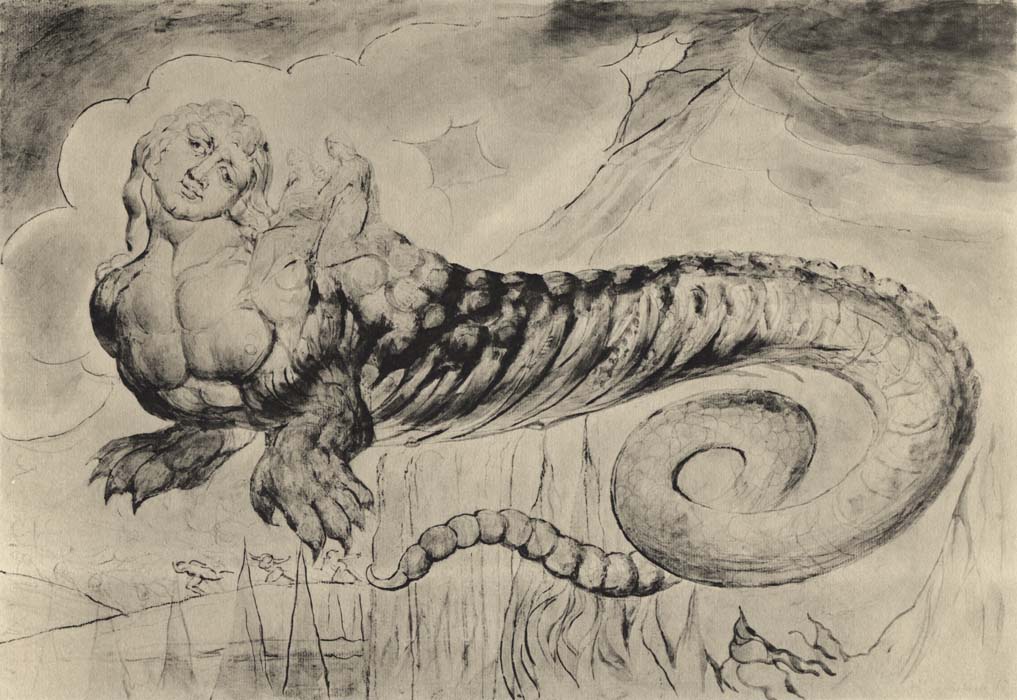
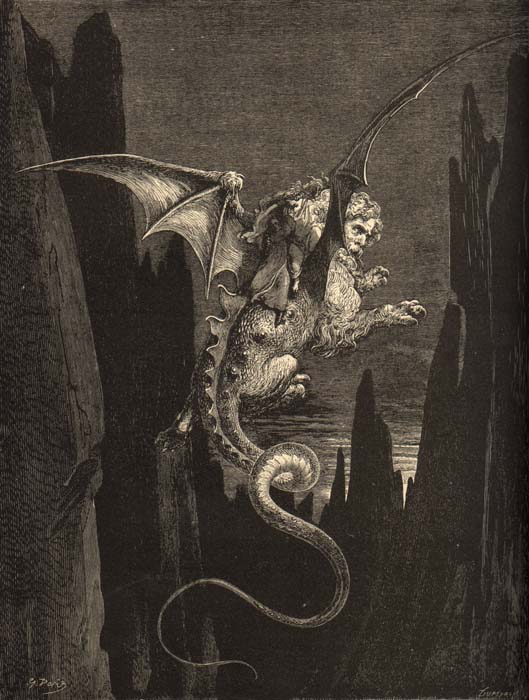
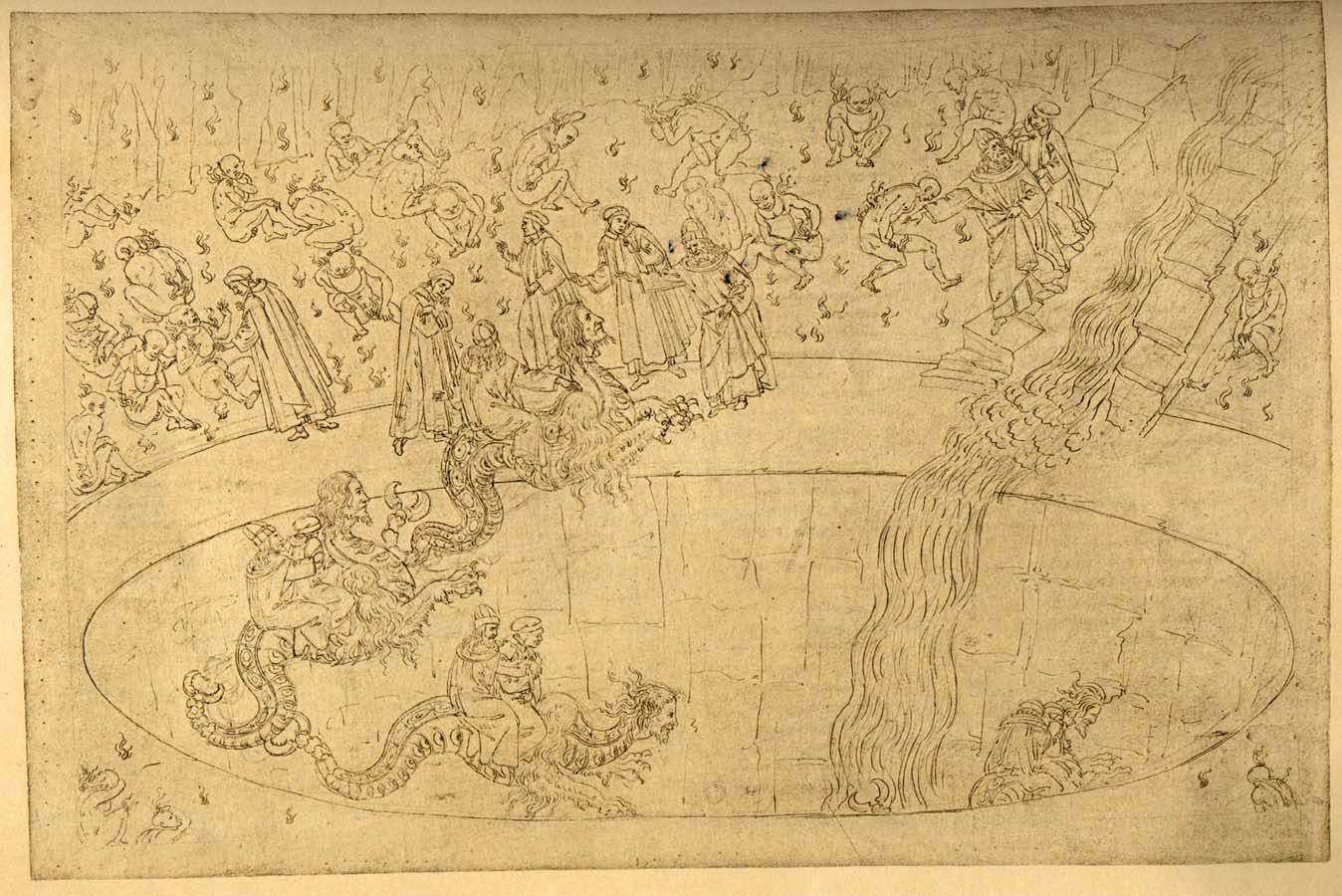
After describing the habits of the intellectual sodomites, Dante continues with the aristocratic sodomites in Canto 16, where he speaks with three men who were great military leaders of Florence. At this point, Dante removes the cord around his waist and throws it down into the pit that opens up at the midpoint of Inferno. The only way that the journey can continue, Virgil knows, is for them to be carried down to Malebolge by the demonic Geryon (see as imagined by William Blake, Gustave Doré, and Sandro Botticelli). This is where Dante, designing the punishments for the fraudulent in ten little pockets (bolgias), is the most comically gross: the flatterers are submerged in shit, the successors of Simon Peter are inverted like the fallen Simon Magus, the diviners weep tears down their own butt cracks, and so on. Here especially, the more recent translations, which do not shy away prudishly from Dante's bathroom humor, are crucial to understanding the spirit of Inferno.
On Sunday night, over 20,000 people (according to newspaper reports) sat down and stood together on the hallowed stones of Siena's Piazza del Campo, to listen to an inexhaustible fountain of words gush from the mouth of Roberto Benigni. If you remember when the Italian comedian and actor accepted an Oscar for La Vita è Bella (on YouTube, if you do not), it was just like that, but in Italian. Actually, he had come to Siena, he said, to speak to the Sienese "Tuscan to Tuscan," and much of his frantic act, over two hours long and free to the public through the generosity of the Monte dei Paschi bank, was heavily accented with dialect-specific language. Add to that my general ignorance of the latest Italian political imbroglios -- a lot of it flew by without my comprehension. In any case, one had the unmistakable sense of being present for an extraordinary event: local opinion confirmed that the Campo had not been that full, excepting the Palio, for a very long time.
What could be understood was Benigni's praise for Siena and its beautiful main square, so full of people that we could see them standing cheek to jowl up all the streets leading into it. He even mentioned the Battle of Montaperti, a famous Sienese victory over Florence, which got a round of applause. If he had quoted Dante's famous line about the blood from that battle staining the Arbia red, he would have brought the house down. Benigni finally introduced his proclaimed subject -- Tutto Dante -- with an enthusiastic championing of Italian cultural heritage, by reciting the artistic and musical terms Italy has given the world, like sonnetto, adagio, opera, and many, many more. It was a wild lead-in to an informed, if slightly unorthodox analysis of Dante's Inferno, and particularly the Paolo and Francesca episode in Canto 5.
Roberto Benigni, Tutto Dante (July 15, 2007) Piazza del Campo, Siena (view other videos of Benigni in Siena)
Benigni missed an opportunity to connect his own political humor with Dante's skewering of political figures of his own time. At other presentations of this show, Benigni has reportedly recited from Inferno 10, as well as parts of Purgatorio and Paradiso, but in Siena he had time only for Inferno 5. You can imagine the scene, as a huge assembly listened raptly while Benigni explained Dante's poem, leading us through the crisis in the dark wood, the meeting with Virgil, the entrance to and upper parts of hell. Understanding the punishment of the Neutrals -- those who are neither virtuous nor evil, who simply sit on the fence and do nothing -- was easy, Benigni said: God hates indifference. As for Paolo and Francesca, they are punished lightly, Benigni believes, because God pities their kind of passionate love, which he likened to the love God felt for La Madonna. Putting aside that strange reading, it was spellbinding to watch the temporary stage become glowing red, as Benigni recited Canto 5 from memory. It was a beautiful and emotional reading, which I followed in my Durling and Martinez edition line for line.
Roberto Benigni, Tutto Dante (recitation of Inferno 5) Pesaro, 2006
The schedule of Roberto Benigni's Tutto Dante tour this summer continues through September 13 in cities around Italy. Tonight, he will be in Grosseto's baseball stadium (July 18), followed by appearances in Florence (the Piazzale Michelangelo, July 20) and Pisa (the Piazza dei Cavalieri, July 22). The latter will be in front of the Torre del Fame, where Conte Ugolino della Gherardesca was imprisoned and killed by starvation, as he explains to Dante in a celebrated passage in Inferno 33. That may probably come up in Pisa, although Benigni could have mentioned any number of embarrassing references to Siena that Dante made in the Commedia. Benigni chose not to do that.
Ambrogio Lorenzetti, Fresco of Good Government, 1337-39 Sala dei Nove, Palazzo Pubblico, Siena
We spent an afternoon in the Palazzo Pubblico (where Simone Martini's Maestà is found), mostly to look at the spectacular frescos depicting good and bad government by Ambrogio Lorenzetti. The Sienese master painted the three walls of the Sala dei Nove, where the nine members of the city's executive council met, from 1338 to 1340. The wall over the entrance of the Nine shows an allegory of good government, with the enthroned figure of Ben Comune (Good Government) reigning among the virtues and with justice and concord binding together the citizens. Then on opposing walls are views of Siena, one imagining the city suffering the results of bad government and the other showing Siena prospering and happy under the effects of good government. These frescos were made shortly after Dante had lived in Siena, where on a trip back from his fatal embassy to Rome, he learned that his rival party had exiled him from his beloved Florence. The concept of ben comune is very much present in the Commedia, in which the forces of intraurban factionalism are condemned.
My favorite details are the signs that Siena is prospering when the citizenry and government together keep Ben Comune on his seat. Crops are planted and harvested, products are brought into the city, workmen climb on scaffolding to repair a building, students in a classroom listen obediently to their teacher, and all vital needs are obviously met. What makes the difference is the little things that we take for granted when our home is prosperous and safe: pets and plants are seen in windows, women dance in a graceful circle in the street, men go out to the country to hunt, and life's pleasures are assured. On the street into the city, there is even an image of a poor man begging, with his hat in his hand. Only with prosperity is charity possible, after all.
The Bad Government side has been badly damaged, because the city government kept its salt stores (salt used to be a state monopoly) in the room underneath. Salt was piled up against the same wall, and mixed with moisture it seeped up through the wall by capillary action and destroyed large parts of the fresco. In a sense, Lorenzetti's Bad Government and Dante's Inferno have a lot in common as criticisms of the forces of party division that undermine Ben Comune.
If you were trying to create the perfect city, you might begin with Siena as a model. It is large enough to have distinct identities in its 17 contrade, or neighborhoods, but small enough to feel like a cohesive town. Twice each summer, on July 2 (in honor of La Madonna di Provenzano) and August 16 (in honor of Mary's Assumption, the day before), each contrada has a chance to participate in one of two festival horse races, known as Il Palio. It is probably impossible to create a tradition like the Palio; it has to evolve organically. It has been a phenomenon in Siena, in one form or another, since the Middle Ages. As it is run now, ten contrade compete in each Palio, consisting of the seven contrade that did not run in the previous race and three contrade chosen by lot. The Piazza del Campo, the heart of Siena, is transformed into a race track, with dirt packed down into a track around the edge, seating in stands around it, and a large space for standing observers in the middle of the Piazza.
The ten horses are chosen from a field of eligible race horses and assigned to the competing contrade by a random selection called the estrazione. Once the horses are assigned, each contrada guards the animal around the clock, keeping it safe in a special house. The jockeys ride the horses bareback, wielding a large wooden stick that can be used on one's own horse, another horse, or another jockey. The race runs around the Campo three times, in a clockwise direction, the opposite of most other race tracks. Just about everything else to do with the race is open to competitive jostling and bribery, and it can be a pretty dirty sport.
Il Palio di Provenzano, July 2, 2007
In this year's July Palio, one of the ten contrade in competition, Chiocciola (the Snail), saw its horse get injured in the opening prova, or trial race. The reason was that the official starter did not lower the starting rope fully, and the horse was tripped. Jockeys can be replaced, but if the horse is out of the race, that is the end for your contrada. Only nine horses raced on the big day. The starter, who is never a citizen of Siena and therefore impartial, resigned and got the hell out of town before things got ugly. The remaining prove went off more or less without a hitch. The seminar participants were invited to the cena della prova generale, the dinner on the evening of the main trial race, the night before the Palio, in the contrada of Onda (Wave). This was a sit-down dinner for about a thousand people, the residents of the neighborhood and their friends, seated at tables along the main street of the contrada.
Although not officially members of Onda, of course, we experienced the Palio mostly from the Onda point of view. (My apartment is actually in the contrada of Leocorno, or Unicorn.) In the exciting estrazione, Onda had drawn an entirely unknown horse, and the reaction from the neighborhood was neutral at first. Over the course of the prove, however, the horse showed it could run fast and had the stamina to run all three laps. The Ondaioli quickly embraced their horse, whose name was Giaguaro (Jaguar), and soon the kids were wearing leopard-skin clothes and jaguar ears and tails and had their faces painted with jaguar whiskers. We were allowed to watch as Giaguaro was brought into the contrada chapel on the day of the Palio, to receive a blessing and have the chance to kiss the reliquary. Horses do not go into church that often, and if they happen to do their business on the floor, it is regarded as the best possible sign of victory.
A few hours before the race, we crammed ourselves into the central part of the Campo at the last possible minute and waited for the race to start. Eventually, the piazza is sealed off and no one can get in or out except for emergencies. There is an incredibly long parade of all of the contrade, including six neighborhoods that do not exist anymore, with pageantry and flag waving (YouTube video), as the horses are taken into the courtyard of the Palazzo Pubblico. In an exciting historical display, members of the a special unit of carabinieri dress up in 19th-century cavalry costumes and ride horses around the racetrack in a full-blown, sword-drawn cavalry charge. As one of our leaders put it, in the age before tank warfare, it is easy to see from this display why cavalry was so feared.
Cavalry charge of the Carabinieri, July 2, 2007
The jockeys, in colorful uniforms but no saddles, ride the horses to the starting rope. There are no gates to keep the horses in their positions, and no one knows that order they are supposed to be in for the start. The names are read out in the randomly determined order, and the starter drops the rope only when the last horse is in place. Until that happens, and it usually takes a long time, the jockeys and horses move around constantly. This is usually where alliances between contrade are revealed, as a neighborhood may accept a payment to help another one win.
In the July Palio, the first big turn once again claimed a victim, as the Drago (Dragon) horse took a bad fall. The jockey was run over by the Onda horse, but the Drago horse got back up and continued to run. At a later point, the Valdimontone horse also lost its rider. Giaguarro, Onda's horse, drew a good position and got off to a good start but was quickly outrun. The horse from Oca (Goose), named Fedora, took off and seemed to have an unassailable lead by the second lap. Incredibly, the horse from Nicchio (Shell), named Dostoievsky, put up an incredible show and caught up with Oca. In the last lap, right by where we were standing, the Valdimontone horse, which had stopped running and was moving randomly around the course, almost tripped up both Oca and Nicchio. They both made it by and sprinted to a photo finish.
The entire crowd tensely watched the windows of the Palazzo Pubblico, where the winning contrada's flag is displayed to indicate the winner. The Oca people believed that the palio (also the name of the banner that is the winner's prize) was theirs and went to the starting platform to claim it. Then the Nicchio flag appeared in the Palazzo window, and the Nicchio people went to take the palio. There was great confusion, and then another person in the Palazzo took down the Nicchio flag and put up the Oca flag instead. (See the race from the misty-eyed Oca perspective in this YouTube video.) It had never happened before in anyone's memory, but the Nicchio flag had been put up preemptively before the race had been officially called.
Oca sings bad things about Torre
Our friends in Onda were happy, if not nearly as happy if Giaguaro had won, because Oca is also an enemy of Onda's enemy contrada, Torre (Tower). Onda rejoiced to see Torre go from jubilation, when their enemy was in second place (the worst possible outcome in the Palio), to annoyance when Oca took the palio in victory. All week since the race, everyone in the Oca neighborhood has been on vacation and partying around the clock, carrying the Palio around the city and showing off their winning horse. (Fedora is a very handsome gray.) On the Sunday after the Palio (last night), they had a huge party in the Campo, preceded by an absurd parade, mostly to make fun of Torre. That was followed by the drawing for the August Palio. The seven contrade that did not run in the last August Palio already knew they were running, and the three others were chosen by lot. The whole Campo was filled again as the Sienese watched the Palazzo Pubblico to see which three flags would appear outside the windows. Adding to Oca's joy, Torre was not chosen to run.
In Canto 10, we meet another of the most vivid characters in the Commedia, the disdainfully proud Florentine aristocrat Farinata degli Uberti. Just as the virtuous heathen are punished at the entrance of upper hell, the heretics are found just within the ramparts of Dis, as if theological sins are the least noxious of their respective categories. Virgil takes Dante on a slight detour through a cemetery of sarcophagi, heated with fire and with their open lids waiting on the ground. These heretics all believed in some way as Epicurus did, that the soul dies with the body, that all happiness occurs in life and one should enjoy all of life's pleasures without concern for the afterlife. According to the law of contrapasso, in which the sin becomes the punishment, these shades will be reunited with their bodies at the Last Judgment, after which soul and body will be sealed in the sarcophagi for eternity. In effect, as they believed, their souls will die with their bodies.
Farinata was condemned posthumously as a heretic for holding a version of this belief. The citizens of Florence dug up his family tomb, burned his remains, and spread them on unblessed ground. They razed all of his family's property and pledged that nothing would be allowed to stand there: in fact, much of the open space of the Piazza della Signoria in Florence today is on the site of Uberti property. Epicureanism is not at all the subject of Canto 10, however, and what Dante and Farinata speak about is the civil conflict that consumed Florence and all of Tuscany in the 13th and 14th centuries. Farinata was the scion of a powerful noble family and a member of the Ghibelline party, mostly the landed families who allied themselves with the Holy Roman Emperor against the Pope's claims on territory in central Italy.
The Ghibellines drove their opponents, the Guelfs (mostly urban families not of the old aristocracy), out of Florence, but the pendulum swung back and forth between the two sides for many years, with disastrous consequences for the city. In a scene that parodies the Gospel account of the resurrection of Jesus, Farinata rises up from his sarcophagus, having recognized Dante's Florentine accent. Using the informal tu, which means he is quite certain that Dante, whoever he is, is his social inferior, Farinata imperiously summons Dante to his side. In a hostile exchange, the Guelf Dante and the Ghibelline Farinata exchange verbal attacks. Farinata reminds Dante that twice he drove the Guelfs out of Florence, and Dante thinks he has won the confrontation because he can inform Farinata that the Guelfs have now finally defeated the Ghibellines after Farinata's death.
Gustave Doré, Virgil and Dante speak with Farinata
After another soul interrupts them briefly, for a different and also interesting conversation, which Farinata scornfully does not even seem to recognize as having happened, Farinata has the last laugh. Another Florentine, the glutton Ciacco in Canto 6, has already hinted at the trouble that awaits Dante in the near future. Although written a few years later, the poem supposedly takes place on Easter 1300, just before the conflict between the rival Guelf factions in Florence, the Whites and the Blacks, broke out that spring. Ultimately, with the help of Pope Boniface VIII, the victory of the Blacks in 1302 included a trial that found Dante and the other White leaders guilty of treason. Dante would spend the rest of his life in shameful exile, a fate that Farinata connects to a specific date.
The irony is that, while trying to disapprove of the spirit of factionalism represented by Farinata, the old Ghibelline, Dante engages in the very same party-based division that leads to his own downfall. Dante was not only a member of the Whites, but shortly after the supposed date of the journey described in the Commedia, he was elected as one of the Priors of Florence, the six-member council that acted as the city's chief executive. It is the hardening of political opposition into violent factions that undoes Florence, and Dante with it, no matter which side is up. The Ghibellines expel the Guelfs; the Guelfs expel the Ghibellines. Farinata's forces slaughtered the Florentine Guelfs at the Battle of Montaperti in 1283, which stained the Arbia red (che fece l'Arbia colorata in rosso) as Dante memorably puts it. The Ghibellines nearly decided to raze all of Florence to the ground, which was prevented only because Farinata opposed it (see the quote featured above). The ultimate Guelf victory led to the destruction of Farinata's property and his condemnation as a heretic. Yet even here at the edge of lower hell, Farinata and Dante continue to argue.
In Canto 11, as the pilgrims pause to let their noses adjust to the stench rising up from below, Virgil helps Dante understand the divisions of lower hell, where violence, fraud, and treachery are punished. The scenes of violence in the seventh circle (Canto 12) seem to be evoked in Lorenzetti's Fresco of Bad Government in Siena's Palazzo Pubblico (more on that soon), where the figure of Timor (Fear) hovers over a city and countryside terrorized by armed men. The centaurs recall the condottieri, or mercenary soldiers who alternately defended and terrorized the city-states of Italy. Also in the seventh circle are the suicides (Canto 13), who commit violence against themselves, represented chiefly by Pier della Vigna, another vivid character in the Commedia, and the blasphemers, usurers, and Sodomites (Canto 14), who commit violence against God. More about that in the next post.
Of course, we spent a long time discussing Canto 5, in which Dante sees Paolo and Francesca in the second circle. Lust is the least grave of the seven deadly sins considered in Dante's conception of hell, but this encounter is one of the most vivid in the Commedia. It is Francesca da Rimini who does all of the talking, while her lover (and brother-in-law), Paolo Malatesta, merely hangs at her side, weeping. Her nephew was Dante's final patron, Guido Novello da Polenta, who sheltered the poet in Ravenna during his last years. In the loathsome marital brokering of the time, she was betrothed to a son of the ruling family of Rimini but reportedly fell in love with her husband's younger brother, Paolo. When her husband found them together, he murdered them both.
The shades of the carnal sinners (i peccator carnali), those "who subject their reason to lust," are likened in the second circle to flocks of birds driven ceaselessly through the air by a whirlwind. Most of them are truly thoughtless and inconstant, like starlings pushed by the air di qua, di là, di giù, di sù (line 43 – here, there, down, up). Others, whose love was worthy of literary fame like Dido, Helen, Achilles, Cleopatra, Paris, and Tristan, are like cranes that fly in more orderly lines, almost above the whirlwind's force. It is from those exalted flocks that Paolo and Francesca descend, like doves called by their desire (quali colombe dal disio chiamate).
On one level Dante sympathizes with Paolo and Francesca, feeling pity so profound that he passes out ("and I fell as a dead body falls"). That they loved steadfastly in the face of social opposition and death is what made them heroes to the Romantics in the 19th century. Dante the poet, however, is as usual up to something much more complicated. On another level, this story is about the danger of bad reading, as Francesca blames the affair on the fact that they were reading an old medieval Romance, the Book of Lancelot du Lac, when they first kissed. This is a stance common to the sinners in Inferno, who are quick to blame their punishment on anything except their own sinfulness. One of the "cranes" is Semiramis, the Babylonian queen who changed her own laws so that she would not be blamed for her carnal sins, which Dante relates with the phrase che libito fé licito in sua legge, showing with a change of one letter that she made what was libidinous licit. As Francesca tells it, We were just reading one day, and the two characters kissed: we looked at each other over the book, and then sex happened.
Dante Gabriel Rossetti, Paolo and Francesca (detail)
One of our leaders described Canto 5 with the term "textual gratification," because the Lancelot romance is only one of many texts referenced in this passage. If Paolo and Francesca had read any of these books (Ovid's tale of Pyramus and Thisbe, the story of Dido and Aeneas, the love poetry of Guinizelli and Dante in La vita nuova [in English translation], and so on), carefully and completely, Dante seems to be saying, the danger of their situation would have been clear. No, they stopped reading, just as, it was pointed out, Augustine stopped reading after he read Paul's warning against fornication (described in Confessions). This brings us to the matter of the contrapasso, the device by which Dante shows how the punishment in Hell fits the crime, or rather, how the crime is the punishment. Paolo and Francesca wanted only one another in that rush of excited passion, and they are joined together for eternity in their deception (one of a series of li altri pianti vani, or so many empty tears, as Dante writes in Canto 21). In spite of their example, Don Quixote still went crazy reading the same old courtly romances.
Dante passes quickly through the sins of gluttony in the third circle (Canto 6), avarice and prodigality in the fourth (Canto 7), anger in the fifth (Canto 7), until he and Virgil arrive at the walls of Dis, the entrance into lower hell (Cantos 8 and 9). There, Virgil suffers his first failure, by which symbolically Dante seems to be showing us that the intellect, which Virgil embodies, is not enough to understand the truth of the journey. Virgil easily masters Phlegyas, the boatman who patrols the Styx (again, a figure of his own classical world). When the devils turn him away at the gate of Dis, a messenger must be sent from heaven to open the way for the travelers.
As most Ionarts readers know, I am in Siena this summer, taking part in an NEH seminar on Dante's Commedia that is based here. We had a weekend of orientation, by people who have lived here a long time, on the traditions of the city, especially the absolutely insane horse race called the Palio. We also took a trip out into the Tuscan countryside to attend a Latin chanted Mass at the Monastery of Sant'Antimo near Montalcino. That monastic house is now occupied by Augustinians, and although they are not a particularly large community, they do sing the Mass and Office in Latin. It was an absolutely appropriate introduction to the medieval world of Dante, who situated the action of his Commedia on Easter weekend in 1300. The rhythm of the Latin liturgy informs much of what Dante wrote, especially in the Purgatorio, where the souls purge themselves of sin through a sort of monastic obedience.
In the first four cantos of Inferno, Dante finds himself in a dark forest, confronted by three ferocious animals. The exact meaning of the spotted leopard, the roaring lion, and the greedy she-wolf are not immediately (if ever) clear, but they make it impossible for Dante to escape. It is the shade of Virgil who comes to his aid, having been sent, as we learn later, by the blessed soul of Beatrice. Your Dante quote for today is from Dante's salutation of Virgil, where he gives homage to the Latin master for lo bello stilo that has brought him (Dante) honor. We spent a lot of time discussing the question of why Virgil is chosen -- by Dante, but in the poem, actually by Beatrice -- as Dante's first guide. Virgil can interpret Hell only by limited standards: at the end of Canto 1 he makes clear that he does not understand the Christian world order from his place in Limbo. He can only conceive of it in imperial terminology: creation as the Imperium, God as Imperator, and heaven as the Urbs. Whenever the pair confronts figures Dante converts from classical sources -- Charon, Phlegyas, Cerberus, the Furies (notably, all characters in Virgil's Aeneid -- Virgil commands them with ease. He is confounded only by the devils, because he just cannot grasp the Christian order.
This little mini-world of classical antiquity is preserved in the lightest part of Inferno, the Elysian Fields reserved for the greatest pre-Christian writers described in Canto 4. Dante places himself sixth in poetic rank in that world: Homer, Horace, Ovid, Lucan, Virgil, and Dante. After listing the morally worthy characters and personages of antiquity, Dante sees Aristotle, attended by Socrates and Plato, in a filosofica famiglia within the nobile castello encircled with seven walls. If you are thinking of Raphael's School of Athens, you have made the connection.
Beatrice and Dante in Paradiso, engraving by Gustave Doré
In La vita nuova (A. S. Kline's English translation), Dante begins his account of the death of his beloved, Beatrice Portinari, by quoting the first verse of Lamentations (the verse in my title could be translated, "How lonely she sits, the city once filled with people!"). These texts were chanted during the Matins services of the Triduum, comparing the Church, bereft of Jesus Christ, to the devastation of Jerusalem described by Jeremiah. It is not the first time that Dante's adoration of Beatrice comes close to blasphemy. Shortly after Dante has a vision of Beatrice's death, he learns the terrible news that she has indeed died, at the age of 24, on June 8, 1290, which is 717 years ago today. (You can visit the site of her tomb.) Here is the second stanza of the canzone, or ode, Dante dedicated to the woman he connected with the number 9:
Beatrice has gone to heaven above, to the realm where the angels have peace, and stays with them, and has left you, ladies: she was not taken from us by a chill or a fever, as other women are, but it was only her great gentleness: for light from her humility pierced the skies with so much virtue that it made the eternal Lord marvel, so that a sweet desire moved him to claim such greeting: and called her from here below to come to him, because he saw this harmful life was not worthy of something so gentle.
The translation is a mixture of the work of A. S. Kline and Stanley Applebaum. I am in the throes of a summer-long obsession with Dante, since near the end of June I will be leaving for several weeks in Siena to take part in a seminar on Dante's Commedia, sponsored by the National Endowment for the Humanities. The music and arts coverage will continue, but there will be regular notices from our travels and study together in Siena.