CD Reviews | CTD (Briefly Noted) | JFL (Dip Your Ears) | DVD Reviews

31.8.19

Briefly Noted: Half-Adapted Bach Sonatas
available at Amazon
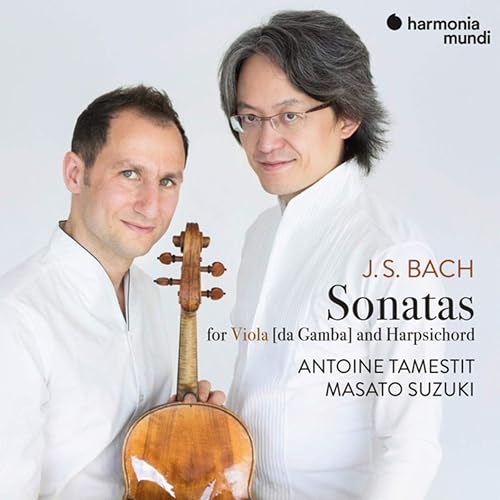
J. S. Bach, Gamba Sonatas (arr. for viola and harpsichord), A. Tamestit, M. Suzuki

(released on August 23, 2019)
Harmonia Mundi HMM902259 | 44'32"
Johann Sebastian Bach's three sonatas for viola da gamba and harpsichord are one of the curious delights of his catalog. The instrument, in the family of softer antecedents to the violin and relatives, was on its way out even in Bach's time. Thanks to the historical instruments movement, we now have plenty of excellent performances of these works available on the original instruments. That makes this arrangement for viola, but still accompanied by harpsichord, mostly a curiosity.

Although violist Antoine Tamestit has recorded and played some Bach in his career, he is not a musician often associated with early music. His sound here is quite luscious, using a Baroque-style bow (Arthur Dubroca, 2010) on the Stradivari viola ("Mahler," 1672) he regularly plays. He partners with harpsichordist Masato Suzuki, son of the pioneering early music conductor and keyboard player, who is carrying on his father's work with Bach Collegium Japan.

The musical chemistry is not always settled, pristinely balanced as each player solicitously makes room for the other's important lines but not always locked into place rhythmically. They present the three sonatas in reverse numerical order, which leaves the best, the G major sonata, for last. Besides the gorgeously rendered third movement, one of Bach's simplest and most moving, what the duo gives a charming surprise to the end of the first movement, which unwinds like a clock at the end of its spring. A single movement, an arrangement of the aria “Ergieße dich reichlich” from the cantata Wo soll ich fliehen hin (BWV 5), is the runaway favorite of the disc.

27.8.19

On ClassicsToday: World-Première Orchestral Songs From Ernő Dohnányi

World-Première Orchestral Songs From Ernő Dohnányi

Review by: Jens F. Laurson
DOHNANY_Symphony_Jiminez_FSU_NAXOS_ClassicalCritic_ClassicsToday

Artistic Quality: ?

Sound Quality: ?

Given its 1944/45 date, the Second Symphony that Ernő Dohnányi—a.k.a. Ernst von Dohnányi—wrote, is an arch-conservative, anachronistic, post-Brahmsian work: A behemoth of grand romantic gesture in four movements. Brass, wind, and timpani push the symphony into hard-edged action with the opening subject of a very properly constructed sonata-form first movement. It’s all a bit mighty and on the nose but it also has that late-romantic appeal that you know you either love or don’t, depending on how you react to Pfitzner or Zemlinsky (whose work is more chromatic) or Joseph Marx or the like... [continue reading]


26.8.19

On ClassicsToday: John Eliot Gardiner’s Revolutionary Berlioz?

Gardiner’s Revolutionary Berlioz? Take The Good With The Ugly

Review by: Jens F. Laurson
BERLIOZ_Rediscovered_Gardiner_ORR_DECCA_Jens-f-Laurson_ClassicsToday

Artistic Quality: ?

Sound Quality: ?

Berlioz: “An acquired taste, but what a taste worth acquiring!” as David Hurwitz points out in his review of the “Philips 50” release of John Eliot Gardiner’s Messe solennelle. Indeed. And even if you think you’ve acquired the taste, Berlioz can still be unwieldy and brittle to the ears. In a way, this box of Gardiner’s Philips and Decca Berlioz recordings showcases both sides of the Berlioz conundrum: The invigorating side that makes you wonder why he is not played more often—and the elusive one, that makes you wonder why he is so famous... [continue reading] (Insider content)


On ClassicsToday: Piotr Beczala’s Lohengrin from Bayreuth (Blu-ray)

Herr Tesla’s Adventures in Brabant—Piotr Beczala’s Lohengrin (Blu-ray)

Review by: Jens F. Laurson
WAGNER_Lohengrin_Bayreuth_Thielemann_Beczala_Harteros_DG_ClassicalCritic_ClassicsToday

Artistic Quality: ?

Sound Quality: ?

This is neither a Lohengrin to seek out for its direction, nor to avoid because of it. As drama, it can’t begin to touch the rats of Hans Neunefels that populated Bayreuth’s previous Lohengrin, already a modern classic. Arguably it’s even a bit lame, but it’s also very pretty and (perhaps involuntarily) traditional. This leaves plenty room to focus on the performances—which is a good thing, as I will elaborate below... [continue reading]


24.8.19

Briefly Noted: Accented Bach & Co.

available at Amazon
J. S. Bach et al., Concertos, Les Accents, J. Brégnac, E. Laporte, S. Marq, T. Noally

(released on August 16, 2019)
Aparté AP206 | 70'18"
For many performers, any experience of the Baroque period was often limited to the music of J. S. Bach. Happily, the early music movement exploded the possibilities by opening up the repertory and the ways of understanding it. The historically informed performance ensemble Les Accents, founded by violinist Thibault Noally in 2014, provides an example.

On the group's new disc, two of Bach's violin concertos (BMV 1041 and 1056R) are set against an array of similar concertos for various solo instruments by composers Bach admired: Johann David Heinichen (1683-1729), Johann Gottlieb Graun (1703-1771), Johann Friedrich Fasch (1688-1758), and Christoph Förster (1693-1745). The last composer's Violin Concerto in G Minor receives its premiere recording, and two fine concertos by Georg Philipp Telemann round out the program. Bach does not so much stand out from his surroundings as fit right in.

The playing is all technically superlative and full of character. Noally takes the violin solos, shadowed by his colleague Claire Sottovia in the double-violin concerto of Telemann. The other soloists are even more polished: Jean Brégnac's subdued traverso, Emmanuel Laporte's perky oboe, and the snappy recorder playing of Sébastien Marq. The sound, recorded by Little Tribeca in the Eglise de Bon Secours in Paris in 2017, feels close, so that you get the grit of bow against string, sharp inhalations of the traverso and recorder players, and the sensation of sitting in the front row.

23.8.19

On ClassicsToday: Sibelius of the Rising Sun. Watanabe's Denon Cycle

Akeo Watanabe’s Sibelius Cycle On Denon

by Jens F. Laurson
SIBELIUS_Cycles_WATANABE-DENON_CDs_complete_Discography_jens-f-laurson
Amid the Japanese embrace of Western classical music, certain composers seem to resonate particularly well with Japanese conductors and audiences: notably Beethoven, Bruckner, and Sibelius. This might be gleaned from the fact that Takashi Asahina alone recorded six Bruckner and seven Beethoven cycles while the... Continue Reading


See also the Sibelius Symphony Cycle Survey.

22.8.19

Dip Your Ears, No. 250 (Knob-Fiddling Beethoven from Wolfgang Mitterer)

available at Amazon
W.Mitterer + Ludwig v. B., Nine In One,
All mixing, editing, composing, re-arranging Mitterer
Original music performed by the Haydn Orchestra of Bolzano & Trento (G.Kuhn)
(col legno)

Didn’t Glenn Gould tell us that a child’s fiddling with the knobs of the home stereo was the first step in a creative act? He might have loved Wolfgang Mitterer. Or maybe not. But on the album “Beethoven: Nine in One”, that’s pretty much exactly what Mr. Mitterer, organist, composer, and “electronics specialist”, delivers. Take briefest splashes of Spanish guitar. Electronic sound bits that might be from another TRON remake. Abbreviated e-guitar riffs. And themes from Beethoven Beethoven Beethoven symphonies. All nine of them. Every major theme from every movement, ordered by movement and crammed into 56 minutes: An Attention Deficit Disorder suffering listener’s digest of the symphonies infused with the spirit of the Electric Light Orchestra’s take on Roll Over Beethoven.

The result is unnerving and annoying one minute, then titillating and cute the next… then enervating again. At its most intriguing, it sounds like flickering aural visions of Alex DeLarge, the protagonist from Clockwork Orange. Most of the rest of the time it sounds as though several recordings of Beethoven Symphonies are being simultaneously fast-forwarded in an audio show-room. If you have always wanted to experience that, this CD – I hesitate to call the arrangement on it a “composition” and, in fairness, so does its creator – is the easiest way to come by it. Concentrated listening to it gets old quickly; as a background track at night it’s weirdly transfixing, given sufficient tolerance for the weird. Wolfgang Mitterer’s symphonic source material for the mix is Beethoven Cycle from that the disgraced Gustav Kuhn’s recorded for the same label and which is at last put to some good – or questionable… depending on your view – use.

5/9


17.8.19

Briefly Noted: Refined Brahms

available at Amazon
Brahms, Violin Sonatas / C. Schumann, Romance No. 1, A. Ibragimova, C. Tiberghien

(released on August 30, 2019)
Hyperion CDA68200 | 71'06"
Both Russian-born violinist Alina Ibragimova and French pianist Cédric Tiberghien have impressed these ears in recital and on disc. Their recording and performing history as a duo goes back a decade, too, including discs devoted to Beethoven and Mozart. This year they have branched out into the Romantic period, first with a disc of French composers (Ysaye, Franck, Vierne, and Lili Boulanger) and now with the three violin sonatas of Brahms, officially released later this month.

Tiberghien's interpretation of Brahms has already struck me as on exactly the right wavelength, an assessment borne out by the transparency, smoldering burn, and rhythmic verve of his playing here. Ibragimova floats above the turbulence of the keyboard part with limpid tone, spot-on intonation, and impeccable awareness of contrapuntal interplay. In particular, the way that the two musicians let go together in the extended hemiola-complicated passages affords a suspended freedom from the barline that is just delightful.

There is force where force is needed, but always in balance between the two musicians so that neither has to over-compensate. The emotional vulnerability hidden in the violin sonatas, through references to some of the composer's intensely personal songs, comes across well. The program is capped by a lovely lagniappe, the first of Clara Schumann's Romances, op. 22. It is worth noting that Clara Schumann, who had received a manuscript copy of the first Brahms violin sonata from the composer in 1879, later told him “she wished the last movement to accompany her into the beyond.”