CD Reviews | CTD (Briefly Noted) | JFL (Dip Your Ears) | DVD Reviews

20.10.09

Matt Haimovitz: Not One Iota More

Style masthead
Read my review today on the Washington Post Web site:

Charles T. Downey, Haimovitz's "Figment"
Washington Post, October 20, 2009

Matt Haimovitz brought his latest CD program, "Figment," to Arlington's Iota Club and Café on Sunday afternoon. For several years, the Juilliard-trained cellist and professor at McGill University has traded on the alt-classical notoriety of performing in unconventional venues, but he drew a crowd that was no more diverse and not much younger than a typical concert hall audience. They even sat in reverent silence for the entire 75-minute program, even though it started half an hour late and had no intermission.

The playing had a bubbly, slightly unfocused energy, adding to the disorienting lack of rhythmic center prominent in the CD's title work, by Elliott Carter. A rasping tone and more elegiac smoothness came to the fore in Ana Sokolovic's "Vez." The amplification of Haimovitz's cello worsened the gaminess of some scratchy high harmonics, in works by Gilles Tremblay and by Haimovitz's wife, Luna Pearl Woolf. It made the noisy electronics component of Du Yun's "San" almost unbearable. [Continue reading]
Matt Haimovitz, cello
Iota Club and Café (Arlington, Va.)
Music by Carter, Sokolovic, Tremblay, Woolf, Du Yun, Stucky, Bach


available at Amazon
Matt Haimovitz, Figment

(released on September 29, 2009)
Oxingale OX2016
Other Review:
New York Times

In the earlier concerts on this tour Haimovitz appeared with composer Du Yun, and the spontaneity of their interaction may have been a large part of what was missing at Sunday's performance (Du Yun had to return to New York after the Philadelphia concert with Haimovitz). The CD has a much more finished (and artificial) sound, which although it is not a must-have by any means features some pieces worth getting to know, including Sokolivic's Vez, the Carter pieces, Tremblay's Cèdres en Voile (Thrène pour Le Liban), and especially Stephen Stucky's Dialoghi.

Matt Haimovitz Previously on Ionarts:
2008 recital | Bach cello suites

19.10.09

Ionarts-at-Large: Thielemann & Bruckner IX in Munich

available at Amazon
Bruckner, Symphony No.9,
Munich Philharmonic
Siegmund von Hausegger, 04/1938
Electrola (now Preiser)
available at Amazon
Bruckner, Symphony No.9,
Munich Philharmonic
Oswald Kabasta, ?/1943
Music & Arts
available at Amazon
Bruckner, Symphony No.9,
Munich Philharmonic
Eugen Jochum, 07/1983
Memories - oop, (BR archives)
available at Amazon
Bruckner, Symphony No.9,
Munich Philharmonic
Sergiu Celibidache, 09/1995
EMI
available at Amazon
Bruckner, Symphony No.9,
Munich Philharmonic
Günter Wand, 04/1998
PROFIL Hänssler
The Munich Philharmonic starts into its 2009/2010 season with a new logo, a clean new website, a new color design (bold orange-yellow instead of blasé gold), newly designed programs (in a font specially created for them), and… no chief conductor.

Well, not quite. Christian Thielemann is still here, and he did show up to conduct Bruckner’s 9th Symphony in a series of four concerts from the 15th to the 19th of October. (He didn’t, and wasn't scheduled to, conduct the season’s first concert.) But just days before his first outing the whole Thielemann-contract-renewal brouhaha cumulated in the announcement that Thielemann had signed a (pre-) contract with the Dresden Staatskapelle, settling his dramatic departure from the Munich Philharmonic, accompanied by acrimonious overtones.

At the performance on the 15th, the audience let the orchestra know which side it took in this undignified affair: The orchestra was roundly booed when it came out on stage—so vigorously that the first violinist couldn’t even tune up with his colleagues. When Thielemann came out, he was greeted by ostentatious applause and bravos. To his credit—and encouraging speculations that he will fulfill his contract until 2011—he did not exploit the situation, quickly set about conducting, and demonstratively hugged his concert-master after the performance.

The topic Christian Thielemann is inexhaustible, and the question whether he was the orchestra’s best shot at fame and an international reputation outside the few Japanese Sergiu-Celibidache-memorial-valleys alone would be worth an article, or two. The job of the orchestra meanwhile is to make music at such an exalted level that the regurgitation of this issue becomes a secondary issue until at least next season—when it will then be supplanted by succession speculations and controversies.

To call the Bruckner 9th on Sunday the 18th “exalted” would be going too far. Even without the flubs that the (unsettled?) brass produced on the 15th, that’s not quite the level at which this slightly restrained, initially cautious performance operated. But once under way—somewhere towards the end of the first movement, it became transfixing all the same. It was as if Thielemann had shifted his attention from harrowing individual moments to the longer line (not usually his specialty) which he then drove along in his usual flexible and—unusual—swiftly propelled way, right to and through the second movement. Having arrived at the Adagio, he became himself again, and the orchestra helped him to transform the slow movement into a glorious celebration of Bruckner’s man above, to whom the work is (allegedly) dedicated. One could just watch the movement rise in grandiose and superbly confident dignity before one’s eyes and ears. It brought to mind the extraordinary history this orchestra has with the work: it premiered the original version and its first ever recording was of that symphony, too.

Dignity aside, the Adagio was stretched to such lengths that it became less and less compelling, teetering on the edge of falling apart before the strings awoke again to find grit and determination for that last shatteringly dissonant triple forte climax. The lulling coda didn’t feel like a true calm after the storm. There are still thunderous times ahead for the orchestra and its conductor.

Murray Perahia

We welcome this review from guest contributor Sophia Vastek, who was once again kindly filling in for your ailing moderator.

Murray Perahia:
available at Amazon
Bach, Partitas 1/5/6


available at Amazon
Partitas 2-4


Online scores:
Bach, Keyboard Partitas (BWV 825-30) | Schumann, Kinderszenen (op. 15) | Beethoven, Piano Sonata No. 30 (op. 109) | Chopin, Mazurkas
Murray Perahia never plays a harsh note. His technique is flawless, his voicing exquisite, his understanding profound. So what, if anything, was missing this past Saturday afternoon when he opened the Washington Performing Arts Society’s Star Series with a well-received concert in the Kennedy Center Concert Hall? The program -- Beethoven's op. 109, Bach's sixth partita, Schumann’s Kinderszenen, and a selection of Chopin works -- was very Perahia, in fact quite similar to his 2007 recital at Strathmore. Each work was like a delicate digestif, even the at-times fiery Beethoven. After all, this is certainly what he is known for, with his perfectly controlled, refined touch, but should all of the works have been treated like light fare?

The Bach was exceedingly well done. Perahia's exploitation of the piano and its range of tools created a partita that really did sound harpsichord-like. His use of pedal at all the right moments, voicing of melodies (however slight), and small range of dynamics all lent beautifully to Bach that was both pianistic and aware of its source. The ornamentation in the gorgeous Sarabande was especially fine: woven, perfectly placed notes that effortlessly circled the melody. The Beethoven sonata, a decidedly quirky one, had a beautiful opening, as if the music had started long ago and he deigned to enter into it. Perahia really made us wait for that first moment of Beethovenian fiery passion, but when it did come in the Prestissimo, it was well worth the wait. It was playing of range, colors, and most importantly, passion, but as quickly as this pianist emerged, he also disappeared.


Other Reviews:

Anne Midgette, Perahia and Bach: a gentle fit (Washington Post, October 19)
Kinderszenen was the high point of the program, where Perahia seemed truly in his element. The music was light and oh so personable, but unfortunately, after this moment of clarity, Perahia went on to the Chopin portion of the program, which was a let-down following the crafted Schumann. Chopin’s mazurkas are particularly odd pieces that very much need accentuation of their oddness to work. Perahia really only touched the surface of the jarring lilt that is the mazurka dance, and without that, these pieces lacked inspiration and personality. Of course, despite this, Perahia’s playing was still gorgeous and immaculate, but this often meant a lack of a colorful spectrum, particularly in the Beethoven and Chopin works. Perhaps a perfect technique and beautiful sound aren’t everything.

The next important piano events in the WPAS series are the lecture by Alfred Brendel (November 16, 7 pm) at the Austrian Embassy and the multimedia recital by Leif Ove Andsnes (November 20, 7:30 pm) at the Kennedy Center Terrace Theater. The latter will pair selections from Schumann's Kinderszenen and Mussorgsky's Memories of Childhood.

Christopher O'Riley at Wolf Trap

We welcome this review from guest contributor Anne Marie McMahon.

Christopher O'RileyThe Barns at Wolf Trap, with a stage set against bare wooden beams, was an appropriate venue for a piano recital by Christopher O'Riley, on Saturday night, that mixed classical tradition with repertoire rooted in the vernacular. Reflections of that unusual melange were visible even in the dressy attire paired with blue jeans, of the audience and O'Riley alike. The majority of O'Riley's program showcased his own works -- "re-imaginings" of Radiohead, Elliot Smith, Portishead, Nirvana, Tears for Fears, Pink Floyd, and Tori Amos. Lasting approximately two hours, including three encores, his program interspersed classical works, including Scriabin's Vers la Flamme and the first movement of Ravel's Gaspard de la Nuit, with the popular music arrangements.

The oldest song to find its way onto the program was titled Darknesse Visible, a virtuosic adaptation by Thomas Adès of a John Dowland song. Noting the melancholic nature of the original song, O'Riley humorously dubbed Dowland "the Robert Smith of the 1610s." More than once O'Riley proceeded straight from a classical work to a transcription, or vice-versa, without taking a break for applause, creating a pairing effect that left mysterious and undefined the relationships between the two works. O'Riley sometimes engaged the audience between pieces, providing both insight about the repertoire and anecdotes to provide comic relief. A "Steinway person," he praised warmly the Yamaha piano on which he performed. The piano certainly returned the compliment, despite the damp turn of weather, accommodating his pool of musical tone colors, of which there were hundreds. On one hand, the gossamer trill fluttering throughout Darknesse Visible tested the extreme sensitivity of the instrument, while the "jangly" chords in the abyssal registers of Nirvana's Heart Shaped Box (see video embedded below) were shocking in their explosive force.


Other Reviews:

Robert Battey, O'Riley offers questionable crossover at Wolf Trap (Washington Post, October 19)
Some have found that O'Riley's transcriptions played seriatim give an unattractive sense of sameness, but that complaint rings false in this reviewer's experience. Each work opened up a new world, and whether or not I recognized the original song, I was drawn into each work with a sense of discovery. Most pieces contained complex textures and strenuous passagework for both hands. Remarkably, O'Riley played all of the pieces with focused, often driving energy, which was impressive given the enormity of the program.

The next pianist scheduled to play at Wolf Trap is Haochen Zhang (November 13, 8 pm), gold medalist at this year's Van Cliburn Competition.


18.10.09

In Brief: H1N1 Edition

Here is your regular Sunday selection of links to good things in Blogville and Beyond.

  • It was inevitable that Alex Ross's blogging would be absorbed back into The New Yorker's Web site, now that the magazine has decided to embrace the Internet age. So -- it's happened. Alex being Alex, of course, it will instantly be indispensable reading. [Unquiet Thoughts]

  • Someone donates some land to the Santa Fe Opera. It turns out there is oil under the land. The company agrees to let drilling proceed, garnering lease fees and a cut of the profits. Environmentalists are miffed. [Seattle Times]

  • Calvin Trillin gets all poetic on Roman Polanski's ass. Brilliant. [The Nation]

  • Edmund White gave this interview that, among other things, included his clawing back in a literary cat fight with Gore Vidal. This will surely be featured on the new Fox special, "When Old Queens Attack." [Salon]

  • Cunard Cruise Lines has struck a deal with the National Symphony Orchestra to provide performances of music on its cruises. [On an Overgrown Path]

  • Duke Basketball, serving Satan since 1984. [The Onion]

17.10.09

Ionarts-at-Large: Munich Chamber Orchestra Opens Season in the Hereafter

available at Amazon
Schubert, Orchestrated Songs (Webern et al.),
von Otter, Quasthoff / Abbado / Ch.O.of Europe
DG
available at Amazon
Britten, Serenade for Tenor, Horn & String Orchestra et al.,
Neil Mackie, Barry Tuckwell / Bedford / Scottish Ch.O.
EMI
available at Amazon
Schubert, Symphonies No.7(8) & 4,
Giulini / BRSO
Sony
The Munich Chamber Orchestra (MKO) is a local musical force to be reckoned with—so much I knew from their recordings on ECM and the appearances at the ARD Music Competition. At the latter, the orchestra around a core of 25 players and music director Alexander Liebreich, proved that they even play with the utmost dedication when they are just ‘hired hands’, performing repertoire not of their choosing. That’s when an orchestra’s character really shows.

Why I have not made it to any of their concerts in the last two years, I do not know. And had it not been for a colleague’s last-minute reminder, I might have missed their opening concert of the 2009/2010 season, too. It would have been entirely my loss as the program titled “Hereafter” was an enticing mix of superbly played Mozart, Britten, Schubert, and 20th century French composer Claude Vivier (1948-1983). The Don Giovanni Overture already told of the darkly dramatic finale with its explosive and crisp execution; so few musicians, so much sound! One wonders if the whole opera could be played so vigorously (and if, whether they could sub for the Bavarian State Orchestra in the upcoming Don Giovanni production).

Claude Vivier’s “Zipangu” for String Orchestra is music of clear lines and bright repetition over a double bass drone. The mildly Asiatic flavor of his travels to Japan and Iran is faintly audible. The central dirge sounds like lonely birds on a winter day, the increasingly astringent violins approximate chalk on a blackboard. It makes for captivating, not necessarily conventional but ‘tame’, modern music that furthered the ashen mood of the program.

Christoph Prégardien and Franz Draxinger took to Benjamin Britten’s Serenade for Tenor, Horn, and Strings, op.31. For the Prologue and Epilogue, Draxinger used a natural horn (the MKO’s brass uses original instruments, wherever the repertoire allows), and his performance was no less impressive for the occasional, almost inevitable glitches. Prégardien’s tenor has to rely heavily on technique for the high notes which were not always the last word in security or beauty. Fortunately intelligence can compensate much—limited projection and range, for example—in a work like the Serenade. It did, and the result was very fine… not the least on account of the work’s strength which is difficult to properly appreciate in a recording, but fascinates with ease in concert.

Where is Anton Webern in his Schubert song orchestrations? In the unfailing tastefulness, the clarity, the absence of anything not essential. It’s as if Webern, by orchestrating them, further parsed the songs’ accompaniment down. The result levitates above the singer like a mobile suspended from silver threads the thickness of hair. The brief, dotted touches of color are already pure Webern, even though these are youthful works compared to his more famous orchestral transcriptions. Every note becomes audible, it’s Schubert as nouvelle cuisine. Prégardien was awfully straight in “Du bist die Ruh”, which ended up rather more pale than wan or sallow. No matter, this was still the absolute high point in a concert that was nicely, inconclusively rounded off with Schubert’s “Unfinished” Symphony, formerly known as the Eighth, now referred to as the Seventh.

NSO and Maazel Work Well Together

We welcome this review from guest contributor Sophia Vastek, who was helpfully filling in for your ailing moderator.

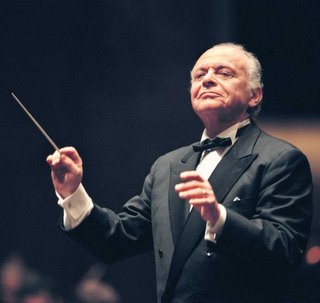
In many ways, the National Symphony Orchestra’s concert last night, conducted by Lorin Maazel, showcased a musical return to true sincerity and a lack of presumption. It was a delightful program all around: Nadja Salerno-Sonnenberg was the featured soloist, performing Barber’s Violin Concerto, which was matched with Mussorgsky’s Night on Bald Mountain, Franck’s Symphony in D minor, and a work by Maazel himself, based on Shel Silverstein’s The Giving Tree. The concert opened with Rimsky-Korsakov’s time-worn arrangement of Mussorgsky’s programmatic work, and with startlingly tight ensemble playing. Maazel is certainly a minimalist when it comes to his conducting style, and, like it or not, the orchestra responded with crisp rhythmic integrity, making for an exciting performance of a work that might otherwise leave something to be desired in the way of substance.

Salerno-Sonnenberg played the Barber Concerto with utmost earnestness, passionate and so clearly intelligent, albeit a bit messy in a few places (but notes aren’t everything after all). Her ability to communicate with and weave in and out of the orchestra was truly remarkable, especially in the beginning of the second movement. She emerged from the orchestra from nothing – literally nothing, leaving the audience clinging to their seats until her sound gained more substance and gracefully exited the orchestra’s aural fold. She was a collaborator in the truest sense of the word, and it was refreshing to see in a soloist.


Other Reviews:

Anne Midgette, Maazel and National Symphony: No Technical Difficulties (Washington Post, October 16)
The orchestra’s rendition of Franck’s Symphony was admirable but never gave way to what can be (or should be) full-blown Romanticism. The piece never really gained momentum, perhaps due to Maazel’s meticulous approach? But it was the two Maazels (yes, two of them) that left the most lasting impression with The Giving Tree for orchestra, solo cello, and narrator. Maazel’s piece is a dark and moving interpretation of Silverstein’s popular children’s book, and Maazel’s wife, Dietlinde Turban-Maazel, a German actress, brought the story to life through her acute and powerful narration. The final words, “and the tree was happy” (after the boy has taken everything the tree has to give), were accented by a tragically dissonant, over-Romanticized orchestra that left much to the imagination in what exactly the word “happy” meant. Despite the apparent simplicity of the text, Maazel deftly crafted a multifaceted and refined orchestration that swirled around the narrative in a way that surely left audience members pondering this simple children’s story and its implications.

This concert will be repeated this evening (October 17, 8 pm), in the Kennedy Center Concert Hall.

16.10.09

Christopher Taylor Doubles His Trouble


Christopher Taylor and the Steinway double-manual piano (photo by Jeff Miller)
Christopher Taylor has made a name for himself mostly for daring, seat-of-the-pants renditions of modern music, like his memorable, idiosyncratic take on Messiaen's Vingt Regards sur l'Enfant-Jésus last year. He came to the Kennedy Center's Terrace Theater on Wednesday night to play Bach's Goldberg Variations, a performance that, musically speaking, was not one of the most remarkable interpretations of the work. The appeal of the evening was the novelty of the instrument that Taylor brought with him, a Steinway double-manual piano that is the only exemplar of its kind ever built. The design was created by a composer and inventor named Emanuel Moór (1863-1931), who convinced several keyboard companies to build models of his two-manual piano. Steinway built its single prototype in its Hamburg factory in 1929, and from there, according to Taylor's account, it went to a Berlin concert venue. It was badly damaged in World War II, sent to the Steinway factory in New York for repairs, and thence to a professor at the University of Wisconsin, where it ultimately ended up in Christopher Taylor's office there.

The instrument has a few noteworthy quirks that Taylor explained, in a slightly dry, off-the-cuff presentation. Both keyboards are linked to the same sound board and set of strings, with the upper one striking the strings an octave higher than the lower one. The white and black keys of the lower keyboard extend together, at a single level, until they continue under the upper keyboard, making a fully chromatic glissando possible in that area between the manuals. A fourth pedal can couple the two keyboards together, making instant octaves possible by playing only single notes (or doubled octaves, by playing octaves). The most important effect the instrument has on playing the Goldberg Variations is in the several movements Bach designed especially for the two-manual harpsichord he had in mind. As if to make the point, Taylor took most of those double-manual movements (5, 8, 11, 14, 17, 20, 23, 26, and 28), which on normal pianos require a delicate sleight of hand to manage the hand-crossing effects, as fast as possible. The visual arc of the two hands, split apart as on a double-manual harpsichord, helped the ear to understand what Bach was doing with the interaction of the two hands.

While Taylor did well highlighting the instrument's strengths, this was not a particularly strong performance technically or musically. Taylor had memory slips, an all-out blank in the third variation that required him to start again, as well as less noticeable ones in 20, 27, and 28. In general, Taylor sacrificed technical polish for unusual tempo or attacks, an interpretation that was more a series of quirky character pieces than a large architectural form. He made no real attempt to keep his tempo choices in proportion to one another, and although he took most of the repeats, he added very few embellishments.


Other Reviews:

Anne Midgette, Pianist Varies His Style on Bach's Goldberg Variations (Washington Post, October 16)
In most of the canons, which occur every third movement with the comes following the dux at an interval that increases by a step with each canon, Taylor took a very slow tempo, choosing to bring out the contrapuntal voices with as much deliberate clarity as possible. It was as if those nine pieces, played in an enigmatic way not unlike how some approach The Art of Fugue, were imported into a much flashier work of greater stylistic variety. While playing them, Taylor even seemed to imitate Glenn Gould, hunching over the keys and ruminating over inscrutable arcana. The most satisfying moment involved the use of that fourth pedal, coupling the two keyboards together, on the repeats of the Quodlibet: the ringing of all those additional octaves gave the impression of a raucous band of revelers intoning the quoted popular songs in a joyous jumble. The encore, Taylor's own double-manual transcription of one of Liszt's Transcendental Etudes (no. 3, F major, "Paysage"), made one smile at the thought of Liszt himself seated at such an instrument. He would have been like a kid in a candy shop.

Christopher Taylor will be back in the area later this month, for a free recital at the Baltimore Museum of Art (October 24, 3 pm), sponsored by Shriver Hall. The program examines the variation form, pairing Derek Bermel's Turning and Frederic Rzewski's fiendish set of variations The People United Will Never Be Defeated! with Beethoven's op. 34 variations.