CD Reviews | CTD (Briefly Noted) | JFL (Dip Your Ears) | DVD Reviews

25.5.07

La Gens

Available at Amazon:
available at Amazon
Véronique Gens, Tragédiennes, Les Talens Lyriques, Christophe Rousset
(released June 6, 2006)
We have reviewed Baroque opera releases that feature Véronique Gens, including Rameau and Lully operas with Marc Minkowski, but she has also been branching out into music from other periods, including her first Mélisande in Berlin in 2004. Following on the successful Handel CD that Christophe Rousset made with Sandrine Piau, reviewing their collaborative career, Gens and Rousset teamed up for this equally superlative recording of arias and orchestral excerpts. Made with Les Talens Lyriques, it is an exceptionally fine survey of the famous and the obscure. Her voice has more heft than the stereotypical baroqueux soprano, a certain dark grain appropriate for the sorceress roles, but she is still capable of breathtaking legereté, which suits her dialogue with flute rossignols in an aria by Pancrace Royer.

The theme indicated by the title of the disc, Tragédiennes, is roles for great operatic actresses in the Baroque period. Some of the choices are lead roles for operas that La Gens recorded at the start of her career, but for which she did not sing the lead role. Her rendition of Lully's Armide, the famous murder monologue and evocation of La Haine, is gripping, and Télaïre's Tristes apprêts from Rameau's Castor et Pollux is suave (if a little on the fast side). Instead of one of Aricie's airs from Hippolyte et Aricie, Gens gives us a powerful reading of Phèdre's Cruelle mère des amours. Besides two Gluck excerpts, the remaining examples of the 12 vocal pieces are from obscure operas by Campra, Cassanéa de Mondonville, Royer, and Leclair, all of them welcome. The orchestral pieces are a beautifully played selection of overtures, passacailles and chaconnes, and dance pieces. The scholarly notes by Jean Duron, Directeur scientifique of the Centre de Musique Baroque de Versailles, are a bonus.

Virgin Classics 00946 346762 2 9


Véronique Gens, Mio ben teco il tormento piu dolce (Eurydice's lament
from Luigi Rossi's Orfeo), L'Arpeggiata Ensemble, Christina Pluhar

24.5.07

Washington National Opera Season in Review

Washington National Opera, 2006-07 Season:

Béla Bartók, Duke Bluebeard’s Castle / Giacomo Puccini, Gianni Schicchi [CTD at DCist]

Nicholas Maw, Sophie's Choice [CTD on the second cast and at DCist]

Giacomo Puccini, Madama Butterfly [CTD at DCist]

Richard Wagner, Die Walküre [CTD at DCist]

Gaetano Donizetti, La Fille du Régiment

Leoš Janáček, Jenůfa

Giuseppe Verdi, Macbeth
The 2006-07 season of the Washington National Opera comes to a close next week, with a concert appearance by several of its singers at the Music Center at Strathmore (May 31, 8 pm) and the last performance of its final production, Macbeth (June 2, 7 pm). It is time to take stock of the company's achievements this season and look forward to what it will offer the city next year. Looking back over our reviews, four productions this season were notable successes -- in order of our raves, Jenůfa, Die Walküre, Sophie's Choice, and Duke Bluebeard's Castle -- and the other three mostly with more positives than negatives.

It was a season with three operas from the 20th century (Jenůfa, Bluebeard, Gianni Schicchi) and one from the 21st (the American premiere of Sophie's Choice from 2002), exactly the sort of production that WNO needs to be doing if it wants to be thought of as a serious company. The company continued its interesting new American Ring cycle, directed by Francesca Zambello, and it is always exciting to see an operatic monument reinterpreted in a new light. Finally, it brought back a lesser Verdi opera that it had not staged in over 20 years (Macbeth). The only two tired choices on the docket were the Butterfly, in a revival of a recent production, and La Fille du Régiment, in an interesting new staging, albeit something of a stretch. Unfortunately, what can make a chestnut doubly unbearable is lackluster casting.

On Monday night, at the end of the penultimate performance of Jenůfa, something became apparent at the sight of the dead baby's clothes and red cap, which are left at the edge of the stage during the curtain call of David Alden's production. If the WNO's season had a unifying theme, it was the loss of children. It is unlikely that this was actually planned rather than coincidental, since such a theme is not going to help sell tickets. Still, who could forget the anguish of the beautiful Angelika Kirchschlager in Sophie's Choice, as she recounted the loss of her children in a concentration camp? Later in the fall, another mother, Butterfly, took her own life rather than face life without her child. Then, to open the spring part of the season, at the end of Die Walküre, a father condemned his disobedient child, placing her asleep in a ring of fire. Even in the parallel comic world of La Fille du Régiment, Marie is reunited with her mother, who lost her when she was a baby.
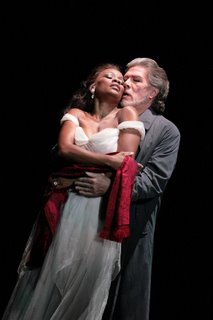
The Macbeths do not have children, and that is an issue that hangs heavily, if silently, over the entire story, as they threaten and sometimes kill first Banquo's progeny and then Macduff's. Does my analysis break down with the first production of the season? Well, in Bartók's Duke Bluebeard’s Castle, we see the loss of a child from the perspective of the child and her kidnapper. As the couple arrives at his castle, the dialogue makes clear that Bluebeard has taken Judith away from her parents against their will. Bluebeard sings to Judith, whom he addresses persistently and disturbingly as child, "Do you hear the bells a-jangling? / Child, thy mother sits in sorrow; / Sword and shield thy father seizeth; / Swift thy brother leaps to saddle."

Actually, operas that touch in some way or another on the death of a child are more common than you might think, perhaps because it is an instantly understandable emotional situation. The only opera presented in this season that does not directly deal with a child's death, Gianni Schicchi, does have one of the most moving illustrations of how much power children have over their parents. In the famous aria "O mio babbino caro," Lauretta pleads with her father to let her marry Rinuccio. She does win over her father's heart, not only because Puccini wrote such a moving melody but because of what she threatens to do if Schicchi does not yield: she sings that she will go to the Ponte Vecchio and throw herself in the Arno. It is the fear of losing his daughter that changes Schicchi's mind.

Most of the formula of this season remains in place for the choices of the 2007-08 season. There is just one major work of the 20th century, a very welcome Strauss Elektra (with Susan Bullock and Christine Goerke and Heinz Fricke at the podium), and a Washington premiere from the 21st century, William Bolcom's A View From the Bridge (with Catherine Malfitano, back after her unforgettable performance in Jenůfa, and Christine Brandes).

One of the modern opera slots has been given over to the category missing from the company's dance card, Baroque opera, with a production of Handel's Tamerlano, with Plácido Domingo and countertenor David Daniels in the lead roles. Some long-time subscribers will remember the company's flirtation with Handel operas in the 1980s and 90s (Semele in 1980, 1983, and 1994; Agrippina in 1991; Julius Caesar in 1999). The opposition of some to those productions is probably due to the style of singer and especially the orchestral component. The trend in European opera houses in recent years is to invite a historically informed performance ensemble into the pit for Baroque opera. WNO may have missed an opportunity to bring this innovation to American audiences, by collaborating with an American HIP ensemble like Washington's own Opera Lafayette or Apollo's Fire from Cleveland. Still, for a baroqueux nut like me, Handel gets no complaints.

It is too bad that the American Ring cycle has been delayed for a year, but the chance to hear Alan Held's first Der fliegende Holländer, with Heinz Fricke conducting, is some consolation. Three slots have been given to chestnuts, with mixed results. A new production of Don Giovanni (last mounted in 2003) and a revival of a previous Rigoletto (last mounted in 1999) feature mostly younger singers, although Lyubov Petrova's Gilda sounds like a good idea. Most disappointing is the season opener, La Bohème (most recently mounted by WNO in 2002) in a new production by Polish film director Mariusz Treliński (of Andrea Chénier and Madama Butterfly). The staging will be gorgeous, reportedly updated to the present day, but the prospect of having to listen to "crossover tenor" Vittorio Grigolo getting "a chance to demonstrate his serious opera chops in the role of Rodolfo" is disheartening. Will he be miked? Who is next, Andrea Bocelli? Il Divo?

By arranging to have this opera's matinee performance (September 23) simulcast onto a large high-definition screen on the National Mall, WNO is angling shamelessly for that elusive young audience. Taking a cue from Peter Gelb at the Met, the WNO will simulcast the same performance into two local cinemas (the AFI Silver and the Old Town) and onto the campuses of universities and high schools around the country. PBS, this is your conscience calling you! We need more opera on public television.

Photos by Karin Cooper, Washington National Opera (1-3), and VittorioGrigolo.com (4)

23.5.07

A NYC Weekend, and More

After years as a working artist and gallery-goer, I’m still surprised by what I see promoted as good art. I understand that’s a loaded statement, we all have our own varied levels of tolerance, our visual pain threshold. With over 300 galleries and counting, a walk through Chelsea any given day will serve my point well. The majority of the work will be mediocre to horrid, the rest of some interest with a remaining percentage, if lucky, quite good. I walk several miles of streets and stairways and wait on too many slow elevators to find the gems.

One such gem, Zoe Strauss, had an opening this past Saturday night at the Silverstein Gallery. I got to meet Zoe at the 2006 Whitney Biennial. She had a small, dark, curtained room all to herself, where a slideshow of her photos was projected on the wall. It was very effective, and Strauss’s raw, distressing images of drug addicts, down and outs, street people, and those of her native Philadelphia most of us never see or never notice were projected right in your face. It was great. It’s also great that Zoe Strauss is a down-to-earth, incredibly nice lady, with very deep convictions about her art. Brent Burket had a sweet ode to Zoe in a post the other day: check it out.

Something that Strauss is adamant about is insuring that her work is reasonably priced: not so for Francesco Clemente at Mary Boone. He’s usually a very good painter, but it doesn't seem to matter when he doesn't hit his mark. This current series of paintings is silly, but all but one of them has sold for $225,000.

I liked Andy Yoder’s cast glass portraits of The Donald, The Martha, and Sam Walton at Winkleman Gallery. I wouldn’t want to have to move them. I think they weigh in at around 300 lbs. It’s a guy thing, to be an R. Crumb fan, I’m told. David Zwirner has a selection of his drawings up through June 16th. Jim Dine has his Pinocchio fetish going on at Pace Wildenstein. At Pace’s other location on 22nd Street, Tim Hawkinson’s wonderful creations are sometimes wacky, often beautiful, but always interesting (through June 9th).

A painter whom I really enjoy, Dana Schultz, was at Zach Feuer (the show closed on Saturday). Crazy, fun, inventive imagery and very good painting. Apparently the gallery has been packed all month and sales brisk. Go, Dana! Also can’t get enough of Alice Neel’s portraits, so thankfully Robert Miller has a show up to coincide with the new documentary, Alice Neel, by her grandson Andrew. Joan Mitchell’s paintings haven't always wowed me, but her drawings can be quite dynamic. Cheim and Read has a gallery full of pastels and charcoals, from 1956 to 1992, that made my day. It’s a challenge to follow her hand: where did she start? What was she thinking? Very powerful, thoughtful work.

I made it a point to visit some of the the galleries on the East Side and Soho. Of note is Amy Ross at Jen Bekman on Spring Street. I like that part of town, but take a map: there are lots of nooks and crannies.

Creativity comes in many forms, including some of the amazing things my yogi friends can do when they explore possibilities with their bodies, emotionally, physically, and with passion. Or observing my buddy Tom Hall, as he lassos the Baltimore Choral Arts Society, guest singers, dancers, and musicians, to mold an incredible performance. That also goes for a dear lady who died this past week at the amazing age of 100. Granny Fuld was a nonstop, no-nonsense, always talking, always knitting gal. She would never have thought of herself as a creative person. To her it was practical, just something she did. Granny communicated with knitting needles at lightning speed, knocking off 5 or 6 pairs of slippers, known as Granny slippers, before getting down to the real task of making sure everyone had an afghan or african as she would say, or mittens, scarfs, or fixing a hem or two. We would all do well if a little Granny ethic were to rub off on us and to remember, it's that creative yarn that holds us all together.

Visit my flickr site to see photos of the weekend, including a few images from an OK Frank Stella show at Paul Kasmin. Let's all send our prayers and positive energy to our blog pal Anna Conti. Her husband, Dave Sumner, is in a fight with leukemia. Get back to what you do best, Dave: taking photos. You can follow his progress at How's Dave Doing.

Opera on DVD: Owen Wingrave

Available at Amazon:
available at Amazon
Benjamin Britten, Owen Wingrave, G. Finley, P. Savidge, Deutsches Symphonie Orchester Berlin, K. Nagano, directed by M. Williams
(released February 22, 2005)

available at Amazon
Benjamin Britten, Owen Wingrave, in box set of Britten operas conducted by Britten (vol. 1, with Albert Herring, Billy Budd, and Peter Grimes)
(released in 2004)
Owen Wingrave is one of the Britten operas I have never seen staged. It does get staged from time to time (just last month by the Royal Opera, for example), although Britten and his librettist, Myfanwy Piper, conceived the work first for television broadcast in 1971 and then for the stage. This film version by Margaret Williams was also made for television, in 2001, and has recently been released on DVD. The narrative comes from a short story of the same title, by Henry James (completed 1892-93), for which you must at least take a quick glance at this incredible hypertext version by Adrian Dover at The Ladder. The opera preserves the short story's time frame, the 1890s, although Britten was probably drawn to the story because of his own experience as a pacifist, facing considerable public criticism during World War II, at a time when public opinion had turned again the Vietnam War. In her film, Williams updates the stories to the 1950s, with an abundance of visual references to monuments to the veterans of the two World Wars.

Williams makes a nice combination of actual dialogue, with characters singing on screen, with inner monologue, in which we hear the singers in voice-over. The medium of film allows for an interesting incorporation of flashbacks to Owen's childhood, too. Sometimes, Williams goes for shots that are too gimmicky (Janet Tovey was the cinematographer), as in the family ensemble, when members of the family come in and out of closeup, wagging their fingers at Owen. Just as often, Williams's eye creates gorgeous tableaux, like the three women of the family seated at table, cutting their meat, and berating Owen in rage. The location for the family manor, Paramore, brings home the wealth of Owen's family, with generations of soldier-ancestors glowering from painted portraits on the Gothic manor walls. When Owen returns to the house, he sings (in voice-over), "And now to face them, all of them, / The living and the dead."

Reviews of Royal Opera Production, 2007:

Anna Picard (The Independent, April 29)

Anthony Holden (The Observer, April 29)

Andrew Clark (Financial Times, April 27)

Warwick Thompson (Bloomberg News, April 25)

Rupert Christiansen (The Telegraph, April 25)

Dominic McHugh (The Opera Critic, April 25)

The Times (April 25)
The gorgeous, brooding score features haunting celesta and often percussively treated strings. It is cut from the same cloth as Britten's earlier scores: in particular, we hear a repeated-note motif quite similar to "Down with the Etruscans/Rome's for the Romans" theme in The Rape of Lucretia. It is played beautifully by the Deutsches Symphonie-Orchester Berlin, under Kent Nagano. The choristers of Westminster Cathedral give just the right wistful background to the Ballad of Paramore, in which Owen describes the legend of his ancestor who, in a room in the mansion now considered haunted, struck his son and killed him. The singers are all cast well by look, which is important in a film with numerous closeups. Most sing equally well, especially baritone Gerald Finley, who is a fine Owen, and mezzo-soprano Charlotte Hellekant as Kate Julian.

The opera is rather short, but the DVD is rounded out with a bonus that is almost as much of a draw as the main feature. The documentary Benjamin Britten: The Hidden Heart, directed by Teresa Griffiths, is an hour-long profile of Britten's relationship with tenor Peter Pears. There is little by way of new information, but the film clips of Britten and Pears are wonderful: Britten playing some of the sea music from Peter Grimes at the piano; Pears singing Grimes; Britten walking next to the young Queen Elizabeth II; Britten conducting and Pears singing at the premiere of the War Requiem.

Arthaus Musik DVD 100 372


Dudley Moore parody of Benjamin Britten/Peter Pears

22.5.07

Milton, At a Solemn Music

What makes a song, sacred or secular, so powerful is its combination of word and melody, everyday words heightened to poetry and further strengthened as music. Here is how John Milton put it, in a poem I recently came across for the first time:

Blest pair of Sirens, pledges of Heav'ns joy,
Sphear-born harmonious Sisters, Voice, and Vers,
Wed your divine sounds, and mixt power employ
Dead things with inbreath'd sense able to pierce,
And to our high-rais'd phantasie present,
That undisturbed Song of pure concent,
Ay sung before the saphire-colour'd throne
To him that sits theron
With Saintly shout, and solemn Jubily,
Where the bright Seraphim in burning row
Their loud up-lifted Angel trumpets blow,
And the Cherubick host in thousand quires
Touch their immortal Harps of golden wires,
With those just Spirits that wear victorious Palms,
Hymns devout and holy Psalms
Singing everlastingly.
You can read the rest of At a Solemn Music online, of course.

An Evening of Operetta at the Austrian Embassy

The Austrian Embassy hosted the popular Embassy Series with a program of works from operetta and opera. Though somewhat lighter in character, the performance Saturday evening involved much fine singing. Works of Johann Strauss, Jr., Gounod, Bizet, and Franz Lehár (among others) filled the program, with the works of Strauss (1825-1899) and Lehár (1870-1949) representative of the respective Golden and Silver ages of Viennese operetta (as indicated in the thorough program notes.)


Daniel Johannsen, tenor
Austrian tenor Daniel Johannsen best assumed the satiric roles. With a ringing voice, he sang with a natural flexibility in tempo, convincing facial expression, and textual nuance – even, according to a native concert-goer seated beside me, doing a number in dialect. Considering his prior training in church music and organ, one sensed a full comprehension of the orchestral parts (reductions), which allowed Johannsen to match his vocal line very well with the accompaniments. He carefully put forth the affect of longing on the repeated word “Komm” in “Komm in die Gondel” (Enter into the Gondola) from Strauss's Eine Nacht in Venedig (A Night in Venice). There was a collective sense of homesickness, by native and non-native Austrians alike, in Johannsen’s rendition of “Grüss mir mein Wien” (Greet my Vienna for me) from Gräfin Mariza (Countess Maritza) of Emmerich Kálmán (1882-1953).

American Soprano Amanda Gosier sang most impressively in “Csárdás” from Die Fledermaus. It was here that she seemed to really enjoy herself, which fixed earlier intonation problems and an overall hesitance to take the stage and embrace the audience. Gosier had an impressive ability to sing lightly in very high registers, though one might have wished for a wider, more open sound in louder moments.

At multiple points in the concert, Jerome Barry, Artistic Director of the Embassy Series, gave lengthy announcements about upcoming concerts. During the intermission, Barry had an eleven-year-old boy-soprano voice student of his sing Schubert (Ave Maria) and Handel (O Thou that Tellest Good Tidings to Zion) selections in a very mannered way – including hand gestures. The audience was very polite. Listeners later sweetly hummed along with the encore of the evening, which was another selection of Lehár.

The next concert from the Embassy Series is a recital by pianist Alexander Tselyakov (June 1, 8 pm) at the Embassy of Canada (501 Pennsylvania Avenue NW).

21.5.07

Inscape Chamber Music Project at NGA

Aram Khachaturian
Aram Khachaturian (1903-1978)
Members of the Inscape Chamber Music Project performed a thoughtful program of chamber works by Khachaturian, Beethoven, and Hindemith at the National Gallery of Art on Sunday evening. The gem of the program was the Trio for Piano, Violin, and Clarinet of Khachaturian. Played with care and flawless ensemble, fresh colors and natural flourishes leapt out of the texture. The final Moderato movement of this work, filled with Armenian folk material, progressed through a variety of instrumental combinations and themes. The moment most reminiscent of Armenian folk music (I am not claiming any expertise here) occured when the clarinet and violin unexpectedly began an angular tune in unison, which was accompanied lightly by the piano. For a time near the end of the movement, the work morphed into a compelling chaconne.

Beethoven's Clarinet Trio in B-flat, op. 11, began very well. The opening Allegro con brio movement had intense contrasts between brisk and slow, chorale-like material. Pianist Danielle DeSwert, with a sparkling tone and cool demeanor, provided true clarity and an exceptionally supreme control over all voices. This trio, heard on a beautiful May afternoon, reminded one of the fun and charm of Mozart. Unfortunately, the pitch of Evan Solomon’s clarinet began and continued to rise from the second movement of the Beethoven through most of the rest of the performance; adding to the intonation problems was cellist Kacy Clopton’s tendency to play on the low side.

The full character of the first two movements of the Quartet for Clarinet, Violin, Cello, and Piano by Paul Hindemith was not achieved because individual motifs were not fully shaped. This caused the texture to sound overly complex and somewhat incoherent. Additionally, noticing a problem in the second movement, violinist Sarah D’Angelo went ahead and moved up to the high pitch of the clarinetist, which left the pitch of the piano strikingly low. Though, all was corrected in the final movement, which had a prancing, jolly nature to it. This final movement ended with a brief toccata.

Mozart and Bruckner with the BSO

Leon FleisherThe Baltimore Symphony Orchestra brought this week's concert to the Music Center at Strathmore on Saturday night. With them came a Baltimore favorite, pianist Leon Fleisher, whose legacy as a celebrated teacher at the Peabody Institute extends throughout the musical world. For years Fleisher made a name for himself playing only repertoire for the left hand, after losing control of his right hand due to focal dystonia. Since a few years ago, when he recovered from that problem, Fleisher has enjoyed an Indian summer as a two-handed performer, most recently reviewed by Ionarts in a Shriver Hall recital last spring. For these concerts, Fleisher returned to the same composer, Mozart, he had played in his last appearance with the BSO. This time, he performed across from another pianist, Katherine Jacobson (who happens to be Fleisher's wife), in W. A. Mozart's concerto for two pianos (F major, K. 242).

Other Reviews:

Tim Smith, Austrians' works showcase the power of harmony (Baltimore Sun, May 19)

Ronni Reich, BSO With Leon Fleisher And Katherine Jacobson (Washington Post, May 21)
This is as it should be, since Mozart conceived the piece for two sisters and their mother, originally playing three pianos, two with difficult parts for the older sibling and mother, and the third basic enough for the younger girl, who was just a beginner. When Mozart later revised the concerto for just two pianos, it was for himself to play with his gifted sister, Nannerl. It is appropriate that this concerto should remain a family affair. In the first movement, Mozart establishes the pattern he will use throughout the concerto, having the two pianos hand phrases back and forth in dialogue, often sounding like a single instrument because they are so closely matched. Fleisher and Jacobson did not quite come together in the opening Allegro, although guest conductor Günther Herbig weighted the strong parts to give a clear line to the work. It was in the middle movement, an exquisitely detailed Adagio, that all elements of this performance gelled. This concerto, composed in 1776, is a musical counterpart to the Rococo style -- decorative, gilded, florid, and sensuous -- and while this was not a superlative performance, due to minor infelicities, it pleased.

Günther HerbigJens has recently called Günther Herbig the "quintessential Kapellmeister," and indeed there is a certain reliability about his appearances with the BSO, most recently just this past March. This week's concert is a sequel of sorts, recreating the same formula from Herbig's very successful concert last year, which combined a Mozart horn concerto with Bruckner's 9th symphony. This time it was the Bruckner 7th, and one might hope that after these two installments, Herbig conducts the BSO in another Bruckner symphony each season. Alas, it is not to be, at least not next season, when the BSO will not play a single Bruckner symphony. With no score and podium between him and the BSO, the baton-wielding, patrician Herbig lovingly shaped the masses of Brucknerian harmony, what Jens has whimsically called "fluid architecture." With a gentle wag of a finger, Herbig often diluted the sound to the right level and drew an exultant, thunderous crescendo from the orchestra toward the end of the first movement.

The four Wagner tubas that Bruckner added to his orchestra, in honor of the composer he called "the Master," evoke Wagner's music in the Adagio. The sound in this performance was liquid and potent, especially in the end of the movement, which is a sort of funeral tribute to Wagner. The disputed cymbal crash was omitted from the end of the Adagio: while both sides of this editing controversy can be logically defended, the cymbal crash does stick out in a symphony that relies so little on percussion altogether. The third movement, which is marked Sehr schnell, seemed relaxed side and not that fast, while the fourth movement opened on the fast side of Bewegt, doch nicht schnell. This was a fine performance that held me spellbound, with excellent playing and Herbig's architectonic sense of structure. Jens, who is our resident Bruckner expert, has recommended the 7th symphony conducted by Günter Wand (on DVD), Karajan, Celibidache, and Philippe Herreweghe (yes, you read that correctly). You can listen online to portions of the fourth movement of the 7th symphony in this NPR piece about the Cleveland Symphony and Franz Welser-Möst.