CD Reviews | CTD (Briefly Noted) | JFL (Dip Your Ears) | DVD Reviews

25.1.07

Film: Babel

The Race to Oscar is on, following Tuesday's announcement of the Academy Award nominations. We welcome back our Hollywood correspondent to help Ionarts get a handle on the field of candidates.

Cate Blanchett and Brad Pitt in Babel, directed by Alejandro González Iñárritu
Babel is the most recent film by Alejandro González Iñárritu. I had in this past season the opportunity, as a member of the SAG nominating committee, to screen the film with its director and three of its now nominated stars. Afterwards, there was a discussion in three different languages with translators, which seemed only fitting considering the vast journey the film captures.

Iñárritu's previous two movies were the exceptional Amores Perros and 21 Grams. Babel is considered the third of this trilogy, and indeed, it shares the scope and depth of the previous two. While there is no direct connection between the three films in terms of plot or characters, Iñárritu's films are a complex crossover of experiences, beauty, and an overwhelming sense of grief lying underneath the surface of every scene. (A feeling Naomi Watts had in Grams and seems to carry in EVERY film she touches.) Here Iñárritu has expanded his scope to cover a multinational palette of characters and experiences ranging from the United States to Japan, Morocco, and Mexico. Yet, as far-reaching as the experiences seem environmentally, Iñárritu has found that common sense of humanity and loss in each varied experience.

Other Reviews:

A. O. Scott | David Denby | Financial Times (partial citation in comments) | Washington Post | Rotten Tomatoes

At the SAG Screening:

When a man in the audience stood to ask the cast a question, he decided to address Cate Blanchett. He went on and on for about three minutes about how Blanchett gets better and better in every role. That she only builds on it in this and how much he blah-blah-blahs. (She studied her shoes.) Then, when reminded he was supposed to be asking a question (oh yeah...THAT), he asked how she did it with practically no dialogue. When the host digested all this, he said into the microphone, "The question is..." Without missing a beat, Blanchett jumped on him and said, "No, what he was trying to say is that I'm terrific." And then blushed at the hilarious uproar. It was my favorite part of the night.
The multiple narratives intersect at the shooting of a woman (Cate Blanchett) vacationing in Morocco with her husband (Brad Pitt). As the story unfolds we are suddenly treated to the events leading up to this accident. A father is teaching his two sons how to tend their herd. In this sequence, the father has acquired a rifle he wants the boys to use to keep away predators that threaten their livelihood. Hence, as the old cinematic rule goes, once you introduce a gun on screen, it’s going to go off. From there, Iñárritu takes us back to the States, where we find the couple's children being attended by a Mexican nanny (played exquisitely by Adriana Barraza) who is urgently trying to get home to Mexico to attend a family wedding. Chauffeured by her nephew (Gael García Bernal) she decides to take the children along with her.

Babel is primarily informed by its deep sense of loss and its characters' desperate desire for those rare moments of joy and transcendence. Iñárritu, himself a buoyant bundle of expressiveness, spoke of his need to speak to something universal after the tragedies of 9/11. Indeed, it is quite fascinating that in all the stories depicted, it is the American couple that seems washed out, grayed, and looking to find some meaning in their marriage and their life after losing a child. Iñárritu orchestrates each of these stories with an overarching sense of dread. Even when the film carries the director's sense of vibrancy (the boys playing, the Mexican wedding, or a girl at a club) one can’t help but feel on edge in these heightened moments of joy.
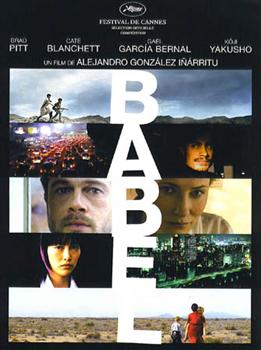
Poster for Babel, directed by Alejandro González IñárrituBabel is receiving some backlash about town, as all films do once the rewards start stacking up, for its overly sprawling narrative as a device or gimmick. Indeed, last year’s Best Picture winner, Crash, has not held up well under critical opinion for that very reason. Certainly, Babel isn’t above such accusations. There is a fourth storyline centered on a Japanese schoolgirl, her relationship to her father, and the loss of her mother. The girl (Rinko Kikuchi) is deaf and is heart-breakingly desirous for someone to see her. These sequences are some of the film's most tragic and beautiful, as Iñárritu envelops us in her muted world and makes us ache with her desperate attempts at connection. Yet, in hindsight, one finds this distant storyline thinly connected to the others. On its own it is strange, disturbing, and beautiful but feels like it is standing alone in juxtaposition to the rest. Yet, I could argue, writer Guillermo Arriaga (also the scribe for Perros and Grams) would like you to connect the fourth simply through feeling.

At the post-screening discussion alongside Iñárritu were Kikuchi, Barraza, and the luminous Cate Blanchett. What was most catching, besides that graceful bird, Blanchett, was how the cast listened so attentively to one another, even when they did not speak the same language. All were keenly poised, as if they were trying to decipher the other's mystery simply through digestion of their presence. Once the criticism burns off the top layer of this film what will be left is feeling. A feeling of connectedness through loss and an understanding of ourselves through simple humanity.

No matter what the language.

24.1.07

La Clemenza di Tito: The Last Word?

Available at Amazon:
available at Amazon
Mozart, La Clemenza di Tito, M. Padmore, B. Fink, Freiburger Barockorchester, René Jacobs (released on September 12, 2006)
The Mozart Year brought us many things, including a renewed appreciation for La Clemenza di Tito. This year Ionarts has reviewed the re-release of the Jean-Pierre Ponnelle production on DVD, heard a live production at Washington National Opera, gave high honors to a new CD recording by Charles Mackerras, and reviewed two new DVDs of the opera.

When I read about the European release of the new René Jacobs recording of Clemenza with the Freiburger Barockorchester, it seemed ready-made to my liking. Jacobs used the full, restored scholarly edition of the opera, including the recitatives as found in the Mozart autograph parts prepared for the singers at the premiere, uncovered in Prague's Lobkowitz Archives. In the extensive booklet of this set, Jacobs contributed an essay on seven crucial misconceptions about Clemenza, with the fourth being these recitatives. Yes, the simple recitatives are the work of another composer and do not appear in Mozart's autograph score. However, the Prague parts were corrected in Mozart's own hand. There is no reason not to record them in their entirety (although in a live performance, dramatic line could easily trump historical accuracy).

In another superb essay, Florence Badol-Bertrand questions the critical reception of Clemenza, beginning with the famous comment attributed to Empress Maria Luisa, dismissing the opera as "una porcheria tedesca" (German pig crap). Those words can only be traced back as far as a quotation in an 1871 book, although the letter the Empress wrote to her daughter-in-law about Clemenza is negative (just not that evocative). Even so, Badol-Bertrand asks the crucial question: "how could the notion of failure be maintained in the face of the exceptional beauty of this music?" The essay also calls into question several of the myths associated with Clemenza and with Mozart's life, as well as providing a compact analysis of some of the score's more remarkable qualities.

For all of its musicological truths, however, a recording must satisfy by the quality of the performance. The Jacobs Clemenza is a beautiful recording, but probably not the most beautiful one. The Sesto on this recording, the richly voiced Bernarda Fink, is more to my taste in this role than Magdalena Kožená, whose tone is lighter. In a related way, Mark Padmore's voice, although lovely, is perhaps too lyrical for Tito, where a stronger voice like Michael Schade would be more in character.

As Vitellia, Alexandrina Pendatchanska's voice is geared toward those striking low passages in the score, while her upper range is darkly colored with vibrato (I would prefer the reverse, a higher soprano capable of sounding those lower notes). It is odd to be able to choose among so many good recordings of Clemenza now, which is the only reason these fine points are even necessary. The strength of this version lies in the conducting choices of Jacobs, here away from his normal ensemble. I agree with Jens that one's choice of this over the new Mackerras recording will depend on your proclivities as far as historically informed performance practice. As I am generally pro-HIP, this recording is a lovely thing, but still not the ideal.

Harmonia Mundi 901923.24

Botero @ the Katzen

Fernando Botero

In a new post by Jack Rasmussen, the director of the Katzen Center at American University, says that he is bringing Fernando Botero's Abu Ghraib paintings to the Katzen in the fall (November 6 to December 30). This is great news, as I have wanted to see this series since hearing of them a year ago.

These are images quite different from the exaggerated puffy forms of the well-known Colombian artist, who usually paints and sculpts a much more light-hearted vision of life. Congratulations, Jack! This should be a very successful exhibit.

La Bartoli in Semele, Zurich

Here is a review by George Loomis (Cecilia Bartoli shines in a new staging of "Semele", January 23) in the International Herald Tribune, of the new Robert Carsen staging of Handel's Semele at the Opernhaus Zürich. By the way, Cecilia Bartoli is singing the lead.

The prospect of witnessing Cecilia Bartoli in an important a new role was probably the greatest draw, but the Zurich Opera House's new production of Handel's "Semele" also happened to be the first staging by the director Robert Carsen since his production of "Candide" met a curious reception at Paris's Théâtre du Châtelet last month. [...]

Admirers of Carsen's work were left wondering whether this level-headed but creatively innovative director might be making a bid for the kind of notoriety cultivated by other opera producers. The appearance of the world leaders, for instance, could easily strike one as analogous to the appearance of religious leaders in the Deutsche Oper Berlin's production of "Idomeneo" which caused such a ruckus last autumn. But Carsen, who has staged "Semele" previously at the English National Opera and Aix-en-Provence, resisted the temptation to engage in radical rethinking. In a program note, he aptly observed that William Congreve's libretto "pulsates with life, feeling, comedy and eroticism." These are qualities that have caused the late Handel work — though originally staged "in the manner of an oratorio" as the composer looked for new ways to impress London audiences as well as to save money — to be regarded as one of the finest operas with an English text.
Loomis notes that this is the first time La Bartoli has sung a role on stage in a language other than Italian. Baroque opera in historically informed performance practice is now so important in Europe that the Zurich Opera has its own resident period-instrument orchestra, La Scintilla, led in this production by William Christie.

23.1.07

Welcome Back, WETA!

Radio antennaThere was a feeling of elation here at Ionarts Central last night at 8 pm, when WETA-FM (90.9) returned to the classical music format it had abandoned almost two years ago. You may recall that we could not help delighting in a moment of Schadenfreude when after almost a year in its all-news format, the station's audience had actually decreased. Now, however, all is forgiven, and all classical music lovers should be ready to renew their membership at WETA-FM. This is especially true since the new format is actually MORE classical music than the previous one, since there will be no more NPR news coverage (other than hourly updates), no Prairie Home Companion, and no folk music.

At 8 pm, announcer Nicole Lacroix and Vice President and General Manager Dan DeVany shepherded in the new (old) format (President and CEO Sharon Rockefeller was notably absent from the airwaves, preferring to acknowledge the change by press release). Lacroix said that the moment called for a fanfare, so the first musical selection after two years of talk was Vivaldi's Concerto for Two Trumpets (with both solo parts recorded by Wynton Marsalis). The station has even inaugurated a classical music blog (one entry by DeVany so far). Here is an Ionarts wish list of programming we hope WETA will pick up:

  • The Monday night New York Philharmonic broadcast
  • The Tuesday night San Francisco Symphony broadcast
  • Live at the Concertgebouw on Wednesday nights
  • The Friday afternoon Boston Symphony broadcasts (is this only on WGBH?)
  • Minnesota Orchestra
  • Los Angeles Philharmonic broadcasts on Sundays
  • Pittsburgh Symphony broadcasts, also on Sundays
  • BP Chicago Symphony broadcasts, also on Sundays (how to choose?)
  • Creators at Carnegie Hall (does that show even exist anymore?)
  • NPR World of Opera
  • Saturday Afternoon at the Opera (CBC Radio Two)
  • Symphony Hall (CBC Radio Two)
  • From the Top
  • SymphonyCast on Sundays (perhaps if individual symphony orchestra broadcasts are not possible)
  • Some programming from BBC Radio 3 would be nice
Obviously, this is probably too much to hope for, but here at Ionarts we dream big. The Post confirms today that WETA's CD collection (25,000 discs) was never given away and that WGMS's collection (18,000 discs) will be added to it. Congratulations, WETA!

Film: Wordplay

available at Amazon
Wordplay, directed by Patrick Creadon (released on November 7, 2006)
available at Amazon
Will Shortz (ed.), The New York Times Little Black (and White) Book of Crosswords
It is probably no surprise to anyone who reads Ionarts that I am a crossword fanatic. When the first trailers for Patrick Creadon's wacky documentary Wordplay started appearing, it was clear the movie was right up my alley, but it took a while for me to get around to seeing it. We all know that crosswords are the best way to stave off the onset of Alzheimer's disease, but who could resist this movie's appeal? One after another, Creadon records the impressions of famous cruciverbalists, including former President Clinton, TV personality Jon Stewart, filmmaker Ken Burns, pitcher Mike Mussina, the Indigo Girls. At the same time, the movie follows the process of how the best crossword in the world, the New York Times puzzle, is created from week to week, with commentary from the puzzle's editor, Will Shortz. We watch a puzzle constructor designing a puzzle -- on the theme of Wordplay -- and get a history of the New York Times crossword.

Jon Stewart solves the Times crossword in pen, Wordplay, directed by Patrick Creadon
Other Reviews:

New York Times | Village Voice | Washington Post | Rotten Tomatoes

Free Online Crosswords:

Washington Post | Chicago Sun-Times

Much of the movie is taken up with a look at several of the top competitors in the American Crossword Puzzle Tournament, this year celebrating its 30th anniversary at its annual March meeting, in Stamford, Conn. Whenever the focus shifts from famous people who happen to enjoy the daily activity of crosswords to everyday people who may like crosswords too much, the interest flags a bit. This is not to say that the skill level of the crossword tournament competitors is not impressive, because it certainly is. Like any obsession, puzzling can go too far, although there is no real harm in the tournament, of course. In any case, for Patrick Creadon's first foray into directing, after mostly shooting soft porn for Maxim -- previous credits as D.P. include Maxim's Girl Next Door and two installments of Maxim Hot 100 -- Wordplay is an admirable achievement. (Maxim's 100-word review of Wordplay is a fascinating document, too.) Even for a non-crossword nut, this unlikely documentary is informative and fun.

Met Simulcast: The First Emperor


Tan Dun and Zhang Yimou speak about The First Emperor

See also this portfolio of Ken Howard's beautiful photographs of the production
Peter Gelb has done a good thing with the simulcasts of live performances from the Metropolitan Opera. If the large numbers of people willing to shell out $18 for a movie ticket -- for the maiden broadcast of The Magic Flute, theaters were filled to 91% of capacity -- are any indication, there is a niche market for opera out there. But seriously, what will it take to get these broadcasts on PBS? This seems to me to be an obvious part of public television's supposed duty to broadcast cultural programming. (Network television is just a pipe dream.) People who may not be able to go the movie theater, either because of timing or cost, would benefit. Most of all, television would make it possible for a viewer, even a kid, to happen upon live opera by chance. No one going to the movie theater to see Happy Feet or whatever is going to think, "Maybe I will pay twice as much to see that opera."

Since I did not make it up to New York to see Tan Dun's new opera, The First Emperor, I was at the simulcast on January 13. Critics have largely judged the opera a failure, but the Met has sold out all performances. Audiences seem to be pleased, although the applause at the matinee was polite but restrained. Now that I have heard and seen it for myself, I think that the nay voices have it right.

The story should be epic, since the title character is Qin Shihuang, the warlord who created the first Chinese imperial dynasty and from whose name we get the country's name, China. The libretto (by the composer and novelist Ha Jin), however, focuses on Qin's obsession with a piece of music he wants composed. The story has been adapted from a movie called The Emperor's Shadow (1996), directed by Zhou Xiaowen on a screenplay by Lu Wei. It is not derived from historical sources but is a sort of historical fiction. The results make the story a little silly, which registered in the audience's laughter every time Qin mentioned his imperial anthem.

The score has some weak points, unfortunately enough of them to outweigh the exciting sounds Tan Dun brings together. As Lisa Hirsch noted in her extensive and perceptive comments on the opera, the major mistake was in the many sections that sounded grossly derivative of Puccini. At one point, I actually thought the orchestra might break into a rousing finale of "Nessun dorma." Several scenes drag on far too long, long after the listener gets the idea. If the creative team has the chance to revisit the opera, with the serious intention of revising it, before the production in Los Angeles, it could be possible to save The First Emperor.

Brian of Out West Arts noted this weekend the two main advantages of seeing the simulcast. First, the choice of shots is excellent, with views of the sets and backstage area close up, including watching the singers coming off the stage or preparing for curtain calls. Theater viewers do not have the effect of hearing the sound in that cavernous house (although we could clearly hear the backstage prompter feeding forgotten lines to Domingo -- I counted three), but we have closeups of the singers, conductor (Tan Dun is an expressive man), and even members of the orchestra (watching them shout the words in the score, sometimes confusing which word to shout, was a stitch). Second, the intermission features are excellent, especially when the host is Beverly Sills. As I said in a post about the recent PBS documentary on Sills, Bubbles has always been a very funny lady.

Remaining Met simulcasts this season include Eugene Onegin (February 24), The Barber of Seville (March 24), and Il Trittico (April 28). All simulcasts begin at 1:30 pm (NB: time is Eastern time zone). Due to popular demand, there will be a rebroadcast of The Magic Flute this evening (January 23, 7:30 pm). Because that will be from the recorded feed, it will take place at that time in all American time zones.

UPDATE:
As if in answer to my prayer, reader Garth Trinkl informs us (in the comments) that PBS will be broadcasting the Julie Taymor Magic Flute (in English). In Washington, you can watch it on WETA TV (Channel 26) on Wednesday night (January 24, 9 pm), with a repeat if your DVR goes awry early Sunday morning (January 28, 3 am). Bravo, PBS!

22.1.07

Bye-Bye WGMS. Hello WETA


The move that we had been waiting for and expecting has finally commenced: WGMS will change its call letters and format - and be our classical station no more. A few minutes ago WGMS broadcast its last bit of classical music (the final chorus of Bach's St. Matthew Passion) and bid its listenership goodbye. After over 30 years of being the most listened-to classical radio station in America (as percentage of market) and the most profitable classical music radio station every of the last six years, Bonneville has decided that, after a bungled sale-attempt to Dan Snyder’s Red Zebra network, that WGMS had no future as a classical station.

WETA is able to use this opportunity to save face and take over classical music – starting at 8PM tonight. They will receive WGMS’ music library, their program director (and presumably other staff, too), its call letters, and on-air support from WTOP and whichever station will transmit on 104.1 – just as WETA (now WGMS) will promote Bonneville’s stations. Read more in the Washington Post on this.

Regrettable as this move may be, it makes sense for everyone involved. After once putting WGMS on the market, advertisers were not likely going to return and commit to an uncertain future – making the future financial success of WGMS less likely. Nor is classical music a format with a great commercial future to begin with, even if this particular station was doing extraordinarily well. Ensuring that WETA will take over the classical format will avert at least some of the negative publicity that Bonneville does not want (but was bound to get for abandoning a profitable classical music station). For WETA it makes sense, because their move to all-talk had not resulted in any of the hoped benefits that the board and GM had promised – but plenty anger among long-time contributors and public figures in Washington. For the consumer, finally, the move should be appreciated because WETA will be able to offer slightly fewer commercials (even if they are not called “commercials” on public radio), a much stronger signal, and slightly more varied and ambitious programming.