CD Reviews | CTD (Briefly Noted) | JFL (Dip Your Ears) | DVD Reviews

21.12.06

Fond Memories of '06

China Painting 1995-96I think it’s the time of year to do something totally new, like an end-of-year list of my favorite 10 shows: bear with me, this has never been done before. In no particular order...

1. Dada was an exhibit that truly surprised me by its depth, the number of artists that were actually involved in the movement, the volume of work displayed, and how relevant the work is to our current times.

2. Brice Marden’s recent retrospective at MoMA was one of my favorite exhibits this season. It’s rare to have an opportunity to view a large body of an artist’s work, especially spanning a career.

3. Combination of The Armory Show and the Pulse Fair. I haven’t made the trip to Miami to see the Art Basel tournament of art buying/viewing, but the New York version is a similar beast. Everyone is gearing up for them in February. I’ve met some wilted gallerists who have just returned from Miami. Love them or not, they have become a vital part of the art trade, and several dealers have confided that they could not survive without them.

4. Manet: The Execution of Maximilian at MoMa. All three versions of this amazing painting.

5. Day for Night, the Whitney Biennial, is another exhibition that brings a mixture of surprise and yawning. Even with the advent of the Wheeler Dealer art fairs, museum-sponsored surveys such as the Whitney’s are still a huge cachet boost for artists. This particular biennial had more yawns than it should have. My suggestion is to have a smaller, more focused exhibit. Don’t neglect the rest of the country: there is a lot of great art being made outside of New York. No, really.

Sean Scully6. Sean Scully. This show didn't disappoint: luscious paint.

7. Edvard Munch: The Modern Life of the Soul. Although I wasn’t totally impressed, on whole this was a special exhibit and a rare chance to see a large body of his work.

8. Tara Donovan's beautiful installation of plastic cups at Pace Wildenstein.

9. Alex Katz: The Sixties. Another Pace show and some of Katz's finest paintings.

10. Cézanne to Picasso, Ambrose Vollard, Patron to the Avant-Garde, a great story recounting the career launching influences Vollard had on so many artists.

Also worth mentioning, some of the best surprises have come in the print and drawing galleries at MoMA, the best part of the newly renovated museum. This has been a great year viewing art. Here's to 2007: peace.

Honorable mentions, from Charles:

Prayers and Portraits: Unfolding the Netherlandish Diptych (National Gallery of Art)

In the Beginning: Bibles before the Year 1000 (Arthur Sackler Gallery)

Constable's Great Landscapes (National Gallery of Art)

Le Douanier Rousseau: Jungles à Paris (Grand Palais)

Hiroshi Sugimoto (Hirshhorn Museum)

Pierre Bonnard Retrospective (Musée d'Art Moderne de la Ville de Paris)

Ingres Retrospective (Louvre)

20.12.06

Ensō Quartet @ LOC

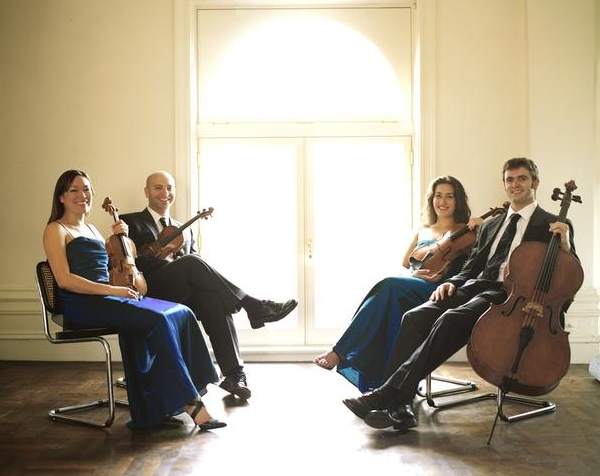
Ensō String Quartet -- Maureen Nelson and John Marcus, violins; Melissa Reardon, viola; Richard Belcher, cello -- photo by David Mehr
Ensō String Quartet (Maureen Nelson and John Marcus, violins; Melissa Reardon, viola; Richard Belcher, cello), photo by David Mehr
On Monday night, for its last free concert in the calendar year, the Library of Congress celebrated Gertrude Clarke Whittall's donation of several precious Stradivari instruments to their collection, on the day of the great Cremonese luthier's death in 1737. For whatever reason, perhaps the mini-Ice Age that made the trees of northern Italy yield wood that was extremely dense, the sound of a Strad is still prized. The last time that a young string quartet, the Jupiter Quartet, was at the Library of Congress to play a concert on the Strads, Jens observed that just because an instrument was built by Stradivari does not mean that it will be a match for a player. When the young players of the Ensō Quartet spoke about the instruments they were using, first violinist Maureen Nelson compared the "Betts" Strad to a thoroughbred. It could be "a little wild," and she had to decide when to give it its head or rein it in.

Nelson had originally chosen to play the darker "Ward" violin but switched instruments with second violinist John Marcus, in the interest of the ensemble's sound. That says something about the Ensō Quartet's approach, and what stood out about their playing was that their sense of the entire composition trumped any individual player's virtuosity. Not only did we hear far more of the inner lines, especially second violin and viola, in this performance than in many others -- we wanted to hear those lines. The group's finest playing of the evening came on the modern work, Alberto Ginastera's second string quartet, op. 26, commissioned by the Library of Congress (through the Elizabeth Sprague Coolidge Foundation) and premiered in 1958 by the Juilliard Quartet. It should be no surprise that the Ensō Quartet played the Ginastera well, as the group won second prize at the triennial Banff Competition, and a special honor for best performance of a new work, albeit without two members in their present makeup. (This was in 2004, as it turns out, the same year that the Jupiter Quartet won first prize.)

Ensō Quartet:
available at Amazon
Pleyel Quartets


Ginastera Quartets:
available at Amazon
Lyric Quartet

This was my first encounter with the Ginastera quartets, and based on the Ensō Quartet's visceral rendition of no. 2, they should make a recording of all three of them. The first movement is marked Allegro rustico, but if it has anything to do with rustic folk, they are murderous peasants: a barbaro 6/8 with accents all over the place, on and off the beat, duple crossing triple, moments of manic shrieking. The second movement featured a lovely viola solo from Melissa Reardon, on the Library's "Cassavetti" Strad, and the third was a magical incantation, spider music so soft at points that it almost evaporated between the stage and my ears. After a folk improvisation, devil's violin scordatura sounds and all, in the fourth movement, the fifth movement pulsated back to the spirit of the quartet's opening. In a case in the auditorium's entry hall, Ginastera's holograph score of the second quartet fooled me: the composer's handwriting was so precise and clear that I thought it was a printed score. His letters to Harold Spivacke (then Chief of the Library's Music Division and dedicatee of the second quartet) are also neatly typed and signed by hand. If he was a perfectionist, he should have felt proud of the second quartet.

Other Reviews:

Andrew Lindemann Malone, Enso String Quartet (Washington Post, December 20)
-- "After a somewhat tentative first movement, the Enso pushed the tempo in the Mozart quartet's slow movement too much, making its repeated phrases sound perfunctory." [Well, we heard the same concert! -- Ed.]
The group's obvious relish of the Ginastera could not have contrasted more with the lackluster performance of one of Mozart's Haydn quartets, K. 421, that preceded it. It was so cautious and well behaved, although with beautiful sound and excellent balance, that it seemed like the dutiful work students do for a piece forced on them by a beloved teacher. The first movement felt overly frenetic, the second movement perfunctory. Happily, the concluding work, Dvořák's E-flat major quartet, op. 51, was far from a disappointment. Last performed at the Library of Congress by the Panocha Quartet two years ago, it relies heavily on Czech folk sources and is nicknamed the "Slavonic." The performance was finely tooled, especially the second movement, in which a melancholy Czech Dumka battles for supremacy with a chipper Viennese waltz, and the lyrical, fast fourth movement. After some coaxing, the Ensō Quartet offered Bagel on the Malecon, a brief multimetric tango by Ljova [Lev Zhurbin, b. 1978]. You can hear it on the entry page to the quartet's Web site. Thank you, once again, to Mrs. Whittall.

The next concert in the free series at the Library of Congress (January 24, 8 pm) features Yuri Bashmet and the Moscow Soloists with pipa player Wu Man, in a program of modern music by Tan Dun, Takemitsu, and Hayashi.

19.12.06

Shostakovich in 2006, Part 3

available at Amazon
Shostakovich, The Golden Age (complete ballet), Royal Scottish National Orchestra, José Serebrier (released on November 21, 2006)
If The Golden Age, a ballet produced at the State Academic Theater in Leningrad (St. Petersburg's Mariinsky Theater) in 1930, was a failure it was not because of Shostakovich's score. Excerpts of the music were included in later ballets, a suite based on the ballet, and piano versions made for the Ballet Suites collection. Although not the first (but the most recent and the cheapest), this recording of the complete ballet has much to recommend it. It is based on the most accurate source for the original production, a piano score edited by Manashir Yabukov, reflecting what Shostakovich anointed as the final version of the score. Since the ballet was pronounced a failure by the Soviet authorities, later perceptions of the score were made through subsequent redactions. This recording also claims to observe all of the repeats indicated for the premiere performance.

The plot is an absurd tale, involving the visit of a Soviet soccer team to an unspecified Western city, identified only as U-Town. When the Mariinsky Ballet attempted to revive the ballet earlier this year, reviewed in its London performance by The Guardian, American choreographer Noah Gelber did his best to update the scenario, by casting the love story not as something that is happening right now but that is viewed historically. Fortunately with a CD recording, the listener's imagination can provide the choreography and scenario and one can merely focus on this side of Shostakovich's musical imagination, the acidic humor (the hysterical "Soviet Dance" in Act I is a manic Offenbach galop on steroids) and extravagantly coloristic orchestration (lots of saxophone, sneering brass glissandi, silly percussion, bumbling contrabassoon, and even a flexatone in Act I's "The Supposed Terrorist" and Act III's "Touching Coalition of the Classes, Slightly Fraudulent").

It is no secret that we at Ionarts are fans of Uruguayan-born conductor José Serebrier. With all of the jazz and popular idioms cheek and jowl with classical traditions, Serebrier brings vital energy throughout, not only in the grotesque waltzes and oompah band sections, but in slow movements like the luscious, tender Adagio "Dance of Diva," where the languorous soprano sax solo incarnates the tempting Western woman who eventually asks the leader of the Soviet team to dance with her. The RSNO's playing is uneven at times, for example not quite aligned at all points in "Foxtrot ... foxtrot ... foxtrot" (CD 1, track 19) -- speaking of which, is that the main theme of "Springtime for Hitler" somehow coiled inside this music? Where the conflict of capitalist and communist comes to a head, of course, is the Music Hall, the "divertissement" that opens the third act, with its jazzy Chechotka (Tap-dance), sultry Tango, famous Polka ("Once upon a Time in Geneva -- Angel of Peace"), and the most clattering, cataclysmic Can-Can that could be imagined. Bravo to Serebrier for the imagination behind the shaping of this sprawling, wandering score.

Naxos 8.570217-18

Go back to Part 2 / Part 1

18.12.06

Christmas with Chantry

Albrecht Dürer, Sackbut playersIn a round-up of holiday concerts in Washington, I singled out two for special praise, including Saturday night's concert by Chantry and the Orchestra of the 17th Century, in the lovely church of St. Mary Mother of God in Chinatown. It is in the same category as the Folger Consort's Christmas concert (on the docket for a review this week) because of the repertory. No carols, no Messiah, no Nutcracker, and yet Christmas. Real Christmas, too, not commercial Christmas: Basilica di San Pietro Dies natalis Christi (Palestrina's motet and imitation Mass Hodie Christus natus est), and Venice transplanted to Lutheran Germany Weihnacht (Schütz's Christmas Oratorio). Obviously proud, conductor David Taylor gave an over-lengthy introduction to each half, all the more unnecessary because his comments largely reprised the extensive program notes.

You are right to expect a certain musicologist to have been elated solely by the program. The musical results in performance were unfortunately uneven, but important marks go to Taylor and his forces for again bringing music of great interest to Washington. For whatever reason, the group's normally pure intonation did not lock in as effortlessly as it has in previous concerts. Thinking that it may have been my position in the sanctuary -- on one of the side aisles with the singers split into two choirs -- I moved to the back of the center aisle at intermission. Adding the less than solid playing of the instrumentalists in the Schütz did not help the situation, nor did the greater distance in the room. All pistons did not seem to be firing properly, but everyone has off nights.

Other Reviews:

Joan Reinthaler, Chantry's Nativity-Themed Program Is Well Shepherded (Washington Post, December 18)
This motet and Mass derived from it are one of Palestrina's relatively rare forays into the Venetian polychoral style. The strange way that he divides the forces, with all the treble voices in the first choir, created a strange lacuna at the top of the second choir. The altos on the right side, who should dominate, were just overwhelmed by the other voices, and the sopranos on the treble-heavy left side clashed more than they meshed, including something that went temporarily wrong in the middle of the Gloria. The interpolation of movements from a keyboard tablature Mass by Claudio Merulo, played beautifully on the portative organ by Adam Pearl, was effective, liturgically appropriate, and lovely.

In the Schütz, the lengthy narrative recitatives seemed wooden as performed by tenor Scott Williamson, whose timbre was on the baritone side of the male voice. In alternation with the storyline are aria moments for various solos or combinations. Nice moments were offered by the four alto shepherds, with the best instrumental playing of the evening (from recorders), and the four bass/baritone high priests and scribes, accompanied by sackbuts. All in all, it was an enjoyable but not excellent evening of music.

Chantry's next concert (March 24, 8 pm) in St. Mary Mother of God, offers music for Holy Week in Renaissance Rome, by Allegri, Gesualdo, Lotti, Palestrina, and Lassus.

Shostakovich in 2006, Part 2

available at Amazon
Shostakovich, Symphony No. 7, Orchestre National de France, Kurt Masur, Sarah Nemtanu (released on October 31, 2006)
Kurt Masur's handling of certain parts of the orchestral repertory is sometimes thought to lack poetry. Over the past year, health problems have caused other concerns, which were evident on his recent trip to Washington with the London Philharmonic. However, reports have reached my ears of his exceptional work with the Orchestre National de France (where he has been music director since 2002), particularly in his Mendelssohn cycle and, although it cannot yet be called a cycle, his work in Paris on the symphonies of Shostakovich. (Masur's Shostakovich was a highlight during his tenure with the New York Philharmonic, too.) Reviews of his Paris DSCH 5th in 2004 were raves, and when his illness last winter seemed to have scuttled his planned performance of the Leningrad Symphony, the ONF decided not to cancel or replace the conductor but to postpone the performance until Masur was well again.

It finally took place on May 18 at the Théâtre des Champs-Elysées, and this live recording captured the extraordinary result. Frank Cadenhead reviewed the concert for Musical America, published on May 26 (the review, Masur Conducts the 'Leningrad' in Paris, can be found on Masur's Web site). He said that the concert "set something of a gold standard, both for performances of the work and for the orchestra's level of accomplishment under this master musician." Christian Merlin also wrote a review (Une fresque saisissante, May 22) for Le Figaro (my translation):
The fact that Masur personally knew the composer and was familiar with Stalinism surely helped him penetrate the spirit of this music. It was not enough perhaps to lessen the sometimes tedious length of this monument, but it allowed him to give it a gripping dramatic intensity, at the edge of what can be sustained: the only way to accomplish the first movement's vertiginous crescendo, not merely an exercise in endurance but a nightmarish unfolding. As if on springs, Masur tapped his foot, made sounds, and his ONF musicians followed him as if a single person, at full bowing in the strings, at full power in the brass, at full incandescence in the percussion (the tireless Emmanuel Curt, on the snare drum).
The 7th symphony (op. 60) -- named the Leningrad because Shostakovich wrote most of the work while in that city during its siege by the Germany army -- is a gargantuan 75 minutes long, with the first movement close to half of that length. The first movement goes through 6 minutes of other identities, a broad, almost official opening, a slow section with solo flute that could be Debussy, before the insistent military march begins, with that same solo flute over insistent percussion. Often compared to Ravel's Bolero, the bulk of the movement is essentially one gesture over the course of over 15 minutes, a huge crescendo over an ostinato pattern, spinning out a single melodic idea. Jens has described his admiration of the Bernstein recording of the 7th symphony precisely because it has a ruthless sense of its military subject, if not necessarily propulsion (at 84 minutes, it is more drawn out than Masur's reading).

When the ONF played the Leningrad at the Proms in August, the London critics were not convinced, to say the least (as in The Guardian). Some listeners, including one Béla Bartók, simply do not care for the Leningrad Symphony. If you are not opposed to it, this recording is a thrilling live rendition, gutsy and on the edge, captured in excellent sound. As a sound document, it is also a tribute to Kurt Masur's career, especially his Shostakovich.

Naïve V 5071

Go to Part 1 / Part 3

17.12.06

Shostakovich in 2006, Part 1

Available at Amazon:
available at Amazon
Shostakovich, Violin and Cello Sonatas, Romance and Nocturne for Cello and Orchestra (from The Gadfly), D. Yablonsky, M. Fedotov, E. Saranceva, G. Petrova, Russian Philharmonic (released on October 31, 2006)
There must be someone out there who has not yet acquired some new discs this year to fill out the Shostakovich corner of his library. The Russian composer celebrated a centenary in 2006, and musicians everywhere have been giving concerts and releasing recordings of his music. These recordings offer some interesting vantage points on Dmitri Dmitrievich and could be nice acquisitions for the end of the Shostakovich year.

First, from Naxos an ensemble recording of works for cello and violin. The Cello Sonata, op. 40, dates from 1934, when the composer was in his late 20s, and he shows his roots quite clearly. One could almost mistake the first movement's opening section for Fauré, and the second movement for moody Schubert. He hews fairly closely to the traditional forms of the classical sonata. The performance is good, in spite of some strained passages from cellist Dmitry Yablonsky, especially in high parts with multiple stops. The tender slow movement is endlessly seductive. The Violin Sonata, op. 134, dates from 1968, and it is as barren, sparse, and enigmatic as the earlier work is lyrical. The performance, with violinist Maxim Fedotov and pianist Galina Petrova, often leans toward the pitiless and mechanical, which captures the bitterness of the score. True, neither of these sonatas really needs a new recording, but the performances have a convincing Russian character. Yablonsky's transcriptions of a romance and nocturne from Shostakovich's nifty score for The Gadfly, a pathetic propaganda film, are bon-bons guaranteed to rot your teeth, and they fill out this cross-sectional look at the composer's multi-faceted work.

Naxos 8.557722

Go to Part 2

In Brief

LinksHere is your regular Sunday dosage of interesting items, from Blogville and beyond:

  • Jessica Duchen has published an article about just what exactly an authentic performance of Handel's Messiah is. Do conductors and audience members have "Messianic delusions," as she her headline puts it? [The Independent]
  • As reported all over the place, Roberto Alagna was booed off the stage of La Scala this weekend. However, Giorgia Meschini had by far the best take on the story, by transforming it into a hilarious comic strip ("Panico alla Scala!!!"), with pictures from the opera house and Photoshopped (Italian) text balloons. My favorite is when Alagna, a French speaker, says "parbleu," a word that instantly marks someone as French in a comic book, even though I have never heard a French person actually say it. [No guru, no method, no teacher]
  • La Cieca surprises many and comes down in support of Alagna in LaScalaGate2006. It is a well-reasoned argument. [parterre box]
  • Steve Hicken quotes a recipe for "Eggs Carter" in honor of Elliot Carter's 98th birthday. [listen.]
  • Glimmerglass will mount the first American production of Wagner's little-known opera Das Liebesverbot. [AP]
  • Having spent some time doing extra work as an editor and proofreader, this comic from Geist, Lesser-Known Editing and Proofreading Marks, made me smile. This was pointed out by a favorite read, an always informative and entertaining, if slightly esoteric blog. [languagehat]
  • Bob Shingleton has a longish review of a new book about, or rather not about, the closeted skeletons in the House of Wagner. [On an Overgrown Path]
  • As predicted in some quarters, WETA's board has officially admitted that it will consider switching back from an all-news format to classical music, if WGMS goes to a sports format. If WETA does go back to classical music, I pledge to make nothing but overjoyed statements here, no smug "I-told-you-so" triumphalism. Promise. WETA, not only will you be making Ionarts happy, but the NEA will get off your back, too. [Washington Post]
  • On a list of the Top 51 Classical Music Blogs, compiled by Scott Spiegelberg, Ionarts comes in at #4. Watch out, Alex Ross (#1), Sequenza 21 (#2), and On an Overgrown Path (#3): you are in our crosshairs. [Musical Perceptions]

16.12.06

Marc Minkowski Releases

Since forming his historically informed performance (HIP) ensemble, Les Musiciens du Louvre, in the 1980s conductor Marc Minkowski has released a stunning number of excellent recordings, many of which have set the benchmark for performance of 17th- and 18th-century music. Quite naturally, the group has specialized in French composers of le grand siècle, although they have made excellent recordings of Handel operas, too, and recently a few forays into other territory, including Mozart and even Berlioz, Méhul, and Offenbach.

Available at Amazon:
available at Amazon
Rameau, Hippolyte et Aricie, Jean-Paul Fouchécourt, Véronique Gens, Bernarda Fink, Laurent Naouri, Les Musiciens du Louvre, Ensemble Vocal Sagittarius, Marc Minkowski (first released 1995, re-released September 2006)
Perhaps the best work that Minkowski and other French conductors, especially William Christie (an honorary citizen of France), have done is give the music of Jean-Philippe Rameau the recordings it deserves. Hippolyte et Aricie was the first major Rameau opera that Minkowski released, in this live recording made in June 1994 at the Opéra Royal in Versailles. Graham Sadler's work on the new critical edition of the works of Rameau has revealed the misconceptions, even fabrications, of the composer's operas and given us guidance on the multiple versions of most of them. In the excellent liner notes, including an essay by none other than Graham Sadler, Minkowski explains how he arrived at the rather complete form of the score recorded here, with some parts that have often been cut from Hippolyte restored. The dance music in this opera is so charming, like the sailors' ballet in Act III (in which we can hear the frenzied clicking of oboe machinery in one of the rigaudons), I would hate not to have it.

The vocal casting is superb, with Jean-Paul Fouchécourt and Véronique Gens in excellent voice as the eponymous lovers. Some of the music is just too good to believe, as in Aricie's opening aria of Act I ("Temple sacré"), which is luscious, gentle, seductive, and harmonically daring. Although some of the minor roles are merely good, Bernarda Fink has a superlative turn as Phèdre, the jealous stepmother (a review of her Sesto with René Jacobs in La Clemenza di Tito is forthcoming), and Laurent Naouri is appropriately solemn as the three gods, Pluton, Neptune, and Jupiter. There are some tracks that could have benefitted from an alternate take, if this were not a live recording. The thunder scene of Diana's anger in Act I, for example, is uneven, with the many runs jumbled by instruments and voices, but the booming percussion and thunder screen makes it thrilling. This set is certainly worth owning, especially since its only competition -- Les Arts Florissants with Mark Padmore and one Lorraine Hunt as Phèdre -- appears to be mostly unavailable in the United States (still carried by Amazon UK). Janet Baker's historic recording is a curiosity worth finding if you can.

available at Amazon
Lully, Acis et Galatée, Jean-Paul Fouchécourt, Véronique Gens, Mireille Delunsch, Howard Crook, Laurent Naouri, Les Musiciens du Louvre, Marc Minkowski (first released 1998, re-released September 12, 2006)
Opera Lafayette gave a live performance of Jean-Baptiste Lully's final opera, Acis et Galatée, here last year. For this 1996 live recording in the Salle Wagram in Paris, Minkowski reunited the two lead singers from Hippolyte et Aricie, with Fouchécourt and Gens singing equally well in these title roles, and Laurent Naouri again, in the memorable role of the cyclops, Polyphème. First released by Deutsche Grammophon in 1998, Archiv has recently given it a most welcome re-release. Fouchécourt has the sweetest high range, perfectly suited to this kind of music, and Gens gives a moving performance in the little scena in Act III, after Acis is fatally crushed by the rock thrown by the cyclops, in alternation with instrumental passages. The music, especially the chaconne and passacaille movements, is exquisite, Lully at the height of his craft. The instrumental performance here is equal to the vocal, with tight, rhythmically activated readings of all the dance pieces, often with the phrase shapes highlighted crisply by percussion.

Minkowski again shows his musicological connections, with the essay in this booklet by Jérôme de La Gorce (and English translations by Graham Sadler). If you are used to the serious tone of Lully's tragic operas, this work is in a lighter pastoral style, and in it, as La Gorce put it in his essay, Lully rediscovered shortly before his death the comic mode he had when he collaborated with Molière. The role of Polyphemus, sung with appropriate bluster and an odd accent by Naouri, is particularly funny: the Act II entrance of the cyclops is preceded by a heavy-footed march, which Minkowski has punctuated by a silly panpipe signal, almost like a slide whistle. Besides all of its strengths (there are not even any "live recording" glitches to be regretted here), this is the only complete recording of the opera, and it is worth owning.

available at Amazon
Rameau, Une symphonie imaginaire, Les Musiciens du Louvre, Marc Minkowski (released on June 14, 2005)
available at Amazon
Rameau, Les Boréades, Les Arts Florissants
Alex Ross praised Minkowski's most recent Rameau disc, Une symphonie imaginaire, when it was released and listed it on his Top 10 List of 2005 recordings. I missed the recording at the time, but it has recently crossed my desk and has become favorite listening, for either focused appreciation or background for cooking dinner. The concept is simple and ingenious: Rameau was universally praised for the symphonic pieces in his operas but wrote almost no stand-alone music for orchestra alone. Minkowski stitches together his imaginary Rameau symphony from various places, including a ritournelle from Hippolyte et Aricie, dance movements from several operas and ballets, and arias with the vocal parts artfully removed. One particularly beautiful example of the latter is "Tristes apprêts, pâles flambeaux" from Castor et Pollux, which recently appeared in an opera scene in Sofia Coppola's latest movie, Marie-Antoinette (sound taken from the excellent recording by Les Arts Florissants). There is even a modern orchestral transcription of Rameau's famous piece for keyboard, La Poule (The hen). Most satisfying are several pieces drawn from Les Boréades, a little-known tragic opera published posthumously. John Eliot Gardner has recorded it, but I am now most interested in seeing the DVD, released in 2004, of a performance of the opera in Paris by Les Arts Florissants, with Barbara Bonney and none other than Laurent Naouri again.

Archiv 445 853-2 / Archiv 453 497-2 / Archiv B0004478-02