CD Reviews | CTD (Briefly Noted) | JFL (Dip Your Ears) | DVD Reviews

25.5.06

Bienvenue: Lazarevitch and Musicians of Saint-Julien

Musical Swan?La Maison Française presents plenty events of interest, and Monday was no exception. In their first U.S. engagement, François Lazarevitch and the Musicians of Saint-Julien – Élizabeth Geiger, harpsichord, and Nima Ben David, viola da gamba – performed a nicely balanced program of French Baroque pieces, with Mr. Lazarevitch leading the trio on transverse flute, recorder (a sonata by Philidor), and Baroque Musette (about which more later).

Frankly I have no business at a flute concert, the modern flute being my least favorite solo instrument, too sweet and insistent for enjoyment at length (apologies to Messrs. Galway, Gaulois, et al., I know it’s not your fault). Mr. Lazarevitch’s transverse flute, however, has a mellow, woody tone and blends beautifully with other instruments, at least in these performance. At no time did he or his delightful companions tire the ear, quite the contrary…they could have gone on for another hour or so.

All the music on the program could be described as light, decorative in the Baroque manner, but there was no lack of that restrained, dignified melancholy that to me encapsulates the Baroque experience, as in the “Tendrement” section of Montéclair’s Deuxième Concert, which opened the program. The viola da gamba, of course, is the perfect embodiment of that sensibility, especially as played by Ms. Ben David, who shone in solo selections from Marais’s Le Tombeau de Monsieur de Sainte-Colombe.

The lovely Ms. Geiger also got her solo slot with two pieces by Dandrieu (La Lyre d’Orphée and La Figurée, respectively nostalgic and bouncy; and the ensemble as a whole did proud the best music on the program, three of Rameau’s Pièces de clavecin en concert. In short this was not a flutist-with-accompaniment recital but a partnership among equals.

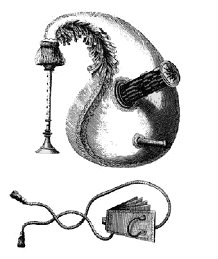
In the closing work, Hotteterre’s La Noce Champétre, the focus moved decisively to Mr. Lazarevitch, and the material became distinctly R-rated despite the soloist’s nice try for a PG in introducing each section: calling the Le coucher section ‘bedtime’, for instance. But Mr. Lazarevitch was playing the Baroque musette, an instrument with more appendages than seems decent, and some of the sounds he produced were much too explicit for the Ionarts reader. At least there was no doubt the Hotteterre was all in fun, in the rustic style of Leopold Mozart’s Bavarian Wedding but (obviously) earlier in date and more imaginative. The Prèlude set the stage and introduced the sound of the musette — called by many, including Mr. Lazarevitch, a bagpipe-ancestor — but played with under-arm squeezebox and keys in a manner that calls to mind the accordion.

The wedding march follows, a bit troubled and solemn on the musette, perhaps forecasting events in Le coucher. A fine display for an archaic instrument, reminding the audience that some music truly demands original instruments and does not benefit from endless retranscription.

Mr. Lazarevitch was excellent throughout, with excellent breath control, and integrating his distinctive sounds with his partners for the benefit of the music. Not to be missed on their next engagement for anyone moved by the spirit of the Baroque.

Domingo Notwithstanding, This Is Thielemann's Parsifal

available at Amazon
R.Wagner, Parsifal,
Thielemann / Meier, Selig, Domingo, Struckmann, Anger, Bankl
DG

Age hardly seems to slow Plácido Domingo down; instead, he seems invigorated by his numerous duties and continuous love for music. It should be little surprise that the tireless tenor is featured on two releases this month; Puccini’s early work Edgar and, more notably, a live Parsifal from Vienna – both for Deutsche Grammophon. It also isn’t surprising that that recording from June last year prominently uses Domingo in its marketing, his name on the cover in as big a font as that of the actual star, conductor Christian Thielemann. Ironically, this Parsifal is hardly notable because of Domingo (and indeed some may say it is notable despite him). In trying to pin down in a few words why this recording turns out to be so appealing, I am peculiarly reminded of the last live Wagner recording of Thielemann’s where the verdict was: if you like the featured singer (a lovely Debby Voigt as Isolde), go ahead – but the real reason to investigate the recording would be the orchestral playing, the way that Thielemann has with the score.

Here it might be modified to read: if you don’t have grave objections to Parsifal being older than Gurnemanz (a very fine Franz-Josef Selig – although I should have liked to see, admittedly still younger, René Pape on it), or Domingo’s still, erm… “operatic” German, or a minor howler from Benedikt Kobel’s First Knight of the Grail, or the fact that you can get the incomparable Waltraud Meier in better voice still on the Barenboim recording, or simply having a second, third, or fourth recording of Parsifal (Knappertsbusch, Barenboim, Kubelik, and even the self-consciously beautiful Karajan are, all in their own way, de rigeur) you should seek this out for true magic being unleashed in the orchestral pit courtesy of the teutonic Thielemann, who conducts in great Romantic, flexible fashion. And given just how rewarding and compelling his reading of the score is, above caveats look very minor suddenly.


available at Amazon
Knappertsbusch, 1962

UK | DE | FR

available at Amazon
Kubelik

UK | DE | FR

available at Amazon
Barenboim

UK | DE | FR
Domingo may be too old to believably take on this role, but at least you don’t have to watch him – replete with hair extensions – on CD, and in Wagner his voice is a smidgen less distinctive (and therefore more amenable to convincingly portray a character) than in any other composer or language; he does not stand out as "Plácido" quite as much. Speaking of language: what he has lost in steady glow since the days of his Lohengrin recording with Solti he has more than made up by improving his German from atrocious to passable. Meier, too, may not soar quite in the same way she once did, but Kundry is still her role; I could think of no one I’d rather hear in it (until, that is, Ekaterina Semenchuk decides to take it on). And what some might consider loss of total security, one could also consider an added animalistic, raw element – particularly apt in Act 1.

Christian Thielemann was often seen as the antipode to Daniel Barenboim. Leading the two big opera houses in Berlin, sometimes verbally sparring, Barenboim as the spiritual descendent of Furtwängler, Thielemann the protégé and successor to Karajan, they were pitted by some as Barenboim the ‘cosmopolitan’ vs. Thielemann the ‘German’. That may all have calmed down since Thielemann spends most of his time in Munich with the Philharmonic and it won’t be fueled any further by this recording, either, because it is Thielemann who is more “Furtwänglerian” than Barenboim, with the tempi magnificently – I don’t want to say ‘pulled around’ - elongated and drawn together. At times Thielemann has Knappertsbusch-like gravitas and breadth, elsewhere he is swift and lean like Krauss and all is done with such a sure hand that the tempos only seem right and appropriate, never as if Thielemann were exerting his will onto the work. The balance of the recording, especially as concerns the choir, is better than in the Tristan & Isolde; stage noises don’t intrude. (Not surprising since, famously, nothing is actually going on in Parsifal.)

A glorious and necessary addition for the Parsifal maniac – but a pricey one. First choice among modern recordings remains either Barenboim or Kubelik (both studio recordings) or, among live and historic recordings, one of the many Knappertsbusch versions. With Thielemann, compromises must be accepted as far as the singing goes; the music is king: Wagnerites and those in the making will want to put this high on their Easter wish list.


DG 4776006 (B0006574-02)

24.5.06

Things I Like in NYC, Part 2

Samuel PalmerKara Walker at the Met: After the Deluge is following the Mining the Museum theme Fred Wilson did with the Maryland Historical Society collection, but on a much smaller scale. It's a post-Katrina exploration of race, class, have and have not, with a nice series on the Middle Passage. I love Walker's large lithographs. Also at the Met, Hatshepsut: From Queen to Pharaoh: a show of art and objects from the reign of the 18th Dynasty's female pharaoh. The sculpture reminds me of Inca or Miyan work. Another exhibit, Samual Palmer: Vision and Landscape, has a few gorgeous, brown watercolors with gum arabic solution. The watercolor arabic combination creates a fabulous deep mysterious brown. It doesn't take a special exhibit to get me to the Met: I could walk around for days enjoying the permanant collection.

Alex KatzWay down in Soho, the Drawing Center has a show of 150 Eva Hesse drawings from 1936 to 1970. More drawings at Deitch Projects, with a small selection of Basquiat. That makes for a segue to Pace Wildenstein Gallery in Chelsea for an exhibit examining the connection of Basquait to Dubuffet; I always made that jump, this show makes it quite clear. At Pace's 22nd Street location is a real treat, Alex Katz: The Sixties. I think it's his best period, a real Matisse influence.

I think George Condo has a great imagination, which is evident in his new work at Luhring Augustine Gallery. Jenny Holzer uses declassified government documents, painted on large canvases, for her show at Cheim Reid. They're mysterious and chilling, with large swatches of black-outs included. Peter Allen Hoffman's landscapes at Freight+Volume remind me of the paintings of Balthus. Nathalie Djurberg's animated videos at Zach Feuer are hilarious!

IMG_0386.JPGIMG_0391.JPG

My last stop in Chelsea was to the Joe Fig Exhibit of recreations of artist studios with recorded conversations with the artist: extended for two more weeks at Plus Ultra. The show is a hit with artists: we're always curious to see how other artists set up their spaces.

Through June 16th Alexandre Gallery has a fantastic show of watercolors by Arthur Dove. This exhibit is part of a benefit for the Arthur Dove/Helen Torr Cottage and Study Center.

SunDrawing.jpgIMG_0408.JPG

And last but not least, Free Arts NYC put on a splendid party/auction at Phillips de Pury. A lot of money was raised for a great organization doing wonderful things, helping kids at risk with healing arts programs.

What to Hear in June

We are going to continue running our monthly schedule feature, Classical Month in Washington, where we include links to the reviews for all the concerts we can (our own and those in newspapers). For now, I am experimenting with the RSS Calendar, which automatically puts a weekly calendar in the sidebar. (Thanks to fellow arts blogger George Hunka for the idea.) It's not yet quite exactly how I want it, so let me know how you like it (or don't). As always, if there are concerts you would like to see included on our schedule, send your suggestions by e-mail (ionarts at gmail dot com). Happy listening!

Thursday, June 1, 7 pm; Friday, June 2, 1:30 pm; Saturday, June 3, 8 pm
National Symphony Orchestra, with Kurt Masur, guest conductor
Beethoven's Leonore Overture and Symphonies 1 and 7
Kennedy Center Concert Hall

Thursday, June 1, 8 pm
Baltimore Symphony Orchestra: Russian Romance
Khachaturian's violin concerto with concertmaster Jonathan Carney
Music Center at Strathmore

Friday, June 2, 7:30 pm; Saturday , June 3, 7:30 pm
W. A. Mozart, Idomeneo
Opera Lafayette (Washington Early Music Festival)
Clarice Smith Performing Arts Center (College Park, Md.)

Friday, June 2, 8 pm; Saturday, June 3, 8 pm
Gilbert and Sullivan, Pirates of Penzance
New York Gilbert and Sullivan Players
Filene Center, Wolf Trap

Friday, June 2, 8 pm; Saturday, June 3, 5 and 8 pm; Sunday, June 4, 2 pm
Folger Consort and Concord Ensemble
Music by Marenzio and Morley (Washington Early Music Festival)
Folger Shakespeare Library

Saturday, June 3, 7 pm
Rossini, L'Italiana in Algeri
Washington National Opera
Kennedy Center Opera House

Saturday, June 3, 7:30 pm
Brothers, Sing On!
Washington Men's Camerata
Kennedy Center Terrace Theater

Saturday, June 3, 8 pm
Spanish Treasure (Granados, Montsalvatge, and Mompou; Sephardic songs, Andalusian folk songs, Zarzuela)
Wolf Trap Opera Company (with Steven Blier)
The Barns at Wolf Trap

Continue reading Classical Month in Washington (June).

23.5.06

Britten's War Requiem

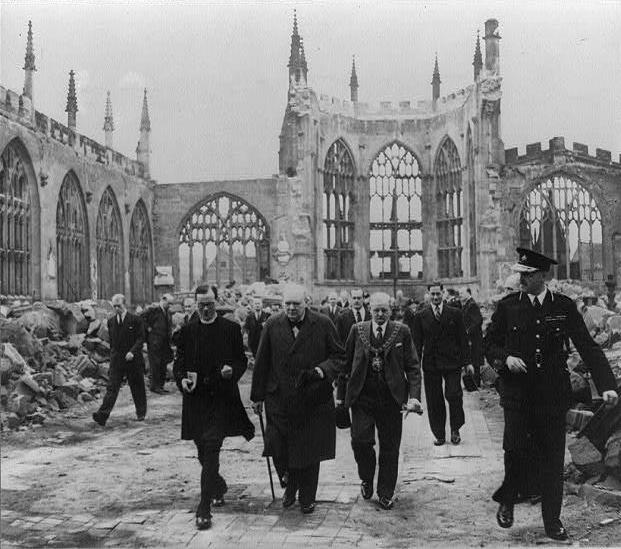
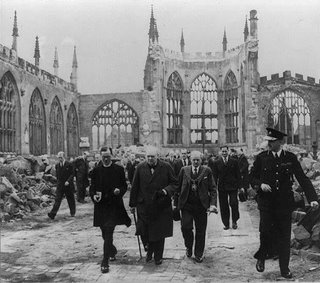
Coventry Cathedral in RuinsIf any choral work of the latter half of the 20th century has achieved classic status, it is Benjamin Britten’s War Requiem. Commissioned for the rededication of Coventry Cathedral, reduced to rubble by German bombing during the Second World War, this conflation of the ancient Mass for the Dead with war-soaked poems of Wilfred Owen — himself a casualty of the First World War — was presented Sunday by the Cathedral Choral Society to conclude its season. The event, prefiguring America’s Memorial Day next weekend, in fact commemorated the anniversary of the Axis surrender to the Allies ending the Second War in Europe: May 8, 1945.

The War Requiem, a favorite of Mstislav Rostropovich during his tenure as National Symphony Orchestra director (Galina Vishnevskaya, his wife, had been chosen by the composer to represent the Soviet Union – next to Britain with Peter Pears and Germany with Dietrich Fischer-Dieskau – as one of three soloists in the 1963 premiere but was blocked from the first performance by the Soviet minister of Culture, Yekaterina Furtseva), was led by J. Reilly Lewis, also Music Director of the Washington Bach Consort. Presenting a major, complex work such as this — multiple choruses, three soloists, chamber ensemble, and large orchestra — is a daunting task anywhere, but the cathedral setting brings unique challenges. Balancing such large forces in both time and space is not so easy without concert hall acoustic reflections, sightlines are broken up, and the slow decay of notes hanging in the air makes it difficult to steer the music precisely. True, the work was designed for cathedral performance and premiered at Coventry — but to accurately render this music in all its complexity, a concert acoustic might be preferred.

available at Amazon
B. Britten, War Requiem, Britten / Pears, Fischer-Dieskau, Vishnevskaya
That Mr. Lewis and his exceptional forces transcended these difficulties is no small tribute to their skills but also demonstrates the conductor’s experience with church acoustics — he took full advantage of what the National Cathedral had to offer in warmth and blending of tones, giving his performance a bit of an ‘old master’ feel. Burnished, soft around the edges (even where Britten is at his pungent sharpest, as brought out in his own classic recording just reissued by Decca), Lewis’s Britten compensated for loss of fine detail with a rich, broad sound, anchored by the cathedral organ, whose sound frequently hung suspended in the air and pierced the ear with its intensity and conviction. If the stunning, serpentine brass proclamations in the Sanctus did not break through as they should, they resonated in the mind longer. Those who find Britten brittle surely would have been converted by this performance.

To grasp the magnitude of this achievement, know that Britten not only blends the Mass and Owen’s searing poems, he sets the two at war with each other with rival performing forces: full chorus, orchestra, and soprano soloist, punctuated by boys’ choir with organ accompaniment for the Mass; chamber ensemble with tenor and baritone soloists for the poems. The opening Requiem Aeternam gently introduces this structure, with full chorus followed (separately) by boys’ chorus leading into Owen’s Anthem for Doomed Youth, sung here by British tenor Robin Leggate (recently Mime in the Washington National Opera production of Das Rheingold). The music for chamber ensemble, which accompanies tenor and baritone, strikes me as a take-off on Weimar cabaret music: cynical, acrid, and acerbic.
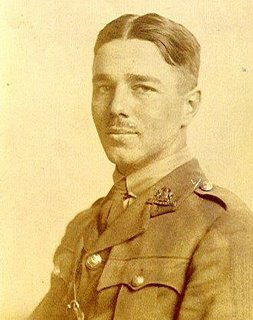
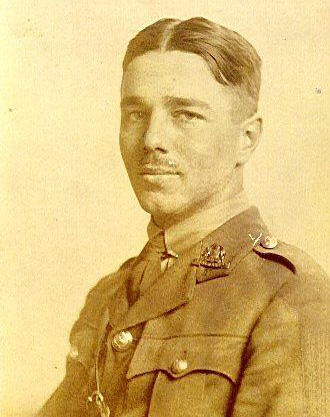
Wilfred OwenThe pivotal Dies Irae introduces the soprano (Liber scriptus), who acts as a kind of interlocutor for the choir, while tenor, baritone, and chamber ensemble challenge war itself. Spiritual regard for the dead, juxtaposed with lashing denunciation of the impersonal forces that bring death. All forces joined, the composer moves between each group with consummate skill, bringing nobility, power, and intense personal feeling into stark contrast. The main chorus, which carries the work, delivered Britten’s sometimes tortured lines with remarkable intensity and precision.

Lewis and company were blessed with an outstanding trio of soloists. In addition to Mr. Leggate, soprano Marina Shaguch (Russia) and baritone William Sharp (America) all did the composer proud and honored, in a slightly different way, Britten’s conceit that the original soloists represent the combatants, not just the victors, in the Second War. The singers, benefiting from discrete miking, delivered their parts with precision, passion, and intensity.

Other Reviews:

Joe Banno, Cathedral Choral Society (Washington Post, May 23)
Music such as this must be heard, not described – and once heard should resonate in the mind and conscience of anyone who cares about 20th-century culture. While the excellent program notes for this performance cite Verdi as an inspiration (big Mass, big chorus, brass eruptions), I hear some Venetian antecedents — the static, almost ritualistic music of Gabrieli in St. Mark’s, for example. Yet this music stands alone. In the concluding Libera me, chorus and orchestra plunge into dark, turbulent despair, wrenchingly conveyed by Lewis et al. A subdued light slowly emerges as the tenor introduces Owen’s Strange Meeting, the dead from warring sides rising to realize their common humanity:
I am the enemy you killed, my friend
I knew you in this dark; for so you frowned
Yesterday through me as you jabbed and killed.
I parried; but my hands were loath and cold.
Let us sleep now…
Reluctant as I am to draw invidious comparisons, Mr. Sharp’s superb presentation of this pivotal dramatic moment capped the performance for me; as indeed it ushered in the symbolic reconciliation in the music, as full chorus, boys’ chorus, soprano, and tenor-baritone-chamber ensemble truly join for the first time in the work. Not in unison, but in a transcendent unity of different parts, as the “Let us sleep” music gently weaves around the chorus’s “Requiescant in pace.” The rising note on the final syllable of “Amen” ends the work in resignation, hope, and the true spiritual uplift only a truly great work of art can bring. Conflict, aggression, violence, endemic in human experience both public and personal, are subsumed and overwhelmed by the common humanity which binds us all.

At the end, a few tears also among the members of the fine orchestra. Lewis was more than ably assisted by Scott Dettra, leading the chamber ensemble, and Michael McCarthy, directing the boys’ chorus (off-stage, in this case behind the nave and out of sight), whose Bach-like chorales help anchor the work in the ancient traditions of Western religious music. A profound, moving and exalting experience.

The Britten was preceded by a very welcome, warm, slightly subdued performance of Arvo Pärt’s Cantus in Memory of Benjamin Britten. The Cathedral Choral Society, while its own season is over, will appear with Leonard Slatkin and the NSO in Mahler’s 8th Symphony, June 8, 9, and 10; and will present a non-subscription performance of Dave Brubeck’s Gates of Justice July 1 at the Cathedral (with the Dave Brubeck Quartet).
Things I Like in NYC, Part 1

IMG_0373.JPGI am lucky enough to have a few days in New York City this week to look at art and also design. One of my favorite trade shows is the International Contemporary Furniture Fair, at the Javits Center. I've posted about this before (in 2004). It has some of the best new furniture and interior designs from several countries: Italy, Scandanavia, Germany, Great Britain, and the U.S. Here are some of my favorites from this year: the most comfortable chair, the HairyBertoia; the coolest party lounger, the king-sized Isle Lounge. This hay bale mattress could be itchy, but with this high chair your baby would be a trend setter.

IMG_0364.JPGThe Danish Design Center had a very nice concept store, called the FLOWmarket,to inspire consumers to be more aware and shop holistically. The products were actually for sale (here and here and here are examples); very funny but thoughtful. There was row upon row of textured fabrics, wallpapers, dinnerware; the next generation of recliners, very cool bathtubs, and hundreds of lighting fixtures.

IMG_0369.JPG

For my musically inclined colleagues at ionarts, the Poul Henningsen grand piano, designed in 1931.

22.5.06

Red Priest Vespers

On Saturday night, two local early music groups -- the Bach Sinfonia and Chantry -- joined forces in an all-Vivaldi program, at Bradley Hills Presbyterian Church in Bethesda. The organizing principle was an interesting one musicologically, to attempt to reconstruct a solemn Sunday Vespers service as it might have been heard in the chapel of the Pio Ospedale della Pietà, the Venetian home for abandoned children where Vivaldi was employed for much of his life. The unwanted babies left at the Pietà were illegitimate or abandoned for other reasons, sometimes brought there by their mothers or rescued by good-hearted Venetians. Boys were allowed to stay only until adolescence, but girls raised in the Pietà, if they chose not to join convents or marry, had the option of living there for the rest of their lives. Many of those who had musical talent did just that, preferring to have a musical career playing in the orchestra or singing in the chorus. In fact, since they were officially without family, the residents were known by a first name often accompanied by the instrument they played or their voice part. The place functioned almost like a convent, led by a "prioress" elected by the residents, but its rule was musical rather than monastic.

Other Reviews:

Joan Reinthaler, Bach Sinfonia and Chantry (Washington Post, May 22)
Nearly everyone who visited Venice as a tourist in the 18th century heard one of the performances of the ladies of the Pietà. Jean-Jacques Rousseau spent an eventful 18 months in Venice, of which he gives a bizarre and -- how shall I say it -- well-detailed account (including his visits with Venetian prostitutes) in Book VII of his autobiography, The Confessions. He describes not only hearing the Sunday Vespers services but actually meeting the performers, who were normally hidden from the audience's view by a grill:
M. le Blond presented to me, one after the other, these celebrated female singers, of whom the names and voices were all with which I was acquainted. Come, Sophia,- she was horrid. Come, Cattina,- she had but one eye. Come, Bettina,- the small-pox had entirely disfigured her. Scarcely one of them was without some striking defect. Le Blond laughed at my surprise; however, two or three of them appeared tolerable; these never sung but in the choruses; I was almost in despair. During the collation we endeavored to excite them, and they soon became enlivened; ugliness does not exclude the graces, and I found they possessed them. I said to myself, they cannot sing in this manner without intelligence and sensibility, they must have both; in fine, my manner of seeing them changed to such a degree that I left the house almost in love with each of these ugly faces. I had scarcely courage enough to return to vespers. But after having seen the girls, the danger was lessened. I still found their singing delightful; and their voices so much embellished their persons that, in spite of my eyes, I obstinately continued to think them beautiful.
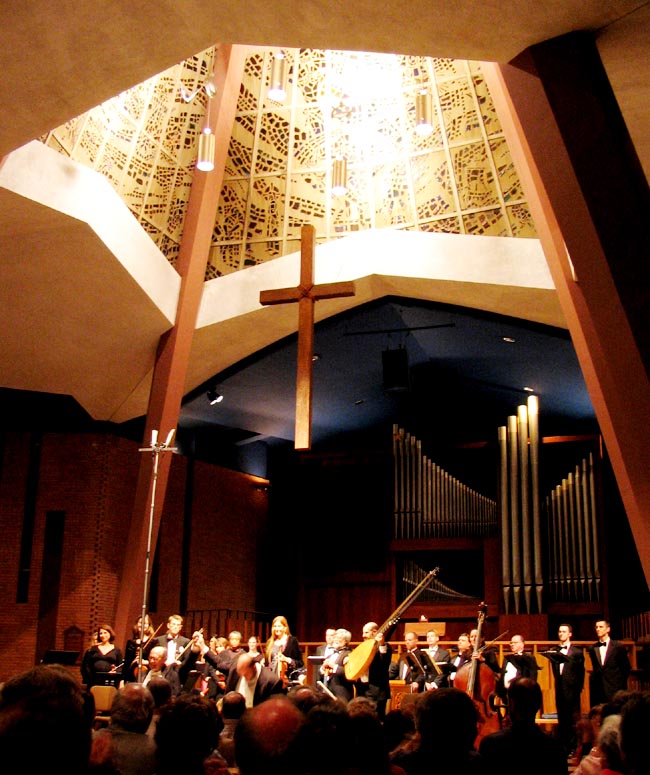
Red Priest Vespers, Bach Sinfonia and Chantry, Bradley Hills Presbyterian Church, May 20, 2006There were no one-eyed or pockmarked musicians on Saturday night, but there was lots of Vivaldi's music to be heard and a nearly full set of pews to hear it. Based on recent research by British Vivaldi scholar Michael Talbot, the two groups assembled the components of a Vespers service -- some in plainchant and some in Vivaldi's choral settings -- with a few extras added. The performance was sound, generally quite fine, although at other times deficient in terms of intonation (especially among the instruments) and strength of production. The last all-Vivaldi program I heard was an extraordinary performance by the REBEL Ensemble at Library of Congress, which I reviewed last February. In that context, this local rendition suffered by comparison, but it was still enjoyable.

Chantry sang plainchant whenever there were parts of the Gregorian Vespers not set by Vivaldi (which were, in some form, what he himself used in such a case). The opening versicle was sung by the treble voices as the singers entered the sanctuary. Strictly speaking, this was unnecessary, since the performance omitted many other parts of the Vespers service, but the effect was solemn. The other plainchant pieces were psalms -- with the ferial antiphons, although none of the Vivaldi psalm settings or the Magnificat had accompanying antiphons. The intonation and purity of sound in the plainchant singing was admirable, although it felt somewhat lethargic. (For the record, it is traditional to omit the intonatio part of the formula for psalms, beginning directly on the reciting tone with the second and all subsequent verses. Canticle tones, like those for the Magnificat, normally have the intonatio for each verse.) Most mysterious were the extraordinarily long pauses after the mediant cadence of each verse in both chanted psalms. Perhaps no one singer wanted to start things off after the break in the middle, but the effect was to destroy the sense of the writing of the psalms, two phrases that say essentially the same thing in two different ways.

The Vivaldi vocal works included one truly great piece, one of his four settings of the Magnificat (RV 610), charming music that I know from having performed it. This piece elicited the strongest performance from the musicians, including solo vocal contributions from members of Chantry and fine work from guest soprano Jennifer Ellis. The other choral psalm and canticle on the second half -- In exitu Israel (RV 604) and Laudate Dominum omnes gentes (RV 606) -- are homophonic settings that are not musically all that interesting. If something had to be cut from this two-hour program, they would have been my suggestion. By contrast, the first psalm of Vespers, Dixit Dominus, received a charming setting in Vivaldi's RV 595 (not the double-choir version). This provided some good opportunities for Jennifer Ellis's rich, broad soprano voice, with good agility and breath support in this difficult music.

Available at Amazon:
available at Amazon
A. Vivaldi, Gloria, motets, cantatas, Emma Kirkby, Academdy of Ancient Music, Christopher Hogwood
At the end of the first half, however, Ellis was slightly overmatched by Vivaldi's incredibly difficult solo motet, Nulla in mundo pax sincera, RV 630. Make no mistake, Jennifer Ellis can sing, but I think that the tempo of the fast sections, particularly the concluding Alleluia, was just too brisk, and the clarity of all those runs suffered. It is probably depressing for any singer to compare herself to Emma Kirkby, but her recording of this pair of opera arias with an intervening recitative shows that a slower tempo can be just as exciting and much clearer. Meanwhile, did Vivaldi really write this "motet" for a sacred setting like Vespers? It's probably impossible to know for sure, but the anonymous text (for example, "But with a furtive touch of the lips, a man maddened by love will often kiss as if licking honey") rang rather strangely next to the psalms. It was perhaps a warning to his favorite Pietà ladies, not to leave his ensemble for married life.

The two instrumental pieces on the program, the sonata and sinfonia "al Sancto Sepolcro," are not quite what Bach Sinfonia music director Daniel Abraham described them as ("for a holy place or space"). The title means "at the Holy Sepulchre," probably placing these pieces in Holy Week. One theory is that they were composed during Vivaldi's stay in Vienna in the 1730s (he may have gone as far as Prague), where there was a ceremony involving a replica of the Holy Sepulchre. Bach Sinfonia had their most solid playing in the sinfonia (a piece the REBEL Ensemble played last year), especially the slow and mysterious opening fraught with daring chromatic shifts.

The Bach Sinfonia has announced its lineup for next season: a period instrument performance of Purcell's Dido and Aeneas in November, a Baroque chamber music program with Barbara Hollinshead in February, a complete Handel's Water Music in March, and a Baroque Bouquet of Bach, Handel, and Pachelbel in May. Chantry has one more performance this summer, on June 10 (music by Palestrina and Monteverdi), as part of the Washington Early Music Festival.

Wonny Song at the Terrace Theater

Wonny Song, YCA
Wonny Song
A gorgeous Saturday afternoon assured that only the hardiest piano lovers among the subscribers of WPAS's Hayes Piano Series (still a substantial crowd) showed up for its season's final recital with Wonny Song. The Korean-Canadian pianist played a program of Beethoven, Ravel, Stephen Paulus, and Musorgsky, beginning with the German-Austrian's Sonata in A Major, op. 2, no. 2, which was a rocky start to a variable program with a successful finish.

The sonata's first movement especially was rife with mistakes that came about in the flurry of the playing; Song was seemingly more interested in impressing an audience with tempestuous virtuoso flair than to enter a dialogue with the piece in front of him. There are works where that is the right approach, but this none too challenging thing is not the right sonata for that. Even where successive movements were more carefully executed, they were still a wash of sound, the Largo with the wonderful bass notes stalking through the music rhythmically uninteresting at first, then better when he sped everything up ever so slightly. If beautiful drudgery were not so evasively contradictory… Sprinkling away in the Scherzo, unselfconscious musicality was the element missed the most. On the upside, Song didn’t skip the repeats of this already long (if not always substantial) sonata and always offered a slightly altered mood in them.

While the obnoxiously loud air-conditioning’s hiss altered the Beethoven joy, it was for a patron, rummaging through a plastic bag for what must have been a minute, to interrupt Ravel’s Alborada del Gracioso which I heard superbly done by Jean-Efflam Bavouzet last January (coincidentally right after sub-par Beethoven, too). Song took to the work's buoyant moods and changes in meter, its brazen character, much more than he did to Beethoven.

It is new music that interests us at Ionarts and with Stephen Paulus’s Preludes, Book 1 we got just that. The title of co-founder of the Minnesota Composer Forum (now the American Composer Forum) with Libby Larsen and an academic career spent from first to last day at the University of Minnesota spell out a pedigree that suggests to me that the music to come might have been gratuitously inoffensive (“Minnesota Nice” – which is why I left that all-too-nice state). Fortunately that was not the case. There was a fair amount of spunk in these experimental -- still solidly tonal, mind you -- works. Where they teased the ears, they did with a certain amount of risk, not in that Garrison Keillor way of being “outrageous” with built-in bourgeois approval.

Other Reviews:

Tim Page, Wonny Song, A Pianist With Real Musicality (Washington Post, May 22)
And while still closer to Peter Schickele than Lee Hoiby, they poked around and raised interest – with the notable exception of prelude no. 2, Mysterious, which was a mash of ponderous, unimaginative, pseudo-sensual ruminating, replete with cheap tricks to insinuate profundity. A very modest effort and exposed for it inferiority by the surrounding works: the heavy, turbulent Sprightly and the concluding, unlikely thundering Serene (finishing with the thump of a held low string).

The second half of the concert was filled out by Musorgsky’s Pictures at an Exhibition (recently heard with Fazil Say). Fast, athletic, superficially virtuosic; more dynamic contrasts than different color and shading was its beginning. Then, starting with a wonderful entry into the Promenade theme before Il vecchio, Mr. Song showed a more variable tone: warmth and soft hues were present when called upon; the chicks dancing a ballet in the shells of their own eggs, for example, were adorable ‘peckery’. Only the Steinway did not quite play along at all points in this display of true skill: for the very lowest notes it seemed to give out.

Fascinated as they were with the Pictures, the crowd demanded two encores from Wonny Song before they let him go. [For a more positive take on this recital, particularly the Beethoven, read Tim Page's review in the Washington Post.]