CD Reviews | CTD (Briefly Noted) | JFL (Dip Your Ears) | DVD Reviews

23.2.06

Exhibition Development @ MICA

Last evening I attended a presentation at the Reginald F. Lewis Museum by Maryland Institute College of Art students, who are part of George Ciscle’s Exhibition Development Seminar. The proposed exhibit, At Freedom’s Door: Challenging Slavery in Maryland, "will examine Maryland’s integral relationship to the history of slavery in the United States.”

The presenting students were divided into five teams: Writing, Historical Curatorial, Contemporary Curatorial, Art Education, and Public Programs. Using a PowerPoint program, the teams discussed the exhibit content and items to be displayed, gallery flow patterns, and Web site design for the exhibit.

This is a very thorough and consuming project, starting in the Summer of 2005 with discussions, museum and gallery tours, field trips, and workshops with assigned mentors and professionals. The exhibit will be presented jointly by the Maryland Historical Society and the Lewis, opening in February of 2007 and running through January 2008. Throughout, the students will report on their progress of designing exhibits, securing commissioned and borrowed works, and hosting several workshops on installation, art handling, and lighting.

The students were impressive, very committed to the project. It’s amazing to see just how much work and coordination can go into an exhibit. I’ll post a follow-up as the project continues.

The Kirov's Parsifal May Have No Pulse, but Wagner Survives


Parsifal is an opera great, grand, glorious, weird, absurd in equal measures. Add daunting, challenging, difficult, transporting, and long. There are those whom nothing can stop from attending a performance thereof, or those whom nothing can convince to endure five hours of Wagner’s final musical statement – and few between those two extremes. Should it have been surprising – or natural – that the Kennedy Center’s Opera House was very well filled on a Tuesday evening at 6PM? Or should it have been astonishing – or expected – that it wasn’t sold out?

With the Kirov and Gergiev in town, Ionarts thought it was a unique opportunity to hear and see Wagner as good as it will get in town. While I still think a Parsifal (even this one) is a unique opportunity that ought not be missed, I am not sure I witnessed anything the WNO can’t improve upon on a good day.


Other Reviews:

Charles T. Downey, Saving the Savior (DCist, February 22)

Joe Banno, The Kirov's 'Parsifal': Russo-Profundo (Washington Post, February 23)

Tim Smith, Kirov presents smooth 'Parsifal' (Baltimore Sun, February 23)

T. L. Ponick, Wagner fully expressed by Kirov (Washington Times, February 23)
Parsifal is one of the most interesting operas to direct because it offers inexhaustible material for interpretation, excavation of meaning, superimposition of ideas that are usually buried deep within the text. It’s so complex – philosophically, psychologically, religiously, musicologically – that directors are more likely err by including too much in their setting. Bayreuth’s current Parsifal is a case in point; although Mr. Schlingensief will surely boil his overwrought production down to the essentials over the next few years. Does it go to the credit of director Tony Palmer that this Parsifal did not fall prey to too much meaning but instead suffered from the utter absence of stimulus courtesy of the staging? Or are the travelling-kit restrictions to blame? If so, the limitations and monotony of the set became painfully obvious over five hours. Turandot’s – cheap Chinese Restaurant or not – was better (for a less demanding opera), the brilliance of Boris Godunov wasn’t nearly matched. There is nothing wrong with bringing out the multiplicity of elements that are part of this opera, accentuating details, nuances, allusions that today’s audience will otherwise understand as little as the original audience did. Indeed, it might be expected. Why wasn't it done?

If left with but a frame for the opera, it would help if at least the music were well performed, the singing excellent. Sadly, that wasn’t so. Valery Gergiev didn’t infuse his orchestra with the enthusiasm necessary for a band to brave five hours of music; although, in their defense, they didn’t dilapidate over the course of the opera; if anything, they improved slightly. Whereas brass was the weak-spot in Turandot, the woodwinds were the culprits in Parsifal and offered the weakest performance and the greatest blunders. The synthesizer-produced bell sound was a distorted, god-awful nightmare. Would it have been so difficult to rent a decent bell from the local orchestras? Oversized pasta pots would have made a better noise than whatever came out of the speakers of the Opera House. Gergiev’s interpretation was one of heft: slow but not crawling, he enjoyed the brassy solid moments (as did his orchestra) more than anything ethereal, this Parsifal stepped confidently along with neither idiosyncratic tick nor particular character. Unlike the sugary-sounding Wagner I have heard from Gergiev on the radio, he did not bother to sweeten the deal any more than necessary on Tuesday. In the Vorspiel, the overture, there was little by way of mystery - but insecurity, instead.

Parsifal, Kirov Opera at the Kennedy Center, February 21, 2006The singing – well… it improved from act to act and ended at “good” with stops at “modest” and “decent.” All had weak moments, none were great, some better than others. Among the latter was Oleg Balashov’s Parsifal. Much improved from the young man who sang into the ground, chin firmly on his chest, during Mazeppa two years ago, he was consistent and good as that curious figure in opera that goes from Tarzan to Jesus in just under five hours. But Parsifal is not about Parsifal, as far as the singing is concerned. The opera is – granted great voices – about either Kundry, or Gurnemanz, or both. Gurnemanz was Gennady Bezzubenkov. He, too, turned in a solid performance with notable peaks and some lows and wobbles. I’ve heard older men sing the role with greater authority and clarity (Kurt Moll, to be precise), but in this cast he managed to stand out.

A fairly small role is that of second-Act-only Klingsor. With a amusingly evil, charmingly dark costume (Nadhezhda Pavlova), make-up, and hair, Nikolai Putilin (Mazeppa in that production here in D.C.) was already fetching. An excellent voice put to good use made me wish that he might actually win the Grail and go on singing in the third act. Better, at any rate, than ailing Amfortas Evgeny Nikitin who, even when he found a pitch he could live with, managed only a very few moments of glory.

Kundry, finally, the real star of the opera, was a failure vocally and visually. The direction made her a meek Hausfrau and odd hag, and Larissa Gogolevskaya looked and acted off-character (a supposed fierce and wild she-beast that has enough sexyness lingering beneath the surface to seduce every knight of the order twice over). Temporarily slipping into a gown and donning some make-up for the second act didn’t turn her into a bomb-shell, either (although the right size, literally), and the suspension of disbelief worked overtime imagining that Parsifal might fall for this, after just having rejected a selection of two dozen delightful flower-maidens. At least her second act was sung much better than the first, in which one had to wonder what she was doing on stage, at all.

Parsifal, Act I, Kirov OperaPronunciation was variable, too, not only from singer to singer but moreso even from moment to moment. The Maryland Boy Choir as behind-the-scenes angels didn’t sound so much otherworldly but irresolute, the solo alto voice and the three soprano voices at the end of Act One were off. The Kirov’s male chorus was one of the strong points of the performance. Assorted squires and knights did their job, some of the flower-maidens sang exquisitely in that second act scene that is so unlike most other Wagner; a scene where he sounds nearly French – perhaps a touch of Delibes.

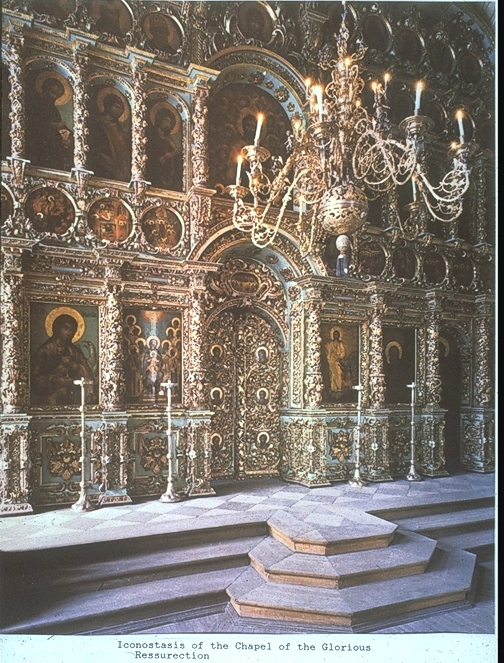
The opera itself had the feel (and often look) of Russian iconostasis. The heavy frame, saturated with warm brass and gold colors, the static action, the flat plane, naively painted or heavily jewel-encrusted backdrops: no individual item may have been particularly Russianesque; the over-all impression, though, very much. Grail Knights were heavily decked out in Baroque armor with gold ornaments, as if they had stepped out of a Rembrandt (possibly Rubens) with a lot of aged varnish. The Lion, the Witch, and the Wardrobe came to mind upon seeing Amfortas’s Shepherd-Snow-King frock, Gurnemanz became Gandalf for the third act. Kundry stepped into Act Two as a Castlevania dominatrix, and in Act Three she's a very unsubtle Mary Magdalene. The flower-maidens looked like an after-hours at the Papagena convention. The concluding dove was AWOL. Still, the incense-laden atmosphere, the slow procession, and the literal takes of the Christian rituals gave the production a feel that had merits on its own right.

Unfortunately, a discussion of Parsifal and its plot would be beyond the scope of this review; suffice it to say (for now) that there is much juice in this anti-Nietzschean, mother-kissing, self-castrating, Schopenhauer-distorting, Jesus-referencing, nymphomaniac-chastizing, ‘pity-by-fire’-touting, Buddhism-influenced opera – and enough of that remained intriguing on Tuesday night, even if untouched beneath the surface. That, and of course the glorious, transforming, slow music of Wagner’s that had Nietzsche admit through his teeth that Wagner may never have done anything better. As such – having the opportunity to see a live Parsifal in Washington – was a great experience. As far as Parsifal's go, it was a rather modest affair. Time permitting, I’d probably go again on Sunday, February 27th at 3PM.


Recommended Recordings:

Best Parsifal recordings
Recordings of Parsifal can be divided into two categories: Knappertsbusch and not-Knappertsbusch. The former are glorious and very slow and marred by less than ideal sound. The latter include some excellent contenders in various styles and generally excellent sound. Some recommended versions are: Knappertsbusch from 1951 (live - mono), 1952 (live - mono), 1962 (live - stereo), Boulez (1970 - live - stereo), Kubelik (1980 - studio - stereo), Karajan (1982 - studio - stereo), and Barenboim (1991 - studio - stereo).


22.2.06

i on who?

Armory Show passCan't get no respect!

Thank you for your interest in the fair. We reviewed your request for a press pass and regrettably, will not be able to issue one.

Your blog does not demonstrate any recent writing. We have a limited number of press passes available and need to reserve them for active, working media.

We hope you can visit the fair during public hours.

Warm Regards,

Pamela Doan
Communications Director
The Armory Show, Inc.
As Todd at From The Floor also posted this morning, the rejections are going out. If you got into the Armory Show with a press pass last year and you're a lowly blogger, you're probably out of luck. I suspect the passes are reserved for early buyers, as last year there were as many pre-buyers as press. Few bloggers were responsible for all those sold stickers on press day. Maybe Artblog, those gurls have serious bling and resources.

To rise from the sewers, the Whitney press office is very happy to know I'll be at the press briefing for the Biennial. Thank you Whitney Museum! Can I also be in the show? OK, the coffee and pastry will be fine.

UPDATE 1

UPDATE 2

UPDATE 3
The nice folks at the Armory Show kindly reconsidered their initial decision. Thanks to everyone who wrote nice things about us, especially Tyler Green at Modern Art Notes, who reacted to the Armory Show's decision with the following: "And then to cluelessly disregard one of the most-widely read all-arts blogs around? Mistake." We read Tyler's blog every day, and you should, too.

Mark, we expect a full report! [--Ed.]

Schoenberg in Boston

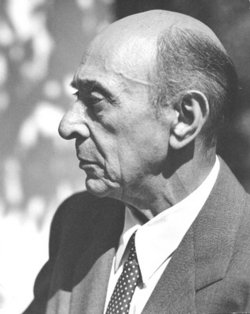
Arnold SchoenbergThis weekend saw the most hotly contested program of the Boston Symphony Orchestra’s 125th anniversary season thus far. However, the ruckus was not due to a lack of available tickets. As part of James Levine’s ongoing project - juxtaposing the works of Beethoven and Schoenberg - the BSO offered a concert bill spotlighting three major orchestral works of the 20th-century icon. This concert was set to match a previous all-Beethoven program (a snow date of which can be caught on February 26) in which the Triple Concerto was presented with the 2nd and 7th Symphonies. Unlike the all-Beethoven, as one could expect, the all-Schoenberg performance elicited ill feelings from subscribers. The Boston Globe reported that over 750 subscription tickets had been returned to the box office. The Globe, however, did not specify how many tickets were actually returned in disgust, how many were traded for other concerts, as is an option for subscribers, or the percentage of those returned tickets that had been picked up in single ticket sales – a growing trend for the BSO this season. Nevertheless, the Globe’s writers - the venerable Richard Dyer being one of them - did their best last week to try to educate the populace in the richness of Schoenberg’s music. As seems to always happen, these attempts eventually fell back to the “accessibility” argument but generally concluded that music must be heard and digested before a determination should be made.

The BSO, for its part, has tried to present its case for the pairing of Beethoven and Schoenberg in its “online conservatory,” which provides detailed analyses of the pieces chosen for each program, in addition to various essays about, specifically, Schoenberg, his life, and his work. Finally, printed in this concert’s program is an extensive interview with Levine, detailing his motivation behind the specific coupling of these two composers. The main point, Levine thinks, is the extraordinary development of their respective compositional languages (in a relatively short time) and the reverberating effects of their innovations. In the end, the hype didn’t seem to work. By all accounts, the performances (including the one reviewed here) were not well attended.

Other Reviews:

Richard Dyer, Schoenberg program is a winner (Boston Globe, February 18)

T. J. Medrek, Levine, BSO measure composer on scale with greats (Boston Herald, February 18)
The present concert’s slate was, in this order, Five Pieces for Orchestra, op. 16; Variations for Orchestra, op. 31; and Pelleas und Melisande, op. 5. The programming attempted to show three distinct phases of Schoenberg’s development – the thick, late Romanticism of Pelleas, countered by the streamlined Five Pieces, which led toward the dodecaphonic Variations. I attended the fourth and final performance of this strenuous program, and the fatigue across the ensemble was evident on the faces of the musicians, but that fatigue was well earned. The players seamlessly fit themselves into Schoenberg’s orchestrations. Pelleas called for huge blocks of interweaving sound, demanding much out of the gifted brass (with four extra horns), who heartily responded. Each overlapping leitmotif called for several soloists, and concertmaster Malcolm Lowe filled that need beautifully, as did Robert Sheen on English horn. Thankfully, with Schoenberg’s emergence out of the Romanticism, his orchestration also matured as he began to grasp the full palette of colors available in the orchestra. In the Five Pieces, subtle color changes demanded a sensitivity of playing in complete opposition to the over-charged emotionalism of the early work. Lastly, the Variations could only have been played as well as it was by an ensemble that globally grasped the development of the line and the manipulation of the row.

As Levine’s thematic programming charges through the rest of this season and into the next, the most comforting thought is that these rarely programmed pieces can be heard by an orchestra of such class and ability. Whether or not the audiences can handle such programming on a longterm basis remains to be seen.

The next installment of the project is Schoenberg’s Gurrelieder, February 23 – 25. All the details of the BSO’s upcoming east coast tour, which includes a stop at the Kennedy Center, can be found in a recent press release.

21.2.06

The Atomium, Brussels

Le Corbusier and Iannis Xenakis, Philips Pavilion, Exposition Universelle et Internationale de Bruxelles, 1958, photo by Hans de BoerGustave Eiffel built one of the most iconic structures in the world, the famous tower that bears his name, for the International Exhibition of Paris of 1889. Like many of the experimental buildings constructed for exhibitions and world's fairs, it was scheduled to be dismantled many times but never was. Now it would be impossible to destroy it, and the same is true of Buckminster Fuller's geodesic dome for the 1967 World's Fair in Montréal.

However, not all of these unusual structures have survived. One of the worst casualties is Le Corbusier's futuristic Philips Pavilion for the 1958 World's Fair in Brussels, designed in part by Le Corbusier's assistant Iannis Xenakis, who later became an experimental composer. A series of projected images and colored lights was accompanied by a soundtrack played on 400 loudspeakers, Edgard Varèse's Poème Electronique and Iannis Xenakis's Concrète PH in alternation. The soundtrack survives in recordings, but the pavilion was dismantled and has now disappeared. Anyone who can tell me exactly what happened to the Philips Pavilion after it was dismantled will get an Ionarts Cookie.

An article by Jean-Pierre Stroobants (L'Atomium de Bruxelles fait peau neuve, February 17) in Le Monde reports on another unusual structure built for that 1958 World's Fair in Brussels (my translation and links added):

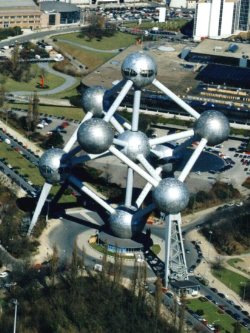
The Atomium, designed by André WaterkeynIn theory, it was supposed to be destroyed after the World's Fair of 1958, which made a statement of unshakeable faith in progress, democracy, and peace. Forty-eight years later, the Atomium -- 2,400 metric tons and 102 meters high -- still reigns over the Heysel plateau in Brussels. This one time, the infinite complexity of Belgium did not scuttle an ambitious project: the incredible construction of engineer André Waterkeyn, who died in October 2005, has been renovated in the record time of 22 months. The public will be able to visit the Atomium again beginning on February 18.

The structure, which represents an iron molecule enlarged 165 billion times, today has the proud allure of something miraculous. The aluminum shells of its nine corroded spheres, abused and sullied by time and pigeon droppings, were recovered with stainless steel panels that reproduce, down to the last detail, the building's original look. The German designer Ingo Maurer put in place new interior and exterior lighting that augments the perception of the building's strangeness and strength. The nine spheres, 240 square meters each, were reworked from top to bottom by Belgian architects, determined to allow only the original work's impression of audacity, the strength of the raw material and technique, shine through, perceived in 1958 as a means of promoting the well-being of humankind.
Check out the Atomium Web site to have a look at the inside and outside of the renovation. Hopefully, the Atomium will again be a symbol for Belgian unity. Many Europeans, including the author of the article in Le Monde, think that Belgium is doomed to divide along linguistic borders into French- and Flemish-speaking countries.

She Kills Men for Pleasure

Kirov's TurandotThe operatic traveling circus that presents itself as Kirov Opera – of the Mariinsky Theatre – has a stop in Washington again. Last year we got an excellent Boris Godunov and bits and pieces, the year before Mazeppa and Eugene Onegin. This year it’s non-Russian fare (at least on paper) with Puccini’s Turandot and Wagner’s Parsifal and the Verdi Requiem thrown in for good measure. That’s a barnstorming blockbuster, one of the greatest grandiose Operas ever written, and the popular “secular Opera” (von Bülow), the famous Verdi work.

Judging just from Turandot we can conclude: How lucky we are! The Kirov under Gergiev bring their most excellent orchestra (the WNO orchestra has much catching up to do, still), singers that are throughout very good (most of them still less well known in the West), and sets that show the WNO that interesting productions can be done on budget even when the whole thing has to fit into a few suitcases without the result looking like the curtain travesty from The Maid of Orleans.

Other Reviews:

Charles T. Downey, A Night in St. Petersburg (DCist, February 20)

Tim Page, China Opening (Washington Post, February 21)

Tim Smith, Kirov cuts loose with strong 'Turandot' (Baltimore Sun, February 21)

T. L. Ponick, Puccini's 'Turandot' dazzles (Washington Times, February 21)
Sunday night was the curtain for the first of the Kirov’s productions with Puccini’s last (and unfinished) work: Turandot. The story of the Chinese Princess Turandot who, like every effective opera character, has several severe psychological pathologies. Hers is the pleasure she takes in seeing her suitors ‘offed’, one after another, stemming from deficient coping with her mother’s fate of arranged marriage, perceived as (or indeed having been) rape. Of course, merely being touched by any mortal would defile a good Chinese empress, creature of light, daughter of the Gods. Enter Prince Calaf (narcissistic personality disorder) who wants to ‘conquer’ Turandot. Singing peasant girl Liù (codependency, pathological selflessness, and masochism) ushers in some drama with her thwarted love and fatal (literally) self-sacrifice, and the three administrators Pang, Ping, and Pong offer comic relief and a little sub-plot excursion. An Emperor watches aloof in the style of old wise kings, Timur, an old man, stumbles about, an anonymous Mandarin lobs off heads, and a Persian Prince provides one such.

Reviews from the London Performances:

Tim Ashley, Turandot - Royal Opera House (The Guardian Unlimited, August 6, 2005)

George Hall, Turandot (The Stage Online, August 8, 2005)
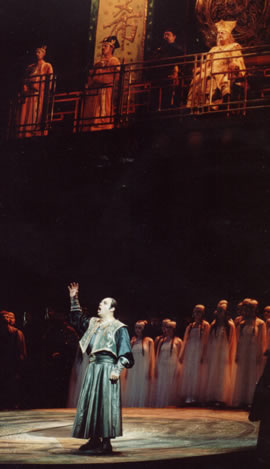
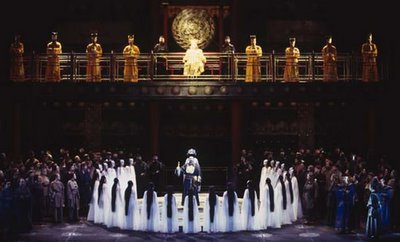
The stage setting (director Charles Roubaud, set designer Iseabelle Partiot-Pieri) is evocative, simple, and beautiful – with many deft touches of color and choreography. The costumes (Katia Duflot) traditional throughout, an inspired choice the wafty, cloudy white and pale girls that accompany the execution proceedings. Traditional, not conservative (just like the opera itself); a setting for an opera that can easily succeed on account of its own story’s strength. Unfurling banners that contain the three answers to Turandot’s three questions were a visual peak; a phosphorescent dragon at the finale more confusing than concluding.

Kirov's Turandot: Vladimir Galuzin as CalafGergiev’s orchestra performed as a top Russian orchestra would: Refreshingly raw, never comfortably sailing but with playing and technique mostly above criticism. Searing at times and packing all the punch one could need. Gergiev worked out the abrasive parts of the score; unearthing the true beauty of Puccini who succeeded in writing a traditional Italian opera in the 1920s that stands the test of time because he uses all the musical means and sophistication at his disposal to achieve his result. Wozzeck – a contemporary opera, after all – it ain’t, but the sound/year discrepancy was underplayed, not heightened. As Dominic McHugh (and plenty others, I am sure) once wrote: “Bitonality, pentatonic scales, and a full percussion section show the influence of the wider musical landscape on Puccini - one can frequently hear strains of Stravinsky, Berg, and even Poulenc dotted throughout. This is not, as some writers would suggest, merely a mindless piece of musical theatre, but a highly imaginative attempt to push Italian opera into the twentieth century.”

I don’t know who these writers are, who would suggest a “mindless piece of musical theatre” – this isn’t La Bohème, after all – and I’d point out that the pentatonic scales service the naïve chinoiserie, not musical modernism. But important is that, for all the somewhat hackneyed arias that have been established firmly out of context – with greasy overweight Italian tenors milking them for ultimate effect over waxing string sections, this is a compelling, a great opera with good music.
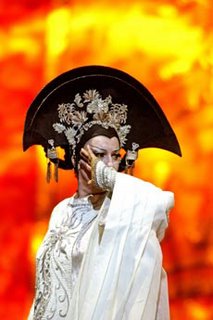
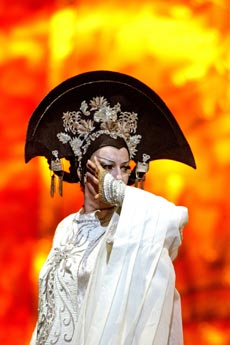
Kirov's Turandot: Irina Gordei as TurandotMusic that was supported by a stupendous Vladimir Galuzin as Calaf (rightfully recipient of the loudest cheers), an appreciable, bold Irina Gordei as Turandot, a fine, later timid Irma Gigolashvili as Liù (it is my understanding that she may not sing on the 25th), as well as Alexander Timchenko, Andrei Spekhov, and Andrei Ilyushinikov as thankfully straight-laced Pangchev, Pingchov, Pongsky. They didn’t ham it up, which served the opera and their characters well. Along with Emperor Viktor Vikhrov (appropriately fragile-voiced: either good characterization or casting) and Mandarin Edem Umerov, the Chorus and the rest of the cast were all beholden to a most curious Italian pronunciation: There were times, in the beginning, especially, where it was nearly impossible to tell whether the singing went on in Russian or Italian. A Russian flavor was also discernable in the costumes: Orthodoxish looking hats for Taoist priests; in every Chinese peasant girl three-quarters a Babuschka. It looked like two dozen of Dostoyevsky’s disenfranchised stranded on the set of The Bridge on the River Kwai. “Nessun Dorma” didn’t get the greatest breath control from Galuzin; the aria got applause, not the interpretation – but it was well coped with by the orchestra and Gergiev.

A Turandot with a Turandot that is more a Verdian heroine on a revenge mission than offering that unlikely, innocent, head-cocked cruelty of a rose-oiled and lavender-scented Turandot-child-princess. She's a woman I'd advise anyone against loving falling for a man I'd recommend running away from. She: all cruelty, cold steel and warm blood on her hands (Liù plunges herself into the knife held by Turandot, thereby underscoring the torture-princess' guilt), he: unbridled passion that has long entered the realm of unconscionable obsession. With that dark characterization, perhaps they actually deserve each other. Forgive her some lesser notes on top and the occasional garble, enjoy Galuzin, enjoy Puccini: Enjoy an evening that will remind every audience member again how opera was once a bona fide popular pasttime. Repeat performances on Thursday, February 23rd and Saturday, February 25th, at 7:30 PM.

UPDATE:
Alex Ross's article in The New Yorker this week is à propos: Puccini Remixed (February 27, 2006). Thanks also to Alex for linking to Ionarts at The Rest Is Noise.

20.2.06

Scarlatti, Il Primo Omicidio, in Lyon

Scarlatti, Cain overo Il Primo Omicidio, directed by Bruno Meyssat, Opéra national de Lyon, 2006, photograph by Franchella/StoflethIf every respectable opera house needs a Baroque performance ensemble in residence, as Hervé Niquet claimed, the Opéra national de Lyon is doing very well. Their latest production with Marc Minkowski's group, the Musiciens du Louvre—Grenoble, was a staged version of Alessandro Scarlatti's sacred divertissement Cain overo Il Primo Omicidio (February 6 to 11). I read a review by René Solis (Caïn et Abel, frères de chant, February 9) for Libération (my translation):

Il primo omicidio, an oratorio composed in 1707 by the prolific Alessandro Scarlatti (1659-1725), has as its plot the murder of Abel by Cain. The one that is the object of Bruno Meyssat's staging is the assassination of music by theater. This is no outrage: the second crime is just as fascinating as the first, and neither music nor theater comes out of the spectacle a loser. It was originally a collaboration between Mirella Giardelli and Bruno Meyssat. The former, a Baroque music specialist, was working with the Musiciens du Louvre, the group directed by Marc Minkowski; the latter, founder of the Théâtre du Shaman, for more than 20 years has been plowing the furrow a gestural and ritualized form of theater, haunted by the memoire of a vanished rural world.

On the Subsistances stage, there are seven players from the Musiciens du Louvre (including Mirella Giardelli at the harpsichord), four young singers from the new studio of the Opéra de Lyon, and four actors familiar with the world of Bruno Meyssat. The musicians and singers have agreed to conform to the working methods of the director, for whom each performance is a longterm adventure, preceded by several weeks, sometimes several months, of rehearsals, with a large part of it left for improvisation. Harmony among all is not the primary goal. The performance bristles with violent interactions: parasitic sounds (barking, buzzing, falling objects), interruptions of the Italian singing with added words spoken in French, pronounced disjunctions between music and gesture.
It all sounds fascinating and is a great reminder that even old music can provoke new experiments. You can see some pictures at the Lyon Opera's Image Gallery.

Change Your Life at $1.87 / Hour

'toter Schwan' - photo by Siegfried StillerHidden, buried, well out of sight (at least I had the hardest time finding it on their Web site, despite knowing what I was looking for) the Kennedy Center actually offers the kind of Student-Ticket program we'd want them to. It is called ATTEND!, and every ticket is $10 (ten!) dollars. The legalese is refreshingly short and painless:

To purchase, just bring your student ID to the Kennedy Center Box Office, ask for your "ATTEND DISCOUNT," mention promotion code 12488, and give the name of your college. Limit 2 tickets per student (for 2nd ticket, you must show other person's student ID). Sorry, these discounts are currently not available online.
For students out there, that program is a treasure trove - but there is a reason I mention it today. Included in this program is tomorrow's performance of Parsifal! [Edit: Subsequent review here] That is of course an insane bargain that really ought not to be missed. I used to say that Parsifal is the most unlikely opera to start one's Wagner experience with, and I maintain that it's probably not ideal. It was the first Wagner opera I saw live, and it was a daunting experience where I felt like a lobster thrown head first into boiling musical water. If that doesn't sound enticing, let me put it another way:

Seeing Parsifal is going to be a seminal experience for you, regardless of whether you liked it or not! Few things or events come your way that will serve as memories for a lifetime - your first Parsifal is one of these. Some of the best things in life tend not to come 'easy', are not always convenient (like making the perfect Vitello tonnato, or love, or climbing a mountain...), but they offer unique rewards. Sitting through five hours of any music is daunting... Wagner's even more so. Glorious as the music is - instantly glorious to some - it may not be comprehensible upon first hearing. No matter: all it takes is a little willingness and an open mind; the understanding that ecstasy is a much slower, tougher joy than the fleeting tickles of lust and fancy. Swamp the opera house with yourself and your student friends. Leave changed forever.