CD Reviews | CTD (Briefly Noted) | JFL (Dip Your Ears) | DVD Reviews

25.10.05

Takács with Hurdles


Getting to the National Gallery of Art in the nick of time is not advisable. Especially not if you don't like the idea of getting roughed up by security guard L. Jones. After being barked at, accused of lying, having my ID inspected twice, my guest refused entry, and being held up long enough to assuredly miss the beginning of the Haydn "Emperor" Quartet, op. 76, no. 3, I got to listen to the remainder from behind the curtains outside the West Garden Court. On the other side played the Takács quartet.


Also on ionarts:

Takács Marathon, Part II (October 17, 2005)

Takács Addiction (October 4, 2005)

Where's My Takács? (March 10, 2005)

Amazing Audial Alliteration: Borodin, Bartók, Beethoven (October 17, 2004)

Dip Your Ears, No. 8: Béla Bartók, The Six String Quartets, Takács Quartet (August 5, 2004)
There was serene beauty in the dampened sound of my national anthem - not only the playing (to the extent that one could tell) but also in the way the music trickled through from the other room. And although I hardly recommend the experience as such, it added an intriguingly melancholic character to that second movement (Poco adagio, cantabile) that went some way in calming my senses.

Borodin's second quartet in D major I last heard a year ago when the Takács gave a moving rendition at the Corcoran the day after the Corcoran's Chairman of the Board, Otto J. Ruesch, had passed away. I haven't sat in the back of the NGA's venue in a while. It is a healthy corrective and reminder that the sound is not as bad as we often complain: it's much worse. The tubby accoustic turned the (avowedly excellent, as trustworthy sources with better seats assured me) Borodin into a mush that belied the quality of the source. I wonder if the William Nelson Cromwell and F. Lammont Berlin Concerts - despite a glorious and prestigious 64-year tradition at their present location - might ever be moved into the larger and more appropriate space of the NGA's East Building Auditorium.


available at Amazon
L.v.Beethoven, Late String Quartets + op. 95,
Takács Quartet
Decca

Beethoven's op. 127 was the second half's offering, and you can't ask for much more than that. Having meandered a couple yards up, I had now a tree in front of my nose, but the sound was much better. So much better, indeed, that it allowed for judgement of the quartet's performance. At least since the Alban Berg Quartet, almost every quartet plays Beethoven with technical precision unheard of just half a century ago. The cold perfection of that approach is the Emerson Quartet who also added a smidgen aggression to the mix. Fairly agressive playing has since become the norm, too... not always to Beethoven's benefit. In the Takács you can hear all these trends, but thankfully they are either put in the service of the music (their usually perfect intonation and execution) or capped at a reasonable level. They stay on that side of energetic playing that is still called "vivacious" and "vibrant," not agressive. That they also have a soft side came out in the Adagio ma non troppo e molto cantabile, the first movement's first part. Violist Geraldine Walther, judging from the Beethoven, is starting to really fit in "with the boys" - it will be interesting to hear their gain in cohesion when they return to Washington for a concert at the Corcoran Gallery on March 31st.

Presto towards the finale. The Takács may be very good in the slow movements of op. 127, but they are superb when it gets a bit faster. (That's just one reason why it is nice to have a 'warmer' set of quartets next to the Takács - preferably the Vegh's second.) The finale itself sounded slightly rushed but lived up to the high expectations, still. The crowd met the performance with unanimous standing ovations.

Rosa Parks (1913–2005)

Rosa Parks
"Back then, we didn’t have any civil rights, it was just a matter of survival. I remember going to sleep as a girl, hearing the Ku Klux Klan ride at night… afraid the house would burn down."
"It pains me that there is still a lot of Klan activity and racism. I think when you say you're happy, you have everything that you need and everything that you want, and nothing more to wish for. I haven't reached that stage yet."
UPDATE:
Lest we forget, the Ku Klux Klan is still active to this very day.

The Châtelet Ring, Part 1

The Ring Cycle, Théâtre du Châtelet, Fall 2005There are three new Ring cycles in Europe this fall, and the most interesting one is definitely at the Théâtre du Châtelet in Paris. It is the parting gift of outgoing general director Jean-Pierre Brossmann, who brought back director Robert Wilson and teamed him up with conductor Christoph Eschenbach and the Orchestre de Paris. I've been reading a lot in the wake of the media saturation in the French newspapers. Here are a few excerpts, beginning with Jean-Louis Validire's interview with Eschenbach (Eschenbach : «Je suis dans les griffes de Wagner», October 15) for Le Figaro (my translation):

What need drove you to attempt the tetralogy right now?

I have always lived with Wagner. When I was young, Wieland and Wolfgang, Richard's sons, gave me the opportunity to witness the performances at Bayreuth for three or four years in the orchestra pit. Each summer for four weeks, I was actually seated inside the score. I have been in Wagner's clutches ever since. I have thus not had to relearn The Ring, only rediscover it, which is very exciting and reminds me of those precious hours in the 1950s and 60s, when I first became aware of the magic of this musical language that is so personal.
Next, Eric Dahan interviewed Robert Wilson («Fidèle à l'idéal wagnérien et à "Star Wars"», October 22) for Libération (my translation):
Your Ring begins in a very prosaic way, almost like a space opera...

I was looking to get past German mythology. Baudelaire, when he saw Tannhäuser in Paris in 1856, wrote that he experieced time, space, and light in an unheard of way. As I see it, this confirms my approach to The Ring, as faithful to the Wagnerian ideal as it is to Star Wars. It's like peering through a porthole on a spaceship, forgetting all of the world's space, letting oneself be invaded by this music that stamps its own time and space on us. Staging tends to saturate space with movements, while I personally seek to eliminate them. I am often bothered by the illustrative and resounding character of a tradition that plays Brünehilde as an agitated hysteric, thus obscuring the power of her ice and fire singing. Yes, Wagner was like Cecil B. De Mille but also wanted his music to be treated nobly. That is a feeling that also strikes me when I hear The Ring.
I'm not sure what any of that means. In English, Mary Blume did a piece on Eschenbach and this production (Eschenbach's united effort behind 'Ring', October 13) for the International Herald Tribune:
He was born Christoph Ringmann in 1940 in Breslau, Germany (now Wroclaw, Poland), where his mother, a pianist, died in childbirth. His musicologist father, an anti-Nazi, was sent to the Russian front to die. As the war ended, Christoph fled west with his grandparents. His grandfather died en route and, quarantined in a makeshift camp, his grandmother was killed by typhus with the child lying by her side. A musician cousin and her violinist husband eventually tracked him down and adopted him. Christoph was unable to speak for more than a year. His horrible experiences, he says, brought him to music. "I had to express myself, find a let-out for those terrible impressions that were locked in me. And when I heard my second mother play and sing I also wanted to play and sing. It was saying yes to music - that was what I wanted to do in life because I was for the first time really happy."
Eschenbach and Wilson have known one another for 20 years. According to Blume, they have been discussing this production for five years and auditioning singers for it for three years. Lastly, there is this interview with Eschenbach by Yannick Millon ("Une certaine atmosphère de musique de chambre", October 15) for the Châtelet program (my translation):
Where do you position yourself with respect to Wagnerian tradition?

I have great respect for it, but I prefer to leave it behind me. My Wagner has little in common with that of a conductor who was the very incarnation of tradition, Knappertsbusch. I loved that tradition very much, long ago at Bayreuth, and I still love to dive into it today through recordings, but for a 21st-century conductor, it's a different world. The one who left a mark on me, because he was truly looking for something new, is Karajan. He discovered a transparency, a certain chamber music atmosphere in these scores, and as a result completely rethought the balance and textures. He was notably among the first not to let the singers constantly shout.
Not constant shouting can certainly be nice. I'll be back tomorrow with some reviews of the production. This being the Châtelet, I assume that their Ring cycle will be available on DVD in a year or two.

Netflix Is Calling

Here are a couple old newspaper articles that I am finally jettisoning from my Bloglines feeds: when and if these movies make it to Netflix, I'll have more to say. The first is a review (The Personalities in the Orchestra Pit, September 9) of Daniel Anker's new documentary Music from the Inside Out, by Laura Kern for the New York Times:

This meditative film sets out to reveal the individuals hidden behind the stern expressions and formal attire worn by the [Philadelphia Orchestra's] more than 100 musicians, who tend to blend together when sharing a stage. Through one-on-one interviews and larger discussions, which could double for group-therapy sessions, distinctive personalities emerge, one more articulate and charming than the next. The musicians relate intimate, insightful stories, some heartening, some bittersweet, and candidly discuss the origins of their passion for music and what continues to motivate them to pursue their dreams, provoking audiences to ponder the same issues.
Second, a new French film by Abdellatif Kechiche, Games of Love and Chance (in French, L'Esquive), reviewed by A. O. Scott (A Classic French Tale Echoes in the Gritty Paris of Today, August 31) for the New York Times:
Its English title, and much of its inspiration, comes from a play by Voltaire's contemporary the 18th-century French writer Pierre Carlet de Chamblain de Marivaux. Mr. Kechiche's interest in connecting France's classical literary heritage with its contemporary social reality is intriguing, and it has resulted, in this case, in a spirited and insightful comedy of manners. That is not the genre usually associated with the banlieue setting, typically the backdrop for grim exercises in realist melodrama. Mr. Kechiche's naturalistic, almost documentary style certainly does not relieve the ugliness of the housing projects, and a late confrontation between some of the characters and the local police temporarily jolts the picture from its youthful reverie. But for the most part "Games of Love and Chance," a hit in France and the winner of several César awards, is a graceful and sympathetic look at how the lives of teenagers intersect with a work of literature. Its script, which Mr. Kechiche wrote with Ghalya Lacroix, choreographs a dizzying series of collisions between the hip-hop influenced, Arabic-inflected staccato of working-class youth slang and the decorous melodies of Marivaux's prose.
It also sounds fascinating.

24.10.05

Philippe Entremont Presents Beethoven from Munich


On a gloomy and rainy Saturday evening, Philippe Entremont presented the Munich Symphony Orchestra at the GMU Center for the Arts, conducting and playing an all-Beethoven program. A full-bodied and very well-played Prometheus Overture with a disciplined and tight string section belied the fact that the MSO is a solid fifth (of five) among Munich’s professional symphony orchestras. (The MuPhil and the Bavarian Radio SO, the Bavarian State Orchestra – the opera orchestra, and the Munich Radio SO are the other four.) Following the overture was perhaps the most perfect piano concerto ever written, Beethoven’s 4th, in G major, op. 58. Maestro Entremont still had the band under control from the piano bench, but in his nimble-fingered performance he and Beethoven would not have suffered from a wee bit more attention to detail – especially in the Allegro moderato. The strings’ wooden and heavy introduction to the Andante con moto jarred with Entremont’s soft touches. The entries, too, could have been cleaner. At times, first violinist Mirian Kraew led the pack by as much as 16th notes. Mr. Entremont’s playing became less clear in the Rondo, but wherever heft was asked for, the Munich forces performed better and, with an old-fashioned touch, very enjoyably so.

Other Reviews:

Daniel Ginsberg, Munich Symphony Makes Its Case for More Respect (Washington Post, October 24)

In the 7th Symphony, Munich’s “Film Music Orchestra” (the MSO provides most soundtracks to films in Germany) found their way back to much of the quality they displayed in the overture. Basses, violas, and cellos were well coordinated and sonorous in the funereal Allegretto with its slow pulse. Then again, I was pretty much sitting in that section, which affected the balance of the experience. The concluding Allegro con brio suited the band: fast, loud, and in multitudes. If winds and brass were not the subtlest bunch, that did not keep the MSO from making a favorable impression. Those in the audience who were not looking for flaws but enjoyment instead had a very good time, judging from the enthusiastic applause and standing ovations after the rousing finale. The Munich players are not likely ever to have been so cheered in their hometown. They could not even play their encore on the first attempt. When they were able to do so, it continued the Beethoven theme with the Principal Guest Conductor and his players digging deep for a somber Egmont Overture, a very substantial treat with which the performers only further played themselves into their audience’s heart.

23.10.05

Midori at Strathmore

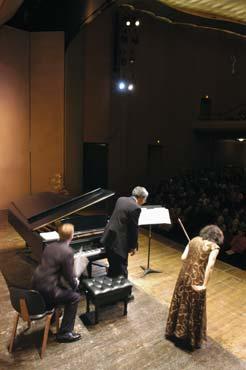
Midori and Charles Abramovic, not at StrathmoreWashington Performing Arts Society is responsible for a large percentage of the best concerts in Washington most seasons. They bring big names and have an audience generally faithful and experienced enough so that those big names can present repertoire that consists of something besides crowd-pleasing chestnuts. That was certainly the case with the recital by one-name violinist Midori and pianist Charles Abramovic at Strathmore last night.

The reason that I went to Strathmore, thereby sacrificing the Takács Quartet at the National Gallery of Art, was to hear Prokofiev's first violin sonata, op. 80 in F minor. It's a piece that she has not recorded, to my knowledge, and based on her excellent performance, I think she should. This piece had the best range of sounds and textures on the whole program, from the somber octaves in the piano's opening and the violin's cold melismas ("like the wind in the graveyard," the composer specified), presented in the first movement and then returning in the last as the sonata's dominant theme. It is one of Prokofiev's wartime works, begun in 1938 and completed after the war in 1946, when it was premiered by David Oistrakh in Moscow.

On Friday night, I had been moved to tears by the conclusion of the Jupiter Quartet's rendition of Britten's second quartet at the Corcoran (see Jens's review). That piece was from around the same time, and the Jupiter Quartet started playing it, they told me after the concert, because they were asked to contribute to a conference on the theme of music and pacifism. In that conclusion, the work's main theme -- a tragic and dissonant melody presented in unison, which seemed to me to represent the spirit of war -- was ultimately overwhelmed by a series of massive, heroic C major chords that ripped off cascades of bowhair. While Britten's response to the Second World War in that case was hopeful and resolved, Prokofiev's sonata gave me a sense of isolation, loneliness, and resigned depression, implying an admission of defeat in the face of a chilling lack of human warmth. It could become the theme song of someone living in Washington during the Bush administration.

Other Reviews:

Joan Reinthaler, A Delicate Balancing Act From Midori (Washington Post, October 25)
In spite of her reputation, I had not so far been bowled over by Midori's playing and have not purchased any of her recordings. She is obviously a talented performer, someone who has grown far past the amazement of her first major performance as an 11-year-old child prodigy. Hearing her live gave me an appreciation of her magnetism on stage. She is an explosive player, often convulsing in front of her music stand as if in a seizure. Her strongest asset is a gorgeous tone, pure, sweet, and even somewhat fragile. She showed off her strongest technical skills in the final work on the program, Beethoven's C minor violin sonata (op. 30, no. 2), where each movement seemed, if anything, perhaps a hair too fast. The only technical problem in her arsenal was the sometimes mistuned double stops in the first movement of the Prokofiev. The charming encore -- the Entr'Acte from Glazunov's ballet Raymonda, which has the violin almost always in double stops -- was much better in this regard.

If I had had to miss anything on the program, it would have been the Mozart selection, the A major sonata, K. 305. As luck would have it, that piece opened the concert. I missed most of it because I was trapped in horrible traffic on the Beltway, as the fans left the football game out in Landover. Schoenberg's odd Phantasy for Violin with Piano Accompaniment, op. 47, was from the same period as the Prokofiev, but it left me mostly cold. It also provoked an obnoxious early applauder (who started up the splitsecond the last note of the tone row sounded, to show that he knew the piece) and mostly lots of murmuring in the semi-full house. Midori's strong, wild, and rather personal reading of the Beethoven sonata was a musical thrill ride, supported ably by Mr. Abramovic, whose playing was always capable, deferential to the soloist, and sensitive, if not particularly memorable.

Upcoming concerts from WPAS that we advise you not to miss include mezzo-soprano Cecilia Bartoli (October 26), violinist Hilary Hahn (November 13), and pianist Mitsuko Uchida (November 15).

Russian National Orchestra

Mikhail Pletnev created the Russian National Orchestra in 1990, free of control by the Soviet government, which was in the throes of perestroika. At the time the Soviet government fell apart, there were an estimated 30 orchestras coexisting in Moscow, almost entirely on state subsidies. An article by Sophia Kishkovsky (In Russia, a free orchestra comes of age, October 20) for the International Herald Tribune tells the latest chapter in the orchestra's story:

Prince Michael of Kent and a retinue of arts patrons including Gordon Getty who have added Moscow to their international high society culture and charity circuit celebrated the 15th anniversary of the Russian National Orchestra - Russia's first and foremost independent orchestra - last weekend with a concert in the Kremlin. Gathered preconcert under gray skies in the Kremlin's Cathedral Square, they exchanged cheery greetings - "Have you just flown in from Switzerland?" "Did we last see each other in Venice?" - as officers of the Kremlin regiment in teal waistcoats and feathered caps re-enacted an imperial cavalry ceremony and tourists craned to peek at the prince, who could be Czar Nicholas II's twin.
Clearly, you need to read the whole thing. They were the first Russian orchestra to win a Grammy, in 2004. Gordon Getty, the son of oil tycoon J. Paul Getty, is one of their most important billionaire patrons. Apparently, he harbors dreams of being a star composer, too. At a concert last Sunday, the orchestra obliged their Maecenas by premiering excerpts of his opera in progress, adapted from Edgar Allen Poe's The Fall of the House of Usher. The concert was not open to the public, so I don't think there will be any reviews.

Sarah E. Geller at An die Musik LIVE

Violinist Sarah GellerThe classical music wing of Ionarts is based in Washington, D.C. From time to time, however, we do recommend and even attend concerts in Baltimore. One of the more interesting cutting-edge series in Charm City is An die Musik LIVE, which offers concerts of all kinds of music, including classical. At the end of this month -- one week from today -- is a concert in which we have a particular interest, a recital by violinist Sarah E. Geller and pianist Vladimir Valjarevic, on Sunday, October 30, at 3 pm. They will be playing a program called "Florestan and Eusebius," featuring Robert Schumann's Sonata No. 1 in A Minor, Clara Schumann's Drei Romanzen, op. 22, Karol Szymanowski's Notturno e Tarantella, op. 28, and César Franck's Sonata in A Major. Tickets are $12, and $8 for students and seniors.

Originally from Maine and living in New York City since graduating from the Manhattan School of Music, where she received the Helen Airoff Dowling Award for outstanding undergraduate violinist, Ms. Geller has played in Weil Hall at Carnegie Hall and Merkin Concert Hall at Lincoln Center, among lots of other places. Besides being an outstanding young performer, in the interest of full disclosure, she has a personal connection to me: Mrs. Ionarts and Sarah's sister are old friends. I hope our Baltimore readers will come out to hear her play.

Other concerts coming up at An die Musik LIVE include pianist Sonya Lifschitz (Saturday, October 29, 2 pm), and violinist Nicolas Dautricourt and pianist Eric Le Sage (Tuesday, November 8, 7:30 pm).