CD Reviews | CTD (Briefly Noted) | JFL (Dip Your Ears) | DVD Reviews

24.9.05

Classical Week in Washington (9/25)

Classical Week in Washington is a weekly feature that appears on Sundays, in conjunction with my Classical Music Agenda at DCist. If there are concerts that you would like to see included on our schedule, send your suggestions by e-mail (ionarts at gmail dot com). Plan your fall concert schedule with our Highlights of the Concert Season, Fall 2005, and Classical Month in Washington (October), or your fall opera listening with our Opera Preview, 2005–2006.

Monday, September 26, 5 pm
Guarneri String Quartet Open Rehearsal [FREE]
Clarice Smith Performing Arts Center

Tuesday, September 27, 7:30 pm; Friday, September 30, 7:30 pm; Sunday, October 2, 2 pm
Trilogy (three acts from different operas, with Mirella Freni Sylvie Valayre in Fedora, Barbara Frittoli in Otello, and Christiane Noll in The Merry Widow)
Washington National Opera
Kennedy Center, Opera House

Wednesday, September 28, 7:30 pm
James Madison University's School of Music: Wanchi Huang, violin, and Gabriel Dobner, piano (music by Bach, Wienawski, Prokofiev, Haney)
Kennedy Center, Terrace Theater

Thursday, September 29, 8 pm
Baltimore Symphony Orchestra, with flutist Emily Skala (Rodrigo, Strauss, Beethoven)
Music Center at Strathmore

Thursday, September 29, 7 pm; Friday, September 30, 8 pm; Saturday, October 1, 8 pm
National Symphony Orchestra, with cellist Truls Mørk (Hovhaness, Elgar, Dvořák)
Kennedy Center, Concert Hall

Friday, September 30, 7:30 pm
Prima Vista String Quartet (Music in the Age of Napoléon, part of Napoleon, An Intimate Portrait, co-organized with the National Geographic)
La Maison Française (4101 Reservoir Road NW)

Friday, September 30, 8 pm
Daedalus Quartet with Donald Weilerstein, viola (Prokofiev, Haydn, Mozart) [FREE]
Library of Congress, Coolidge Auditorium

Saturday, October 1, 11 am
Baltimore Symphony Orchestra: The Promise of Youth (with Kirill Gerstein, piano)
Music Center at Strathmore

Saturday, October 1, 2:30 pm
Recreating Characters in 18th-Century Opera, with Ryan Brown, Millicent Scarlett, and Tony Boutté
Opera Lafayette
Hillwood Museum and Gardens (4155 Linnean Avenue NW)

Saturday, October 1, 7 pm; and Tuesday, October 4, 7:30 pm
Giuseppe Verdi, I vespri siciliani (with soprano Maria Guleghina)
Washington National Opera
Kennedy Center, Opera House

Saturday, October 1, 7:30 pm
Washington Musica Viva (music of George Walker, Maurice Saylor, Jacques Ibert, Libby Larsen, Thomas Kerr, Charles Ives, John Work)
BannerArts Studio (4233C Howard Avenue, Kensington, Md.)

Saturday, October 1, 8 pm (preconcert lecture at 7 pm)
Axelrod Quartet (Smithsonian Chamber Music Society)
Renwick Gallery, Grand Salon

Sunday, October 2, 5 pm
Trefor Smith, piano [FREE, with admission to museum]
Phillips Collection

Sunday, October 2, 6:30 pm
National Gallery Orchestra (with guest conductor Christopher Kendall and violinist Nicolas Kendall)
Music by Mahler, Schoenfield, and Stravinsky
National Gallery of Art

Sunday, October 2, 7 pm
Chanticleer, Earth Songs
George Mason University Center for the Arts (Fairfax, Va.)

Sunday, October 2, 7:30 pm (preconcert lecture at 6:30 pm)
Axelrod Quartet (Smithsonian Chamber Music Society)
Renwick Gallery, Grand Salon

Sunday, October 2, 7:30 pm
Donizetti, La Fille du Régiment (staged and complete, with piano)
Opera Bel Cantanti
The Lyceum (201 S. Washington Street, Alexandria, Va.)

Sunday, October 2, 7:30 pm
Takács Quartet with Garrick Ohlsson, piano (Mozart, Chopin, Brahms)
Shriver Hall, Johns Hopkins University (Baltimore, Md.)

Sunday, October 2, 8 pm
Guangzhou Symphony Orchestra, with Lang Lang, piano
Kennedy Center, Concert Hall

——» Go to last week's schedule, for the week of September 18.
Chamber Music at the Terrace Theater

Pleasantly filled with young(ish) audience members, the chatter and murmur in the Kennedy Center’s Terrace Theater gave way to Mozart’s delightful sounds in the Prelude Festival Chamber Concert of the Kennedy Center Chamber players. The first offering was a suite from Don Giovanni arranged for all brass with percussion. There were some nice moments in the arrangement of the overture and the arias “Notte e giorno faticar,” “Là ci darem la mano,” and “Fin ch’han dal vino,” but even acknowledging the difficulty of the parts, the playing simply wasn’t very good. The players did neither themselves, nor Mozart, nor the audience much of a favor.

But if that curiosity was not to everyone’s liking, how can anyone resist the unalloyed beauty of the Clarinet Quintet that followed? Quintets of any sort are the high points in Mozart’s chamber writing, and this quintet is to many the primus inter pares. While the difference between a crack string quartet with solo clarinetist vs. an assembled chamber group playing the work is noticeable, it is mostly a matter of character. The former becomes a virtuoso piece for quartet and soloist, the latter is Hausmusik for five musicians. Paul Cigan contributed on the clarinet, his tone getting continuously warmer during the performance. Jennifer Mondic’s viola and Mark Evan’s cello provided the backbone. Similarly, Heather Ledoux-Green on second violin was above criticism… if anything her precise playing occasionally exposed first violinist Carola Tafoya Evans’ pitch ambiguity.

The Andante in C, K. 315, for flute may have been intended as an alternative finale for the G Major flute concerto, but in its stand-alone version with piano accompaniment this short delight was hardly less pleasing. His sensitive partner in this and the anonymous transposition and adaptation of parts of the 24th symphony (K.Anh.184) was Michael Adock. The short ditties these works are, they were exquisitely played.

The conclusion of this opening of the 250th anniversary of Mozart’s birth (we’ll hear plenty more of his music in the next ten months) was the Quintet in E-flat Major for Piano, Oboe, Clarinet, Horn and Bassoon, K. 452. The work is beautiful enough to make for enchanting listening even in merely competent performances, but the five players – Lisa Emenheiser (who later that day played at the Corcoran’s Modern Music concert and Wednesday in the Barber Violin Concerto), piano; Kathryn Meany [sic] Wilson, oboe; Edward Cabarga, clarinet; Steve Wilson, bassoon; and Gabrielle Finck, horn – conjured near-sublime moments. Short of some excessive hissing on part of one of the reeds, it was all one could ask for. A nice birthday present for Mozart. The next Kennedy Center Chamber Player performance takes place on November 13th at 2PM.

23.9.05

Beethoven, Schoenberg, and James Levine

Ionarts is taking over the world. With this post, we welcome new contributor Frank Pesci, Jr., an old musician friend from Washington, who has recently relocated to Boston. This is his first report on what's up with the Boston Symphony Orchestra.

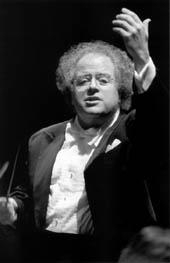
Next weekend, Maestro James Levine begins his second season leading the Boston Symphony Orchestra. The BSO’s programming features an acrobatic display of 20th-century orchestral works, including a heavy dose of Americana: Gershwin, Ives, Elliot Carter, Lukas Foss (all on one program), Copland, Jonathon Dawe, George Perle, Gunther Schuller, and premiers from Michael Gandolfi and Peter Lieberson. It's not difficult to understand the emphasis on American composers, since Levine is the first American the BSO has hired as its music director in its 125-year history.

A quick comparison of the programming of other major northeastern orchestras – National, Baltimore, Philadelphia, and New York – with Boston’s shows a less than enthusiastic approach to new works or pieces by American composers, let alone late-20th-century fare in general. Gershwin and non-lethal doses of Stravinsky seem to be hip this year, as are the all-Mozart programs commemorating the 250th anniversary of his birth. The BSO, in addition to its all-Mozart concert, is presenting all-French (opening night), all-American, and all-Boston – Copland, Ives, Hanson, Piston, and Frederick Converse (whose opera, The Pipe of Desire was the first American opera to be performed at the Met) – in addition to several all-Beethoven and all-Schoenberg programs. These last two commence a two-year project juxtaposing major works of Beethoven and Schoenberg.

This is not necessarily a new concept in programming - historical records of Beethoven/Schoenberg performances by American orchestras are easy to find, from the Indianapolis Symphony to the L.A. Philharmonic. The Philadelphia Orchestra is currently on to something similar this season, pairing Beethoven symphonies with premiere commissions from Jennifer Higdon, Bright Sheng, and Daniel Kellogg. Good orchestral recordings of deliberately programmed pieces by Beethoven and Schoenberg take a little digging, but do exist. The breadth of the BSO’s project, however, is daring and welcome, boasting 11 programs over the next two seasons. The pairing itself has been the subject of cautious discussion, ranging from the composers’ overindulgence in their own psyches at the expense of everyone else (I found Dylan Evans’s July 2005 article in The Guardian very entertaining), to one composer fundamentally refuting the other (succinctly displayed on Alex Ross’s blog), to the somewhat bland reasoning the BSO offers in their own press release:

While seemingly very different, the parallels between the two composers are striking, and taken together their work makes an incredibly powerful statement. These carefully crafted programs examine how Beethoven and Schoenberg both broke new ground while working within traditional forms, while also reflecting the immense range of the individual development within their respective bodies of work.
Well, whatever that means, the ensuing melee should still be fun to watch. The BSO will also conduct a tour of the northeast, making a stop in DC on March 11, 2006. That program will include Peter Lieberson's Neruda Songs, featuring mezzo-soprano Lorraine Hunt Lieberson as soloist, Strauss's Till Eulenspiegel's Merry Pranks, Elliott Carter's Three Illusions for Orchestra, and Beethoven's Symphony No. 7.

Fazil Say Opens the Baltimore Symphony's Season

available at Amazon
Fazil Say
The Baltimore Symphony Orchestra opened its 2005/06 season with an ‘American Concert’ that consisted of Gershwin’s American in Paris and Rhapsody in Blue, followed by Dvořák’s 9th Symphony, which although wholly Brahmsian and Bohemian in character, has been adopted by Americans as ‘their symphony’ – a status either caused or reinforced by the nickname “From the New World.” The soloist for the Rhapsody was the ever-spunky Turkish pianist Fazil Say. (His sadly deleted recording of the Rite of the Spring for piano, four hands, is one of the most exciting piano recordings I know – so I was very much looking forward to seeing him live.)

There were moments of Slavic melancholy in the American in Paris, which sounded like a an American émigré from the Dontesk visiting Paris and getting homesick. But that mood had no chance of lasting when the more ebullient run-up to the finale came crashing in, swaying at the hips. Highly animated and with a stubborn jaw, Fazil Say sported an “I couldda been a contender” look along with the boyish and feisty in the following work. Wide-eyed, he turned to the orchestra whenever his concentration wasn’t demanded at the keyboard, where he pounced around like a kitten on catnip. Several times I thought he was going to strike up a conversation with the concertmaster. Gershwin’s Rhapsody is a work that not only takes irreverence in stride, it thrives on it. The choice of this never-grown-up, silver-brown-haired punk of a European pianist seemed perfect for a work that can easily slip towards cliché. To be sure, Say makes Lang Lang look tame on the piano bench… but where the overly dramatic gesticulating is a constant source of annoyance for me with the latter, the former’s finds me bemused. Presumably because Say’s antics are actually linked to the way he performs. Kick that piano, for all I care.

The reception of his performance was such that he played an encore – one of his own compositions in which – like in his Rite – he manipulates the piano by plucking and holding down its strings to great effect. The work had clearly Middle Eastern (it is fair to assume: Anatolian) roots but a recognizably western dress. (Speak to any Turkish politician, and he will tell you that that’s also indicative of the country as a whole these days.) The work had the audience spellbound.

The Dvořák 9th that followed was a captivating performance that did well to remind the more cynical listener that maybe the symphony is not as popular as it is just because of its American association. What seemed a rather well-behaved performance at first (everything does, though, after seeing Say play) turned its charms on and was aided by particularly fine winds. The brass section of the BSO will be Temirkanov’s legacy (if nothing else). They had power, warmth, and quality of playing all on their side, and the Dvořák was exactly the kind of piece for which they were honed to excel. Anyone who will see the concert either today at 8PM at the Joseph Meyerhoff Symphony Hall, on Sunday at 3PM (same place), or on Saturday at Strathmore (8PM) is in for a treat.

Classical Music for Children, Fall 2005

Mini-Critic and I have reviewed some classical concerts for children together: one of the National Symphony's kinderkonzerts and the production of the Opera Summer Camp for Kids. This fall, I am trying to keep track of all of the performances of classical music one might take children to hear. Mini-Critic and I will hopefully be reviewing some of them.

Coming up soon, on October 1 (Saturday, 1 pm), the CityDance Ensemble and Levine School of Music will present that perennial favorite for children's concerts, Prokofiev's Peter and the Wolf. This performance, which combines dance with the narrated score, will take place in the Education Center (Room 405) of the Music Center at Strathmore. Tickets are very reasonable, $5 each. To order, call (202) 686-8000 ext. 1302.

For whatever reason, most of the children's concerts do not happen until November. The National Symphony Orchestra hosts three kinds of concerts for children. The Family Concerts feature the full orchestra in the Concert Hall but are generally the manageable length of about one hour. The Kinderkonzerts, for ages 4 and up, are in the smaller Theater Lab, with a smaller group of musicians and shorter musical excerpts. The Teddy Bear Concerts are intended for very young children (3 to 5 years old).

The first example of the latter type, which is a new series this year, is scheduled for November 6 (Sunday, 12 pm and 1:30 pm). Violinist Marissa Regni and harpist Dotian Levalier encourage children to bring a favorite stuffed animal for the NSO Teddy Bear Concert: Tunes 'n' Tales, in the Kennedy Center Theater Lab. Tickets: $15. Here is the schedule of the remaining NSO concerts for families:

Saturday, November 12, 11 am and 1 pm
NSO Kinderkonzerts: Brought to You by the Letter "B" (Bach, Beethoven, Brahms)
Ages 4 and up
Carole Bean, flute; Dotian Levalier, harp; and William Wielgus, oboe
Kennedy Center, Theater Lab

Sunday, November 13, 1 pm
NSO Ensemble Concerts: Connections: History and Music (developed by NSO cellist Yvonne Caruthers)
History and music of colonial Jamestown, the Lewis and Clark expedition, the post-Civil War era, and the 20th century
Ages 9 and up
Kennedy Center, Theater Lab

Sunday, November 20, 1 pm and 3 pm
NSO Family Concerts: Rip Van Winkle and Other Musical Tales
Ages 7 and up
Kennedy Center, Concert Hall

Saturday, November 26, 1:30 and 3:30 pm; Sunday, November 27, 1:30 and 3:30 pm
NSO Kinderkonzerts: Prokofiev's Peter and the Wolf
Kennedy Center, Terrace Theater

In November, the Salzburger Marionettentheater will present two marionnette performances of Mozart operas: The Magic Flute on November 8 (Tuesday, 7:30 pm) and Don Giovanni on November 9 (Wednesday, 7:30 pm). Both performances are listed as 2 hours in length and will last too long and too far past bedtime for very young children. However, they should be excellent performances for older kids (and even adults will enjoy them). The troupe uses great recordings of the operas and stages the action (somewhat abbreviated) with incredibly lifelike puppets. These shows take place in the Kennedy Center Terrace Theater.

Finally, take the choirboy or girl in your life to see concerts by two of the most famous children's choirs in the world. The Choir of Westminster Abbey will perform a concert at Washington National Cathedral on October 23 (Sunday, 4 pm). And on December 11 (Sunday, 3 pm) the world-famous Vienna Boys Choir will be at the Music Center at Strathmore.

UPDATE:
Also, I have just learned about the Child-Centered Look-In Performance of the Gershwins' Porgy and Bess on Saturday, November 5, 11 am. This 1-hour program will be hosted by WJLA-TV/Channel 7's Maureen Bunyan, in the Kennedy Center Opera House. It includes some child-oriented explanation of the story, the sounds of jazz, and staged excerpts from the opera. Tickets: $10 for children, and either $15 or $35 for adults. Call (202) 295-2400 to reserve your seats.

On November 13 and 19 (both at 3 pm), Opera Theatre of Northern Virginia will present the Lyric Opera of Chicago's children's adaptation of Rossini's The Barber of Seville. Performances are held in the Thomas Jefferson Community Theatre in Arlington. Call (703) 528-1433.

The Central Pennsylvania Youth Opera will give a special performance of Humperdinck's Hansel und Gretel, in one of the Saturday morning children's shows at the National Theater, on December 3. These special, short performances, on most Saturdays, are free, starting at 9:30 and 11 am. There are no advance tickets or reservations, and the seating is limited. Tickets are distributed on a first come, first served basis, beginning a half-hour before curtain.

National Book Festival

An article (National Book Festival Planned for September, July 29) by Vanessa de la Torre for the Washington Post got me interested in this year's National Book Festival (scheduled for September 24). The event has been hosted by the Library of Congress here in Washington every year since 2001, when it was inaugurated just a few days before the September 11 attacks. The list of writers who will attend is impressive, and I expect fisticuffs or pistols at dawn when Dana Gioia and E. L. Doctorow have that friendly chat about the Bush administration. Also, Second Lady Lynne Cheney will be studiously avoiding questions about her racy first novel. Don't miss any of the action, tomorrow, on the National Mall.

UPDATE:
This is a reminder from Mark Barry, that the Baltimore Book Festival is also this weekend.

22.9.05

The NSO's Opening Salvo

available at Amazon
Itzhak Perlman
It’s good to be back, and after a little taster two weeks ago (review on September 9), this was the beginning of the National Symphony Orchestra’s concert season – its 75th. The soft touches of Carl Maria von Weber’s “Oberon” overture (plus a cell phone ring tone) under Leonard Slatkin’s baton opened the 10,907th concert. It’s one of those overtures said to be “the most popular part of the opera,” because the actual opera is fraught with problems. It’s true for Oberon, even if the lovely Gardiner recording (released last month) doesn’t change that. The opera, on a side note, suffers from the curious understanding of ‘opera’ the English had at the time and it is a mix – not to say mess – of different styles. Recorded in the original English and with speaker for the narration (so softly spoken, I had to turn the stereo up and back down for it), Gardiner makes more of it than I thought possible. Although enjoyable, it isn’t quite enough for a recommendation, despite its Gardiner Gramophone Record of the Month award.

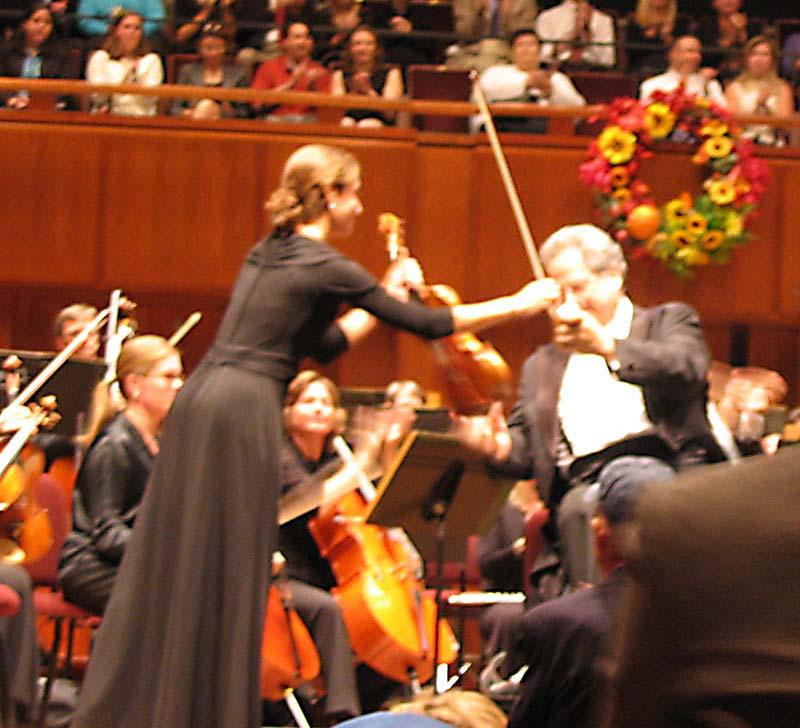
Nurit Bar-Josef assists Itzhak Perlman, NSO, September 21, 2005Vaughan Williams's Five Variants on "Dives and Lazarus" for string orchestra and harps is to folk song what his Fantasia on a Theme of Thomas Tallis is to, well, Tallis or the Fantasia on “Greensleeves” to Henry VIII. (He’s the composer of ‘Greensleeves’, even if he is more widely known for his drive to liberalize divorce laws on the scepter’d isle.) The work is not nearly so much less than its more famous cousins as that fame discrepancy would suggest. It also gave concertmaster Nurit Bar-Josef once more an opportunity to shine.

Other Reviews:

Charles T. Downey, DCist Goes to the Symphony (DCist, September 22)

Daniel Ginsberg, The NSO Delivers a Promising 'Prelude' (Washington Post, September 22)
Those two pieces, however, were but appetizers. The real draw was clearly Itzhak Perlman who got a boisterous greeting from a crowd that included many young faces. He played the Barber Concerto for Violin and Orchestra, op. 14, that Barber wrote at 29. Of Barber’s three concertos it is the most popular, although that popularity did not come until almost thirty years after its composition… in large part because Isaac Stern included it in his repertory. The second movement’s oboe-stated theme is no less hauntingly beautiful than Brahms’s in his violin concerto’s second movement. Mr. Perlman, in whose oversized hands even a cello would look like a toy, played with dedication and the efficiency of enviable musical experience and expertise. (He fared much better than in his disappointing Beethoven recital last season at Strathmore.) In the third movement’s whirling beginning, a bit of Perlman the virtuoso shone through as he treated the ‘moto perpetuo’ runs with seeming ease and delight. Barber did well not to change the brief and loaded finale when it didn’t please its commissioner. To the listener’s benefit he returned the commission fee and had it his way. The audience gave a – for DC standards – generously long standing ovation in appreciation of his performance at least as much as due to his reputation.

Tchaikovsky’s 4th Symphony was the second half’s offering and the opening’s brass fanfare blared loudly into the Kennedy Center’s Concert Hall before it was mellowed by the woodwind’s segue into the strings getting their due. It’s of course a rightly popular work, and you’d think that concert halls and recordings would be flush with great performances. All the more surprising – to me at any rate – is how seldom I hear it pulled off with all the fire and nuance that make for a wholly thrilling account. It would be easy to say that Slatkin only truly excels in Anglophone music, but last season’s Rachmaninov 2nd and Mahler 9th proved that wrong, anyway. Nothing was amiss in this powerful fourth, either, but it left that intangible last bit that makes for a great performance unexplored. It may be a lame excuse for my inability to put it into words, but playing off a famous quote about pornography I admit that I can’t tell you where the exact line between dutiful performance and playing with complete abandon lies, but I can tell you when I hear either. Perhaps not so intangible was the brass’s performance that was akin to a high contrast photo, sharp at the edges and almost uncomfortably present. Voluminous, not crass, but neither with the warmth and soft hue that make the difference between a snapshot from the last vacation and an Henri Cartier-Bresson photograph. That’s all criticism from a vantage point of luxury, though – and I don’t think anyone was disappointed by the performance.

The pizzicato third movement is so dominant and, I think, unparalleled in kind and length, that it is surprising that the symphony shouldn’t have gotten a catchy nickname along those lines. Wouldn’t “Pizzicato Symphony” fit right between “Little Russian” and “Pathetique”? The crashing noise that opens the finale and jolts audience members out of their slumber was executed with such decibel-happy gusto that I could just imagine the boyish smirk on Maestro Slatkin’s face as his orchestra really dug into it. Con furioso indeed.

Repeat performances take place today at 7PM and on Friday at 1.30PM.

Dip Your Ears, No. 45 (In Spiritum)

available at Amazon
C.Franck, In Spiritum, Olivier Latry
DG


Massive French organ music of the late Romantics is admittedly not everyone’s cup of tea. But if you like organ music and have no problem with the sometimes fairly dense structures of Vierne, Dupré, and Co., you should give Olivier Latry’s latest CD with music of César Franck, In Spiritum, a listen. A big draw is likely the SACD surround sound this disc offers – it is not even issued in a Red Book-only version. (Latry’s disc before this one, Midnight at Notre Dame, was chosen by Gramophone Magazine to be the best disc to test the abilities of your surround sound system.) If the regular stereo and stereo SACD sound of this hybrid are anything to go by, it must truly be a sonic spectacular and definitively a major nuisance to your as-always noise-oversensitive neighbors. The Grande Orgue de Notre Dame had its beginnings in 1402 when Frédéric Schambantz built it but got its unashamedly Romantic grandness largely from the famous French organ builder Aristide Cavaillé-Coll when he took to it in 1868 (it has since been restored and added to twice, in 1963 and 1992). It is lovingly and enthusiastically helmed by Latry, the Notre Dame organist who has, among other recordings, made a name for himself with his excellent integral Messiaen organ music cycle.

César Franck’s talent with the organ received the attention and support of Cavaillé-Coll, and his organs were in turn the impetus behind some of Franck’s compositions for the instrument. So, for example, the Pièce héroïque, the third of the Trois pièces pour la grande orgue from 1878, a secular piece composed to show off the grand Cavaillé-Coll organ at Trocadéro, built for the World Fair. It gives downright delicate insights into the compositions of Franck, who was working on his piano quintet at the same time. The work’s two themes merge for a simply awesome finale.

Prélude, Fugue et Variation, op. 18 (also in B minor), is the conclusion of Six pièces d’orgue, written in the late 1850s. Romantic polyphony in a classical structure makes this a particularly interesting semisacred musical contribution. The melodic, serene prelude comes back throughout the variation – the fugue, more or less in the middle, provides an instantly recognizable and hummable melody… not necessarily the norm in heavy-duty Romantic organ music.

Trois chorales pour grande orgue (E major, B minor, and A minor) from 1840 are more ‘Bachian’ yet, perhaps hence the particular appeal? It’s the only work presented within their complete set and at over 40 minutes it is the most substantial offering. If Romantic polyphony sounds more or less appealing but Reger’s music doesn’t quite do it for you, this probably would.

As a disclaimer I have to say that having grown up with Bach’s organ music enthusiastically piped through our house, I am partial to the instrument. (I did have a crisis of faith when I first realized that church organs, for lack of pumping choristers, need electricity; something that had not occurred to me until I switched the local church organ on. I have since recovered.) Still, while this is not a disc for everyone, those who take to the kind of music and aren’t afraid of cranking it up will be delighted. I myself am left with the greedy question of when we can have the complete Franck organ works with Latry.