CD Reviews | CTD (Briefly Noted) | JFL (Dip Your Ears) | DVD Reviews

28.7.05

Art Viewing, by Degrees

MatisseWhat better way to see the gallery season off than by melting away in 100 degree heat. There are alternative ways to spend your time in New York, or waiting for cool fall or spring days, but this was not to be this past Wednesday; my Italian Ice, not ice.

The best move I made was to begin at the Met where the budget allows for the finest of cool air. I’ve been avoiding the, Matisse: The Fabric of Dreams exhibit (Charles was there earlier this month) for fear of crowds, but the heat seems to have kept them at bay. It's worth the trip also because of two fabulous paintings on loan from the Hermitage Museum, that you may never get another chance to see, Still Life with Blue Table Cloth and Dishes and Fruit on a Red Black Rug. The Russians have some of the best Matisse, more, more! Also here is Woman in Blue, from the Philly Museum, and Purple Robe and Anemones, from the Baltimore Museum of Art, and Dream (think Milton Avery), from a private collection; I want a Matisse.

Free ArtsThroughout the exhibit are dozens of ink drawings. What a hand this guy had: I bet he could do the crossword puzzle in ink. A treat for me was a grouping of small paper cutouts, which are exquisite (I'm used to the larger works at the National Gallery of Art), and many fabric samples and robes that his models used. The fire department had to be called in to hose down the overheated cash register in the gift shop: summer in the city.

In search of the finest cool gallery air, I headed to Chelsea. Coming up on his first year in Chelsea, Walter Randel has very good air, a comfy bench in the center of the gallery, and one of his better shows, Peter Golfinpoulos's recent paintings of brightly colored abstract floral-esque (my word) compositions.

James Cohan has decent air and is featuring Bill Owens, America, 60s and 70s vintage photos. Lehman-Maupin, with OK air: I saw this show during my last visit, amd I like Angela Dufresne’s painting, with the very long title.

Stephen Haller has good air, and you can spend some time on the Jonas Gruen Artist Gaze series to see how many artist/actors you can recognize in the photos. Mitchell-Inness and Nash will open in Chelsea this coming fall, and they’ll have really good air for sure.

Jeremy BoyleHudson-Franklin has little air, but a nice show featuring a mesmerizing spinning video by Jeremy Boyle and two small series paintings by Elizabeth Saveri, Making Iced Tea and Watering My Garden.

Fair Air at George Billis and a pretty fair group figure show: of note are the paintings of Maureen Mullarkey, a reviewer at Art Critical.

Now you can't compete with Pace for air: you could keep meat fresh in there, or a Damian Hirst from stinking, maybe. They've also got a nicely lit Tara Donovan Scotch tape drawing on the floor, a Tim Hawkinson, and to make up for all the dissing I've read of his rooftop exhibit at the Met, two beautiful Sol Lewitt wall drawings. Take your time; chill.

Advertising/art near Penn Station and the end of a heat wave: cool.

Summer Opera: Danielpour's Margaret Garner

Other Newspaper Reviews:

Bernard Holland, Giving New Voice to Former Slave's Tale of Sacrifice (New York Times, May 9)

Mark Stryker, 'MARGARET GARNER': Swooning music lifts up a tragedy (Detroit Free Press, May 9)
Ionarts can only go to so many opera locations in one summer, and we have seen opera this summer in Washington, New York, Pittsburgh, St. Louis, and Santa Fe. One place I really wanted to go this summer, but could not, was Cincinnati Opera Summer Festival. For the first time in their history of 85 years, Cincinnati presented a newly commissioned opera, Richard Danielpour's Margaret Garner, with a libretto by Toni Morrison (actually premiered back in May by Michigan Opera Theater. For some background on the historical events, which took place in the Cincinnati area, and Morrison's fictionalization of them, we read an article (Uncomfortable opera, July 23) in the Cincinnati Post:
The opera has received national acclaim and has set modern attendance records in Cincinnati, with more than 10,000 tickets sold to its three shows, the last of which was Friday night. That interest has been so high and that local reaction has been so intense is just further evidence that we as a region - and as a nation - have yet to finish grappling with the issue of slavery, and some of our personal ties to it. By bringing us face to face with our consciences, and by bringing together whites and blacks both symbolically and physically (via diverse crowds) to discuss this issue, the opera has done this region a service.

Composed by Richard Danielpour with libretto by Nobel laureate Toni Morrison, the opera focuses on the life of a slave named Margaret Garner, who lived on Maplewood Farm in Boone County, and her attempt to escape her tragic destiny. The opera is not literal truth, changing dramatically what little is known about Garner and her life, much as Morrison put a literary spin on the story with her best-seller "Beloved.'' Further complicating the debate is Steven Weisenburger's locally famous 1998 book "Modern Medea,'' whose facts have been questioned furiously by descendants of the Gaines family, who owned Maplewood. What is certain is that 22-year-old Margaret killed her 2-year-old child, Mary, when confronted with slave catchers after escaping with her husband and his family across the frozen Ohio River in 1856. They were tried before a federal commissioner in Cincinnati under the terms of the 1850 Fugitive Slave Act and remanded to slavery in Kentucky. Margaret died of typhoid fever on a Mississippi plantation in 1858. Her husband, Robert, fought with the Union in the Civil War and died later in the North. There is plausible speculation that Margaret's owner fathered the slain child. In the opera, Margaret is raped by the Gaines patriarch, Robert is lynched, she kills two of her children, she is tried for "theft of property" in Kentucky and is sentenced to death by hanging.
Andrew Adler reviewed the opera ('Margaret' retells story of slavery, July 21) for the Louisville Courier-Journal (the plantation Margaret escaped from is just south of the Ohio border in Kentucky):
Running about three hours and structured over a broad first act and a swifter second, the opera revels in its bigness. The choral writing is particularly vivid, with Danielpour reaching back to gospel-derived traditions for his slave ensembles. Overall his music extends an aesthetic defined by such composers as Barber and Bernstein: tuneful, conservative in harmonic design, with an imperative to drive the action forward. I wish there was more nuance to his method, which often sounds too facile for its own good. Still, at the second Cincinnati Opera performance, Saturday night, most of the capacity Music Hall audience was clearly enthralled.

No doubt listeners were responding to the exceptional singing of mezzo Denyce Graves in the title role, and perhaps above all to soprano Angela M. Brown's Cilla, Margaret's mother-in-law. [Danielpour wrote the role specifically for Jessye Norman, who was not able to participate at the last minute.--CTD] Both of these artists projected their characters with vocal confidence and, frankly, plenty of guts. Graves also responded credibly to Kenny Leon's muscular stage direction, no matter how physically taxing. She had a capable partner in baritone Gregg Baker's Robert Garner, though baritone Rod Gilfry was in raspy voice as Edward Gaines, Maplewood's master. Stefan Lano conducted members of the Cincinnati Symphony Orchestra with an appreciation for the sweep of Danielpour's music and evident care for his singers. The remaining Music Hall performance is tomorrow; like the first two, it is sold out.
For more information, Janelle Gelfand wrote a great interview/article (Composer learns from 'Garner', July 17) on Danielpour and the process of writing the opera for the Cincinnati Enquirer, and I also enjoyed this photo gallery of opening night from the Cincinnati Enquirer on July 17. This photo of the opening night, which I would show here except that it's copyrighted, is thrilling to see, because the opera house in Cincinnati is full to the brim with faces both black and white. The performances, I understand, were intense for the audience. The opera's Web site (Margaret Garner) has a page of reviews, too.

Margaret Garner was a joint commission of Michigan Opera Theatre, Cincinnati Opera, and the Opera Company of Philadelphia. Ionarts will hopefully be going to see the latter's production of the opera, scheduled for February 10 to 26, 2006. Charlotte's Opera Carolina is planning a production for April 2006, and given the work's critical popularity so far, it will surely be mounted in other cities in the following season.

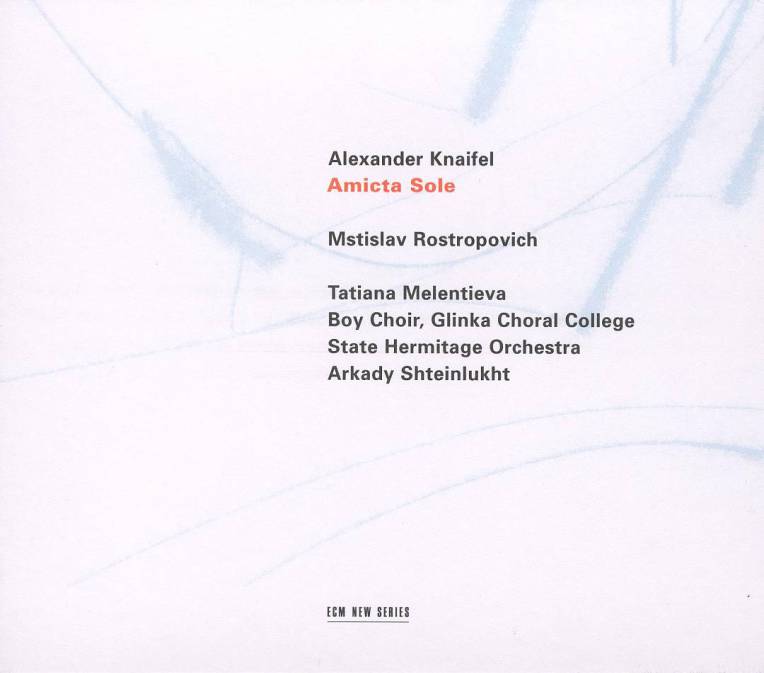
Dip Your Ears, No. 38 (Rostropovich in Knaifel)

available at Amazon
A.Knaifel, Amieta Sole,
M.Rostropovich et al.
ECM

Alexander Knaifel's Psalm 51 (50) is an austere, spheric, single-instrument pursuit of a musical line that has the meditative, solitary quality of Orthodox church music. The instrument is the cello, and it's played by none other than "Slava," Mstislav Rostropovich. It's almost unbearable in its static monotony, but then that may just be its point. The title piece, Amieta Sole (“Clothed with the Sun”), is similar, but the voices of boys' choir, solo soprano, other assorted throats, and orchestra give it colors that easily sustain interest over its thirty-some minutes. Its subtitle “for soloist (female) of soloists” invites to ponder – the music should appeal to those who like Paert, Silvestri, Kancheli, and the like.


27.7.05

www.ionarts.org

Yes, that is our swell new address. You can still use the old one, but we would appreciate it if all our friends out there in Blogville and around the Internet would use the new address to link to us. It will forward right here to the same content you have come to expect, but we're paying for the damn thing so we look a little more professional, so use it, OK? Try it out, and tell your friends to do the same. We appreciate it.

Fetid Swamp Hellhole

That's what Washington is in the summer. It takes a week away in a different summer climate, the dry desert of northern New Mexico (posts on Santa Fe Opera and productions of Peter Grimes, Barber of Seville, and Lucio Silla, in case you missed them), to remind me that this city is just not meant for human habitation in the summer. The only solution, as it has been ever since the city was built, is to leave for the worst weeks of the season. When you step out on your porch at midnight, and the humidity and temperature are still somewhere near 100, something is terribly wrong.

On my last day in Santa Fe, I met soprano Anne-Carolyn Bird for coffee and got to hear about her experiences of the apprentice program there and her future projects, all of it quite exciting. Anne-Carolyn was part of the incredible ensemble behind the truly excellent production of Peter Grimes I heard on its opening night. She is also performing in the Santa Fe Turandot (which I missed) and the upcoming revision of Osvaldo Golijov's Ainadamar, which will open this Saturday and promises to be a major media event. Anne-Carolyn is as intelligent and talented a person as you might expect from reading her blog, The Concert. If you are not reading yet, you should be.

Thanks to Anne-Carolyn, I was able to sit in on a full rehearsal of the work, on Monday evening. It's not good form to write about a rehearsal, but I can say that I was very impressed by this opera, and I look forward to reading what the big press critics have to write about it. I will share some thoughts about it after it opens. The apprentices will also present their opera scenes on August 14 and 21. We hope they will all break legs.

Shostakovich 8th with Rostropovich on LSO live


available at Amazon
D.Shostakovich, Sy.8,
M.Rostropovich / LSO
LSO Live

Even if you know how to approach and appreciate Dmitry Shostakovich’s works, it might take quite a few repeat experiences with any particular symphony in order to have a modest grasp of it. The 8th symphony is no different in that regard. “Unhealthy individualism” and “pessimism” were terms attributed to this stubbornly tragic work when it was singled out for criticism at the 1948 conference of culture-apparatchiks that condemned Russia’s best composers. (It was to have celebrated the turn of the tide in the war - and it just didn't sound like much of a celebration...)

The opening upward fifth after a few introductory bars teases with expectations of the 5th symphony, but neither the younger sister-symphony’s increasingly propulsive character nor her final (if disingenuous) victory march are to be had in the 8th. There is much tumult in the long first movement, as well as the short and fast second and third movements. But the Largo and the final Allegretto are calm and cold in comparison.


available at Amazon
D.Shostakovich, Sy.8,
M.Jansons/ Pittsburg SO
EMI

Rostropovich knew Shostakovich (though I was not aware that they were such “dear friends” as the booklet claims) and he seems to be setting out on a second cycle of DSCH’s symphonies with the London Symphony Orchestra on their own label. (A good idea, because the first cycle was largely forgettable. So far, a fine 5th and 11th are out. My copy of the latter has a dynamic level that is far too low and I have not figurged out if my copy came from an an-off batch or if it is a more widespread problem.)

The overall structure of the 8th may be put into words easily enough, but it is difficult to understand ‘from the inside’, partly because of the meandering first movement, the Adagio-Allegro non troppo. The latter part of the movement has a rather typical Shostakovich buildup of force (with repeated themes and small musical cells, rhythms, xylophone- and timpani-supported marches, and many mini-climaxes) but then ends in a long, quiet, and reflective (or numb?) cor anglais melody that takes you out of the movement’s greatest upheaval.

The resonant and forceful second movement (Allegretto) may be grim and sardonic, but the inner ear can grab a hold of it, and with the Allegro non troppo of the third movement (both are about seven minutes long, compared to over 20 minutes for the first movement and around 15 for the last two) it is one of the keys through which the symphony reveals itself.

Despite slightly recessed sound that is lacking that last bit of clarity (everything very dry, not quite muffled though), Rostropovich brings this live performance off most impressively. I like the sound of the Barshai (Brilliant – West German Radio SO) and Jansons (EMI – Pittsburgh SO) recordings a smidgen better (Barshai’s clear but cool, Jansons rich but not damp), and the third movement is more resistible with Rostropovich. But the cellist-turnedd-conductor holds more than his own in this symphony. BBC magazin, for one, though they might have to be excused for their British bias, thinks that this is the new reference recording of the 8th. I myself would have a difficult time rating any of the three versions I compared as significantly better than another – all three satisfy. If pressed, I'd go with the CHOC-winning Jansons. Gergiev’s version of the 8th is about to be re-issued and should make for interesting comparison. Like the Rostropovich recording, a new Wiggelsworth recording on BIS will be available in the SACD format.


Update: A review of the Wigglesworth and Gergiev recordings can be read here.

Summer Opera: Sallinen's The Horseman

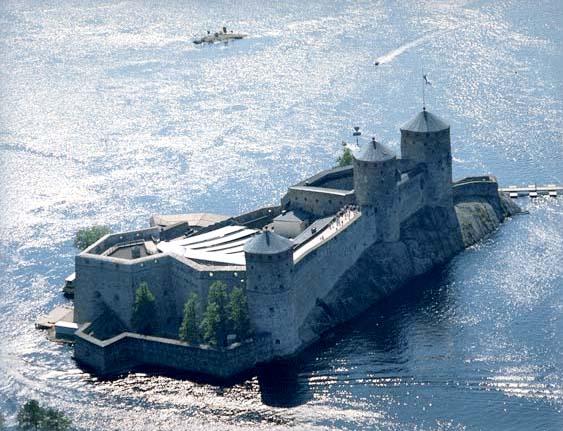
Olavinlinna Castle, site of the Savonlinna Opera FestivalYou know, for someone who has never actually been to Finland, I am quite a Finnophile (Finlandia at Ionarts on May 25, February 2, and August 20, 2004). I figure that it is only a matter of time before one or two of the new Finnish operas gets to a place where I have a chance to see it. Until then, however, I harbor dreams of going one day to the Savonlinna Opera Festival in Finland. This year's festival, as I mentioned in Opera in the Summer 2005, features a production of Aulis Sallinen's opera Ratsumies (The Horseman), from 1975, which opened on July 8. (Only one performance remains, on July 27.) George Loomis, lucky bastard, was in Savonlinna (A grim, uneven tale at Savonlinna festival, July 12) for the International Herald Tribune:

There can't be many opera companies that put on an opera having an act set in its own theater, but the Savonlinna Opera Festival performs in no conventional opera house. Its venue is Olavinlinna Castle, a 15th-century fortress built to give Sweden control over the lake district of what is now Finland in their ongoing struggle with Russia. Today the region is an idyll of marine serenity, but times were tough back then, if Aulis Sallinen's opera "The Horseman," written to celebrate the castle's 500th anniversary 30 years ago, is any indication. As seen in the festival's new production, it's a grim tale of political and personal oppression, from which desperate and ultimately futile acts of violence offer the only escape. Certainly the legal system is no help. The opera's second act consists of a courtroom scene in the castle itself involving three unrelated persons, each linked to a mysterious horseman: all three are sent to prison, along with the horseman.

"The Horseman" is the first of Sallinen's six operas and is widely credited for helping to precipitate a wave of Finnish operas in a unique burst of operatic activity for a small country. Savonlinna is right to revive those deserving of iconic status, and Sallinen's are a good place to start. Already a seasoned composer, his operas have had success internationally; one, "Kullervo," premiered in Los Angeles. And his admirably straightforward "King Lear" does not seem intimidated by its hoary source. It's understandable that the shadowy "Horseman" exerts a pull on an audience. The primitivism of Paavo Haavikko's libretto is charged with sex and violence. And the opera's arresting mix of modernistic and neo-Romantic elements makes for musical richness. But "The Horseman" has the cumbersome dramaturgy one associates with first operas. Each of its three acts culminates in an act of violence, but the scenes are not always skillfully prepared — especially the first, when Antti binds the merchant couple that enslaved him and his wife Anna and sets them on fire. The music, too, in this act is often fragmentary and lacking in direction. Better is Act III, in which Sallinen vividly portrays the unruly crowd that drafts a skeptical Antti to lead them in a vain attack on a royal manor. But the courtroom act is best, as plot strands interestingly come together.
You can read the whole thing here. Loomis adds that a new Finnish opera by Olli Kortekangas is planned for the summer of 2007, just in time for my visit to Finland. Another article by Galina Stolyarova (The singing festival, July 22) for the St. Petersburg Times (Google-cached here if that link doesn't work) does not have much on the Sallinen opera but is an interesting read for information on the festival's history, from a Russian perspective.
Finland's Savonlinna Opera Festival, one of the oldest in Europe, running until Aug. 7, opened earlier this month with an opera set in the ancient Russian capital Veliky Novgorod, 300 kilometers south of St. Petersburg. "Set in a land of forests, the opera tells about complicated human relationships and confrontations between people and regimes, from slavery right up to the league of free nations dwelling in the forest," said librettist Paavo Haavikko of the opera, "The Horseman," which he created with composer Aulis Sallinen. "Dream and reality, historical truth and fictitious events interweave in music, poetry and emotion." The tale takes place 500 years ago and begins in the house of a Novgorod merchant, where horseman Antti and his wife Anne are serving their master. The story begins with a peculiar twist: Anne spends a night with the master, while the master's wife humiliates Antti by sending him to go round the city looking for a maiden, dressed as a bear.
To get Finnish opera in the United States, we are going to have to do what they do every year at Savonlinna, that is, host a guest opera company "which brings over both their national operas and works from the classical operatic repertoire." The Mariinsky Theater, the Latvian National Opera, and this year the Gran Teatre de Liceu (from Barcelona) have all been invited. The Catalunyan troupe this year presents zarzuelas and Donizetti.

UPDATE:
Finnish-Canadian artist Marja-Leena Rathje responds to this post at her blog. Meeting Marja-Leena at the Savonlinna Opera Festival in 2007? It sounds like yet another excellent reason for Ionarts to go to Finland.

26.7.05

Alsop and the BSO III

This is the third (and presumably last) article discussing the appointment of Marin Alsop as Music Director of the Baltimore Symphony Orchestra. Previous opinions can be found here and here.

Marin Alsop
Marin Alsop
Marin Alsop, as we know now, will be the Baltimore Symphony Orchestra’s Music Director Designate in the 2006-07 season and then the Music Director from 2007-08 to 2009-10. Lacking divination, we won’t know what those years will bring exactly, but that can’t keep us from speculating wildly.

There are enough positives about Alsop that even those who regard her critically might find reason for hope. Ironically, one of those great strengths – her devotion and particular ability with 20th-century and contemporary repertoire – may not even appeal to the musically more conservative circles that so urgently wanted her to lead the BSO. (So urgently, indeed, that they did not mind ruffling many feathers among the BSO’s presumably most important employees, the musicians.) Ionarts, however, should be very excited about that particular aspect of Ms. Alsop’s tenure to come. While Philip Glass, Steve Reich, Ellen Taaffe Zwillich, Joan Towers, Jennifer Higdon, Christopher Rouse, and John Adams are hardly hard-core modernist fare among contemporary and recent classical music, it’s still choice repertoire that has been neglected in the region, despite Leonard Slatkin’s worthy and admirable efforts. Since I have decried the BSO’s conservative programming of romantic stalwarts under Yuri Temirkanov on a few occasions, I ought to hail the naming of a conductor as MD that excels in the above named composers and has her baton-holding hand very much on the beating pulse of music. (Not coincidentally she will conduct Rouse and Corigliano performances with the BSO in 2006.) I can only hope that she will bring the enthusiasm, communicativeness, and ingenuity of a David Zinman to the BSO.

available at Amazon
Philip Glass, Symphony Nos. 2 and 3, M. Alsop / BmthSO
available at Amazon
J. Adams, Shaker Loops, M. Alsop / BmthSO
If you are interested in dipping your ears in some of that which might be to come, try two particular recordings of Maestra Alsop. Her recording of Philip Glass’s 2nd and 3rd symphonies is a must-have, anyway. Those two works are among the most enjoyable works of Glass, especially for those who have reservations about too much minimalism à la Einstein on the Beach. Superior to symphonies nos. 5 and 8 (the other ones either available on record or recently heard live), they are at least as well recorded and played as the Nonesuch recordings under the estimable Dennis Russell Davies. They may lack the attractive couplings, but on one disc at eight dollars as opposed to two discs at $17 each, it is a steal.

The other record I particularly recommend is the John Adams Shaker Loops disc with “Short Ride in a Fast Machine,” “The Wound-Dresser,” and “Berceuse Elégiaque.” Also on Naxos, playing and interpretation are exemplary. I’ll be sure to listen to those recordings whenever my gripes about her nomination threaten to take over. Hopefully Marin Alsop won’t swear off that repertoire, though, given that she has recently expressed her displeasure with the automatic association of her with contemporary American repertoire. In the San Francisco Chronicle (August 5th, 2004) she told Joshua Kosman that she is “trying to get away from the American Stigma,” relating how her European career (Bournemouth, mostly) and her recording projects (Brahms with the London Philharmonic Orchestra) were “steeped in the standard repertoire.”

It is that standard repertoire that I have my doubts about with Ms. Alsop. Her recording of the Brahms 1st Symphony I thought to be nothing special, to say the least (though it got some favorable reviews in the press) – and her Brahms 3rd at the Strathmore recently was less inspiring, still. To be fair though: one really ought to ask Bournemouth audiences to get a better picture of her way with such works. Everyone can produce lackluster Brahms. Bernhard Haitink, for example, just finished a distinctively indistinctive Brahms cycle with the LSO, and no one would dare question Maestro Haitink’s abilities re: Brahms or any other “standard repertoire” composer. (Nor would it keep me from dancing on the table – as I promise I would/will – if Haitink were to be nominated a conductor in the region!)

Recording prolifically has raised Marin Alsop’s profile considerably, and we can hope that she might continue that with the BSO, who could use the challenge. Unfortunately, that may remain a hope elusive given the self-defeating and (quite frankly) insane restrictions and powers that the unions in U.S. orchestras impose and wield. Only if the BSO moved outside the union restrictions for the purpose of recording – like the Philadelphia Orchestra had to in order to sign a contract with Ondine – might there be a chance to profit from Ms. Alsop’s recording activities. (The unions still hold enough power, as any Philadelphia Orchestra member can tell you. Just recently the union rep. successfully managed to torpedo a patch-up session for Mahler that the PhilO had recorded on their Asia tour, because it was likely to go beyond the session limits by 15 to 30 minutes.)

If you add to Marin Alsop’s record with new music and her recording success two more crucial elements that work in her favor, it becomes clear why the board shoved its MD pick down the musicians’ throat: she’s undoubtedly a media darling – not the least because she’s a female in the last bastion of a rampantly chauvinistic and patriarchic profession. This might well translate into favorable and extensive media coverage and particularly more, new sponsors and donors for the needy (very needy) BSO. Also: the maestra is inexpensive. Word has it that she will take in less than half a million US dollars per year – a basement bargain for a renowned conductor… and somewhere between half and a quarter of what Temirkanov costs the BSO. To whatever extent it is also a statement about her rank among conductors – glass ceiling or not – is difficult to tell.

Marin Alsop
Marin Alsop
What remains most important about a conductor is his or her ability to bring an orchestra to the next level. The BSO, for all its quality, has plenty of room for improvement. Is Ms. Alsop the conductor who can do that? I have my doubts. Not only is the move from Mr. Temirkanov – and I am no enthusiastic fan of his, either – to Ms. Alsop not a step up, I simply can’t see in her the drill-master that the BSO needs to reach those new and higher planes. (Lorin Maazel, for example, could be the type that would ensure pristine playing and no missed entries ever again… even if he isn’t always the most inspiring of conductors. Coincidentally Maazel has some experience with players of an orchestra not taking to his appointment very kindly when he started out in Cleveland.)

The orchestra certainly does not think she is what they need – as evidenced in their substantial disagreement with the board’s decision to name Alsop the MD. That disagreement itself should be the main worry. Starting a tenure with that many players less than enthused about their new leader might doom the all-important relationship between orchestra and conductor. In an interview on NPR’s Performance Today on Friday, Marin Alsop said that she had thought about not taking the position given the dissent among the ranks. Which begs the question: what made her decide to take it, after all? Did she, after pausing for a moment, think: “Ah, f*$# the musicians?” (It’s hardly her style, but the thought occurs.) It’s particularly puzzling since the BSO’s was certainly not the only offer from a major US orchestra likely to come Ms. Alsop’s way over the next few years. I suspect she figures that she is able to mend fences sufficiently by 2006. (If her moving speech to the orchestra ahead of the official press conference is anything to go by, she may well be right!)

Another worry I have, meanwhile, is that what (not only) I consider her strength – aforementioned way with conservative modern American classical music which could do so much to ‘Americanize’ the classical music tradition and experience here – may not be played out to its full potential. The BSO seems comfortable in the Romantic (and less challenging, less novel) repertoire that has been a Temirkanov hallmark. The approach may have worked, too, as the BSO seems to be gaining audience members out of the stock of (former) NSO patrons that occasionally refuse to go along with Mr. Slatkin’s more imaginative and sophisticated (all my very subjective opinion, of course) programming. Not that I mind a Bruckner 9th, Mahler 2nd, and Schostakovich 1st symphony (all of which the BSO will serve up next season… especially the DSCH should be a hoot with the acoustics of the Strathmore – Tip: Get tickets all the way up on the upper tier for a stomach-tickling rumble!). But even the tiniest bit of Carter, Wuorinen, Salonen, Henze, Berio, et al. would be great for orientation in the world of (near) living classical music.

David Zinman
David Zinman
As it is, audiences can hope for the best and the players can start getting over their rightful frustrations. Meanwhile we can start delicious speculations about whom the NSO might appoint as a successor to Leonard Slatkin. Last season has converted me from a Slatkin-doubter to a Slatkin-near-enthusiast. I dare say it’s a shame he will leave… and despite reports that say otherwise (Washington Post), it is my understanding that the players of the NSO actually would not mind if he stayed, too. (We hear that opinions that suggested that the players dislike Slatkin had been prominent in direct relation to their isolated nature.) But leave he will – and it will take a foremost conductor to fill his shoes, much less signify a step up. The NSO’s board promises to shy no expenses to get only the best. Unfortunately, there is a caveat, namely: “…that can be gotten.” Most of the great conductors that would fit the NSO are not on the market or seem unlikely to take the job. If we focus on English-speaking conductors reasonably familiar with the U.S. cultural scene, the two foremost figures – Esa Pekka Salonen and Michael Tilson Thomas – are not going to switch coasts. A Simon Rattle could not be lured away from Berlin shy of a ticket to Paradise. Maazel is a bit old and wants to compose more, but would be very good for the NSO. David Zinman may not be a distinctive move up ‘on paper’, but would in many ways be my ideal. Ricardo Muti I can just imagine to say: “Washingtone is - a – how do you say… beneath-a me.” Another great catch might be James Conlon, a conductor who happens to be a champion of one of my favorite composers, Zemlinsky… so I am biased right there. Dennis Russell Davies and Hugh Wolff would fit part of the profile, but aren’t the big names that would necessarily scream “best of the best.” Roberto Abbado doesn’t seem too popular among the players here – and Stéphane Denève, whom Tim Page mentioned as a possible successor, allegedly behaved in such ways during rehearsals that won’t see him reengaged in Washington for some time to come. (Unlike in Baltimore, the players’ representation on the board of the NSO – also a third – can, like any other third, veto the respective other two thirds.) All this is idle speculation of course – but it’s great fun. Like speculating on NBA trades during off-season or whether Real Madrid is sacking Beckham for Ballack. As regards the BSO, we’ll prepare for Alsop (listen to those CDs!) and at the Kennedy Center we’ll hopefully enjoy Slatkin surpassing himself again and again in two more seasons with the NSO.

UPDATE:
Marin Alsop recollects (Women's work: Conductor of an orchestra, August 3) her rise to the podium of the BSO for BBC News in Great Britain, where she is conducting the Bournemouth Symphony at the Proms.—CTD