CD Reviews | CTD (Briefly Noted) | JFL (Dip Your Ears) | DVD Reviews

13.1.04

Martianscaping? — by Mark Barry

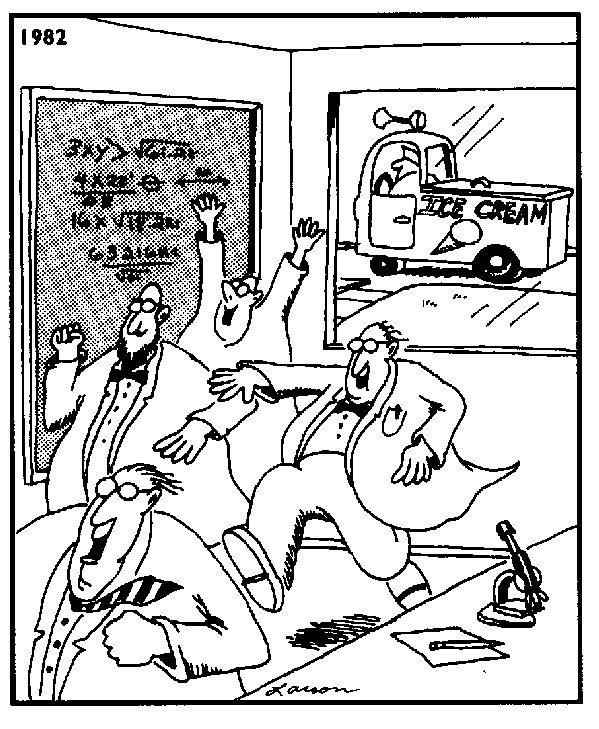
As many were, I am totally amazed by the successful landing of the spacecraft Spirit on Mars recently. I have difficulty with HTML, RSS, and sometimes even just scrolling down a page, let alone sending a video buggy to the moon, complete with side impact airbags! Sitting at home that night, flipping back and forth from Saturday Night Live and the NASA cable station, the NASA feed won hands down for comedic pleasure. As the first signals were relayed back to earth, the control center exploded with joy. If you can imagine the stroke of midnight at a New Year's Eve party for nerds, that was the scene. A Gary Larson cartoon for sure. (I mention that with great respect: please don't hack my Web site. Thank goodness for nerds.)

As the beautiful wide angle images start to stream in, my initial reactions are, "What a barren place" and "How do I relate it to my own experiences?" A desert? a beach scene with out the ocean? Brazilians would know how to make this place more fun looking: Rio De Janeiro, Ipanema, with scanty space suits.

Most of the "space art" I am used to is fantastic in nature, visionary, or subtitled as the artist's conception. Many are truly beautiful and dazzling, in the tradition of a Ray Bradbury novel, but merely the beginning. When artists go to Mars or beyond, and we will (not me!), that’s when the true emotional, humanized response to other worlds will be translated. "One small step for man" was rigid military-speak: poets in space are desperately needed. If NASA wants 20 trizillion dollars for planetary exploration, beyond the militarization of space only, the mission must be enhanced by an artist’s perspective, using poets, writers, and visual artists to enlighten and excite the public's imagination.

It’s quite a challenge. The real success of the Mars lander is a renewal of our collective dream of other worlds, galaxies, a brief moment of distraction from the mess we have gotten ourselves into on Earth. What would it be like to paint on the Martian surface? What are the atmospheric effects on color? What would my message be? I’m still thinking of that Martian beach scene: maybe I will go along.

12.1.04

Vuillard Painting Will Return to France

A reader remarked that there should be some sort of notice at the top of each post about who is writing. To that end, posts from guest contributors will now have their names displayed in the title bar. If there is no name there, you can assume that it's my post.

Édouard Vuillard, Le Salon de Madame Aron, 1904, Private collectionA short article (Le Canada va restituer à la France un Vuillard volé par les nazis [Canada will return to France a Vuillard stolen by the Nazis], January 10) in L'Express announced that the National Gallery of Canada will send one of its paintings back to France. The museum's own investigation showed that Vuillard's Le Salon de Madame Aron, from 1904, was hidden in a bank vault during the Second World War, looted by the German occupiers of France, and eventually sold by a Parisian gallery to the museum in 1956. The canvas will be reclaimed by descendants of the wartime owners, Alfred Lindon and his son Jacques.

A related painting is Denise Natanson and Marcelle Aron in the Summer House at Villerville, Normandy, from around 1910, now in the Norton Simon Museum in Pasadena, California. Some of the photographs in the Vuillard exhibit last year at the National Gallery included Marcelle Aron, at the Château-Rouge in Amfreville. This show, now called Vuillard: From Post-Impressionist to Modern Master, will be at the Royal Academy of Arts in London, from January 31 to April 18. Martin Gayford has already a published a preview of the British exhibit, focusing on the photographs: Kodak fragments of an artist's life, January 10, in The Telegraph. Gayford also made the connection that came to mind when I was looking at the Vuillard that is being returned to France, that Vuillard's work can be considered in many ways the visual counterpart to Proust's novel À la recherche du temps perdu. However, I haven't had any luck in discovering who Madame Aron or any of the figures in the painting are, so I can't really make a comparison with any of the characters in the novel. Still, Vuillard images like this one will be in my mind as I read the book now.

Of course, it is admirable to right a historical wrong by returning a painting that never should have been taken. However, it also does not make me happy to think about a painting leaving a public museum to return to a private collection. Take your last look.

11.1.04

Werther at the Met

The libretto for Massenet's Werther, by Édouard Blau, Paul Milliet, and Georges Hartmann, is based on Goethe's novel The Sorrows of Young Werther (in the original German, Die Leiden des jungen Werthers, published in 1774). The young Goethe was himself madly in love with a woman named Charlotte Buff, who was to be married to his friend, Georg Kestner. This was when Goethe lived for a while in the town of Wetzlar, where the novel and opera take place. In his despair, the author contemplated suicide but it was another man who also fell in love with a woman after she was married who actually committed suicide, as Werther does in the novel. The novel was so popular that it supposedly inspired a series of suicides by poetic young men who saw their own frustrations in love reflected in the story. Young men even began to wear the blue jacket and yellow vest that Werther wears in Goethe's novel. Charlotte Buff's house, where Goethe spent so much time with her, is a sort of Goethe museum today in Wetzlar.

The production at the Met, which could be heard live on a radio broadcast yesterday (see yesterday's post), featured some very talented child singers as Charlotte's younger brothers and sisters. They were heard in the first scene, rehearsing their Christmas carol (in July), an innocent but sinister harbinger of what will happen on the following Christmas eve (see the picture here). (You can listen to several excerpts from the 1999 EMI recording of the opera with Roberto Alagna, Angela Gheorghiu, Thomas Hampson, Patricia Petibon, and the London Symphony Orchestra if you have Real Player: look at the bottom of this page.) Alagna's first appearance, in the aria "Je ne sais si je veille ou si je rêve encore!" was strong and received enthusiastic applause. The crucial moment in the first act, the love scene between Charlotte and Werther, was a delight. In the 19th century, this became one of the quintessential Romantic scenes, the first blossom of pure love, the strongest force possible, which is ultimately doomed. The music from this scene, which is heard at crucial points in the rest of the opera, is touchingly poignant, evoking the hope of Charlotte's love that is born in Werther and that drives him to his suicide.

At the first intermission, we were treated to a recorded performance by Susan Graham of four lesser-known songs (she learned them especially for the broadcast): Massenet's Le Nid, from 1898; Crépuscule, with piano accompaniment of simple chords, disarmingly simple; Ouvre tes yeux bleus, on a poem by Paul Robiquet; and Madrigal, from 1869; and Reynaldo Hahn's Infidélité. Steven Blier, the host of this segment, made a good point about songs by Massenet and others of this period in France, that they are more effective vehicles for singers, especially sopranos, than the operatic roles in some ways. Ms. Graham's performance was perhaps the most beautiful of the afternoon. Blier made a good comparison of this sort of music to the world of art:

Massenet is definitely the Renoir of songwriters. They were both unashamed of their love for sheer prettiness. At the Barnes Museum in Philadelphia which houses several rooms filled with Renoir’s canvases, I was reminded of his credo: "I never think I have finished a nude until I think I could pinch it." But after I’d seen a few walls filled with Renoir’s flowers, children, and corpulent nude women, I started to overdose. I felt as I were being force-fed Godiva chocolates.
In the second act, an offstage organ creates the illusion of a liturgical celebration inside the "temple" (a French word that usually means a Protestant church), a device that is also very effective in the Saint-Sulpice scene (from Act III) in his Manon. Listening to Alagna's superb performance in his big aria in this act ("Un autre est son époux!") made me think that someone has to be able to make money off this voice, if EMI cannot (see yesterday's post). In the role of Charlotte's sister Sophie, Lyuba Petrova demonstrated great flexibility and beautiful high notes in the technically demanding "Tout le monde est joyeux! le bonheur est dans l'air!"

The third and fourth acts were performed without intermission, which makes sense because the action is more or less continuous. The fateful Christmas Eve arrives for Charlotte, who with Werther dominates the end of the opera. Mezzo soprano Vesselina Kasarova (Charlotte) had some of her strongest moments here, especially in her mournful aria with bassoon ("Va! laisse couler mes larmes") and in the charged duet with Werther that concludes the act. Werther's main aria, I think ("Pourquoi me réveiller, ô souffle du printemps"), was stellar and received lots of applause and bravos. At the end of the act, Albert discovers that his wife was with Werther and orders her to send Werther his pistols, as he requests in a letter. This reflects the story of Goethe's friend, who committed suicide with pistols belonging to the husband of the woman he loved.

In the fourth act, as Werther lies dying, Charlotte tells him that she loves him. Offstage, the laughter and singing of the children in the Christmas service seem to make light of Werther's death, as the beautiful "Noel" the children were rehearsing at the opening of the opera is heard again. If you missed this broadcast, tune in next Saturday at 1:30 pm for a live broadcast of Franz Lehár's operetta The Merry Widow, which will be sung in the English translation of Martin Crimp, with the delectable Susan Graham in the title role. If you don't know where to tune the radio in your area, find out.

10.1.04

Tuning in to Opera

The season of live broadcasts from the Metropolitan Opera is well under way. Today's offering (at 1:30 pm) is Massenet's Werther, which was first performed at the Imperial Opera (now the Wiener Staatsoper) in Vienna (see post on December 28, Opera and the Way Things Should Be; thanks to Stirling Newberry at Symphony X for his appreciation of that post on December 31) in 1892. This opera has a long history at the Met, since it was first performed there in 1894.

The title role will be sung today by tenor Roberto Alagna, who will not have his contract with EMI renewed next year (although his wife, Angela Gheorghiu, will keep hers), as I learned from an article (Look Who's Been Dumped, December 31) by Norman Lebrecht in La Scena Musicale, by way of Arts & Letters Daily. Alagna's misfortune has provided another opportunity for the favorite activity of classical music critics, to lament the decline and death of classical music. (For starters, see the scuffle on January 6 between acdouglas and Terry Teachout at About Last Night.) I agree that EMI's decision is shocking, and it is a sign of how bad CD sales are these days. All of classical music is probably not dead, but the CD and recording industry (and not only that for classical music) is clearly ailing. It has to be pretty bad if EMI really cannot make a profit from a voice like Roberto Alagna's.

In other news, congratulations to Tyler Green on getting his blog, Modern Art Notes, moved over to the ArtsJournal blogs. Thanks to Tyler for listing Ionarts in his "This Month's Blogroll": we appreciate it!

9.1.04

Road Trip — by Mark Barry

Mark Barry, Blind Woman's BluffAfter a nice long holiday, I am excited about getting back to painting. It's time to get back to a real schedule of art making that includes carpooling and house stuff. Picasso most certainly did not do house stuff or carpool, although he may have walked the children home if he knew the teacher was young and attractive. Matisse, no way.

I've always had a regimen to guide me. Early morning, with breaks throughout the day to attend to the things of life, and conclude in the early evening. So many ideas and possibilities for paintings have drifted from my consciousness due to responsibilities other than art making. That's not a complaint, just considering it part of the process. One of my solutions is to block time for the studio and stick to it. Another is to keep a notebook with me. I'm always finding spare parts for paintings in my travels: a gesture, a color combination, sometimes enough for a whole painting. A camera has been an important addition too, especially a digital. Take as many pictures as the memory card will allow, delete the nonessential, Photoshop and file the keepers. Digital jpegs have been a great way to send images of my paintings to collectors and galleries.

The most important rule for me is to be conscious of any opportunity, even in the car. There may never be a great carpool painting; I might be wrong, but there are many possibilities along the way. Great and not so great moments in human behavior now take place in the car: gourmet dining, neverending drama through the windshield, and the occasional immaculate conception, the drama of an accident; I believe Caravaggio could have been inspired by a multi-car pileup.

About a week ago Artnet had a post with a picture of a Fragonard painting, Blind Man's Bluff. I'm always on the lookout for imagery that will spark my painting process. The scene, a woman blindfolded but peeking slightly, in a lush, flowing environment, stepping closer to the edge of a stair, loaded with metaphor as with all of Fragonard's work. The image stayed in my mind for the following week, and I knew it held potential for me. Indeed, while driving the afternoon shift to chauffeur my daughter from school, I noticed a group of kids running across a large green lawnscape, and the last child had on a blindfold. The scene lacked the wanton lust of the Fragonard, but I know an epiphany when it kicks me, usually. I started my own version (Blind Woman's Bluff, shown here) today, and the possibilities are endless, blindfolded, tiptoeing carefully in an uncertain world, quite relevant to my current world view. OK, back to work.

8.1.04

Botero at the Musée Maillol

Fernando Botero, BallerinaPhilippe Dagen, in Fernando Botero, un système qui tourne rond [Fernando Botero, a system that turns round] (Le Monde, January 8), reviews an exhibit of recent paintings by that artist (Fernando Botero: Œuvres Récentes), at the Musée Maillol in Paris until March 15. (The museum's Web site is a cool and pretty Flash representation, so I can't give you a direct link.)

Biographies recount that in 1956, at 24 years old, while he was painting Still Life with Mandolin, Fernando Botero had the idea to break with the normal scale of volume and to make bodies and objects considerably fatter. Botero then became one of the most famous artists on the planet. He shows in almost all major cities and enjoys a retrospective almost every year.

His name is linked with an immediately identifiable figure: a very fat woman, with a monumental head, arms, fingers, thighs, stomach, and ass. Her breasts and feet seem very small in comparison. With very few changes, this procedure is also applied to men, animals, fruits, dishes.
Indeed, the last Botero exhibit was at the Gemeentemuseum in The Hague, from June 21 to September 28, 2003. What I think Dagen really captures about Botero's work is how the artist's commercial appeal makes him uneasy as a critic. Botero, he says, over a 40-year period, by perpetuating his signature style, has created a simple and automatic reaction in the public.
Visitors to a Botero exhibition know what they are going to see before they enter, they find it there, and they leave it again thus satisfied. This is the way it is at the Musée Maillol in Paris, as it was several months ago in The Hague. Everything is done, in each work, so that it can be that way: it exists only by disproportion. One perceives no other stylistic individuality. After having drawn the forms, Botero colors them, staying carefully within the lines. A slight effect of light or shadow underscores the shapes, and it's done.

One can hardly give the Colombian artist grief for having understood capitalism. He diffuses his trademark through all media, as sports and movie stars do, as the photographer David Hamilton used to do with his willowy nymphettes. It is harder to understand the writings that attempt to legitimate this activity either intellectually or historically.
Ouch. (It gets worse.) He then attacks the authors of the catalogues for the Hague and Paris exhibits, who both try to depict Botero as Gauguin in reverse, using European imagery to paint South American subjects.
Botero is happy to parody figures taken from Piero della Francesca, Velázquez, Manet, or Degas. There is nothing in this that is specifically "South American"—if we suppose that that term has any meaning today—or that "disturbs or even reverses the well-ordered trends and genres of art history in the 20th century."

This is more a process of recycling classic sources, especially Picasso, which makes the 1956 story suspect. Fernando Botero studied and imitated Picasso beginning in the late 1940s. At the time, he loved the "Blue" and "Rose" periods. He had only to advance in the chronology to discover the paintings made between 1919 and 1921, in which Picasso plays with disproportion in his treatment of the feminine body. The bathers become colossal, and their hands thick.
If you want an idea of what he's talking about here, take a look at Picasso's Trois Danseuses [Three Dancers], a pencil drawing dated 1919-1920, and Deux femmes nues [Two naked women], a pastel from 1920. (Those links are from the excellent On-Line Picasso Project.)

The hatred of popular appeal and the charges of being derivative remind me somewhat of similar reactions to the J. Seward Johnson show at the Corcoran here in Washington (see posts on September 13 and September 4). Not that I really want to revisit that.

7.1.04

Death of Classicism

Oedipus and the SphinxSouren Melikian certainly put me in the Christmas spirit with his article (Classicism to Cataclysm: A Cycle's End, December 20) in the International Herald Tribune. He reviews two shows at the Louvre, Tanagra: Mythe et archéologie [Tanagra: Myth and Archaeology] and L'Esprit Créateur de Pigalle à Canova [The Creative Spirit From Pigalle to Canova], both of which ended on January 5. The description of the two exhibits and how the rage for Classical art influenced the last two centuries of art history is interesting. However, he also uses that platform to answer an interesting and depressing question: "How did the Western fascination with the legacy of Ancient Greek and Roman art come to an end?" Melikian connects the end of artistic interest in Classical art with the general decline of educational focus on antiquity:

It was the crumbling of its literary foundation that signaled the ultimate demise of Classicism. Until the eve of World War II, Greek and Latin humanities underpinned traditional West European cultural values. By the time they left high school, young Europeans were familiar with Greek myths, had read parts of the Iliad and the Odyssey, and knew by heart poems by Virgil and Horace. Greek was the first to go. Nowadays, Latin is on its last legs. The destruction process hit the visual arts a very long time ago, as witness Canova's first thoughts, so different from his finished art.
You may remember that, last month, I was complaining about this deficit in my own education (see my post Childhood in Greek Art, December 8), but I had never really thought about connecting our general ignorance because of declining educational values with an artistic trend.

6.1.04

Political "Fog" Cleared in Morris's Documentary — by Todd Babcock

Invariably, during the holiday, when all my fellow "escapees" return from their various checkpoints across the map to converge on my little hometown of Jackson, Michigan (the self-reported Birthplace of the Republican Party [picture of the convention Under the Oaks]), there is one night where we all gather to report in on our various accomplishments and lack thereof. This usually takes the form of a lot of cheese, martinis, and spattering the air with verbal jockeying for attention. It’s a lively bunch so you’d better have your rap down.

Once the various islands of catch-up have run their course of war stories on relationships, work struggles, and artistic achievements, the conversations generally find their way to a common circle that has erupted about politics. Here the Leftists passionately plead to be understood, the Right insists they are misunderstood, and the Centrists mumble occasionally that he/she "has a good point." In the end we all go away thinking the other is crazy and gushing over and over, "I can’t believe he said that!"

In a year in which we saw another war in the Middle East, Saddam’s capture, Howard Dean’s anger, Arnold Schwarzenegger made governor, and Rush Limbaugh accused of having an addiction to illegal painkillers, one would think the time was ripe for this year-end discussion. Yet I found myself oddly checked out of these discussions. Perhaps it was overload from a year of political rhetoric that has permeated every nook and cranny of the media. With seemingly 50 news programs, event graphics, Internet polling, orange alerts, and an airport voice-over reminding you of terrorist threats, there was no place to hide. Even the comedians have turned their eyes on matters of the state as HBO’s biggest comedy shows seem to be talking heads spouting left and right in the forms of Bill Maher and Dennis Miller (in an epic struggle, to be sure) and the Clooney/Soderberg-produced K Street. Bestsellers from the likes of Hillary Clinton, Al Franken, Ann Coulter, Ariana Huffington, and other politicians vying for time slots on Leno, Letterman, and O’Brien (in between bouts of an insult comedy dog and stupid pet tricks) have left no stone unturned.

In the end, I fear, my burnout had less to do with the proliferation of political agendas on the airwaves and more to do with my lack of faith in anyone being open to another’s idea. The word agenda seems extremely apt when one gets the feeling that every discussion is coming from a "party line" and any straying from it is a form of losing ground. This polarized defensism is nothing new to politics but has certainly mutated to a new form in entertainment. One feels while watching Ann Coulter spar with Eric Dyson on Bill Maher that if either gives an inch they are going to lose a sizeable margin of book sales that year. When FOX News and CNN and such have a following based on the perception they lean one way or another how can one feel they will risk losing their hard-earned demographic in order to embrace the "truth"?

Yes, indeed, it has been reported that viewers were beginning to tune into Jon Stewart’s The Daily Show on Comedy Central in order to get their news. Apparently, Mr. Stewart has found a fine balance of egalitarian satire by skewering the media itself and thus blanketing the entire dialogue in a cloak of ridiculousness. The point being that the only "line" that Jon is towing is the one with "punch" as its prefix. Indeed, Jon is a whore to the bottom-line joke, and who can’t have a little faith in that? The real joke being that, of course, folks are tuning into a mock news program on a network titled "Comedy Central" for their updates on world events. A point that seemed to disturb Mr. Stewart, though I’m sure he was oddly pleased. He won’t miss a beat.

In the end, our own "three-party system" took the form of the Leftist New York designer condemning the Rightist importer from Chicago, while the defeated LA actor tried to find a way to make it funny. (Which is why we have to stop electing actors into office but that’s another posting.)

Feeling reasonably guilty for my lack of input in our annual dissection, I decided I needed some intellectual nutrition to atone for my sins. So I went to the movies. Not any movie, mind you, but a documentary. Not any documentary either, but one about an 86-year-old retired Secretary of Defense talking for 100 minutes on his years during the Kennedy administration. If going to the cinema took the form of penance, this surely had to be it.

How wrong I was.

Errol Morris (The Thin Blue Line, Mr. Death), the documentarian, has a history of taking unconventional subjects and making them seem effortlessly captivating. This is the man who took a topiary gardener, lion tamer, and man preoccupied by mole rats and wove them together in Fast Cheap and Out of Control and made the link seem like common sense. In The Fog of War, Morris is in top form with this spoken-word documentary that seems to blend biography with history to achieve a certain type of political allegory.

The subject here is William McNamara, the aforementioned Secretary of Defense during the Kennedy administration and later under Lyndon B. Johnson. McNamara is 86 and looking every bit the man twenty years his junior. The man is so lucid and energetically poignant, I found myself doing math equations in my head trying to figure out how a man so young could have served under Kennedy. Born in 1918, the telling of this man’s life in politics can’t help but take the form of a recounting of the twentieth century. Yet, this is no dry history lesson. McNamara speaks with a conviction that drives the film forward as Morris's close-up camera lens practically absorbs his energy and seeps it into the theatre.

The material is rich here. Even if you are a political junkie or a curious onlooker seeking Spalding Gray-type enthusiasm, you won’t be disappointed. McNamara lends himself to intriguing structure as he moves forward with forceful sentences and hand gestures while occasionally cutting back in time twenty years in a shot without ever losing the focus. (Morris intercuts vintage footage of McNamara in press reports, news footage, and actual audiotaped conversations between him and the two presidents.) While Morris's hand is certainly not invisible here with shots of dominoes falling over a world map and his occasional shouted questions coming from what seems like a room a hundred yards away, the effect is fluid and continuous edification.

Though many are aware of McNamara and his time with the Oval Office they may not be aware of the richness of his life outside of politics. Simply hearing a man recount his memory at the age of two (yes, two) of the ending of WWI gives you a certain faith in the wealth of information he can access. Hearing him recount Kennedy’s attempt to lure him from the Presidency of Ford Motor Company to be Secretary of Defense is at once endearing and chilling. ("You know, William," Kennedy allegedly said, after McNamara refused both Defense and Treasury positions due to lack of confidence, "There’s no school for being President, either.")

Throughout the film I found myself trying to find some form of refuge from many of the horror stories from behind-the-scenes politics our narrator continually spouted. When you hear of the nuclear close calls and disheartening conversations with Johnson and Castro, you keep waiting for some sense of reassurance. There is none. In a culture so cinematically and politically reared to be assuaged with safety and the assumptions of "I hope they know what they are doing," this film reminds you that even those with their fingers on the button are just men. Men who make mistakes, make them again, and probably again. McNamara's point he makes repeatedly is that any person in authority in war, no matter what you're told, has made a mistake that has cost human lives, in his case, tens of thousands, but the hope is that you minimize and learn from them.

In the midst of a political mire of information from all sides, this film seems to peel away agenda and simply humanize that which seems so dehumanized by our media. While it's chilling to hear in Johnson's own voice, "I want you to kill some people," there's also a comfort in someone letting you know these men are still simply trying to solve problems. McNamara is a numbers man and made his decisions based purely on what was statistically sound (indeed, he was first recruited by the Air Force as a statistician out of Berkeley). It may seem cold yet, oddly, often the statistics had a form of morality of their own.

While my true desire in seeing "Fog of War" was in the hope that an 86-year-old politician might actually throw caution to the wind and tell the truth. In this case, it plays out like a "be careful what you wish for." McNamara has no interest in shaming the people he worked with or himself. In fact, his honesty, even when harshly revealing, has the effect of humanizing its subjects. He never condemns one side or the other for their methods but simply points out their various levels of effectiveness. When asked about Vietnam and whether there's guilt or regret, he implies that a response will serve no one. "I'm damned if I do and damned if I don't. I'd prefer to be damned if I don't."

In a time when you feel you can't trust a single source for its authenticity in reporting, "Fog of War" feels like a revolutionary act. Yet one is reminded in this film of a quote from another bastion of political insight and reportage. The movies.

"I want the truth."

"You can't handle the truth!" I hope most people can. See this film.