CD Reviews | CTD (Briefly Noted) | JFL (Dip Your Ears) | DVD Reviews
Showing posts with label ionarts from Salzburg. Show all posts

15.9.26

Notes from the 2026 Salzburg Festival ( 3 )
Sol Gabetta & Kristian Bezuidenhout

Salzburg Festival • Soloists Concert • Sol Gabetta & Kristian Bezuidenhout


Also published in Die Presse: Salzburg: Sol Gabetta kredenzt hübsche Violoncello-Zuckerl


available at Amazon
Brahms / Mendelssohn
Cello Sonatas
♥ Starker/Sebők ♥
Mercury, 1996

US | UK | DE

Gabetta and Bezuidenhout: Well-behaved German Romanticism

Pretty Cello Bonbons and a Trio for Piano, Cello and Hearing Aid


Tuesday at the Mozarteum she was still part of Patricia Kopatchinskaja’s quintet, on Wednesday she was back as the headliner: Sol Gabetta – with fortepianist extraordinaire Kristian Bezuidenhout, in the Haus für Mozart. Schumann’s Fantasiestücke, sonatas by Brahms (No. 1) and Mendelssohn (No. 2), garnished with arrangements for cello and piano of various smaller melodic confections. The two concerts could scarcely have been more different. Gabetta fits in beautifully when Kopatchinskaja sets the agenda – wild, unruly, tussled. When the Argentine star is in charge herself, different principles apply. Here she plays with lyrical assurance, always nice-sounding, dutifully beautiful to the point of cooing. In the golden depths of her cello, she is tonally at home; as the register rises, the tone seems to lose color. Somehow Bezuidenhout went along with all of this and appeared to recede into the background.

This exquisite music-making – take Gabetta’s honeyed sweetness in the slow Allegro non troppo of the Brahms Sonata, and Bezuidenhout's sparkling-delicate accompaniment – is all a pleasure and music-making at the highest level. Objectively there is nothing to fault in the trim attack with which Gabetta draws her notes from the cello. Nor in her intonation or phrasing. And yet… Perhaps it was the vast acoustic of the Haus für Mozart itself, which resists the intimacy her playing needs – swallowing any and all of the energy that didn’t come directly from the chosen tempos. Fast tempos, however, had to wait until the concluding Mendelssohn Sonata. For everything before it – entirely in keeping with Johannes “ma non troppo” Brahms’s own prescription – was awfully tasteful and measured.

And yes: as if something had been building up, the Mendelssohn was, if not exactly exuberant, at least somewhat uberant. The applause after the first movement felt natural, necessary, and was considerably more welcome than awkward embarrassed coughing would have been. Then, at the close, a rogue hearing aid joined the ensemble persistently – at times louder than the cello. Gabetta was not notably displeased. Friction arrived at last. She threw herself into the notes with good deal of bite and fury: The best three minutes of the evening.

Sol Gabetta (Cello), Kristian Bezuidenhout (Piano) © SF/Marco Borrelli


13.9.26

Notes from the 2026 Salzburg Festival ( 2 )
Kopatchinskaja, Friends, and György Kurtág

Salzburg Festival • Chamber Music • Hommage à Kurtág


Also published in Die Presse: Kopatchinskaja in Salzburg: Schnurren und Kratzen für Kurtág & Co.


available at Amazon
Kurtág / Schumann
Hommage à R. Sch et al Kashkashian, Levin, Brunner
ECM, 2006

US | UK | DE

available at Amazon
György Kurtág
Játékok (selection) Gábor Csalog, M.& G. Kurtág
BMC Records, 2006

US | UK | DE

Playing with Music

Music as lived joy: Kopatchinskaja brings Kurtág to Salzburg — and it's simply great entertainment


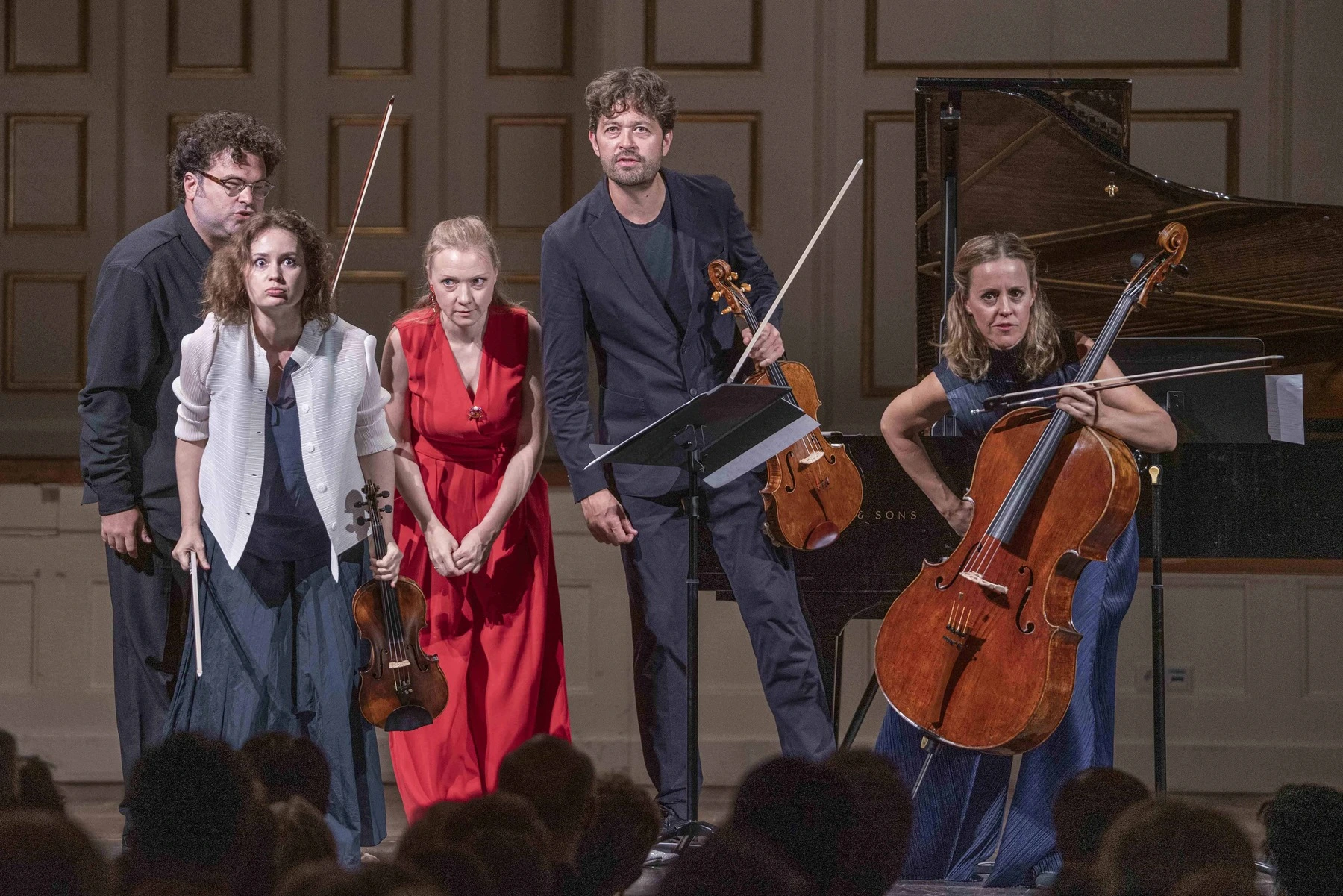
Patricia Kopatchinskaja was made for playing the music of György Kurtág — or vice versa. However that may be, in her chamber music homage to the hundred-year-old composer at the Salzburg Festival, she demonstrated how much is already won — not only in contemporary music — when a violinist refuses to insist on playing just beautifully, and instead interprets with the whole body, from the curls down to the tips of her toes.

Fiddling, stomping, plucking, she worked her way through Kurtág's profound scrawlings from „Zeichen, Spiele und Botschaften" and the „Játékok" collections with her musical partners. Pianist Olga Pashchenko had already impressed in the opening second Bartók Rhapsody for violin and piano — both in the restraint of her part, palying along as if parallel to the violin, and in the suddenness with which she lunged forward, like a hungry moray-eel, whenever Bartók thrusts the piano into the spotlight. In the Kurtág she drew out the abstract tenderness of „Hommage à Márta," just as Kopatchinskaja shaped „…féerie d'automne…" as a pianissimo exhalation — light as on butterfly-wings. Elsewhere Kopatchinskaja plunged into her instrument — alone or alongside Pashchenko, violinist Jonia Ilias Kadesha, the lusciously toned Lawrence Power on viola, and/or Sol Gabetta on cello — like a tomcat in a mating fight, driving it through Kurtág's fragile, skewed, compressed music. What strikes one above all is how unpretentiously modern Kurtág writes. What would sound simply absurd from other, self-important composers is here disarming.

Bartók's „Bagpipe" Duo from the „44 Duos" for two violins was staged as a small, spontaneous theatrical piece for all six musicians, with the musicians eventually exiting until only Reto Bieri (clarinet), Kopatchinskaja and Pashchenko remained for the wild „Contrasts" for violin, clarinet and piano — also Bartók — which, living up to its name, was carried forward wild and unleashed, then whispering and murmured.

Mozart's Clarinet Quintet K. 581 waited as a reward in the second half — though the audience was already so enthused by the Kurtág and Bartók that no lure would have been needed. Then again, one simply doesn't say no to a slow movement that sublime — and so they listened to the fiveseome, gathered around Bieri and his modern basset clarinet, in these four movements of pure pleasure: Sensitive, soft and supple, genuine ego-free chamber music atmosphere par excellance. Where Bieri had — deliberately — hissed and spat air in the excitable Bartók, here he was milk and honey manifest in the form of a clarinet, bewitchingly quiet and breathless in the slow movement. But „contrasts" was the watchword here too — the Quintet went off in the Menuetto as if stung by hornet: Kopatchinskaja does not let such opportunities pass to go for broke instead of playing nice. (That's rather Gabetta's game, although she went along with the general gist quite nicely here.) The Variations finale was handled with generous latitude — entirely in keeping with so playful an ensemble.

Jonian Ilias Kadesha, Patricia Kopatchinskaja, Olga Pashchenko, Lawrence Power, Sol Gabetta. SF / Marco Borrelli


18.11.25

Notes from the 2025 Salzburg Festival ( 5 )
Cuarteto Casals in Shostakovich

Salzburg Festival • Chamber Music • Cuarteto Casals


Also published in Die Presse: Serenade zum Todestag von Schostakowitsch: Cuarteto Casals in Salzburg


available at Amazon
D.Shostakovich,
The String Quartets (v.1),
Cuarteto Casals
Harmonia Mundi


available at Amazon
D.Shostakovich,
The String Quartets (v.2),
Cuarteto Casals
Harmonia Mundi


available at Amazon
D.Shostakovich,
The String Quartets (v.3),
Cuarteto Casals
Harmonia Mundi


Death Becomes them: Shostakovich Quartets in Salzburg

The Cuarteto Casals scored with dark sonority rather than hard edges in their DSCH-dedicated chamber music recital


Monday evening at the Salzburg Festival brought another birthday serenade for Shostakovich’s 50th death anniversary at the Mozarteum Hall – from the Cuarteto Casals. They promised three string quartets. Only three? After all, the Mandelring Quartet (CD reviews here, here, and here) still played all 15 quartets at the Festival back in 2011! (Reviewed on ionarts here.) But one doesn't want to be immoderate, and with Quartets 1, 8, and 15 – i.e. the first, last, and most famous – the selection was promising enough.

All the more so since there are no “early” string quartets with DSCH: When the 32-year-old Shostakovich took his first crack at the genre, with op.49, he was already an experienced composer with one suppressed and four performed symphonies plus two operas under his belt. The Lady Macbeth scandal that had brought him to the edge of the Gulag, and the ‘resurrection’ thanks to the Fifth Symphony, lay behind him. It should not surprise, then, that this first quartet is immediately a masterwork – as if it had sprung, Pallas-Athena-like, from Zeus’s head.

Right away, the Cuarteto Casals’ gloriously solid, perpetually beautiful, expressive sound – from top to bottom, first violin to cello – makes quite an impression. Cellist Arnau Tomàs (check out his Bach!!!) handled his part with resonant, bearish authority. Wonderful, the woody, round-cheeked timbre of Cristina Cordero’s viola. Fascinating the mediating work of second violinist Abel Tomàs. And fitting excellently into the picture: the dark-timbred first violin of Vera Martínez Mehner. One doesn’t miss the rougher approach that has a long tradition in these works at all, because the Spanish quartet’s lyricism, while luxurious, never seems superficial. Nor did it ever feel like the quartet was rounding the edges too much – a criticism that might be (though it doesn’t have to be) made of the Mandelrings. Small and infrequent intonation wobbles couldn’t distract amidst the astonishment over the sound.

That the Eighth Quartet is so much better known than the others does, in a way, surprise, since they all seem equally good. Or more evenly superb than the symphonies, anyway. On the other hand, it doesn’t take much to make the difference between hit and rarity, icon and footnote. (Are, for example, Mozart’s symphonies really as much better than those of Vanhal and Mysliveček as the fame gradient would have us believe?) But perhaps it’s also the dark vein of op.110 – so fitting the clichéd image of DSCH – that fascinates us, seeing that it appears to reflect the composer’s suffering and disguised resistance in Soviet terror…

And it was melancholy-gripping, what the Cuarteto Casals – currently recording all the quartets for Harmonia Mundi (see the Shostakovich String Quartet Survey) – delivered. “If his 15 symphonies are, according to the composer, ‘gravestones’”, writes Robert Reilly in Surprised by Beauty, “then the quartets are the flowers he lays on the graves.” The Cuarteto Casals’ tone – sadly beautiful and mellow – suits this poetry of suffering well.

One could title the six slow, relentless, embittered movements of op.144 with: “The Six Last Words of the Survivor”. Even more so than with Haydn, this deceleration on Shostakovich’s part is a gutsy, deliberate, and pointed imposition on the listener. The interpreters’ long lines made concentration easy, though, thanks to the unremitting inner tension amid this sustained slowness, and the pinch of Haydnesque mischief. The encore from the Third String Quartet, meanwhile, was merciless and had a symphonic earthiness about it. Fabulous, all, and very promising as far as their recordings are concerned.

Vera Martínez Mehner (Violine), Abel Tomàs (Violine), Arnau Tomàs (Violoncello), Cristina Cordero (Viola). SF / Marco Borrelli


27.9.25

Notes from the 2025 Salzburg Festival ( 2 )
Alexander Malofeev and María Dueñas in Recital

Salzburg Festival • Recitals • Malofeev & Dueñas


Also published in Die Presse: Begeisternd: María Dueñas und Alexander Malofeev im Mozarteum

Unlikely Duo at the Mozarteum

On paper, Alexander Malofeev and María Dueñas have only their age in common. In concert, though, the quiet, pale-blond Russian at the piano and the savvy Spanish violinist made for an unexpectedly effective musical pairing.


Kids at work: Malofeev is 23, Dueñas 22, and when Karol Szymanowski wrote his Violin Sonata in D minor, Op. 9, the Polish composer was just 21. The three met , not for the first time, at the Salzburg Festival soloist recital in the Great Hall of the Mozarteum – and they delighted the audience. Dueñas, with her wild, expressive tone — a touch of viola-like smokiness, high intensity, and more than a hint of risk (or at least the impression of it) — threw herself irresistibly into her part, lips pursed, eyes shut tight. A bit of show? Surely. But who would begrudge her.

The lanky, long-limbed Malofeev, sitting at the Steinway like the Peanuts’ Schroeder, fingered a surprising amount of music from his score. One wanted to listen to him every bit as much as to her, as seemingly simple accompaniments were turned into impressionistic studies or sounded as if he were improvising them on the spot.

That the young man would impress was no surprise, after causing a stir at the Musikverein last February (“Critic’s Notebook: Alexander Malofeev gives his recital debut in Vienna”). He is surely one of the most exciting, promising pianists of his — already well-stocked with good pianists — generation. María Dueñas, on the other hand, had so far made her mark with a meticulously planned and marketed career, stoked by media hype and record contracts, helped by rich parents and dusted with pristine “vanilla cupcake” playing (“Wiener Symphoniker: 16er-Blech und die ‚Fünfte von Brahms‘“). Musical character, however, less so.

That this combination should succeed was by no means a given when the concert was booked — though a nearly identical program intermittently performed in New York’s Weill Recital Hall had raised hopes. In any case, this recital (like most in the “Soloists’ Concerts” series) is not an indigenous Festival event but at best an ornamental garnish, that pretty much anyone can garnish their musical with, assuming they knock at the right agency’s door. That’s neither good nor bad per se; it all depends on the combination. Any Wiener Schnitzel with potato salad benefits from a touch of parsley. But only parsley — musical commodity fare — makes for a dull plate. See Grafenegg.

After the youthfully-exuberant Szymanowski — already cheered frenetically by the (nearly as) youthful crowd on the balcony — things continued promisingly with Debussy’s swan song, his G minor Sonata, written just before the composer’s death. An earthy note came into play, here, not the cliché of ether, but variety and depth. In this work, as in the first two movements of the concluding, massive César Franck A-major Sonata, Dueñas impressed not only with the energy of her playing but also with her kaleidoscope of timbres: smoky, delicate, hefty by turns.

The third movement’s hectic episodes seemed a bit aimless, and in the finale Dueñas’s personal touch — the variety that had benefited the music so far — gave way to a clean, somewhat sharp and loud tone, as if she were intent on bringing the final stretch home without mishap. But this did not diminish the overall impression — and the vociferous audience refused to let the duo go until after a third encore, among them Piazzolla, and an arrangement of Richard Strauss’s “Morgen”, tenderly, almost hesitantly accompanied by Malofeev.


16.8.25

Notes from the 2025 Salzburg Festival ( 1 )
A Recital with Igor Levit filling in for Evgeny Kissin

Salzburg Festival • Recitals | D-S-C-H • ex-Kissin | Igor Levit


Whispered Brahms, Affectatious Shostakovich

Substituting for Evgeny Kissin is no picnic – even for Igor Levit. But at least he tried.


The solo recital with Evgeny Kissin, part of Salzburg’s “DSCH” series of concerts, had to go ahead without its planned soloist who had fallen ill on short notice. He was going to play the same program he gave in late March at the Musikverein. Shostakovich, who died exactly fifty years ago that week, at least, remained the focus of the second half, thanks to Igor Levit, who stepped in for his colleague and left that part similar enough. In fact, on paper, the Second Sonata was still the same piece. Musically, everything was fundamentally different, though – including said sonata.

Alfred Brendel in 11 Haydn Sonatas

D.Shostakovich
Preludes & Fugues op.87
Igor Levit
Sony (2021)


US | UK | DE

Alfred Brendel in 11 Haydn Sonatas

D.Shostakovich
Preludes & Fugues op.87
Keith Jarrett
ECM (1992)


US | UK | DE

The surge, seriousness, and underlying humor that Kissin had drawn out were blown away. In their place came playfulness, a murmur, a small-small in stubborn mezzopiano – here and there interrupted by an occasional furious, note-snatching dash across the keyboard. Musical incidents that each stood like a monolith amid the whispering. Energy, when it was present at all, was derived from speed, not mass. This worked quite nicely for the Preludes and Fugues from Opus 87, as did Levit’s inclination to dissolve the notes into architectural elements. Quirky, in the best sense; a little as if Gyro Gearloose had taken up the piano.

The Largo of the Sonata no longer stood, as with Kissin, in spiritual proximity to Debussy; it was pushed toward twelve-tone music and Schoenberg. “Pointillist,” one might say. Or “frayed.” The ostentatious renunciation of loudness – especially effective in the broad expanse of the Grosses Festspielhaus – was not without appeal. Levit’s delicate, soiree-appropriate soft, and even touch was consistently admirable – especially in the Brahms Intermezzi Op. 117 and Four Ballades Op. 10 of the first half. Brahms benefits from this, to a point – though the approach shifts the burden of generating tension from the performer to the audience: either it sits in raptness (which, in the restless first half, could hardly be claimed) or one faces a certain risk of the audience nodding off.

The question also arose whether there might be such a thing as “over-interpretation,” so much did Levit demand of every phrase in these simply beautiful Intermezzi; so introspective every attack had to become; so brooding every pause: every tiniest note a carefully curated miniature. The Ballades, too, received this detail-minded, intelligent treatment. Like pulled pork, it seemed: so tender it fell apart if you as much as looked at it – a tightrope walk between touching and tiresome. The contrast of the thunderous leap into the B minor Ballade, as rough-hewn as Michelangeli liked to play it, came out all the sharper in this setting. Sweetening the close was another Brahms Intermezzo as encore – holding back the already-breaking-out just once more, and making the already-jubilation-primed remainder of the audience cheer all the harder.